[Recent Entries][Archive][Friends][User Info]
Below are 7 entries, after skipping 60 most recent ones in the "Сообщество, посвящённое ра" journal:| March 19th, 2012 | |
|---|---|
| 07:03 pm [industrialterro] [Link] |
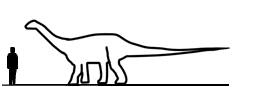
Melanorosaurus Melanorosaurus (meaning "Black Mountain Lizard", from the Greek melas/μέλας, "black", oros/ὄρος, "mountain" + sauros/σαῦρος, "lizard"), is a genus of basal sauropodomorph dinosaur that lived during the Late Triassic period. A herbivore from South Africa, it had a large body and sturdy limbs, suggesting it moved about on all fours. Limb bones were massive and weighty, like sauropod limb bones. The type specimens, syntypes SAM 3449 and SAM 3450, were described and named in 1924 by Sidney Henry Haughton. They were collected from the Triassic Lower Elliot Formation, dating to the early Norian, on the north slope of the Thaba 'Nyama (Black Mountain) in Transkei, South Africa. The first complete skull of Melanorosaurus was described in 2007. Two species are known: M. readi, the type species, and M. thabanensis named in 1993 by François-Xavier Gauffre, based on holotype MNHN LES-16, a femur found in the Jurassic Upper Elliot Formation. Melanorosaurus was once classified as a prosauropod, but Prosauropoda no longer appears to be a natural group. According to some definitions of Sauropoda, Melanorosaurus is an early sauropod. However, these definitions also take in many other former "prosauropods," and Adam Yates has proposed a definition of Sauropoda that will specifically exclude Melanorosaurus (Sauropoda as all sauropodomorphs closer to Saltasaurus than Melanorosaurus). This definition would allow Sauropoda to retain its traditional concept. Melanorosaurus had a skull which measured approximately 250 mm. The snout was somewhat pointed, and the skull was somewhat triangular when seen from above or below. The premaxilla had four teeth on each side, a characteristic of primitive sauropodomorphs. The maxilla had 19 teeth on each side of the jaw. Melanorosaurus was around 8 metres (26 ft) long, with a weight of 1.3 metric tons (1.3 long tons).
Размеры тела в сравнении с человеком:
Tags: Вымершие рептилии, Триас, авеметатарзалии, архозавроморфы, архозавры, диапсиды, динозавроморфы, динозавры, завроподоморфы, меланорозавриды, прозавроподы, ящеротазовые |
| 06:41 pm [industrialterro] [Link] |
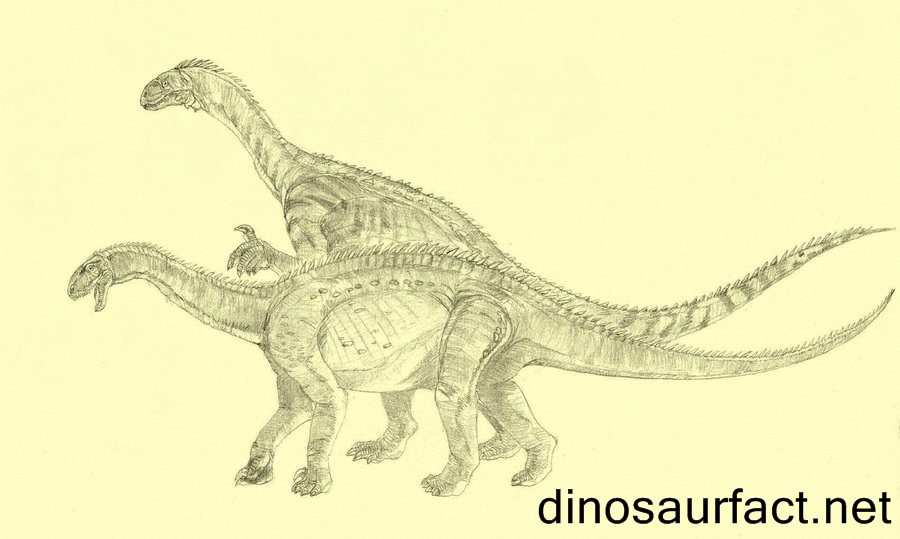
Lessemsaurus Lessemsaurus is an extinct genus of sauropodomorph dinosaur (possibly a melanosaurid) named for the writer of popular science books Don Lessem. The type species, L. sauropoides, was formally described by José Fernando Bonaparte in 1999. This dinosaur was around 30 feet long, and was discovered in strata dating to the Norian stage, around 210 million years ago. The Melanorosauridae were a family of sauropodomorph dinosaurs which lived during the Late Triassic and Early Jurassic. The name Melanorosauridae was first coined by Friedrich von Huene in 1929. Huene assigned several families of dinosaurs to the infraorder Prosauropoda: the Anchisauridae, the Plateosauridae, the Thecodontosauridae, and the Melanorosauridae. Since then, these families have undergone numerous revisions. Galton and Upchurch (2004) considered Camelotia, Lessemsaurus, and Melanorosaurus members of the family. A more recent study by Yates (2007) indicates that the melanorosaurs were instead early sauropods. The two members of the Riojasauridae, Riojasaurus and Eucnemesaurus, have also been placed in Melanorosauridae, which would render the Riojasauridae an invalid taxon. Прозавропо́ды (Prosauropoda) — одна из подгрупп группы ящеротазовых динозавров. У них был длинный хвост и бочкообразное туловище. Некоторые прозавроподы передвигались на четырёх лапах, другие — только на двух. Питались они растениями и были первыми крупными динозаврами, появившимися на Земле. Жили в позднетриасовом и раннеюрском периодах (220—180 млн. лет назад). В течение триасового периода прозавроподы жили по всей Пангее, то есть по всей поверхности планеты (прим. - cуши, естественно). Несмотря на свое название и ряд общих черт, роднивших их с завроподами, эти динозавры вовсе не являлись их прародителями. Вероятно, они представляли собой побочную ветвь группы завропод. Небольшие размеры позволяли прозавроподам ходить на двух лапах. Но это они делали далеко не всегда, поскольку могли благополучно передвигаться и на всех четырёх. Поднимаясь на задние лапы, они поедали листву с верхних веток. Кроме растительной пищи прозавроподы питались и животной. Остатки прозавропод известны ещё с XIX века. Например, скелет анхизавра нашли в 1818 году, но лишь в 1885 году выяснилось, что кости принадлежат пресмыкающемуся. Остается спорным следует или нет рассматривать данную группу как парафилетическую (то есть включает лишь часть потомков гипотетического общего предка) среди базальных зауроподоморфов, или можно выделить прозавроподов как монофилетическую группу, причем в последнем случае динозавры вряд ли могут быть включены в эту группу. Galton и Upchurch (2004) определяет кладу прозауроподы, как группу, включающую платеозавра и все таксоны более тесно связанные с ним, а также все виды базальных завроподоморфов, не принадлежащих к зауроподам. Другие исследователи (например, Пол Серено, 2005) считают, однако, что прозавроподы, охватывающие все эти виды, будут являться парафилетической группой, к которой будут относится предки зауроподов, но не сами зауроподы. В последние годы некоторые ученые сделали попытку пересмотреть систематику прозавроподов, таким образом, чтобы исключить их из числа предков зауроподов. Например, Йетс и Китчинг (2003) исключили из их числа базальных прозавроподов Thecodontosaurus и Saturnalia, а также рассматриваемых ими в качестве базальных зауроподов - Anchisaurus и Melanorosaurus. Ятс (2007) пошел еще дальше, заявив, что прозавроподы, такие как Massospondylus и Riojasaurus, на самом деле, более тесно связаны с завроподами, чем с другими прозавроподами.
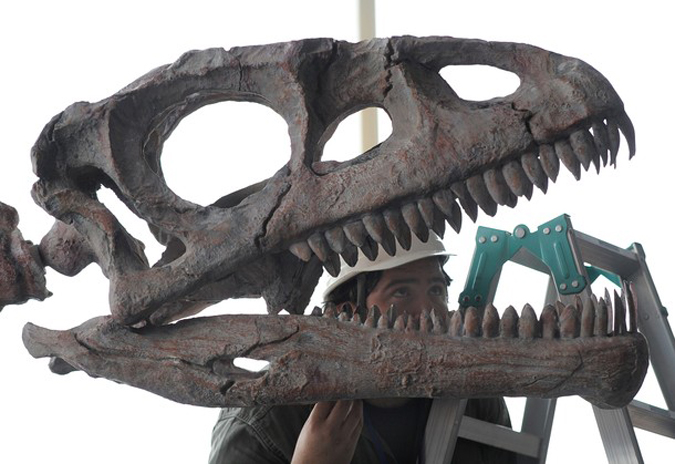
Ископаемые останки (1, 2, 3, 4):
Tags: Вымершие рептилии, Триас, авеметатарзалии, архозавроморфы, архозавры, диапсиды, динозавроморфы, динозавры, завроподоморфы, меланорозавриды, прозавроподы, ящеротазовые |
| March 18th, 2012 | |
| 05:48 pm [industrialterro] [Link] |
Isanosaurus Isanosaurus (meaning "Isan [northeastern Thailand] lizard") was one of the first true sauropod dinosaurs, with all four legs always on the ground. It lived 210 million years ago in Thailand. The type species is Isanosaurus attavipachi. It is known from a partial skeleton, including a neck vertebra, a back vertebra and part of another, six tail vertebra, two chevrons, fragmentary ribs, the right sternal plate, the right shoulder blade, and the left thigh bone. These remains came from a skeleton that had unfortunately been mostly eroded away. The bones belonged to an individual perhaps 6.5 metres (21 ft) long, that may not have been fully grown. They were found in dark red sandstone of the Nam Phong Formation near the village of Ban Non Thaworn, in Chaiyaphum Province.
Размеры тела в сравнении с человеком:
Tags: Вымершие рептилии, Триас, авеметатарзалии, архозавроморфы, архозавры, диапсиды, динозавроморфы, динозавры, завроподоморфы, завроподы, ящеротазовые |
| 04:00 pm [industrialterro] [Link] |
Guaibasaurus Guaibasaurus is an extinct genus of basal dinosaur known from the Triassic of Rio Grande do Sul, southern Brazil. Guaibasaurus was originally named on the basis of the holotype, MCN PV2355, a well-preserved partial postcranial skeleton and the paratype, MCN PV2356, an articulated and nearly complete left hindlimb, which were discovered in the "Sesmaria do Pinhal 2" locality near Candelária, Rio Grande do Sul, in Brazil, in the geopark of Paleorrota. Later, two additional specimens were referred to G. candelariensis: UFRGS PV0725T is an articulated and nearly complete postcranial skeleton missing one forelimb, both feet and the neck, and MCN PV 10112 is still being unprepared block containing articulated parts and some isolated elements of which, including a partial hand. The referred materials were collected from the "Linha São Luiz" locality near the town of Faxinal do Soturno, Rio Grande do Sul, also in the geopark of Paleorrota. All specimen were collected in these two localities from the lower portion of the Caturrita Formation (Rosário do Sul Group, Paraná Basin) or alternatively the uppermost Santa Maria 2 Sequence, dating to the early Norian faunal stage of the Late Triassic, about 216.5-212 million years ago. Specimen UFRGS PV0725T is articulated with hindlimbs tucked underneath its body and forelimbs flexed to the side. Although most of the neck is not preserved, the vertebrae at the base of the neck are present in UFRGS PV0725T and curve to the left, suggesting the entire neck was curved toward the left side of the body. The posture of this skeleton is similar to the resting position of birds, and is otherwise known only from advanced maniraptoran dinosaurs that are closely related to birds. Like living birds, Guaibasaurus may have rested in this position to conserve body heat. José Bonaparte and colleagues, in their 1999 description of the genus, found it to be possible basal theropod and placed it in its own family, Guaibasauridae. Bonaparte and colleagues (2007) found another early Brazilian dinosaur Saturnalia to be very similar to it, and placed the two in the Guaibasauridae which was found to be a primitive saurischian group. Bonaparte found that these forms may have been primitive sauropodomorphs, or an assemblage of forms close to the common ancestor of the sauropodomorphs and theropods. Overall, Bonaparte found that both Saturnalia and Guaibasaurus were more theropod-like than prosauropod-like. However, all more recent cladistic analyses found the members of Guaibasauridae to be very basal sauropodomorphs, except Guaibasaurus itself which was found to be a basal theropod or alternatively a basal sauropodomorph. Guaibasauridae — семейство примитивных ящеротазовых динозавров, известных по ископаемым останкам из позднего триасового периода на территории современных Бразилии и Аргентины. Точный состав и классификация Guaibasauridae остается неопределенной. Семейство первоначально было введено Хосе Бонапартом и его коллегами в 1999 году, тогда содержало один род и один вид — Guaibasaurus candelariensis, и было первоначально причислено к группе тероподов. После второго найденого образца Guaibasaurus, этот динозавр был описан более подробно в 2007 году, что дало возможность сравнить его с другими малоизученными представителями ранних ящеротазовых динозавров, которых часто трудно классифицировать, поскольку они сочетают в себе характеристики двух основных групп ящеротазовых — тероподов и зауроподоморфов. Бонапарт и его коллеги, в свете новой информации, полученной от второго образца, пришли в выводу, что род Saturnalia (который анатомически очень похожи на Guaibasaurus) может быть также отнесен к Guaibasauridae. При дальнейших исследованиях Бонапарт с коллегами обнаружили, что Guaibasauridae обладают большим количеством черт, присущих тероподам, нежели чем черт, присущих ранним зауроподоморфам (или «прозауроподам»). Таким образом, согласно результатам исследований Бонапарта, Guaibasauridae, скорее всего, являются очень ранней базальной группой, находящейся на вершине филогенетической схемы, ведущей к завроподоморфам или группе общих предков зауроподоморфов и тероподов. Кроме того, авторы интерпретируют эти данные, как доказательство того, что общий предок обеих линий ящеротазовых динозавров по внешнему виду был более близок к тераподам, чем к прозауроподам. По классификации M. D. Ezcurra (2010) семейство включает в себя подсемейство Saturnaliinae, содержащее 2 рода — Chromogisaurus и Saturnalia.
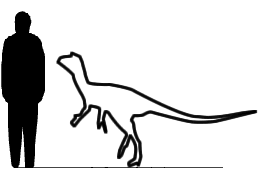
Размеры тела в сравнении с человеком:
Tags: Вымершие рептилии, Триас, авеметатарзалии, архозавроморфы, архозавры, диапсиды, динозавроморфы, динозавры, завроподоморфы, тероподы, ящеротазовые |
| March 17th, 2012 | |
| 05:37 pm [industrialterro] [Link] |
Efraasia Efraasia — род вымерших ящеротазовых динозавров из группы зауроподоморфов (Sauropodomorpha), живших в позднем триасовом периоде (около 210 миллионов лет назад), на территории нынешней Европы. Окаменелости динозавра были найдены в Германии. Впервые описан палеонтологом F. von Huene d 1907–1908 под названием Teratosaurus minor. Представлен одним видом - E. minor. Efraasia was once thought to be a relatively small dinosaur, about 2 to 3 metres (6.6 to 9.8 ft) long, but this was because the most complete known fossils are from juvenile animals. Yates in 2003 has estimated the adult length at 6.5 metres (21 ft); the largest specimen is SMNS 12843 with a femur length of 627 millimetres (24.7 in). Efraasia was lightly built for its size, with gracile hands and feet. Like many "primitive" sauropodomorphs, Efraasia might have been partially bipedal and partly quadrupedal. It had long fingers and mobile thumbs, with which it would have been able to grasp food, but the shape of its wrists might have allowed it to walk easily on all fours. Some researchers however, contend that the lower arm did not allow pronation, a rotation of the radius around the ulna, so that the hand could not be directed downward, making the animal an obligate biped. The skull is small, pointed and triangular. There are four teeth in the premaxilla. The neck is only moderately elongated but thin. The neural spines of the tail are low. The second finger is longer than the third finger. The first toe is not strongly reduced. Von Huene identified a cluster of stomach stones (gastroliths) in association to specimen SMNS 12667. Yates identifies two unique derived traits (autapomorphies): the presence of a raised crescent-like ridge on the upper part of the inner side of the pubis shaft; and the presence of a vaulted bony web between two lower extensions of a braincase bone, the processus basipterygoidei, with a raised central bony platform on top of the vault. Von Huene continued interpreting these forms as predatory dinosaurs, in 1932 assigning them to a separate family Palaeosauridae as part of the Carnosauria. Only in 1965 Charig established they were plant-eating sauropodomorphs. In 1973 Galton assigned Efraasia to the Anchisauridae, but he used this name as a paraphyletic group encompassing all "prosauropods" that were not melanorosaurids. Modern phylogenetic analysis has indicated that Efraasia is a basal sauropodomorph, somewhat more derived than Thecodontosaurus, but less than either the Prosauropoda (including Plateosaurus) or the Sauropoda. The genus is sometimes recovered as the sister taxon to the last common ancestor of both larger groups.
Tags: Вымершие рептилии, Триас, авеметатарзалии, архозавроморфы, архозавры, диапсиды, динозавроморфы, динозавры, завроподоморфы, ящеротазовые |
| March 16th, 2012 | |
| 07:10 pm [industrialterro] [Link] |
Chromogisaurus Хромогизавр (Chromogisaurus) — ископаемый род примитивных ящеротазовых динозавров из семейства Guaibasauridae, живших в конце триасового периода (около 228.7—216.5 миллионов лет назад) на территории нынешней Южной Америки. Представлен одним видом — Chromogisaurus novasi. Окаменелости зауроподоморфа (голотип PVSJ 846) были найдены в геологической формации Ischigualasto Formation относящейся к Carnien (провинция Сан Хуан в Аргентине). Впервые описан палеонтологом Мартином Д. Эскуррой (Martín D. Ezcurra) в 2010 году. Известен по частичному посткраниальному скелету. Он включает в себя правую локтевую кость, весь таз, кости бедра, левой ноги, правой голени, фаланги, среднего и переднего хвостового позвонка. Название рода происходит от др.-греч. «chroma» — «цвет», и «gè» — «страна», ссылаясь на Лос-Колорадос, красочные скальные образования в Valle Pintado. Видовое название дано в честь аргентинского палеонтолога Фернандо Эмилио Новаса (Fernando Emilio Novas). Chromogisaurus является одним из старейших известных динозавров. В длину достигал около 2 метров. По словам исследователей форма относительно длинной локтевой кости указывает на то, что эти динозавры хотя бы иногда передвигались на четырёх конечностях. Задние конечности значительно длиннее передних. В результате кладистического анализа Мартин Эскурра отнес Chromogisaurus к базальным зауроподоморфам в семейство Guaibasauridae, вместе с Guaibasaurus, Agnosphitys, Panphagia и Saturnalia. В Guaibasauridae образует небольшое подсемейство Saturnaliinae вместе с сестринским таксоном Saturnalia.
Tags: Вымершие рептилии, Триас, авеметатарзалии, архозавроморфы, архозавры, диапсиды, динозавроморфы, динозавры, завроподоморфы, ящеротазовые |
| March 12th, 2012 | |
| 05:36 pm [industrialterro] [Link] |
Antetonitrus Antetonitrus (pronounced ant-EE-tohn-IET-rus; meaning "before the thunder") is the oldest known genus of sauropod dinosaur, living during the Late Triassic Period of southern Africa. It was a quadrupedal herbivore, like many of its later relatives, although it was far smaller than some of them. Antetonitrus was the largest animal in its environment, reaching up to 33 feet (10 m) long and weighing up to two tons, but still shows some primitive adaptations to use the forelimbs for grasping, instead of purely for weight support. The fossils now known as Antetonitrus were actually discovered by Kitching in 1981 in the Free State of South Africa, and were stored in the Bernard Price Institute where they were labeled as Euskelosaurus. Yates recognized them as a separate taxon and published a description several years later. The holotype, or original specimen, consists of several vertebrae and numerous bones from both forelimb and hind limb, all presumed to be from one individual. Five more limb bones from another smaller individual were also referred to the genus. Antetonitrus shows several features which appear to be approaching those of sauropods, but still retains some primitive features. Unlike most of its smaller and more lightly built ancestors, Antetonitrus was primarily quadrupedal. Like sauropods, its forelimbs were much longer relative to its hind legs than earlier animals, and the wrist bones were broader and thicker to support more weight. However, the first digit of the hand, also called the "thumb" or pollex, was still twisted and flexible, capable of grasping against the hand. In more derived sauropods, the wrist bones are large and thick, arranged in such a way as to lock the hand into a permanently pronated position for full-time weight support, and the hand is incapable of grasping. A cladistic analysis recognizes Antetonitrus as a basal sauropod, occupying a position between more derived animals such as Isanosaurus or Vulcanodon, and more basal sauropods like Melanorosaurus. The back vertebrae are extremely similar to Lessemsaurus from South America, while the limb bones are similar to Blikanasaurus, another stocky early sauropod from South Africa. However, these animals were not included in a cladistic analysis with Antetonitrus because they are poorly known (Yates & Kitching, 2003). While Antetonitrus is not the earliest sauropod from a phylogenetic standpoint, it currently the oldest known sauropod chronologically, or rather tied for that distinction with other early sauropods from the same formation, like Melanorosaurus and Blikanasaurus. Fossils of these animals were recovered from the Lower Elliot Formation, which dates to the Norian stage of the Late Triassic, or approximately 221 to 210 million years ago. Before Antetonitrus and the other Lower Elliot animals were recognized as sauropods, the oldest known sauropod had been Isanosaurus from the Rhaetian stage, a slightly younger segment of the Triassic, of Thailand (Buffetaut et al., 2000). Early sauropods and their prosauropod relatives were found around the world as all of the continents were at the time united into the single supercontinent, Pangaea, which made dispersal across the entire terrestrial world possible.
Tags: Вымершие рептилии, Триас, авеметатарзалии, архозавроморфы, архозавры, диапсиды, динозавроморфы, динозавры, завроподоморфы, завроподы, ящеротазовые |