[Most Recent Entries] [Calendar View]
Monday, September 24th, 2012
| Time | Event | |||||||||||||||||||||||||||||||||||||||||||||||||||||||||
| 4:01a | Thermaltake Armor A30 Case Review: Opening the Puzzle Box It's pretty clear on our side of the fence that smaller enclosures and leaner builds are increasingly becoming the way to go for most users these days, with even die hard enthusiasts drawn to these smaller cases if for no other reason than to see just how much horsepower they can cram into a small form factor system. There are tradeoffs made in going small form factor, though, and if you go too small the cooling demands can produce system noise that may be too much for many users. That's why there are slightly larger, Micro-ATX scale enclosures like the Thermaltake Armor A30. Thermaltake's case is designed to support a Micro-ATX motherboard and a substantial video card or two, and the cooling system is remarkably robust. Yet as it turned out, working with the A30 proved to be a remarkably fraught experience, with the case having split personalities. Cooling and acoustic performance were actually quite good, but the case itself is tough to recommend. So what happened? 
 | |||||||||||||||||||||||||||||||||||||||||||||||||||||||||
| 11:00a | Samsung SSD 840 Pro (256GB) Review If we had an award for most improved in the SSD space, it would have to go to Samsung. When we first encountered Samsung MLC drives a few years ago they were pretty bad. Prices were high and performance was low. Samsung offered no end-user upgradable firmware for those early drives either, although that was eventually rectified. The first Samsung MLC SSDs were reliable, they just weren't worth the money when you had much better options from companies like Intel. Samsung had all of the right pieces for success however. Like Intel, Samsung made its own NAND, controller and wrote its own firmware. Unlike Intel, Samsung stuck to the vertically integrated formula. I remember arguing with Samsung engineers a few years ago about the importance of random IO performance compared to sequential speed. I remember feeling like they were making the same mistake that all SSD makers were making back then: heavily prioritizing sequential IO when it was a failure to deliver good random IO performance as well that really hurt SSD adoption. Although the first Samsung SSDs weren't very good, they got better over time. While the first generation couldn't be recommended, the Samsung SSD 470 could. It still wasn't our favorite drive, but it finally brought performance up to a reasonable level. Last year's 830 release showed us that Samsung woke up. Today, Samsung is adding two new members to the family: the Samsung SSD 840 and the 840 Pro. The former is the first productized consumer SSD to use Samsung's 21nm 3-bit-per-cell MLC (aka TLC) NAND, while the latter is Samsung's new flagship drive using 21nm 2bpc MLC NAND. Unfortunately we don't have samples of the unique TLC SSD 840, just the MLC 840 Pro. Despite the use of TLC NAND, Samsung claims the vanilla 840 should offer similar performance to the current 830. Samsung also claims that endurance should be reasonable for consumer workloads. The 840 Pro should be tangibly faster than the 830 thanks to a new controller, new firmware and new NAND. Read on for our full review of the Samsung SSD 840 Pro. 
| |||||||||||||||||||||||||||||||||||||||||||||||||||||||||
| 11:00a | Samsung Releases TLC NAND Based 840 SSD
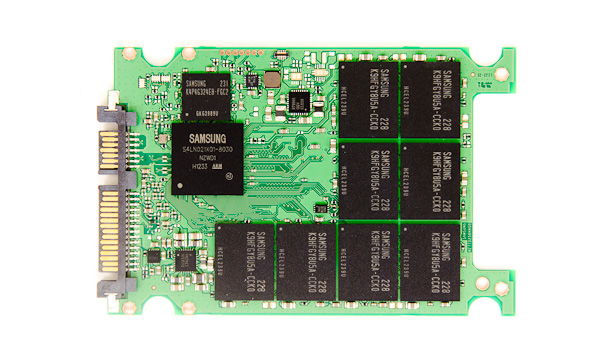
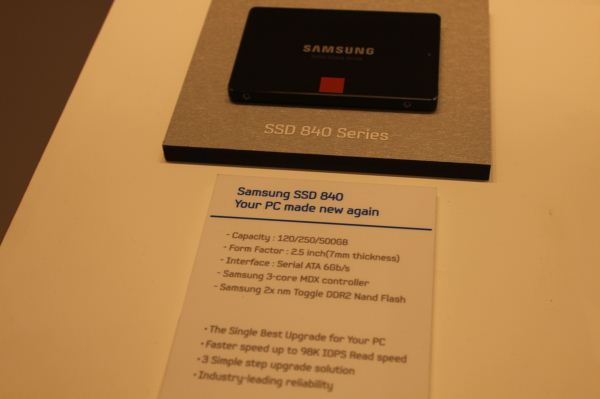
Along with Samsung's release of the 840 Pro SSD today, Samsung is also releasing a more mainstream oriented 840 SSD. It's based around the same Samsung MDX controller as the Pro series, but uses 3-bit-per-cell (TLC) NAND instead of 2-bit-per-cell (MLC) NAND found in the 840 Pro. The 840 Pro also has a firmware which is tuned for heavier workloads consisting of more writes and random IOs, whereas the 840 is designed more towards read centric (i.e. consumer) workloads.
Samsung is actually the first manufacturer to publicly release a TLC NAND based SSD, so we will have very interesting time testing it. Remember, adding more bits per cell reduces endurance and also increases program, erase and read latencies. In a Q&A session Samsung couldn't tell us any exact P/E cycle numbers, but they claimed that the 840 has higher endurance than many competitors MLC based SSDs. We didn't get more specifics than that, but we hope to be able to test this as soon as possible. As for the performance, Samsung again wouldn't tell us any raw latency numbers, but they said their TLC NAND is roughly 50% slower than their MLC NAND. For a more in-depth look at the architectural differences between MLC and TLC, refer to our Understanding TLC NAND article.
The regular 840 SSD will be available in capacities of 120GB, 250GB and 500GB. The increased amount of spare area makes sense given the use of lower endurance TLC NAND. The 840 will be available as a bare drive or in a notebook kit, which adds $20 to the prices in the table. Both, the 840 and 840 Pro will be available on October 15th. Samsung only provided 256GB 840 Pro SSDs for reviews, so unfortunately we haven't been able to test the 840 yet. However, I should get our review sample later today and hopefully some other capacities of the 840 Pro as well. 
| |||||||||||||||||||||||||||||||||||||||||||||||||||||||||
.jpg)


| << Previous Day |
2012/09/24 [Calendar] |
Next Day >> |