[Most Recent Entries] [Calendar View]
Friday, October 5th, 2012
| Time | Event | |||||||||||||||||||||||||||||||||||||||||||||||||||||||
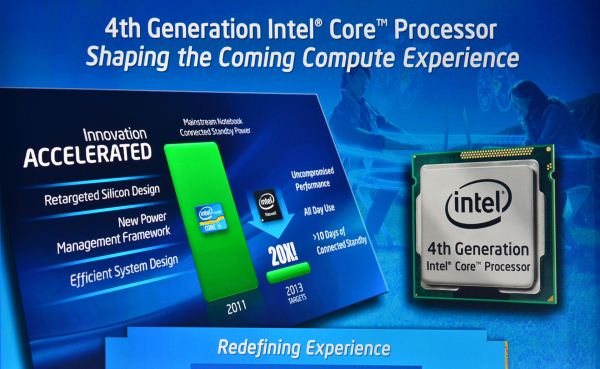
| 6:45a | Intel's Haswell Architecture Analyzed: Building a New PC and a New Intel Atom was originally developed not to deal with ARM but to usher in a new type of ultra mobile device. That obviously didn't happen. UMPCs failed, netbooks were a temporary distraction (albeit profitable for Intel) and a new generation of smartphones and tablets became the new face of mobile computing. While Atom will continue to play in the ultra mobile space, Haswell marks the beginning of something new. Rather than send its second string player into battle, Intel is starting to prep its star for ultra mobile work. Haswell is so much more than just another new microprocessor architecture from Intel. For years Intel has enjoyed a wonderful position in the market. With its long term viability threatened, Haswell is the first step of a long term solution to the ARM problem. While Atom was the first "fast-enough" x86 micro-architecture from Intel, Haswell takes a different approach to the problem. Rather than working from the bottom up, Haswell is Intel's attempt to take its best micro-architecture and drive power as low as possible. Read on for our full analysis of both Haswell as a microprocessor architecture and as a ultra mobile platform. 
 | |||||||||||||||||||||||||||||||||||||||||||||||||||||||
| 4:00p | Radeon HD 7850 Prices Fall Again Update 10/07: AMD sent us a clarification this morning stating that they were not the ones responsible for the recent reduction in 7850 prices, bur rather that it was a result of the "natural economics that are governing the channel, promotions and agressive pricing that the ecosystem is driving on its own". While we typically take what AMD says at face value, it's hard to imagine partners are able to undercut AMD's MSRP by $20+ on a sub-$200 part if AMD has not changed the prices they're charging their partners. AMD’s initial launch prices for the Radeon HD 7000 series were not well received by the thrifty. But as AMD has since discovered, starting high means you can make a big deal of price cuts, and that’s exactly what they’ve been doing for roughly the past 6 months. Through a few different rounds of publically announced price cuts on the 7900, 7800, and 7700 series, AMD has not only improved their competitive positioning versus NVIDIA and their old products alike, but has also quickly won favor with a budget-conscientious public. It should come as no surprise then that AMD is continuing this campaign of public price cuts this fall with yet another round of price cuts. As part of AMD‘s preparations for future events AMD’s cheaper 7800 series card, the Radeon HD 7850, is receiving an all-but-official price cut to shore up the card’s competitive positioning.
For this latest round of cuts AMD is reducing prices on the 7850 by a further $20, putting the market price on the 2GB 7850 at around $189. Meanwhile the largely neglected 1GB 7850 has also seen its market price come down to what’s best called a very rough $169, with individual SKU prices being relatively scattered due to the very small number of SKUs on the market (4, up for 2 a week ago). As with prior cuts the 2GB 7850 will remain as AMD’s primary 7850, with the less common 1GB model covering a specific niche for AMD. These latest cuts follow AMD’s last round of price cuts in August, where between the launches of the GeForce GTX 660 Ti and GTX 660 we saw the 7870 move from $299 to $249 and the 2GB 7850 move from $239 to $209. Unlike past cuts though these new prices are technically not going to be MSRPs – AMD is making sure not to call them that – but the end result is much the same. Using market prices allows AMD to quote a number that more closely reflects the price of basic feature cards, which in the case of the 7850 have typically undercut the official MSRP by $10. 
| |||||||||||||||||||||||||||||||||||||||||||||||||||||||


| << Previous Day |
2012/10/05 [Calendar] |
Next Day >> |