[Most Recent Entries] [Calendar View]
Thursday, October 18th, 2012
- ARM-based EZ single-bay network attached hard disk for home users
- ARM-based ix series for value-focused consumers
- x86-based px series for performance-focused consumers (These come in both desktop and rackmount form-factors)
| Time | Event | ||
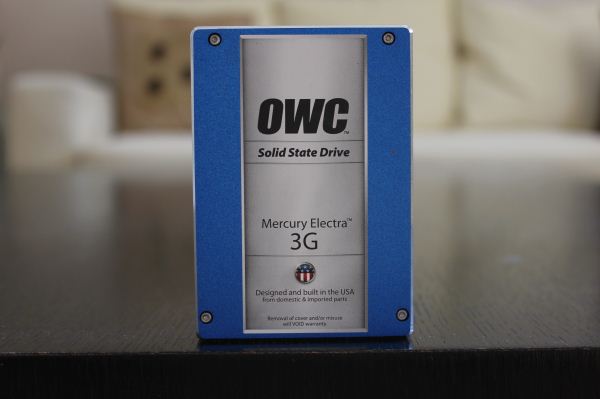
| 5:00a | OWC Mercury Electra 3G MAX 960GB Review: 1TB of NAND in 2.5" Form Factor The decrease in NAND prices has opened doors for bigger SSD capacities. 512GB SSDs have been available for a couple of years now but even though prices have come down significantly, we haven't seen a move to capacities bigger than 512GB yet. There are some architectural limitations that cause this but there are a few exceptions that offer more than 512GB. OWC offers a 960GB Mercury Electra 3G MAX, which is among the first 2.5" SATA SSDs with 1TB of NAND. Read on to find out how it is built and how it performs. 
 | ||
| 9:31a | Boston Viridis ARM Server Gets x86 Binary Translation Support
We covered the launch of the Calxeda-based Boston Viridis ARM server back in July. The server is makings its appearance at the UK IP EXPO 2012. Boston has been blogging about their work on the Viridis over the last few months, and one of the most interesting aspects is the fact that x86 binary translation now works on the Viridis. The technology is from Eltech, and they have apparently given the seal of approval to the Calxeda platform by indicating that the Boston Viridis was the fastest platform they had tested. Eltech seems to be doing dynamic binary translation, i.e, x86 binaries are translated on the fly. That makes the code a bit bulky (heavier on the I-Cache). The overhead is relatively large compared to, say, VMware's binary translator (BT) that does x86 to x86, becauseof the necessity to translate between two different ISAs. Eltech uses a 1 MB translator cache (similar to the translator cache of VMware's BT), which means they can reuse earlier translations. The translation overhead will thus decrease quickly over time if most of the critical loops fit in the translator cache. But it also means that only code with a relatively small footprint will run fast, e.g. get the promised 40-65% of native performance. Most server applications have a relatively large instruction memory footprint, so it is unclear whether this approach will help to run any heavy server software. Some HPC softwares have a small memory footprint, but since the HPC users tend to pursue performance most of the time, this technology is unlikely to convince them to use ARM servers instead of x86. In general, the BT software will be useful in the - not uncommon - case where one may have a complex web application comprised of multiple software modules where one small piece of software is not open-source and the vendor does not offer an ARM based binary. So, the Eltech solution does handle a small piece of the puzzle. x86 emulation is thus a nice to have feature, but most ARM based servers will be running fully optimized and recompiled linux software. That is the target market for products such as the Boston Viridis. 
| ||
| 12:00p | Acer Iconia A110 Guns For Nexus 7
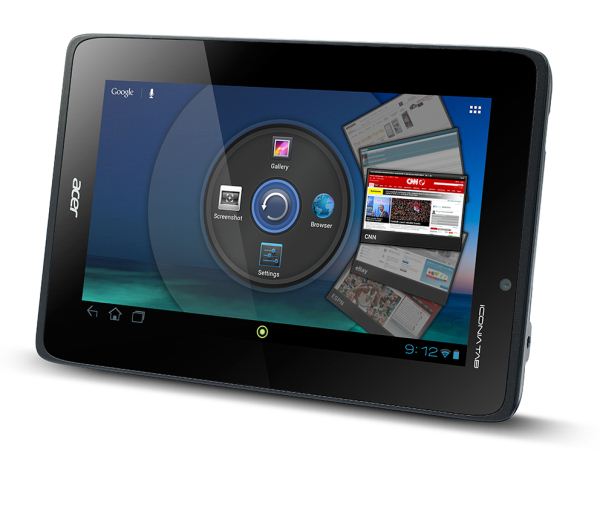
Everyone's getting into the small tablet market, and with the success of Google's own Nexus 7, and Amazon's Kindle Fire, it's no surprise. The Iconia A110 fills that segment for Acer, but does it have what it takes to compete with the Nexus 7? At a high-level it matches up well. The venerable NVIDIA Tegra 3 SoC makes an appearance, as does Android 4.1 (Jelly Bean). The A110 has an edge in connectivity and expandability with microUSB sitting alongside microSD and microHDMI. From there, though, things drop off a bit. With just 8GB of NAND storage on-board, the out of the box value is a little diminished. Then there's the display, which might be stellar in person, but with just the specs to look at, the 1024x600 resolution is a let down. And then we have pricing. At $229.99 MSRP, the Iconia A110 is somewhat more expensive than the Nexus 7, and if rumors of a 32GB Nexus 7 SKU slotting in at the $249 price point are true, the 8GB A110 will face stiff competition. We'll find out how it fares on October 30th. 
| ||
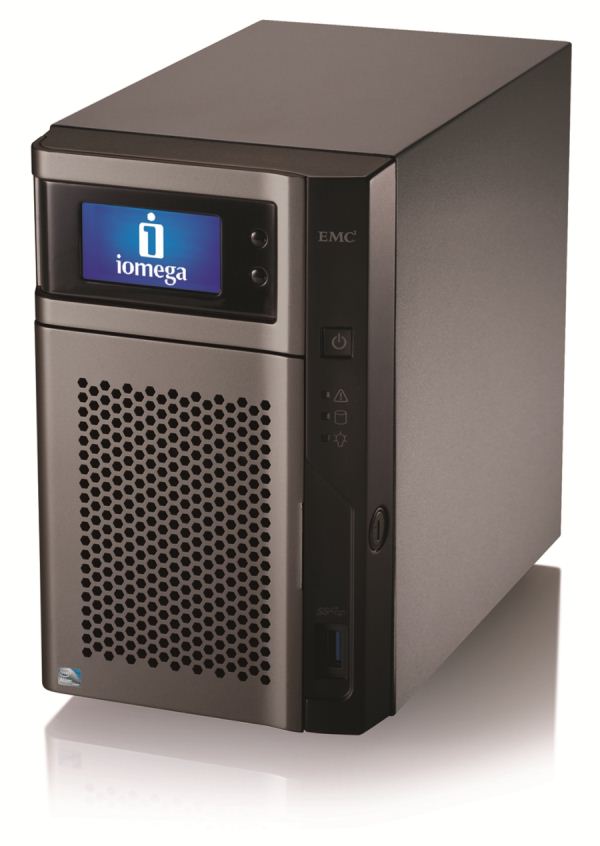
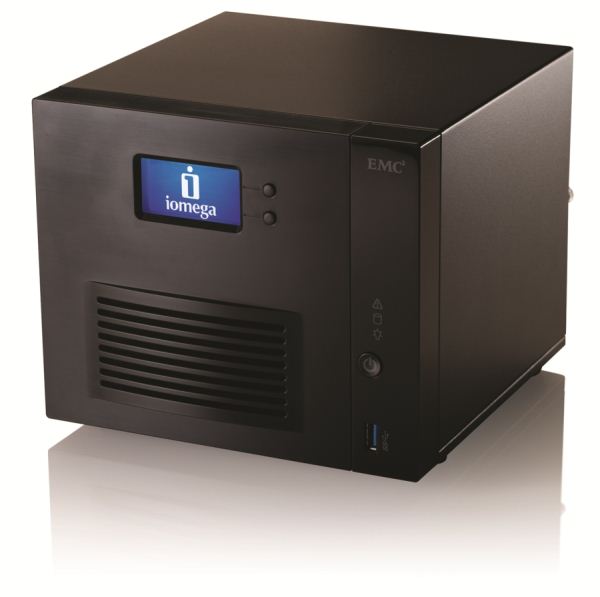
| 1:00p | Iomega StorCenter NAS Lineup Refresh: 2-bay px2-300d and 4-bay ix4-300d Today, Iomega is announcing two new NAS models, one each in the ix and px series. Traditionally, manufacturers have tended to focus their performance platform efforts on 4-bay and higher NAS systems. ARM-based systems make up the majority of the 2-bay offerings. However, huge amounts of data are being generated everyday even in the home (thanks to high resolution videos and photos, as well as movie backups and DVR recordings). This has opened up a market segment for 4-bay value offerings. Distributed SMB (small and medium-sized businesses) locations, in turn, have made small high-availability NAS systems with a performance emphasis necessary. In order to cater to the performance market, Iomega is launching the px2-300d Intel Atom-based 2-bay model. Equipped with 2 GB of DDR3 memory, the unit supports hot-swapping of drives as well as volume encryption capabilities. The unit also has two GbE ports and comes with a customized version of McAfee Enterprise (with local scanning). A 3-year subscription for virus definitions is included. Pricing ranges from $500 for the diskless configuration to $1200 for the 2 x 3TB configuration. A point to be noted is that the disks shipped with the px2-300d are enterprise / server class drives. The ix4-300d is equally interesting because it seems to be the first Marvell ARMADA XP based NAS system shipping to customers. The latest Marvell based refreshes we have seen from other manufacturers have all been based on the Kirkwood MV628x platform. The ix4-300d is based on a dual core 1.3 GHz Marvell SoC (MV78230 seems to be the likely candidate, though Iomega didn't confirm the exact part number). This unit also comes with dual GbE (something we see rarely in the value segment) and has 512 MB of DDR3 memory. Unlike the other 4-bay ARM-based NAS systems such as the Netgear NV+ v2, this model doesn't have hot-swap capabilities. Addition or replacement of disks requires a power cycle. Pricing ranges from $600 for the diskless configuration to $1300 for the 4 x 3TB configuration. Both of the new NAS systems run the Iomega LifeLine OS. The latest version of the LifeLine OS has shifted the RAID filesystem from EXT3 to EXT4. Iomega indicated that this brought about higher efficiency. The new version has also apparently enhanced Active Directory support and added MySQL server support as well as video surveillance capabilities. Extra apps for the system are available here. The OS also allows linking of two StorCenter units in different locations for seamless cloud disaster recovery. The Iomega Link iOS / Android application allows mobile devices to access the NAS. The units are also DLNA certified. We are particularly excited about the Marvell ARMADA XP based 4-bay system (ix4-300d). With Synology having thrown their weight behind Freescale this year, the competition amongst silicon vendors for the value-based NAS platform seems to be heating up. 
| ||
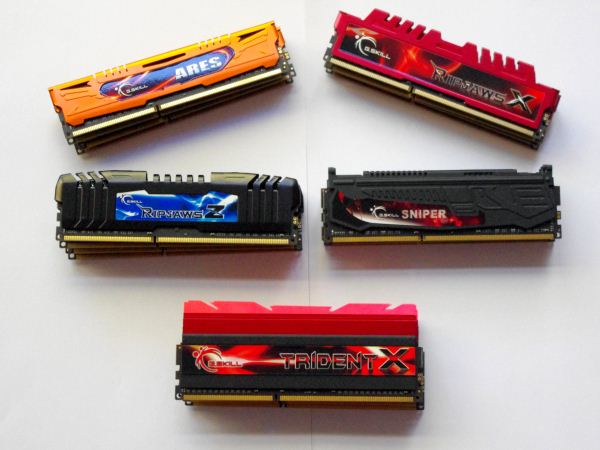
| 4:00p | Memory Performance: 16GB DDR3-1333 to DDR3-2400 on Ivy Bridge IGP with G.Skill Memory reviews are, in my opinion, actually quite hard to do. There are plenty of memory kits available that are nice and cheap, and the easy way to differentiate between them in a review is usually though synthetics – without too much effort we can find memory comparison articles online that deal solely in synthetics. The downside of synthetics is that they rarely emulate real-world performance. When the requests came in for a comparison of memory kits available on the market, I was stumped to find real-world examples where memory truly matters by significant margins, and benchmarks to match. Fast forward a month or so, and we have compiled a series of tests taking advantage of some of the most memory limited examples common to most users – IGP performance using memory from DDR3-1333 to DDR3-2400. Inside this review we have also mixed in some encoding, compression, and you may be surprised to hear that USB 3.0 performance is also affected by memory speed. In this article we also look at and review the memory kits that G.Skill has gracefully provided from their Ares, Sniper, RipjawsX, RipjawsZ and TridentX brands. 
|



| << Previous Day |
2012/10/18 [Calendar] |
Next Day >> |