[Most Recent Entries] [Calendar View]
Monday, October 29th, 2012
| Time | Event | ||
| 4:01a | Cougar Challenger Case Review: Is Competitive Performance Enough? It's fun to review the big enthusiast-class cases like the NZXT Phantom 820 and the Mini-ITX and Micro-ATX custom marvels like the BitFenix Prodigy and SilverStone SG09, but the fact is that cases like those aren't doing the grunt work on the market. That job is usually handled by standard ATX cases in the sub-$100 bracket, where bang for the buck matters most. Hovering around the $80 price point there are often good deals to be had, and that appears to be true again with the Cougar Challenger we have on hand today. Selling for $86 on NewEgg, the Cougar Challenger is capable of offering a pretty healthy performance profile along with a couple of added perks like the hotswap SATA tray on the top of the case. But what was sacrificed to reach the sub-$100 price point, and might you still be better off spending up a bit on a different mainstream enclosure? 
 | ||
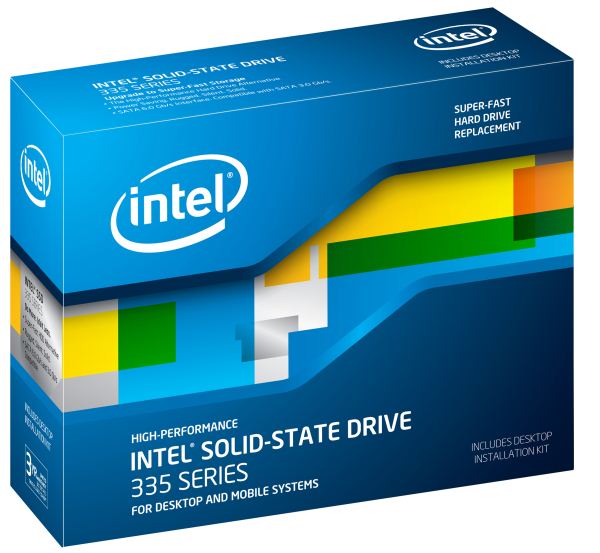
| 3:30p | Intel SSD 335 (240GB) Review Back in February, Intel released its first SandForce based SSD: the Intel SSD 520. Since then Intel's SSD lineup has evolved. A couple of months after the 520's release, Intel released a more mainstream focused SSD 330. Architecturally the SSD 520 and 330 were the same as both used SandForce's SF-2281 controller and IMFT's MLC NAND. The only real differences were limited to NAND quality and firmware; the 520 used higher binned NAND with more P/E cycles and its firmware was also more finely tuned to provide better performance. While SandForce has yet to release its 3rd generation SSD controller, there's still room to upgrade one major component of these drives: the NAND itself. IMFT (Intel's and Micron's NAND joint-venture) has been fairly open about its next generation NAND products, including the transition to 20nm MLC NAND. Moving to smaller process geometries decreases die area, which increases the number of NAND die that can be produced on a single wafer (or increases the capacity that can reliably be produced on a single die). The move to 20nm is a necessary part of continuing to drive SSD costs down, although as with all process transitions we won't see those cost savings initially (die savings are offset by higher costs of a new process at the start).
IMFT's 20nm announcement happened back in April 2011. At the time, we were told not to expect to see 64Gb 20nm MLC NAND devices in SSDs until the middle of 2012. Now, a year and a half later, production is finally at a stage where volume and yields are both high enough for an actual product release. The vehicle for introduction? Intel's SSD 335. 
| ||
| 4:39p | LG and Google Announce the Nexus 4, Starts at $299 This isn't how they wanted to do it, but LG and Google are going ahead with the announcement of the Nexus 4, and it's a steal. The lineage of the device is clear, with specs aping those of the LG Optimus G, but blessed with the latest update to Jelly Bean: Android 4.2. The Qualcomm Snapdragon S4 Pro features four Krait cores clocked at 1.5GHz , the Adreno 320 GPU, and paired the requisite 2GB of RAM. The same 4.7" TrueHD IPS Plus display has a 1280x768 resolution, and the design is updated with a new back surface. Available in 8GB and 16GB configurations, the new Nexus will start at just $299, and top out at $349 unlocked and off-contract, through the Google Play Store on November 13th. When Google's Galaxy Nexus was sold unlocked for $349 it was a stupendous bargain, despite somewhat dated hardware. With today's announcement, though, we have top of the line hardware being sold at prices that bend the price curve drastically against buying on-contract devices. We'll see how that all plays out over the coming months.
There's also some indication that announcements are imminent for the other devices that were in the works for today's canceled event, including the 32GB Nexus 7 and the new Nexus 10 slate from Samsung. We'll update as we hear more. 
| ||
| 4:58p | Microsoft's Windows Phone 8 Event - Liveblog We're in San Francisco for Microsoft's Windows Phone 8 event today, where the software giant will unveil the latest in its smartphone platform. There's a lot more in store today from Windows Phone, so stay tuned.

| ||
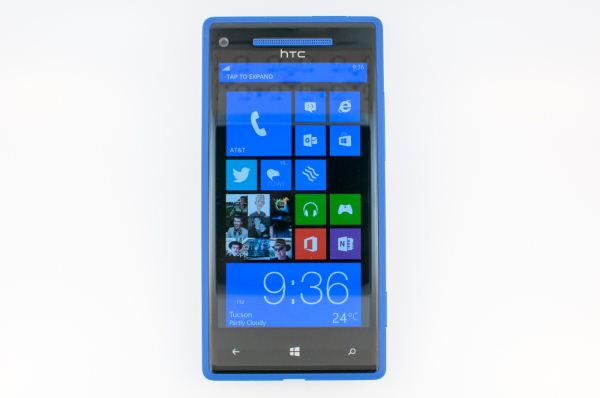
| 6:10p | Windows Phone 8 and Windows Phone 8X by HTC Preview For a long time Microsoft was in an enviable position in the smartphone space. It had almost all the pieces of the puzzle you’d expect for delivering a truly unique smartphone platform. It had the historical perspective, from the initial days of PocketPC, to Windows Mobile platforms, the software giant hasn’t exactly been uninvolved with the smartphone space. It is and remains first and foremost a software company, while other players come either the web or primarily hardware-focused perspectives. Lastly, it had the relationship with OEMs like HTC already, willing to commit to radically different platforms. It seemed like execution was just a matter of lining up all those assets and clicking go. With Windows Phone 7, we saw Microsoft make a clean break from Windows Mobile and begin to morph the mobile experience from something tailored largely for users wanting a smartphone that emulated the Windows experience as much as possible on a smaller screen to a mobile-driven UI with a completely ground-up look at what needs to be part of a smartphone OS. WP7 was a radical re-imagining of Microsoft’s mobile story at a point in the smartphone explosion where it wasn’t very clear who would emerge victorious and who would fizzle out. I remember being at MIX10 two years ago and watching the elements of WP7 taking shape, and while that launch didn’t necessarily have every last feature needed to guarantee success, Windows Phone is still around and a few other big players notably aren’t. At that point Microsoft essentially started anew and since then has largely remained something of a number three in the smartphone OS space while iOS and Android have continued charging ahead. The question now is just how Windows Phone 8 will upset that balance. 
| ||
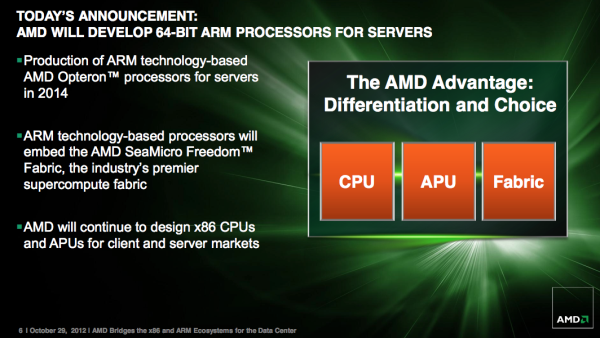
| 8:48p | AMD Will Build 64-bit ARM based Opteron CPUs for Servers, Production in 2014
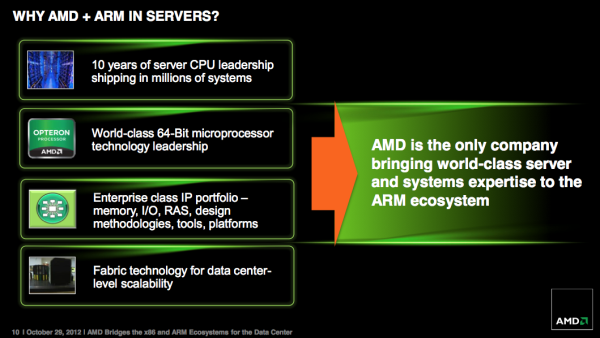
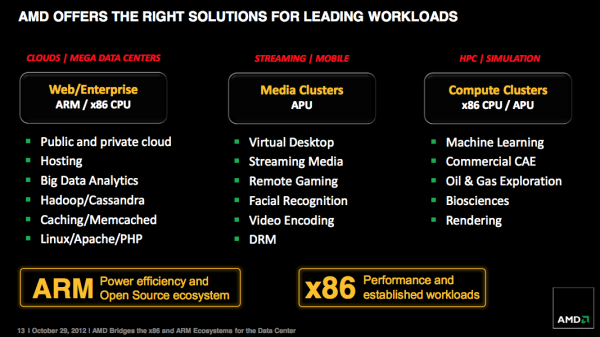
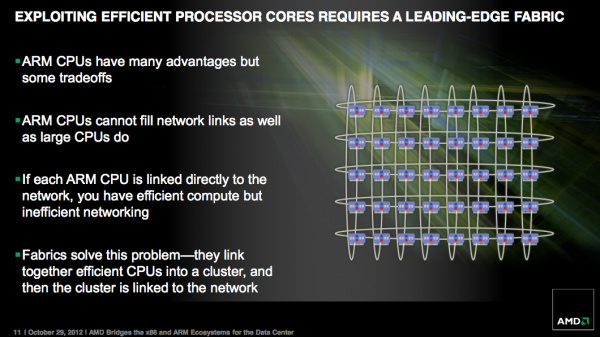
Last year AMD officially became an ARM licensee, although the deal wasn't publicized at the time. Fast forward to June 2012 and we saw the first fruits of that deal: AMD announced it would integrate ARM's Cortex A5 core into its 2013 APUs to enable TrustZone support. Today comes a much bigger announcement: AMD will be building Opteron processors based on a 64-bit ARM architecture. There are no product announcements today, but the 64-bit ARM Opterons will go into production in 2014. Today's announcement is about a processor license, not an ARM architecture license - in other words, AMD will integrate an ARM designed 64-bit core for this new Opteron. The only other detail we know is that these ARM based Opterons will embed SeaMicro's Freedom Fabric, presumably on-die. AMD offering ARM based Opterons is really to target the microserver market. As for why AMD isn't using Jaguar for these parts, it's likely that by going with ARM it can lower the development time and cost to get into this market. The danger here is the total microserver market is expected to be around 10% of the overall server market, but that includes x86 + ARM. With x86 as the default incumbent, it's going to be an uphill battle for AMD/ARM to carve out a significant portion of that market. AMD was quick to mention that despite today's announcement, it will continue to build x86 CPUs and APUs for client and server markets. Overall the move sounds a lot like AMD trying to move quickly to capitalize on a new market. It's unclear just how big the ARM based server market will be, but AMD seems to hope that it'll be on the forefront of that revolution - should it happen. Embracing ARM also further aligns AMD with one of Intel's most threatening sources of competition at this point. The question is whether or not AMD is doing itself more harm than good by working to devalue x86 in the server space. I suspect it'll be years before we know the real impact of AMD's move here. The other major takeaway is that AMD is looking to find lower cost ways of bringing competitive platforms to market. I do think that a Jaguar based Opteron would likely be the best route for AMD, but it would also likely require a bit more effort than integrating an ARM core. Obviously competition will be more prevalent in the ARM server space, but here is where AMD hopes its brand and position in the market will be able to give it an advantage. AMD will also be relying heavily on the SeaMicro Freedom Fabric for giving its ARM based Opterons a leg up on the competition. This is one time where I really wish AMD hadn't spun off its fabs. 
|
.jpg)



| << Previous Day |
2012/10/29 [Calendar] |
Next Day >> |