[Most Recent Entries] [Calendar View]
Friday, November 23rd, 2012
| Time | Event | ||||||||||||||||||||||||||||||||||
| 4:01a | Fractal Design Node 304 mITX Case Review: Paving the Way to the Future We've said it before but it bears repeating: desktop systems are getting smaller. ATX is becoming less and less necessary, and mini-ITX-based machines more and more offer the same performance and features that their bigger brothers do. That's just the direction of the technology industry as a whole, cramming everything we need into a space half as large. What's specific to cases is their own evolution running parallel with the technology we're putting into them. Fractal Design's Node 304 is in many ways a surprising jump forward in case design. We've seen SilverStone, BitFenix, Lian Li, and Cooler Master all try their hands at mITX cases with varying degrees of success, but there's just no set design language when you get down this small. The conventions we take for granted in ATX case design don't really apply here, but Fractal Design has tried for something fairly different with the Node 304, even by mITX standards. Read on to find out where they've deviated from an already unpredictable design language. 
 | ||||||||||||||||||||||||||||||||||
| 9:40a | Nexus 4 Includes Support for LTE on Band 4 (AWS)
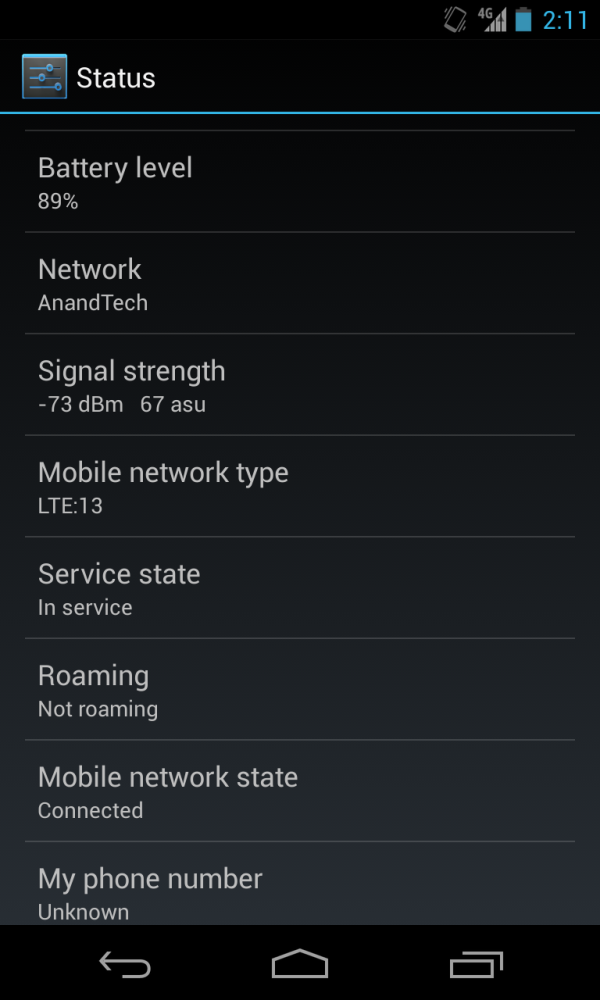
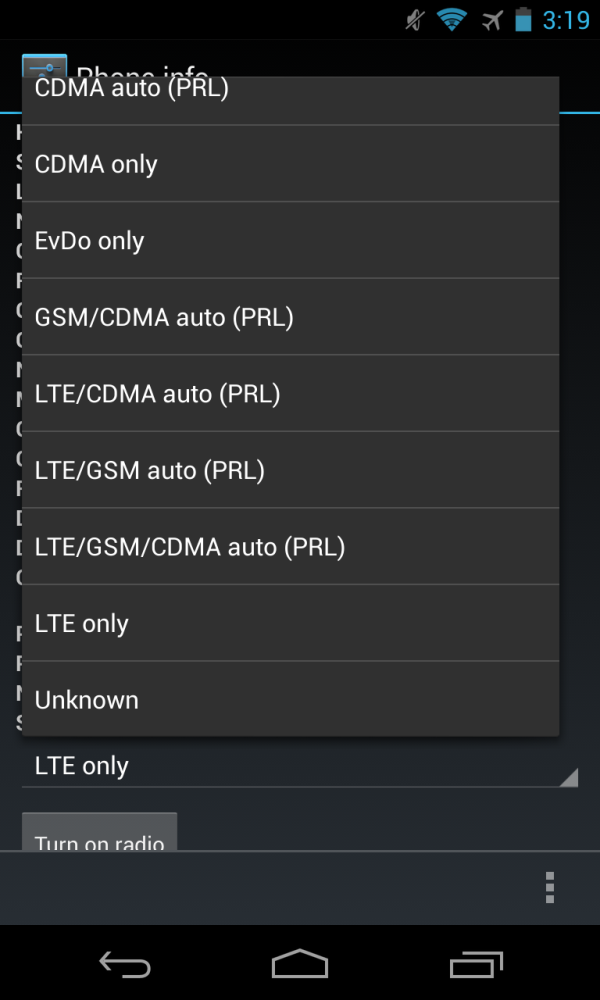
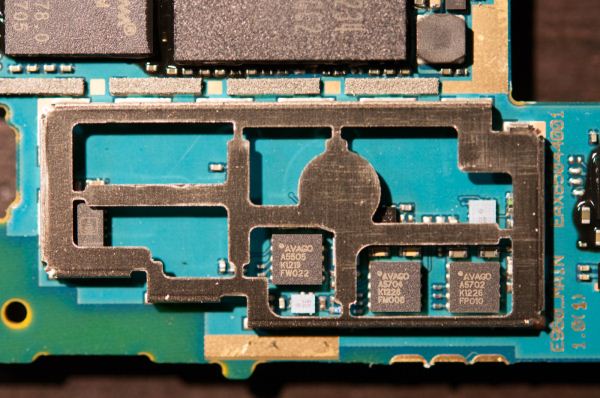
I noted in my review of the LG/Google Nexus 4 that the device included hardware necessary for LTE on at least some of its bands, namely bands 1 (2100 MHz), 2 (1900 MHz), and 4 (AWS 1700/2100) based on what I saw in my teardown. Enabling LTE on a given device requires everything in the cellular chain to include support — the cellular baseband to support it must be present and loaded with the appropriate software, the transceiver must be the appropriate kind, and finally the right power amplifiers (PAs) have to be in place for the wider channel bandwidths that LTE brings (up to 20 MHz) over WCDMA (5 MHz). In the case of the Nexus 4, the hardware includes the latest and greatest cellular hardware from Qualcomm with MDM9215M, its third generation 28nm Category 3 LTE multimode baseband, and a WTR1605L transceiver. I tore down the Nexus 4 to ascertain whether PAs were present that could work with LTE, and saw indeed that at least bands 4, 2, and 1 did have Avago power amplifiers (A5704, A5702, and ACPM–7251) which noted support for LTE. The remaining piece of the puzzle was software stack, both in Android and inside the version of the AMSS (Advanced Mobile Subscriber Software) running onboard MDM9215M. Recently some Nexus 4 owners in Canada posted on XDA that they had working LTE support on Band 4 if they enabled the appropriate "Preferred Network Type" in the dropdown menu there. This menu is inside "Phone Info" which has been part of Android forever and can be accessed on almost every Android phone either by dialing *#*#4636#*#* (INFO) or using an app called Phone Info which launches that activity directly. Recently, Anritsu graciously loaned me an MD8475A signaling tester and LTE/WCDMA/CDMA2000 base station emulator for me to test and evaluate devices with. I tested the Nexus 4 on DC-HSPA+ for the review but didn't think to try testing LTE on the appropriate bands since Google and the FCC documents are both explicit about only WCDMA/GSM being present. I tested for LTE on all the bands that the Nexus 4 includes UMTS support for, starting with 5 MHz wide LTE channels. It appears that Nexus 4 only has support for LTE on Band 4 (AWS) with bandwidths up to 20 MHz in fact. I put together a table for easier parsing. If a band isn't listed, it isn't supported. Update: Lots of people have asked me to test some additional bands (3, 7, 20) because of their international relevance, these unsurprisingly are not supported given the fact that there are no PAs present for them. I've updated the table to be explicit however.
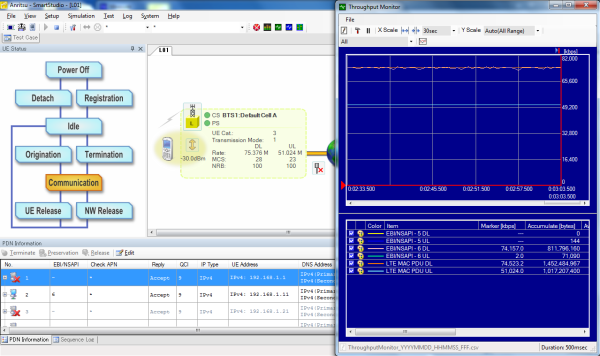
Because testing the 2x2 MIMO configuration requires cabling up the Nexus 4 to the antenna leads directly, and my LG-appropriate antenna connectors haven't arrived yet, I only can test with a 1x1 configuration. The Nexus 4 does include Rx diversity for every band, and thus it's entirely possible on Band 4 that users will see the full 2x2 MIMO rates (37 Mbps on 5 MHz, 73 on 10 MHz, 100 Mbps on 20 MHz), but I can't confirm it directly. For the 1x1 configuration I could test, however, I saw the expected ~75 Mbps on 20 MHz FDD LTE which is very close to the maximum of 75.376 as shown.
Gallery: Nexus 4 Anritsu LTE Testing       The conclusion is that the Nexus 4 at present curiously includes the software profile on MDM9215M that enables support for LTE on Band 4 (AWS), and users only need to set the appropriate network type preference in Android to use it. None of the other bands that there are even power amplifiers for have LTE support, which is unfortunate for users in places where carriers aren't running LTE on AWS, such as the USA. For example, in the USA, AT&T previously discussed plans for LTE on Band 4 but has only rolled out LTE on Band 17 to date, and is rumored to be turning to refarming its PCS (1900 Band 2) and Cellular (850 Band 5) holdings for additional LTE capacity, perhaps in the stead of AWS. T-Mobile US however will use AWS for LTE. Nexus 4 LTE support is definitely unofficial (and somewhat surprising) at this point, but if you're lucky enough to be in a place where your carrier has rolled it out on Band 4, it's just a setting away. Source: XDA Developers 
| ||||||||||||||||||||||||||||||||||
.jpg)


| << Previous Day |
2012/11/23 [Calendar] |
Next Day >> |