[Most Recent Entries] [Calendar View]
Friday, August 16th, 2013
| Time | Event |
| 9:30a | A Tour of Moto Maker: Customization Meets the Moto X
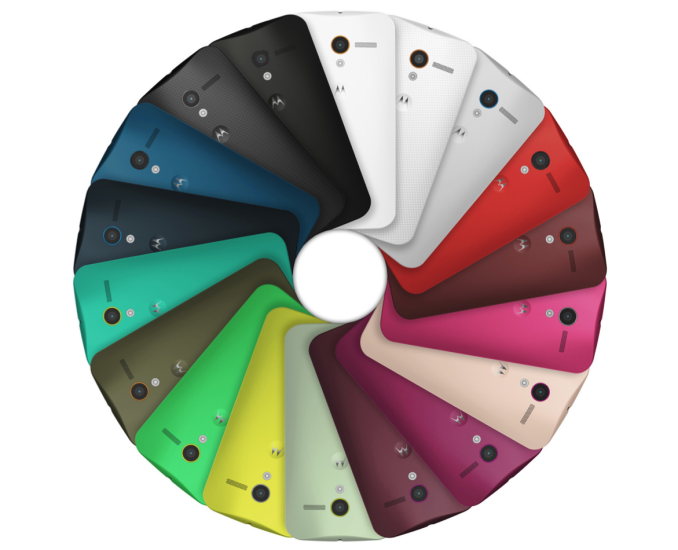
A key part of the Moto X's story is one of hardware customization. At launch, those users buying Moto Xes on AT&T will be given the option of selecting from 18 back colors, 2 front colors and 7 accent colors. Additional options include custom text on the back of your device, storage capacity (16GB or 32GB), charger color, cases and headphones. It works out to around 504 different possible combinations of Moto X choices users can select from. I won't go into great detail on the Moto X here as Brian has already done a great job of that in his original piece, and we have a full review in the works. If you show up at an AT&T store, you'll be able to see examples of color combinations in person, but you can only go home with a woven white or woven black model. This is the composite material, carbon fiber-looking back we've shown photos of already, with a matching black or white front. If you want to customize a Moto X, you can buy a Moto X redemption card - good for one customized Moto X. Take the redemption card home, head to motorola.com/designit, type in your PIN and off you go. The AT&T store visit is purely optional however, you can just go to motomaker.com and buy a fully customized Moto X directly from Motorola. In both cases, the Moto X receives final customization and assembly in Fort Worth, Texas. The process should take approximately 4 days depending on component availability. If you don't like what you end up with, you're free to exchange/return the device within a 14-day window. Motorola provided us with PIN codes to try out the nearly-final version of Moto Maker and pick out our own custom Moto X design options. Brian put together an excellent video taking you through the entire process:
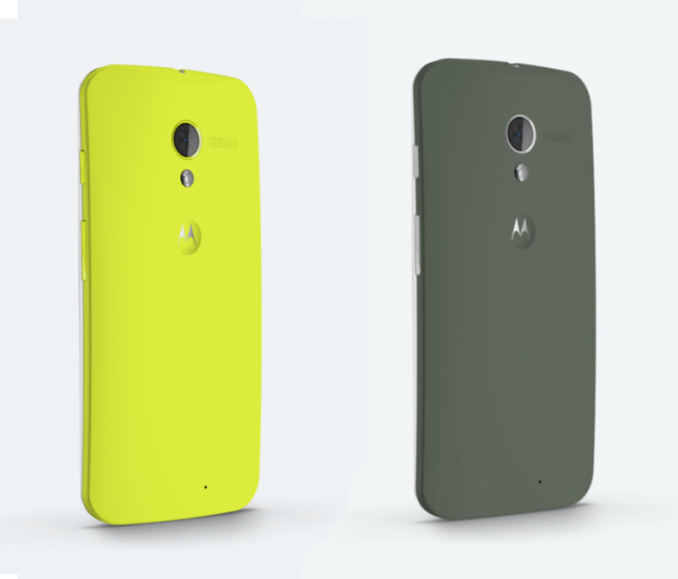
There are a few minor bugs/inconsistencies in the Moto Maker webapp itself but otherwise the process is quite painless. It's pretty easy to tell what color combinations work or don't work, and Motorola has a number of recommendations for designs already made. As with any online configurator, image accuracy is always a concern. We won't see the results of our customizations for a few days, but we'll do a follow-up post comparing what Moto Maker presented us with and what it looks like in person. At present the options include the different colored backs which are polymer, in addition to the two woven composite materials. Other patterns will gradually be made available, along with the wood back options that we were shown, although Motorola still doesn't have specific timing beyond saying sometime in the Q4 timeframe for those wood options. It took me much longer than I expected to settle on a color combination. There aren't an overwhelming number of choices, but there are enough options to make you think - and a number of really good looking combinations. I found it very easy to put together a fairly subtle phone with a splash of color thanks to the 7 accent colors, but I ultimately ended up designing something pretty over the top – lemon lime with yellow accents and the white front. Brian settled on olive with silver accents and the white front.
There is a small amount of software customization that comes with Moto Maker. Based on the color you choose for the back of the Moto X, Motorola will pre-select a wallpaper that matches. You can specify custom text to be displayed at boot, and finally you can opt to automatically setup your Google account on the phone to simplify the out of box experience when you finally get it. The purchase experience is something that we rarely talk about in our reviews, but it does play a major role in customer satisfaction. I feel like Moto Maker is a successful attempt to improve the smartphone purchasing process. The customization options are easy to get excited about, and the overall experience is without equal in the phone space today. Given how personal these smartphones are, the customization play with Moto Maker is clearly very well thought out. As we've seen in the past though, personalization alone isn't enough to make for a successful product. Stay tuned for our full review of the Moto X.
Gallery: Moto X: Moto Maker
      |
| 10:17p | GIGABYTE Announces FM2+ A88X Series Motherboards for Kaveri
The evolution of the Bulldozer module, through Piledriver, and Steamroller on Kaveri to come has been an eventful journey. Despite recent rumors floating around the Internet reporting delays to AMD’s deployment of Kaveri (which AMD have since confirmed to the media that Kaveri will ship to customers in Q4-2013), motherboard manufacturers, like GIGABYTE, are announcing their lineup for Steamroller based APUs. These APUs will be using the FM2+ socket, which is backwards compatible with Trinity/Richland FM2 APUs (FM2 based motherboards are not forwards compatible), as well as a new chipset in the form of A88X, which as far as we know is for FM2+ only. These new APUs offer native support for PCIe 3.0 as well as DX11.1 and 4K support – something all AMD partners will be keen to promote. GIGABYTE’s initial FM2+ lineup will consist of seven models with four ATX and three micro-ATX:
G1.Sniper A88X
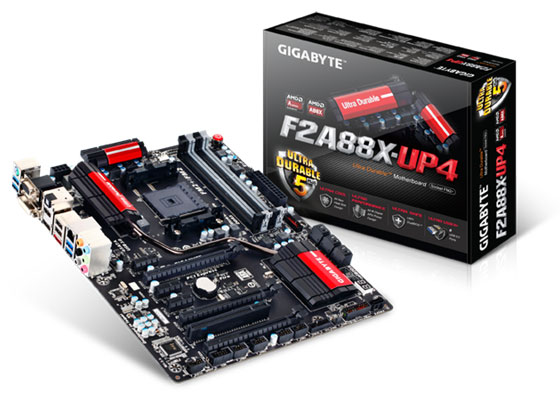
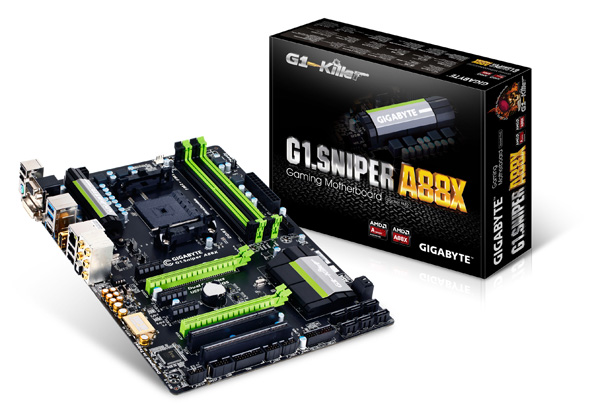
Continuing on the Sniper theme, the G1.Sniper A88X is aimed at the gaming market with two new exclusive audio features – GIGABYTE USB DAC-UP (a feature for optimized power to user DACs) and Gain Boost where high gain output is required. This board will also feature the high end audio solution from the G1.Sniper 5 (the Intel Z87 version), including OP-AMP, audio tracing separation and filter caps to improve noise quality. Below the G1.Sniper A88X is the F2A88X-UP4, which will feature 60A IR3550 ICs in its power delivery, similar to the F2A85X-UP4 which we reviewed in our initial Trinity coverage. Release date for these motherboards is likely to be the same day that AMD release Kaveri, which should be in the hands of system integrators by the end of the year.
|

| << Previous Day |
2013/08/16 [Calendar] |
Next Day >> |