[Most Recent Entries] [Calendar View]
Wednesday, January 8th, 2014
| Time | Event | |||||||||||||||||||||||||||||||||||||||||||||||||||||||||
| 12:00a | GIGABYTE BRIX Pro: A First Look at the Intel i7-4770R with Iris Pro HD 5200 Intel's high-end Crystal Well, the Core i7-4770R, has remained out of reach for consumers despite being introduced back in June 2013. While Apple's notebooks use the mobile Crystal Well parts, the 2013 iMac restricts itself to the Core i5-4570R. Users wanting to stay out of the Apple ecosystem have been left in the cold. Gigabyte is coming to the rescue with the launch of the BRIX Pro in the NUC form factor. The higher end SKU is equipped with the 65W TDP i7-4770R. Read on for our first look at the BRIX Pro along with some quick benchmark numbers. 
 | |||||||||||||||||||||||||||||||||||||||||||||||||||||||||
| 9:30a | Diamond Multimedia Tests Networking Waters at CES
Diamond Multimedia is well known for its AMD graphics cards and USB capture devices. To date, the AMD graphics cards continue to be their cash cow, flying off the store shelves at retailers such as Fry's. DisplayLink products (eg.) also form a good chunk of their product catalog. We dropped by their CES suite to see the products on display. The most interesting DisplayLink product (pictured above) was the Ultra Dock dual video USB 3.0 / USB 2.0 docking station. With the advent of ultrabooks (which forsake expansion ports in order to achieve a thin profile), docking stations like the Ultra Dock can fulfil important functionality when the unit is being used on a desk. All ultrabooks come with a healthy number of USB 3.0 ports, and one of these can be used as a host for the Ultra Dock. The dock is also externally powered, and provides four USB 2.0 ports, a GbE port, HDMI and DVI ports on the rear and two USB 3.0 ports as well as a headphone jack on the front. Diamond Multimedia is also testing the waters of the networking market by coming up with some 802.11n dual-band routers and 500 Mbps HomePlug AV PLC (powerline communication) networking kits. They also had a 'pet camera' on display which connects to the router using HomePlug technology built into the camera. The kit also comes with an adapter to connect to the power lines at the router end. The camera and This is a very interesting IP camera feature that seems to be an ideal PLC application.
Gallery: Diamond Multimedia - CES Suite       A network TV tuner was also on display. Similar to the HD Home Run class of devices, it also comes with a HDMI port. The product appears to be still in development and is expected to release in the second half of the year. 
| |||||||||||||||||||||||||||||||||||||||||||||||||||||||||
| 9:45a | Asustor Updates ADM OS, Prepares Haswell-based Rackmounts
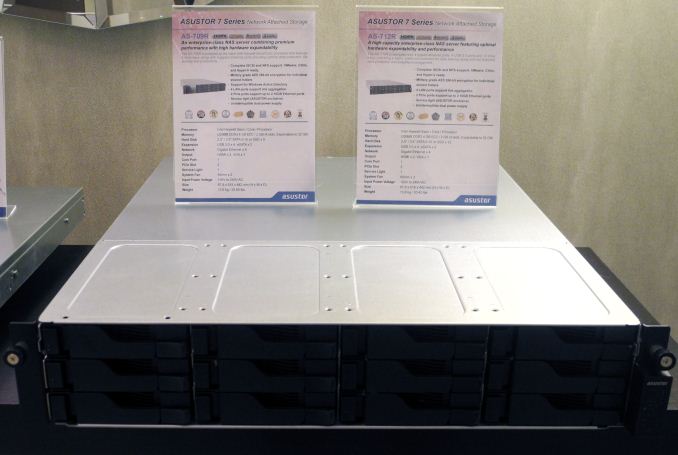
We visited Asustor at CES last year and saw a host of Atom-based NAS units. In the span of one year, a lot of changes have taken place. There is better delineation of models. The AS-2xxT and AS-3xxT models target home consumers while the AS-6xxT and the AS-6xxRS / AS-6xxRD targets business users (SMB and enterprises requiring tower form factor and rackmounts respectively). The AS-3xxT comes in 2 and 4-bay varieties and they are based on the Intel Evansport platform. I have been privately informed by people in the know that the Asustor AS-3xxT is one of the better Evansport NAS units, and we are looking to arrange a review of the 4-bay. Amongst the updates we received today are changes in the OS, the Asustor Disk Manager (ADM) and news on the 7-series rackmount models based on Haswell Core i / Xeon processors. The changes in ADM include the addition of a 'MyArchive' feature where up to two disks / bays in an Asustor unit can be reserved as removable storage. The disks in these bays are not part of the RAID volumes, but separate Linux ext4 single disk volumes. Asustor cites sharing, collecting and power saving as some of the advantages of the MyArchive feature. The Asustor 7-series comes in 9 and 12 bay varieties, with two PCIe expansion slots compatible with 10G cards. The units come with dual power supplies for redundancy and have four 1 GbE ports. The units are expected to come to the market in Q2 2013. 
| |||||||||||||||||||||||||||||||||||||||||||||||||||||||||
| 10:00a | Lenovo's BEACON Brings Evansport to the Living Room
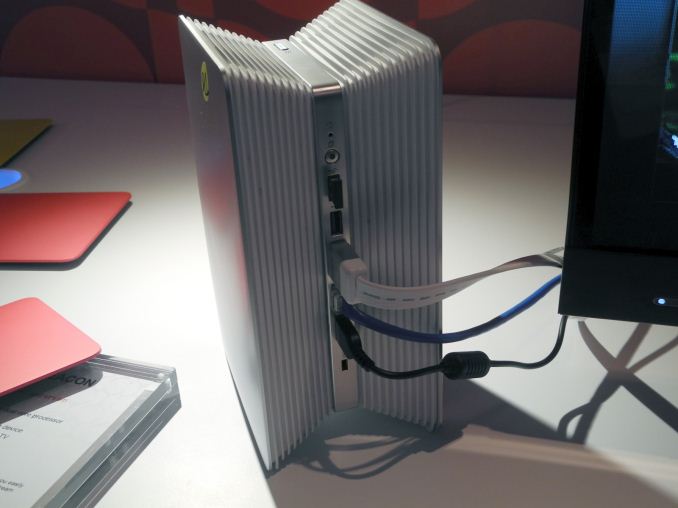
Intel's Evansport storage platform and their Berryville STB platform are, for all practical purposes, the same. Given this, it is only logical to expect an Evansport NAS to double up as a media streamer. The Evansport NAS units currently in the market (such as the Thecus N2560, Asustor AS-602T and the Synology DS214play) all come in the standard NAS tower form factor. This looks pretty out of place in the living room / entertainment center. To address this concern, Lenovo is coming out with the BEACON, a product based on the Intel CE 5315. The unit's industrial design is a work of art, as shown in the gallery below.
Gallery: Lenovo BEACON    Two hard disks can be installed and configured in either RAID-0 or RAID-1. An XBMC app is available for media playback through the unit's HDMI port. Evansport's transcoding engine is taken advantage of to stream media to mobile devices. Currently, Android and Windows Phone are supported, with iOS support slated to come later (understandable, since Lenovo sells Android and Windows Phone devices). It must be noted that the product is from Lenovo, and not LenovoEMC. The latter concentrates on traditional-looking NAS units for home consumers as well as SMB / enterprise customers. The Lenovo BEACON is slated to hit shelves in April at a price point of $199 for a diskless unit. 
| |||||||||||||||||||||||||||||||||||||||||||||||||||||||||
| 12:00p | AMD Reveals First Mobile Radeon M200 Parts & Rebadges
While CES is generally not a big show for the GPU divisions of the major chip makers – those firms preferring to make major GPU announcements at their own events – due to the fact that CES itself aligns so closely with OEM refresh cycles, we do see some quieter GPU announcements come out of the show every year. In recent years this has especially been the case for laptop/mobile graphics thanks to the larger volume and higher levels of integration as found on those parts, though this does have the unfortunate side effect of meaning GPU announcements get caught up in the deluge of announcements coming out of CES. At any rate with our first 2014 discrete GPU announcements in hand, we’ll be starting our look at CES 2014 dGPU news with AMD’s first mobile product unveilings. AMD Radeon M200 SeriesFor their 2014 mobile GPU series, AMD’s mobile GPU branding is being caught up with their desktop GPU branding. On the desktop AMD launched their new Radeon 200 series of products in Q4 of last year, and now at CES 2014 we’re seeing the launch of the mobile counterpart of the Radeon 200 brand, the Radeon M200 brand. Meanwhile in what has quickly become a CES tradition if there ever was one, the lack of alignment between GPU development cycles and OEM refresh cycles means that we’re going to be starting off the year with a combination of new SKUs and rebadges of existing SKUs. For their product refreshes OEMs need new products to show off – whether or not new SKUs are truly available – leading to component suppliers such as AMD and NVIDIA playing the rebadge game to satisfy their OEM customers. The end result is that we get some “new” products that aren’t really new, a situation we’re not big fans of, but something that we have come to terms with for the OEM market. Unlike CES 2013, AMD hasn’t held a press briefing for these mobile parts, and accordingly this is a far more tempered rollout than the nearly top-to-bottom 8000M rollout last year. Still, we already have published information for 2 M200 parts, and partial information for a third. If history is any indication there will be some more SKUs (and more rebadges) to further flesh out this lineup, but this is what AMD is officially starting with for the moment.
Starting at the top we have the flagship of the group, the Radeon R9 M290X. The M290X is a straight-up rebadge of the 8970M (itself a minor variant of the 7970M), offering the same specifications and performance as the 8970M that came before it. This means we’re looking at a fully enabled Neptune (Pitcairn) GPU, with its 20 CUs and 32 ROPs running at a base clock of 850MHz with a boost clock of 900MHz. This is attached to 2GB or 4GB of GDDR5, running at 4.8GHz. Since we’ll be starting 2014 on the same 28nm process node as 2013 (and 2012), there’s little surprise that AMD’s flagship hasn’t changed. AMD’s Tahiti GPU was too hot and power hungry for laptops and Hawaii is the same, so Neptune (Pitcairn) remains the largest GPU AMD can offer in this space. Moving on to our second confirmed product, we have a new low end SKU called the R5 M230. The details on this one are a bit sketchier, as we know the functional unit counts and clockspeeds, but not the underlying GPU. In terms of performance this is a very low end part, featuring just 5 CUs (320 SPs), 4 ROPs, and a tiny 64bit DDR3 memory bus. AMD’s specs call for it to ship at clockspeeds up to 855MHz for the GPU and 2GHz for the DDR3 RAM, so shader performance and memory bandwidth should be competitive with the wider but lower clocked 8570M (Mars/Oland), but the ROP count is only half as much, which will hurt performance in pixel-heavy scenarios and higher resolutions. Functionally speaking this is a lower end part than any of the 8000M parts, and based on what we know about desktop Kaveri, unlikely to offer better performance than the iGPU in many Kaveri SKUs. Meanwhile we also don’t have official confirmation on what GPU is in the R5 M230. Our initial assumption would be that this is another Mars (Oland) part, utilizing a cut down die. But AMD never offered such a product in the 8000M series. Furthermore Mars was 8 ROPs attached to a 64bit memory bus; while it’s easy enough to independently disable a CU, disabling ROPs without disabling part of the memory bus is an unusual endeavor. Sticking our arm into the rumor pool, we’ve heard rumors that AMD has developed another GCN GPU, mobile codename Sun, that’s even lower end than Mars. Seeing the number of functional units available on M230 this would certainly fit the description of Sun. For the moment we’re listing this as a Sun part, but we’re trying to chase down AMD to get confirmation of this. Technical specifications aside, it’s not immediately clear what M230 is targeted at. With such a low performance profile, even in the best case it’s not going to be much faster than AMD’s iGPUs. At the same time it’s going to be rather big (relatively speaking) to pair with something like Kabini. It may be getting pitched as a cheap upgrade for Intel’s iGPUs, but that’s just a guess on our part. Finally, we have a small bit of information on a 3rd AMD mobile SKU, whose full details have not been published yet. ComputerBase.de has a slide from an (unknown to us) AMD presentation that lists the R7 M265, which has yet to be posted by AMD. Since we don’t have specifications on this one we won’t spend too much time speculating on it, but there are really two ways this can go. Considering this replaces the 8700M series, this is either another Mars part, or we may finally be seeing a Bonaire part reach mobile. Heathrow (Cape Verde) was retired from AMD’s desktop lineup with the 200 series, and we’d expect the same to happen on the M200 series. In any case we’ll have more details on this SKU once AMD publishes some additional information on it. 
| |||||||||||||||||||||||||||||||||||||||||||||||||||||||||
| 2:30p | Mushkin CES 2014: Ventura Ultra SF-2281 and Atom USB Sticks
One of the first products we saw at Mushkin’s suite is their final USB 3.0 USB stick with a SandForce SF-2281 controller. Not everyone needs ultra-high performance from a USB stick, but if 39K IOPS of random read/write performance sounds enticing, this could be your solution. Dubbed the Ventura Ultra, the USB stick is available in 60GB, 120GB, and 240GB capacities. The target market will be more for IT professionals looking for a fast and small “tool kit” device, or perhaps users looking for a small and portable USB-based OS. Pricing and availability weren’t given either, but while SF-2281 is pretty old news now, it’s still far faster than anything else in the USB stick market. Read/write performance is rated at up to 450/445 MB/s, and while Mushkin didn’t list prices, at least one online reseller is selling the 240GB model at $299. As for the Atom, no, we’re not talking about Intel’s Atom CPU/SoC but rather a second ultra-small USB stick. It’s the sort of form factor that allows you to leave the stick plugged into a notebook even when you’re putting it in a bag without too much concern for damage. Mushkin promises “big USB 3.0 speeds” despite the tiny size…and they at least partially deliver. They gave us their product brochures on an 8GB Atom stick, so I was able to run a few quick tests. Write speed for a large 303MiB file ended up pretty poor at just 5MB/s average. Read speeds on the other hand were far more promising – after rebooting, I measured read speeds off the drive for the same file of over 80MB/s. Getting a bunch of useful files on the Atom initially may require some time and patience, but at least copying them back off again won’t be nearly as bad. It’s frankly pretty crazy to think just how much storage we’re now able to fit into an ultra-small device, as the Atom is available in 8GB, 16GB, and 32GB models. 19.8mm x 16.5mm x 7.5mm isn’t all that much larger than a standard USB connector. The 8GB model is already available online for $10, so I suspect availability of the other capacities will come soon.

| |||||||||||||||||||||||||||||||||||||||||||||||||||||||||
| 3:00p | Khronos Offers a Quick Peek at the Next Version of OpenGL ES
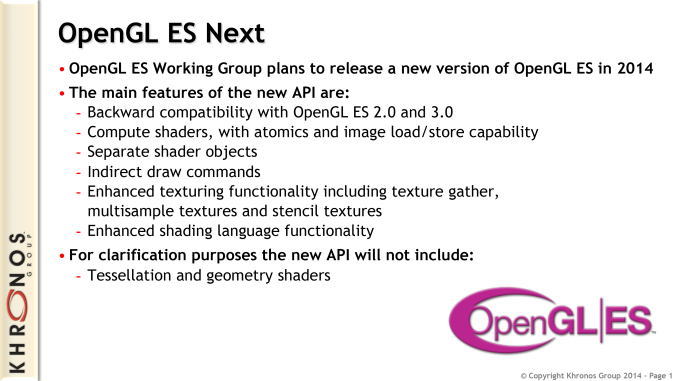
Amidst the hustle and bustle of CES 2014, Khronos has published a short announcement regarding the next version of OpenGL ES (OpenGL ES Next). In it they are offering a brief high level overview of their plans for their mobile graphics API. In short, Khronos is announcing that they will be releasing OpenGL ES Next this year, which would put it roughly 2 years after the release of OpenGL ES 3.0. As is expected it will come with several new features – many of these being brought over in some form from mainline OpenGL – while at the same time continuing to walk the narrow line between being a separate API and a pure subset of OpenGL. Feature wise, OpenGL ES Next will bring with it support for a number of features that were introduced in OpenGL 4.x. This includes compute shaders (OGL 4.3), shader atomics with load/store capabilities (OGL 4.2), indirect draw commands (OGL 4.0), texture multi-sampling (OGL 3.2). All of these features will be important additions to the API for different reasons, be it increasing the capabilities and performance of the shader system, or further adding onto the functionality of the texturing system. The addition of compute shaders will likely be the marquee feature for OpenGL ES Next, but that shouldn’t discount the importance of the other feature additions. Meanwhile Khronos has also offered a brief glimpse of what they won’t be including, in order to better illustrate where they’re going with OpenGL ES Next and how it compares to other APIs. OpenGL ES Next will not be including some of OpenGL’s high-end geometry functionality, specifically geometry shaders (OGL 3.2) and tessellation (OGL 4.0). Just as how OpenGL ES 3.0 isn’t quite at feature parity with OpenGL 3, these omissions mean that OpenGL ES Next will still have some significant differences compared to OpenGL 4, and even OpenGL 3 again. In other words, just as how OpenGL ES 3.0 was in many ways a reduced scope version of OpenGL 3, OpenGL ES Next will continue that trend by being a reduced scope version of OpenGL 4. Wrapping things up, with a publication date set for this year, it’s a solid bet that we should hear more about OpenGL ES Next towards the middle of this summer. Khronos’s major announcements typically come around SIGGRAPH (Aug. 10-14, 2014), with OpenGL ES 3.0 and OpenGL 4.4 being announced at that show in previous years, so that’s where we’d expect Khronos to announce at least a preliminary draft of Open GL Next, if not the final version. Special thanks to our own Rahul Garg for catching this announcement 
| |||||||||||||||||||||||||||||||||||||||||||||||||||||||||
| 7:19p | T-Mobile CES 2014 Uncarrier 4.0 Event Live Blog We're seated now at T-Mobile's CES 2014 press event, where the operator will hopefully share some of its plans for the fourth step in its uncarrier series of changes. Read on for our live blog coverage. 
| |||||||||||||||||||||||||||||||||||||||||||||||||||||||||
| 10:26p | Mushkin CES 2014: SF-3700 SSDs
USB sticks and memory are fine, but the more interesting products at Mushkin are their upcoming SSDs. We’ve already discussed their new line of enterprise class SSDs, but Mushkin has plenty of other drives planned for the coming year. The big news is going to be all of the LSI SF-3700 drives that should show up in the coming months, and not surprisingly Mushkin has a full suite of planned drives. Of course there will be the usual 2.5” SATA SSDs, with the SF-3700 models launching under the Helix brand name; Helix will also be the brand for the M.2 2280 PCIe models. The M.2 Helix drives will ship in capacities up to 512GB while the 2.5” Helix drives will support capacities up to 2TB. Other new drives are planned as well, with the Atlas line getting upgrade to 128Gb Micron NAND and thus supporting up to 512GB without any daughterboard on the Atlas II models. Mushkin will also be releasing the Scorpion II, which will hold up to 2TB of storage in a PCIe 2.0 x4 card solution. The Scorpion II as well as the 2.5” Helix at present are the only two options from Mushkin where eMLC NAND is also an option, likely for performance/endurance reasons. All of the upcoming SF-3700 SSDs from Mushkin can use either MLC or TLC NAND and have ONFi 2/3 and Toggle Mode 1/2 NAND support, so Mushkin will likely have a variety of drives targeting different price points depending on what NAND is most readily available, or what NAND will perform best. The drives will also have the standard SF-3700 feature set: DuraWrite, SHIELD Error Correction, RAISE Technology, and Dual AES-256 Encryption. Performance is expected to be better than the existing SF-2281 SSDs, naturally, but Mushkin hasn’t disclosed their performance targets yet. The PCIe-based drives should be faster, particularly in sequential transfer rates, but we’ll have to wait and see what actually gets shipped. Pricing and expected release dates are not yet known. Gallery: Mushkin CES 2014: SF-3700 SSDs _thumb.JPG) _thumb.JPG) _thumb.JPG) _thumb.JPG) _thumb.JPG) _thumb.JPG) 
| |||||||||||||||||||||||||||||||||||||||||||||||||||||||||




_575px.JPG)
_thumb.JPG)
_thumb.JPG)
_thumb.JPG)
_575px.JPG)
| << Previous Day |
2014/01/08 [Calendar] |
Next Day >> |