[Most Recent Entries] [Calendar View]
Thursday, January 9th, 2014
| Time | Event | ||
| 3:00a | VisionTek at CES 2014: The R9 290 Liquid Cooled CryoVenom
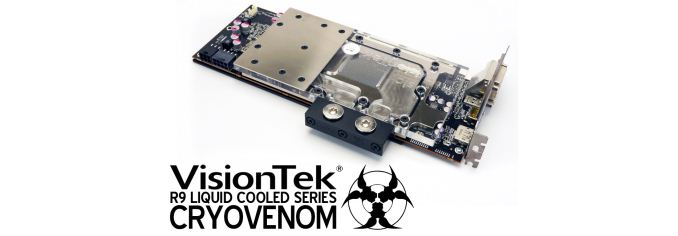
Extra performance is always welcome, whether that is CPU performance, memory performance, SSD performance or GPU performance. It makes it a lot more worthwhile if the performance comes at a lower than expected cost. This is what VisionTek are trying to do with their new R9 290 CryoVenom – this is a custom built liquid cooled card designed to be cheaper than a self-built liquid cooling solution. On the front of it, the CryoVenom is just another GPU with a water block attached (users will have to supply their own water loop), however VisionTek are trying to cut out a lot of the hard work for the user. The card will have the water block preinstalled (similar to the EVGA Hydro range), and will be factory tested for a suggested overclock. The GPU will come out of the box at stock settings, but VisionTek will custom test each one and provide in the box a certificate with their 95% percentile overclock, allowing users to go straight in to Catalyst and set the numbers. VisionTek are going to sell the CryoVenom for $550 with a one year warranty, which they compare to a DIY version which breaks down into the following cost scenario: R9 290 card $400.00, Water block $140.00, Back plate $36.00 This is fair enough – if you water cool your own cards then the warranty is gone and there is always a risk that something might break. That being said, the CryoVenom is $150 more than a standard R9 290 card, although it is a quiet solution and has all the tools necessary for a good overclock as long as the user has a suitable water loop to pair it with. The water block itself is designed to cover the GPU core, the memory and the VRMs, leaving nothing uncovered. The copper base is nickel plated to prevent corrosion and precision cut acrylic is applied on top. The rear back plate is anodized aluminum, providing passive VRM cooling. The VisionTek R9 290 CryoVenom should be available today direct from their website at $550.
Gallery: VisionTek R9 290 CryoVenom       
 | ||
| 5:15a | OriginPC: New Genesis and Millennium Systems (and More)
OriginPC is a boutique PC system integrator with a twist: they ship their systems in gigantic wooden crates designed to kill reviewers like Dustin (RIP). The past couple of years they’ve apparently been working on their own custom chassis design, with the intent of building one chassis to satisfy the demands of the vast majority of their clients. Whether or not they will succeed is yet to be determined, but at CES this year they’re ready to unveil the fruits of their labors. The new chassis features variable mounting – a term coined by OriginPC to talk about their case – which simply put allows you to orient the motherboard and internals in one of four directions: standard ATX, inverted ATX (basically flip the motherboard to the opposite side of the case), 90 degree (e.g. vertical GPUs and expansion slots), or 90 degrees inverted (vertical expansion slots with the motherboard on the opposite side of the case). This allows users to have their system built in whatever orientation fits their particular needs best – e.g. if you have your case against the wall to the left of your desk, the “inverted” orientations will allow a case window to still show the interior. Besides the variable mounting, the new chassis has plenty of other features. For one, the bottom of the chassis can be replaced on the Millennium and Genesis, so the top portion of the case is the same on both systems. The Millennium doesn’t have anything extra on the bottom, while the Genesis has three options for the bottom compartment. You can install a custom water-cooling radiator and dual 3x120mm radiators, or a storage compartment with one of two setups: it can hold up to 14 3.5” drives, or you can flip things around and install up to 24 (possibly more?) 2.5” SSDs. The full-tower expansion kit that converts the Millennium into the Genesis will also be available for purchase. Either case has a variety of mounting options for radiators as well, with space for top, bottom, rear, and front radiators of varying sizes. Other features include the ability to support up to 4-way SLI configurations (in any orientation), a smart fan controller (with a minimum fan speed of 30%, so that you don’t accidentally cause your system to overheat), remote controlled LED lighting, a dual-hinge front panel that can be configured to open to either the right or the left, five hot-swap bays, up to E-ATX motherboard support (as well as support for dual-socket motherboards), and probably some other items I missed. It’s a very impressive feat of engineering, certainly, though perhaps not for everyone considering the size, styling, and price. You can view OriginPC’s video introduction to their new case for perhaps a better understanding of how things work, and Origin has also posted (better quality) pictures of the case. You can completely customize just about any aspect of a new desktop/workstation built using the new chassis, with pricing starting at $1629 for the Millennium and $1849 for the Genesis. Other items shown at their suite included a sneak-peak of upcoming 3U and 4U rack mount workstation/server chassis, as well as their customizable notebook based on Clevo’s P157SM (but with Origin’s log on the touchpad and a custom cover, with perhaps a few other minor tweaks). OriginPC definitely isn’t in the business of selling budget hardware, but if you’re after customization and perhaps something different in terms of a PC chassis, they’re worth a look. 
| ||
| 7:58a | Swiftech: Enhanced Liquid-Cooling Options
Swiftech is a fairly well-known name in the realm of computer cooling, founded nearly 20 years ago by Gabriel Rouchon (but not officially named Swiftech until 2001). While they have various other products, at CES their focus is solely on the world of liquid cooling. Last year they unveiled a new product similar to a closed-loop-cooling (CLC) kit that incorporated a pump on the CPU waterblock, with the interesting twist being that it came with quick disconnect valves and the pump is powerful enough to drive a full liquid-cooling setup with GPU(s), chipset, and of course CPU. This year, they’re going in a similar route only now the pump is being integrated onto the radiator. The H220X comes with a compact 2x120mm radiator and fans with an integrated high power pump, reservoir, and CPU waterblock. There’s a window as well to show the current coolant level and LED lighting. It’s shipped in a ready-to-install state with the coolant pre-filled. The expected delivery date is March 2014, with an MSRP of around $150. Prototype models with 1x140mm and 2x140mm form factors were also present but not yet ready for launch. Swiftech had several other items on display as well, including a new Swiftech designed ultra-high pressure pump, the MCP50X. Swiftech had the new pump and their current MCP35X set up in a demonstration showing that the new pump provides roughly 20% more pressure. I also noticed that the new pump runs cooler to the touch than the existing pump. Swiftech didn’t want to provide an MSRP yet, but it’s also expected to ship at the end of March. There is also a new Apogee XL waterblock for Ivy Bridge and Haswell that features a higher flow rate than previous Apogee blocks, and going with the LED lighting on the H220X there’s now LED lighting on the waterblock that pulses “like a heartbeat”. Continuing the theme, new Komodo GPU cooling blocks are available for AMD’s R9 290/290X GPUs and NVIDIA’s GTX 780 Ti. Both blocks feature a large window to show the coolant and LED lighting (that can be changed through the use of colored plastic strips to red, blue, or green along with white). Wrapping things up, there’s a new Maelstrom V2 5.25” bay reservoir (again with LED lighting) that’s paired with the new MCP50X pump. You can see a shot of this in the gallery where it was hooked up to a couple of R9 290X cards with the Komodo coolers, an Apogee XL CPU cooler, and three 3x120mm radiators. Also on display are quick disconnect fittings with a new black chrome finish that some users are certain to love. While most people will never use liquid-cooling on their PCs, the segment of the market that wants to improve cooling and lower noise – and maybe add some visual flair to their PC in the process – will always appreciate new liquid-cooling solutions and that’s what Swiftech is delivering. 
| ||
| 5:35p | Samsung SSD 840 EVO mSATA (120GB, 250GB, 500GB & 1TB) Review Samsung is in a unique position in the SSD market. It’s the only company in the consumer SSD business with a fully vertically integrated business model and zero reliance on other companies. The controller, NAND, DRAM, firmware and software are all designed and produced by Samsung, whereas other companies only focus on their core strengths and outsource the rest. The strength of Samsung's business model has been time to market and the 840 EVO mSATA is yet another fruit of that. Read on to find out more! 
|


_575px.jpg)
_thumb.jpg)
_thumb.jpg)
_thumb.jpg)
_thumb.jpg)
_thumb.jpg)
_thumb.jpg)
_575px.jpg)
_thumb.jpg)
_thumb.jpg)
_thumb.jpg)
_thumb.jpg)
_thumb.jpg)
_thumb.jpg)
| << Previous Day |
2014/01/09 [Calendar] |
Next Day >> |