[Most Recent Entries] [Calendar View]
Thursday, February 13th, 2014
- Charging (over USB 3.0 standard we would assume)
- Docking to an external keyboard/battery/audio
- Connecting Storage, Audio outputs, Video outputs, USB hubs
- Share video or run multiple video screens
| Time | Event | ||
| 8:58a | AMD’s DockPort Given Virtual Overview
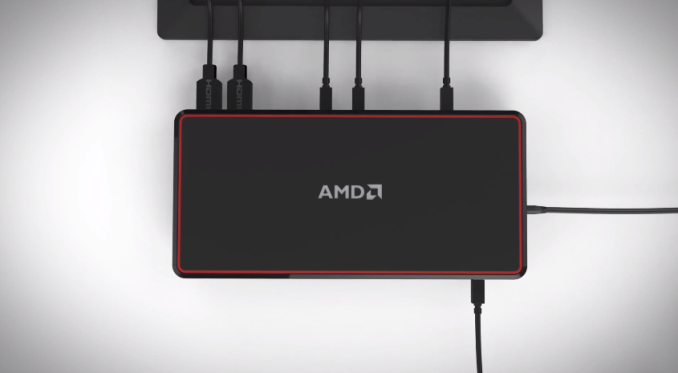
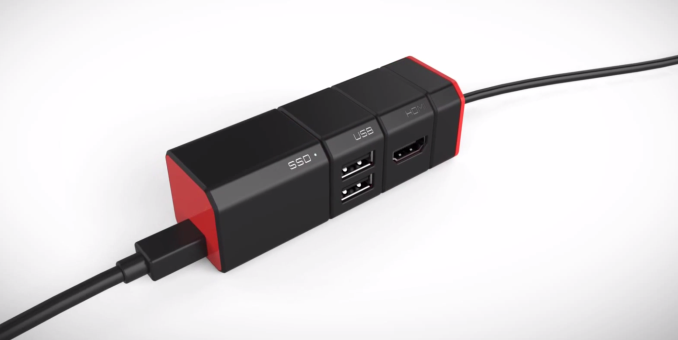
Flying somewhat under the radar, DockPort from AMD is designed to be a low-cost all-in-one solution for external connectivity for a PC or tablet. Sound familiar? Like Thunderbolt familiar? This is AMD’s solution to the issue of connectivity, using the DisplayPort connector to transfer USB information as well as audio/visual. Not a lot has been said about DockPort, despite originally being given a name sometime in 2012, but since CES 2014 has been adopted as an official DisplayPort standard extension by VESA with a finalized standard expected in Q2. With the combination of DisplayPort and USB 3.0 over a single cable, AMD’s video explains it best how it can be used:
To list the possible uses: Basically this is everything USB can do, including video stream via DisplayPort, albeit in a single interface that is already standard across many systems and form factors. AMD have not specified what extra hardware is needed beyond DisplayPort compatibility (presumably the next iteration of the DisplayPort standard) or whether this extension is just for limited use with a bridge chip. DockPort verified cables will be needed, and no idea on the cost of those this early in the development cycle, or whether the standard will be roped into DisplayPort fundamentally. The main competition is of course with Intel's Thunderbolt, where one of the features I am most looking forward to is Graphics over TB. That will not be possible with DockPort, but it will try to do everything else it seems, although it does seem to suggest that DockPort will be limited to USB 3.0 for any data-related daisy chaining, unless AMD have an ace up their sleeve. I would imagine AMD would tie this technology into their desktop motherboard line, as well as their SoCs, when it is ready which might increase adoption rates faster than Thunderbolt. Having both interfaces use a similar sort of connector asks the question whether the two interfaces might be coherent in the same output/input, making future devices (namely storage) able to use both in one connector rather than have specific DockPort/TB inputs. This is still early days, given the computer generated nature of AMD’s video. Computex is still several months away – we might see an real world update then. Looking forward to it…!

 | ||
| 12:00p | The AMD Radeon R7 265 & R7 260 Review: Feat Sapphire & Asus The launch of the Radeon R7 250X earlier this week and today the Radeon R7 265 are part of a larger refactoring of AMD’s mainstream desktop product family. AMD is cutting prices and launching new products both to maintain and enhance their competitive position, and to fill holes in their lineup – however small – to cover as many price points as possible. The end result is that along with a price cut for the existing R7 260X, which will see AMD’s flagship Bonaire part drop to $119, AMD is also using this time to launch parts above it and below it in order to fill the holes this refactoring is creating. A key part of that refactoring strategy will be today’s launch of the Radeon R7 265. With R7 260X dropping to $119 and R9 270 holding at $179 (MSRP), AMD has a $60 gap that needs to be filled with a new product, and R7 265 is that product. Based on AMD’s venerable Pitcairn GPU, R7 265 will be filling this gap by bringing a variant of the Radeon HD 7850 back to the market, creating a 3rd tier Pitcairn product for the 200 series. Compared to the 7850 that it’s based on, R7 265 is receiving the same GPU clockspeed and memory clockspeed bump that the 7870-derrived R9 270 series saw last year that will make the R7 265 a bit faster than the 7850 it functionally replaces and making it better suited to fill the gap between the R9 270 and R7 260X. 
| ||
| 7:00p | Nanoxia Deep Silence 6 Review We've reviewed a few of Nanoxia's cases already, and they've done well overall. Today we're looking at their latest and grandest creation, the Deep Silence 6. As the name implies, this is the sixth case that Nanoxia has designed and it's targeted towards a very specific segment of the market, namely hardcore enthusiasts and advanced users that might want a gigantic case. How does Nanoxia fare when you take their core design and "super size" it? Read on for the full review. 
|



| << Previous Day |
2014/02/13 [Calendar] |
Next Day >> |