[Most Recent Entries] [Calendar View]
Thursday, February 20th, 2014
- “The processor supports two 2011-land, 40-mil pitch organic flip-chip LGA package options”
- Mini HDMI
- 4K and Triple Display via miniDP
- M.2 and 2.5” drive options
- USB 3.0 ports
- WiFi and Bluetooth built in
- Replaceable lids for NFC and Wireless Charging
| Time | Event | |||||||||||||||||||||||||||||||||||||||||||
| 9:00a | AMD Center Giveaway: ASUS Radeon R7 250 Lately there's been a lot of excitement around value video cards. Part of it is due to the simple fact that for low resolution gaming, you can generally approximate the experience of a modern game console with fairly low end hardware. Late last year AMD announced its Radeon R7 250, an Oland based part priced at $89 for the value discrete market. The R7 250 also serves as an interesting Dual Graphics/CrossFire option for Kaveri users looking to increase the performance of their processor graphics (we'll have a look at this later this month). AMD wants to give a bunch of these R7 250s away to users who can really use them. This week we're giving away three Radeon R7 250s from ASUS to three lucky readers. Here's the deal. To enter, simply post a comment below (US residents only, please only make a single post, contest requirements below) explaining your current PC setup and why you want, or need to win a Radeon R7 250. What I'm looking for here is an understanding of what your current system configuration is, why the Radeon R7 250 matters you and how you'd use it. Make your entries good as they may come in handy for some other stuff we've got planned in the future. If your entry from last time still applies, feel free to re-use it. If you win, AMD wants your feedback on the GPU after you get it. You'll be asked to provide a short review (a paragraph or two, or video if you'd like) talking about your experience with the card. Do a good job and your feedback may even be featured on AnandTech.
| |||||||||||||||||||||||||||||||||||||||||||
| 9:45a | Intel’s Three Versions of Socket 2011, Not Compatible
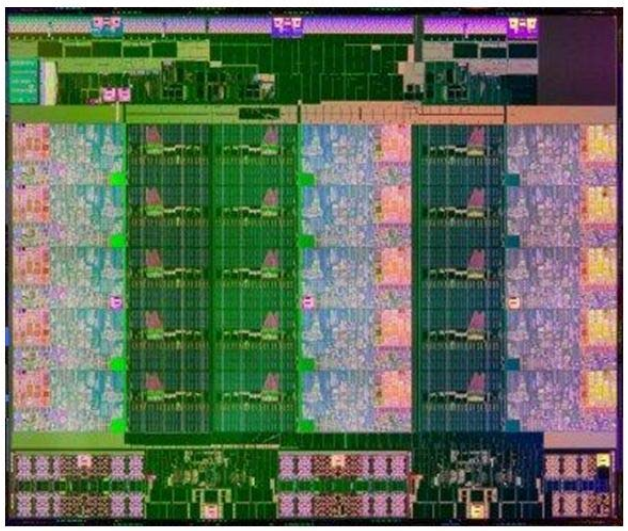
With our recent discussion regarding Intel’s launch of the 15-core Xeon E7 v2 ‘IvyTown’ processors, thoughts for a lot of high end consumers focused on the underlying hardware for these 4P and 8P systems that would be entering the market. Previously with high end systems there has been a disjunct between the sockets used for the mainstream 1P and 2P processors (-E and -EP) compared to the higher end 4P/8P models (-EX). For example:
With Nehalem/Westmere, the single socket Bloomfield Xeons were LGA 1366.
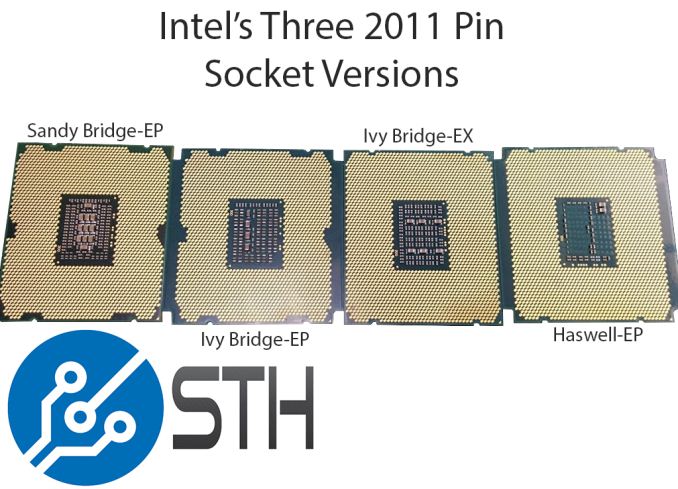
With Sandy Bridge-E/Ivy Bridge-E, the single socket Xeons are LGA 2011. Reported images of Haswell-EP Xeons also point to LGA 2011, but different again. Back at ISSCC, when we reported about the talk around the new IvyTown based processors, we lifted the following line from the official documentation: This produced speculation to whether the processor package for EX would be the same as EP, despite a reconfigured memory controller, additional QPI links and a different pin layout. Given at the time we were under NDA we could not mention they were different, but some investigative work from Patrick at ServeTheHome answers a lot of questions. Simply put, Ivy Bridge-EP, Ivy Bridge-EX and Haswell-EP all have LGA2011 designations (officially FCLGA2011, for flip-chips), but have different physical mountings in the socket:
Despite the contact patches/‘wings’ on Ivy Bridge-EP, it will fit in the Sandy Bridge-EP socket – the issue is more the pins on Ivy Bridge-EX and Haswell-EP, where on the left and right it is more ‘filled in’, as well as at the corners. The notches for the processors (the indents on the top and bottom) are also different, moving to Ivy Bridge-EX. The Ivy Bridge-EX and Haswell-EP processors look very similar from these images, despite the extra wings on the Haswell-EP. The key here is the bottom right of the two processors, and count the number of pins between the notch and the edge – Ivy Bridge-EX has four, Haswell-EP has six. All in all, this may not much of anything – users spending thousands on processors should be making sure that the motherboards they buy have the processor they want listed in the QVL (Qualified Vendor’s List). My concern might be users thinking they can drop a Haswell-EP Xeon into an Ivy Bridge-E, and then trying to force it when it might not fit. Back in previous eras (socket 775 comes to mind) this was an even bigger issue – the processors might fit, but the processors that a motherboard could take was determined by the chipset used by the motherboard manufacturer and the QVL. At least this way the CPUs will not physically fit, but it is something that confuses the situation – it might be worth doing some clever renaming (LGA2011-EX, LGA2011-H), at least from an editorial point of view for the future. Source: ServeTheHome | |||||||||||||||||||||||||||||||||||||||||||
| 6:05p | Broadwell NUC Roadmap Revealed
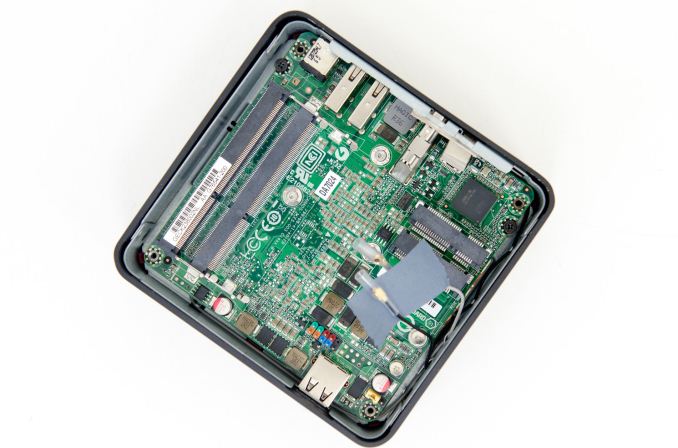
The Next Unit of Computing (NUC) from Intel is becoming a part of the PC roadmap like never before. Anand reviewed the first generation of the NUC, the DC3217BY, featuring a dual core Ivy Bridge ULV CPU (Core i3 3217U, 17W TDP, 1.8 GHz, HD 4000). Ganesh got the Haswell NUC, the D54250WYK, with a dual core Haswell CPU (Core i5-4250U, 15W TDP, 1.3 GHz/2.8 GHz Turbo + HD5000), as well as the GIGABYTE BRIX Pro, with a full on quad core Haswell CPU (Core i7-4770R) featuring Crystal Well and Iris Pro HD 5200 graphics. The next batch in line will be the Broadwell models, and the road maps for these have just become available courtesy of FanlessTech.
On the consumer side, we have the DN2820FYKH Bay Trail platform coming out in Q1 2014, under the Forest Canyon code name. This gives a Celeron CPU, HDMI, USB 3, 2.5” drive support, an Ethernet port and infra-red/audio capabilities. For Q4 2014, the Broadwell NUCs should be upon us. If this roadmap is correct, we should expect an i3 and an i5 kit to come to market, under the Rock Canyon code name. Features for Rock Canyon include: The M.2 connectivity is welcomed, although the replaceable lids might not matter much if a NUC is used in a VESA mount – hopefully there might be a way to run the lid connected to the system via a cable and just resting on the desk. No formal mention of the format of the WiFi connectivity, although as it is now mentioned as part of the kit and built in, hopefully this will be at least a 2T2R 802.11ac solution given we now see it on $150 Intel 8-series motherboards. Also available is the commercial roadmap, which lists a series of different products:
Using the Maple Canyon code name, the Broadwell commercial NUC is aimed more at a late Q4 launch. Using the Broadwell i5 and vPro with Trusted Platform Module support, this kit mirrors the Broadwell NUC in the consumer line up (4K, M.2, NFC, USB 3.0) although with two miniDP ports for connectivity. For Atom, starting in Q1 2014 we have the DE3815TYKHE and DE3815TYBE. These are fanless Atom SoCs based on Bay Trail, using 4GB of eMMC as well as HDMI, VGA, eDP and support for legacy IO. The aim here is embedded solutions, such as digital signs and kiosks.
Source: FanlessTech | |||||||||||||||||||||||||||||||||||||||||||


| << Previous Day |
2014/02/20 [Calendar] |
Next Day >> |