[Most Recent Entries] [Calendar View]
Tuesday, March 11th, 2014
| Time | Event |
| 1:15a | NZXT Kraken G10 Review: Liquid Cooling for Your GPU Liquid-cooling is nothing new in the world of computers; enthusiasts first started creating custom water cooling setups back in the 80486 era, and even prior to that some mainframes used liquid-cooling. Due to their cost and complexity however, such cooling solutions often do not appeal to a large portion of users. With the advent of of closed loop, ready-to-run liquid-cooling kits from Asetek and CoolIT a few years back, however, liquid-cooling is now significantly less costly and complex. Today, the cooling solutions of both these two OEMs are being marketed by several brands and are becoming increasingly popular among all classes of users. Today we have NZXT's Kraken G10 GPU cooler; read on to see how it performs relative to the stock air-cooling solutions. |
| 7:25a | CeBIT 2014: MSI Shows New Intel Motherboards, R9 270X Gaming ITX
While we do not have anyone on the floor of CeBIT this year, manufacturers are showcasing several new products worth mentioning between now and Computex in June. MSI has sent over their EU contingent with a few new interesting products worth a mention and came back to us with an image deck. First up is the next in the line of mini-ITX sized graphics cards: the R9 270X Gaming ITX:
As with the GTX ITX cards we have seen from ASUS and MSI, MSI has transplanted the idea into the AMD range on the latest R9 2xx series. The GPU will feature a 1000 MHz core frequency, with 1050 MHz boost, along with 6GB GDDR5 (!?). The card in the image that says 6144 MB, which feels incorrect – MSI has some high memory capacity cards (4GB GTX 630 for example) but 6GB does seem like overkill. The card will have DisplayPort, HDMI 1.4 and dual DVI-I ports. Length for these cards is limited to 17cm, compliant with mITX specifications. Also on display are some images of upcoming Intel motherboards. These might be related to the release of the Haswell CPU refresh we reported on recently:
There is not much to see – these motherboards must be in the final design stages before mass production. There are clearly M.2 slots on all the motherboards, suggesting the move away from mSATA based connectivity. It is hard to say if these are powered by one PCIe lane or two. There are a few ASMedia controllers dotted around, which look to be additional USB 3.0 ports or hubs. I have asked MSI for higher definition images and will update if we get some! Source: MSI |
| 8:00a | Xirrus to Offer Low Cost 2x2 802.11ac Upgradable Enterprise AP
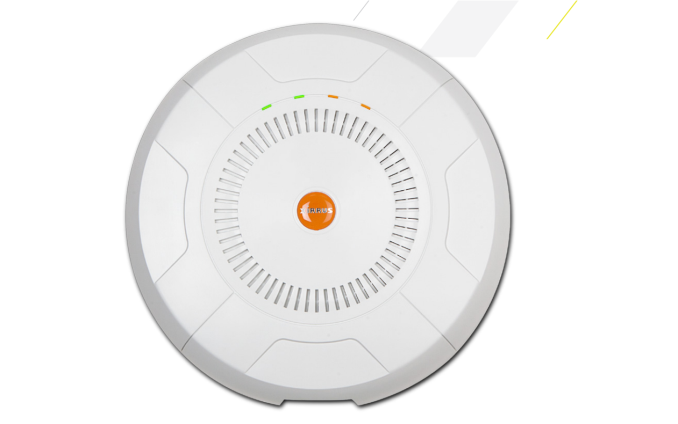
A good number of companies play in the enterprise Wi-Fi market: Aruba Networks, Ubiquiti and Ruckus Wireless to name a few. Enterprise Wi-Fi looks at markets that have dense casual user access but high levels of management therein, such as hotels, dormitories, hospitals, waiting rooms, office spaces and retail areas. Last year Ganesh reported on Ubiquiti’s initial Enterprise Wi-Fi AP offering, and a year further down the line Xirrus got in contact regarding their 802.11ac AP line. Xirrus’ offering comes from the point of view of upgradeability – buy an 802.11ac access point at 802.11n prices, but further down the line pay for a software update to enable 802.11ac access. This method of delivering data would allow businesses to upgrade without the need to replace hardware as well as spread the cost of network upgrading. The main product Xirrus got in contact with us about is the new XR-620 Access Point, designed to be the lowest-cost 2x2 802.11ac enterprise solution on the market. This system is based off a Qualcomm Atheros SoC, and due to the dual stream nature the device is capable of 867 Mbps per radio. This is compared to Xirrus’ 3x3 XR-630 that can manage 1.3 Gbps per radio. The AP will have dual radios for 2.4 GHz/5GHz or dual 5 GHz operation, and be suitable for up to 240 concurrent users with four integrated antennas. While there are two gigabit Ethernet points (802.3ad / link aggregation compatible), cloud based management comes part of the solution as well. The XR-600 series comes with intruder detection and prevention systems with zero touch provisioning.
Administrators controlling the AP will have access to Xirrus’ Application Control. This software uses Layer 7 deep packet inspection to prioritize access of certain applications over others, with 1200+ applications being monitored. While not explicitly mentioned, Xirrus does have dedicating meshing support on the 620. Xirrus are bringing the XR-620 into the market at $675, with availability in March. Source: Xirrus |
| 4:00p | Valve Publically Releases "ToGL" Direct3D-to-OpenGL Shim
Though firmly rooted in the Microsoft technology camp for much of their history, in the past few years Valve has been expanding their reach to additional platforms and technologies. This started with porting their own games to OpenGL based OSes – first Mac OS X and later Linux – and of course more recently their efforts in rolling their own Linux distro with SteamOS. Throughout all of these processes Valve has been relatively open about what they’re doing and how they’re doing it, and this week they’re getting a bit more open on the API side. Posted this week to GitHub, Valve has released the source code behind their “ToGL” shim to the public. ToGL is the translation layer Valve uses to bring OpenGL support to their games, essentially emulating a limited subset of the Direct3D 9.0c API and translating those calls to OpenGL. It is implemented within the game binary itself (this isn't an external wrapper), so this is primarily a tool for game developers. And although not particularly common, translation layers such as ToGL and even bigger full-on wrappers are often used to bring big budget multiplatform games to OpenGL platforms, as the PC ports of many games are still primarily coded against Direct3D and native OpenGL renders are sparse. This release of ToGL comes from Valve’s latest game, DOTA2, with Valve pulling ToGL directly from said game’s source tree. Valve’s release notes, though short, give us a quick idea of just how large of a subset of Direct3D 9.0c ToGL supports. Since it’s not a full Direct3D 9.0c implementation, only part of Shader Model 3 is offered; multiple render targets (which are heavily used these days) are supported, while vertex texture fetch is not. Meanwhile we can see that Valve has been doing shader translation (HLSL-to-GLSL) at a bytecode level, rather than doing the translation at a higher level. Finally, though Valve’s notes don’t specifically state why they’re releasing ToGL to the public at this time, it’s readily apparent from their releasing it in open source form and their choice of license that they’re looking to spur further Mac OS X and Linux ports of games. By opening up ToGL to other developers and making it free to use via a BSD-style license, developers building games targeting Direct3D 9.0c have an avenue for making the porting of the graphics layer significantly easier. Though with that in mind, it remains to be seen just how productive it will be to release a Direct3D 9 shim at this point in time. With Windows XP’s retirement next month, all supported versions of Windows will support Direct3D 11 (feature levels not withstanding), so the number of games being written against Direct3D 9 will be low. On the other hand this would still greatly speed the porting of older games, which could help to further build up the list of games available on SteamOS. |
_575px.JPG)


_thumb.JPG)
_thumb.JPG)
_thumb.JPG)
_thumb.JPG)
_thumb.JPG)
_thumb.JPG)


| << Previous Day |
2014/03/11 [Calendar] |
Next Day >> |