[Most Recent Entries] [Calendar View]
Monday, May 26th, 2014
| Time | Event | ||||||||||||||||||||||||||||||||||||||||||||||||||||||||||||||||||||||||||||||||||||||||||||||||||||||||||||||||||||||||||||||||||||||||||||||||||||||||||||||||||||||||||||||||||||||||||||||||||||||||||||||||||||||||||||||||||||||||||||||||||||||||||||||||||||||||||||||
| 3:00a | HTC One mini 2 Review Last year around this time, HTC had yet to release a mini version of their flagship phones. As OEMs continued to push bigger and bigger displays into bigger phones, there was a distinct push for a phone that had flagship specifications, but without the size that normally entailed such flagship specifications in the Android space. HTC then proceeded to launch the One mini, a phone that was the size that everyone had been asking for, but just wasn’t the same as its larger cousin. While there are now phones around the size of the One S that have flagship specs, the One mini was a distinctly midrange device, with a number of concessions made to reach a midrange price. Of course, that was the past. Today we’re looking at the successor to the One mini. Unfortunately, for those that want everything in a One (M8) repackaged to fit into a phone the size of a One S, this is not that phone. However, the bigger question is how well this phone fits into the mid-range spectrum, and how well it compares to the competition. To this end, HTC seems to hope that better design and the halo effect from the One (M8) will differentiate the One mini 2 from the rest of the competition. To find out how well it did, read on for the full review. | ||||||||||||||||||||||||||||||||||||||||||||||||||||||||||||||||||||||||||||||||||||||||||||||||||||||||||||||||||||||||||||||||||||||||||||||||||||||||||||||||||||||||||||||||||||||||||||||||||||||||||||||||||||||||||||||||||||||||||||||||||||||||||||||||||||||||||||||
| 12:26p | AMD Publishes Mobile Kaveri Specifications
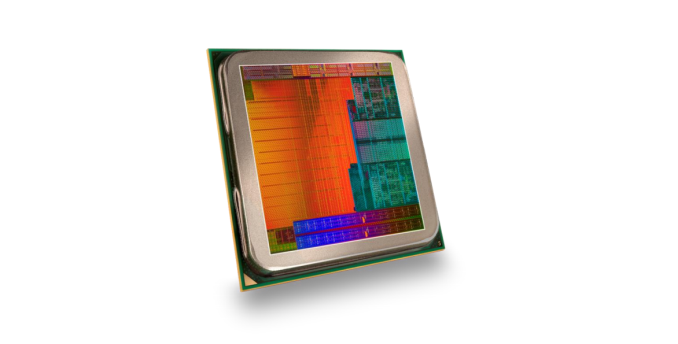
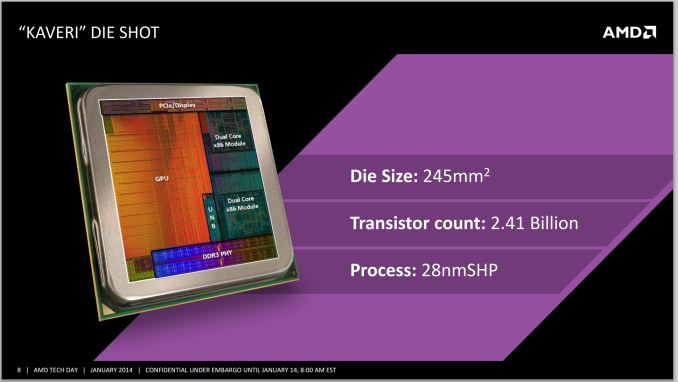
In an unexpected (and likely erroneous) move, AMD has published the specifications for their forthcoming mobile Kaveri APUs on their website this morning (scroll down and click on Model Comparisons and Product Specs, Update: they've since been pulled. Screenshot here). Kaveri, AMD’s latest generation high-performance APU, was of course first released on the desktop back in January of this year. Since then we have been eagerly awaiting the release of its mobile incarnation – which has been scheduled for H1 2014 for some time now – as mobile has traditionally been a stronger play for AMD due to the significant GPU performance of their APUs coupled with the space benefits of an integrated GPU versus a discrete GPU. Mobile of course is not without its challenges. Power is paramount, and while AMD has always been able to meet their desired TDPs, there is always the question of what kind of performance tradeoff will come with those TDPs. At the same time there is stiff competition from Intel as always, and mobile begins to approach the range of non-x86 devices such as tablets and ARM based Chromebooks.
In any case, almost exactly a year after the launch of mobile Richland, AMD is back with mobile Kaveri. Kaveri will bring with it a number of improvements, including the higher performance Steamroller based CPU cores and modern GCN based GPUs. AMD will be going up against Intel’s existing mobile 4th generation (Haswell) products, with mobile Kaveri representing AMD’s best chance to claw back market share from the Haswell family. As a quick disclaimer, while AMD’s website team is no stranger to accidentally posting product specifications early, they are also not always accurate. The specifications listed on AMD’s site appear to be correct – there are no noticeable flaws in the specs – but until mobile Kaveri formally launches these should be taken with a grain of salt.
Starting at the low-power end of the spectrum we have AMD’s 17W APU, the A6-7000. This is AMD’s only 17W mobile Kaveri part (Richland had 2), and as one would expect for a 17W part the A6-7000 is a rather lean chip. Featuring just one Steamroller module and 192 GCN steaming processors, the A6-7000 ships with a base/turbo CPU clockspeed of 2.2GHz/3.0GHz, while the GPU turbo clock stands at 553MHz. Compared to the previous generation Richland processors, the A6-7000 gains all of Kaveri’s architectural improvements along with an additional 200MHz for its CPU’s turbo clockspeed. GPU clockspeeds on the other hand take a hit, but this is offset by GCN’s greater performance and a badly needed increase in the maximum DDR3 memory clockspeed. In fact with mobile Kaveri, DDR3-1600 is now the baseline, with all processors supporting 1600 or better.
The next step up is AMD’s 19W APUs. These products gain a second Steamroller module and better GPUs in exchange for higher power consumption. Among these we have the A8-7100, A10-7300, and FX-7500. Yes, AMD’s FX branding is back, and this time it’s being used in the mobile space to represent the class of products beyond A10. The inconsistency is, well… inconsistent compared to the A[number] branding, but at least the product numbers are consistent. On the CPU side all 3 products are closely clustered together, differing by just 300MHz. This puts the A8-7100, A10-7300, and FX-7500 base and turbo clockspeeds at 1.8GHz/3.0GHz, 1.9GHz/3.2GHz, and 2.1GHz/3.3GHz respectively. At the high end this is a rather significant step up in clockspeeds, besting the Richland based A8-5545M by as much as 400MHz for the base clockspeed and 600MHz for the turbo clockspeed. Meanwhile the A8-7100 gets a 256 stream processor GPU while the other SKUs get 384 stream processor GPUs, each of which is also clocked higher. Memory bandwidth willing – and again everything gets a bump to DDR3-1600 here – based on these specifications there should be a pretty significant step up in GPU performance between the A8-7100 and A10-7300.
Finally we have AMD’s 35W APUs. With mobile Kaveri AMD has seemingly done away with their 25W APUs, making 35W the next tier beyond the 19W APUs. 35W sees 3 more APUs, the A8-7200P, A10-7400P, and FX-7600P, with all 35W APUs using the P suffix to indicate that they’re 35W parts. Shipping at 2.4GHz/3.3GHz, 2.5GHz/3.4GHz, and 2.7GHz/3.6GHz respectively, compared to AMD’s previous top tier mobile Richland APUs clockspeeds haven’t changed very much, meaning the greatest gains are going to come from architectural improvements, including any ability to turbo for longer periods of time. On the GPU side each APU comes with a different GPU configuration, using 256, 384, or 512 stream processors respectively. With GPU clockspeeds topping out at 686MHz this is once again a small step back from Richland, but should more than be made up for with GCN’s architectural efficiency and at the high end the overall increase in SPUs. That said, feeding these increasingly powerful GPUs becomes an increasingly more difficult task, which is why maximum memory clockspeeds are up to 1866MHz for the A8 and A10, and meanwhile the FX processor goes one further to 2133MHz. Given just how hard it is to feed a fully enabled APU like the FX-7600P – a problem we’ve already seen on the similarly configured desktop SKUs – the memory bandwidth increase is a welcome sight. Moving on, along with these APUs AMD’s specification tables also list a smaller number of “Pro” variants, the A10 Pro-7350B, A8 Pro-7150B, and A6 Pro-7050B respectively. These APUs are apparently equivalent to the FX-7500, A10-7300, and A6-7000 respectively. The pro branding is new to an AMD APU, and AMD’s product site does not go into any detail over what makes these parts different than their standard APUs. Also of note, AMD has listed what feature differences we can expect between the various tiers. Eyefinity and TrueAudio support will be limited to the A10 APUs; the A8 APUs lose this functionality, and the A6 loses Dual Graphics functionality. On the other hand only the A6 APUs get ARM TrustZone functionality, whereas the higher-end A8, A10, and FX APUs do not. Wrapping things up, the impending launch of mobile Kaveri APUs will serve to finish fleshing out AMD’s 2014 mobile APU product lineup, forming the high-performance counterpart to AMD’s recently launched Beema APUs. Ultimately there’s not a whole lot we can say about performance (especially competitive performance) from a specifications table alone, but this at least gives us an early glimpse of what AMD intends to deliver with mobile Kaveri in the near future. | ||||||||||||||||||||||||||||||||||||||||||||||||||||||||||||||||||||||||||||||||||||||||||||||||||||||||||||||||||||||||||||||||||||||||||||||||||||||||||||||||||||||||||||||||||||||||||||||||||||||||||||||||||||||||||||||||||||||||||||||||||||||||||||||||||||||||||||||
| 7:00p | NVIDIA GeForce 337.88 WHQL Driver Now Available
Scheduled for release this week is Watch Dogs, Ubisoft’s heavily promoted open world techno thriller. As is often the case with these high profile AAA games, NVIDIA and AMD's GPU driver teams have been hard at work putting together their launch drivers for this game, which means this week should be a busy week for driver releases. The first party out of the gate is NVIDIA, who today is releasing their 337.88 WHQL “game ready” driver. The bulk of NVIDIA’s emphasis with this driver is of course on Watch Dogs compatibility and performance, especially since NVIDIA has been including it as a bundled game since late last month. Along with the bundle Watch Dogs is also NVIDIA’s latest technology showcase title – implementing a few enhancements from NVIDIA’s GameWorks libraries including TXAA anti-aliasing and HBAO+ – so the company is eager to back their latest showcase, even going so far as to publish an extensive Watch Dogs performance and tweaking guide over on their GeForce.com portal. Watch Dogs aside, NVIDIA has also worked in a few smaller additions with 337.88 that should be of interest to GeForce owners. As the first WHQL drivers from the R337 branch, these are the first WHQL drivers to incorporate all of the performance improvements we first saw last month with 337.50, with a significant focus on cutting down on CPU overhead. NVIDIA notes that they’ve worked in some further performance optimizations since then, though they do not specify what those optimizations are or how they are different from what they already did with 337.50. If nothing else it looks like NVIDIA has updated a number of game profiles for SLI, adding or tweaking support for multi-GPU configurations.
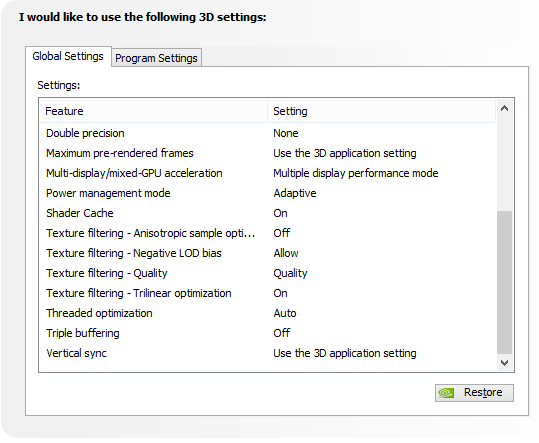
Meanwhile we finally have an official description for the shader cache feature first introduced in the 337.50 drivers. At the time NVIDIA was not talking about the feature, but they have now published a more through explanation, stating that the shader cache setting is designed “to reduce CPU usage by saving compiled shaders to a disk cache. This may improve performance and reduce the time it takes for a game to load.” This setting is enabled by default. Finally, GeForce owners will be happy to hear that NVIDIA is addressing a number of display issues with 337.88. Single-tile (SST) 4K displays such as the Samsung U28D590D are now fully supported in NVIDIA’s drivers; previously only multi-tile (MST) displays were supported, whereas in the long run multi-tile displays will eventually give way entirely to single-tile displays now that the necessary controllers are now available. NVIDIA has also fixed a number of surround issues, including surround problems on GTX Titan Black and 3/4-way GTX 780 Ti configurations. As usual, you can grab the drivers for all current desktop and mobile NVIDIA GPUs over at NVIDIA’s driver download page. | ||||||||||||||||||||||||||||||||||||||||||||||||||||||||||||||||||||||||||||||||||||||||||||||||||||||||||||||||||||||||||||||||||||||||||||||||||||||||||||||||||||||||||||||||||||||||||||||||||||||||||||||||||||||||||||||||||||||||||||||||||||||||||||||||||||||||||||||

| << Previous Day |
2014/05/26 [Calendar] |
Next Day >> |