[Most Recent Entries] [Calendar View]
Monday, June 2nd, 2014
- Windows Laptop
- Windows Tablet
- Smartphone
- Android Tablet
- Android Laptop
- CI540: $369.99/479.99
- CI520: $309.99/409.99
- CI320: $149.99/259.99
- CA320: 179.99/289.99
| Time | Event | ||||||||||||||||||||||||||||||
| 12:55a | ARM Announces CPU Design Center in Taiwan
As part of Computex 2014, ARM has announced their first CPU Design Center in Taiwan, focusing on the next generation of Cortex-M class cores for IoT and wearables. Initially this will mean 40-50 individuals within the talent pool in 2014 before scaling based on demand. A large part of the press event has been geared towards demand for ARM processors and the segmentation therein, focusing on the uses of Cortex-M within an ecosystem that counts sixteen billion processors shipped into embedded to date.
ARM will be working with research institutes to grow and scale, with the aim to produce important engineers with experience in the field. ARM sees Taiwan as a focal point of the industry with respect to the large number of ARM’s semiconductor partners in the region, hence the choice of the region for their fourth CPU design center. One of the outputs of the new design center, due to the increase of interest in wearables, ARM sees the segment as two main parts – the low end sensor based wearables, and the high power models requiring sensor calculation relating to features such as HUDs, particularly in the professional and medical markets. ARM also mentioned it is developing MBED, a platform for embedded developers incorporating an OS and a system of tools to help bring ideas to fruition. THe platform will be open source, with libraries and web based tools allowing developers to mix and match microcontrollers, radios, sensors and software stacks.
| ||||||||||||||||||||||||||||||
| 1:56a | ASUS Press Event Computex 2014 Live Blog I am here at the ASUS press event at Computex, waiting for the event to start. Just me on text and photos today, stay tuned! | ||||||||||||||||||||||||||||||
| 4:31a | Computex 2014: New Transformer Book V from ASUS
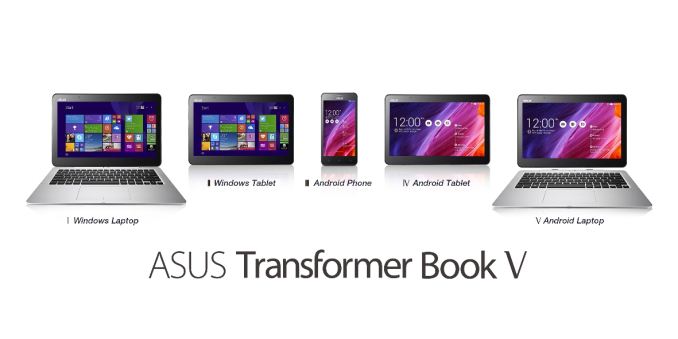
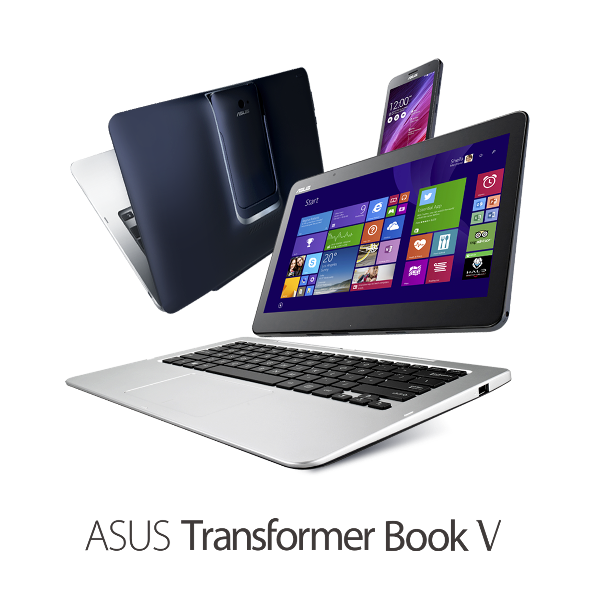
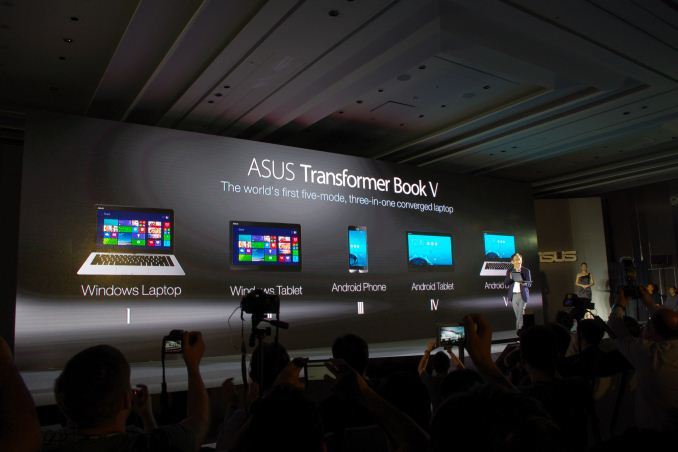
One of the interesting dynamics in the mobile device industry is the integration of several form-factors in the same device. ASUS has been a major proponent in this, with their FonePad, PadFone and Transformer Book. Coupled on top of this is the use of Windows and Android in various forms across the systems, so naturally there should be one device to cover all usage models, right? This is the Transformer Book V, a five-mode capable, three-in-one converged laptop, smartphone and tablet.
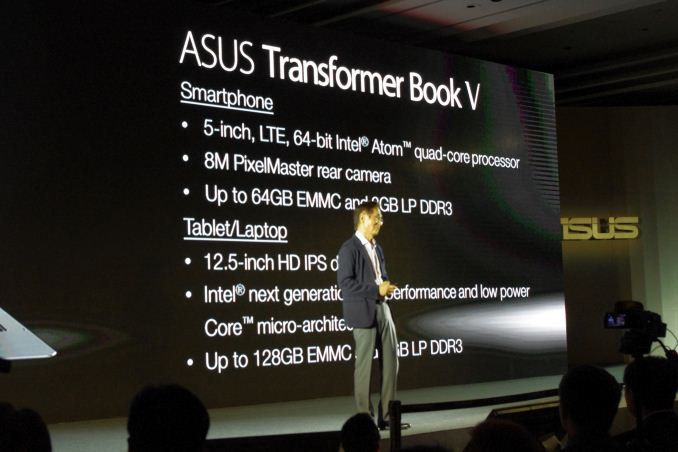
To be clear, the five modes are: The three parts are a 12.5-inch tablet, a 5-inch smartphone that docks into the tablet, and keyboard that also docks into the tablet. The tablet component uses a next-generation Intel Core processor (suggestions are pointing to low-powered Broadwell) with up to 1TB of storage. There was no indication of resolution, but the panel is IPS. The smartphone is a 5-inch LTE device with an Intel Atom quad-core device, powered by Kitkat 4.4 and a 2500mAh battery. Storage is set for 64GB eMMC with 2GB LPDDR3. The tablet segment has 128GB eMMC storage with 4GB of LPDDR3, which suggests that the tablet dock contains the 1TB as a secondary drive. A small button on the tablet helps switch between Android and Windows. Given the suggestion that the device is aimed at Broadwell and the lack of specifications for the resolution, DRAM storage and so on, release would presumably occur based on Intel’s timeframe.
| ||||||||||||||||||||||||||||||
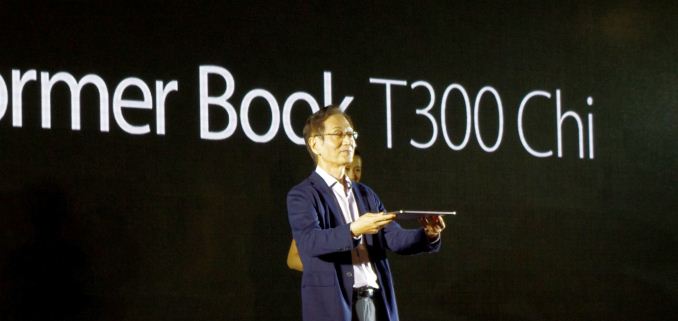
| 9:54a | Computex 2014: Transformer Book T300 Chi from ASUS
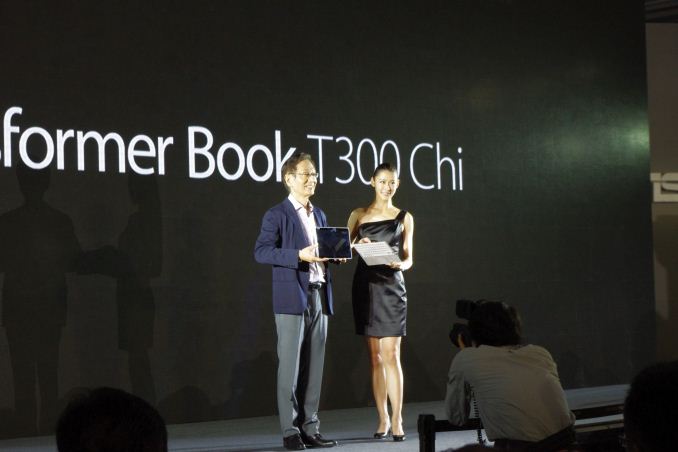
In the myriad of eight announcements from ASUS in the space of 45 minutes at their press conference, one of the new products is the Transformer Book T300 Chi.
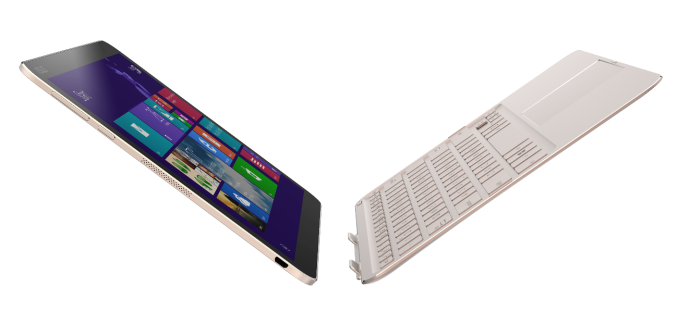
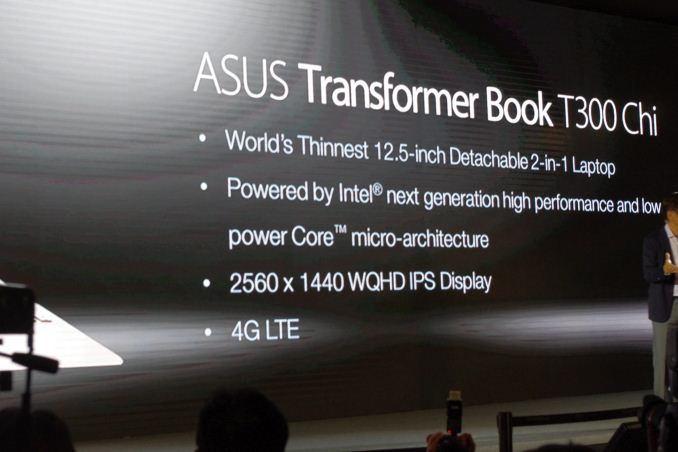
The design is completely fanless, with LTE support and a 2560x1440 IPS display in a 12.5-inch panel. At this current point in time ASUS is only stating Intel next generation CPUs and low power Core micro-architecture, which like the Transformer Book V might but the T300 Chi in the Broadwell timeframe.
ASUS is stating a 7.3mm thickness, although it was not confirmed if this was including the keyboard dock or not. Given that depth, we might suggest that the CPU selection is in the lower half of what is available, but as long as it can drive interactive content on both of the screens, all that matters is the price. I expect we will see more of the T300 Chi around CES time.
| ||||||||||||||||||||||||||||||
| 10:21a | Computex 2014: All new Intel Atom based Fonepad 8, MeMO Pad 7, MeMO Pad 8
Alongside the smartphone element inside the Transformer Book V announced today, it would seem that the Silvermont-based Intel Atom series is pushing more in to the mass market via ASUS, with ASUS’ new announcements today for the Fonepad 8 and the MeMO Pad 7/8 as well. The Fonepad 8 (FE380CG) is the next iterative design on the previous model, essentially a tablet-as-a-phone, this time with an 8-inch 3G connected device sporting a 5.06mm bezel for a 72.2% screen-to-body ratio. The display comes in at 1280x800 IPS, with the CPU quoted as a quad-core Intel Atom Z3580 (1.8 GHz) as well as dual-SIM functionality. My own experience with large phones makes them perfectly fine for calling, but as long as the device can be answered with one hand effectively rather than two, for example when carrying a cup of coffee from the office.
ASUS showcased two new MeMO Pad devices, again both using Intel Atom as the processor. The MeMO Pad 7 (ME176C) is a 64-bit Atom Z3745 quad core device with support for Miracast and NFC. The 1280x800 display in the Pad 7 is an IPS panel, with the dual PixelMaster cameras at 5MP and 2MP. The MeMO Pad 7 will go on sale in Taiwan on June 6th, with other regions being considered.
The MeMO Pad 8 (ME481CL) is a big upgrade over the Pad 7, featuring LTE support, 802.11ac and a quad core Intel Atom Z3580 (2.3 GHz) at the helm. The display is upgraded to 1920x1080, covered with Corning Gorilla Glass 3. The design weighs 299g, is only 7.45mm thick and features a multi-layer coating with non-conductive vacuum metallization technology. Judging by the name of this coating, I would assume that it is a deposition under vacuum that instigates a metal effect, though in order to be non-conductive it would be without metal, unless the deposition of the film is over a metal body.
Both the new FonePad and MeMO Pad will ship with ASUS’ ZenUI, which should feature over 1000 new enhancements. No word on pricing or release outside Taiwan yet, however we will be visiting by the ASUS booth later in the week and I will try and find some more information. | ||||||||||||||||||||||||||||||
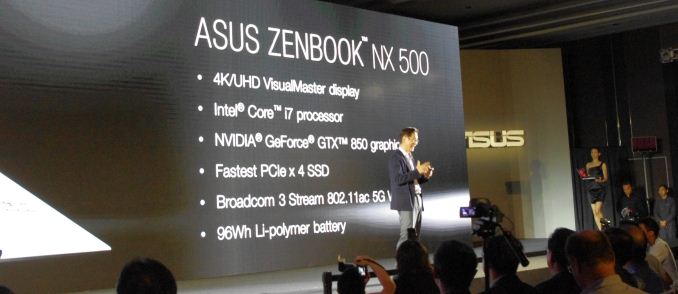
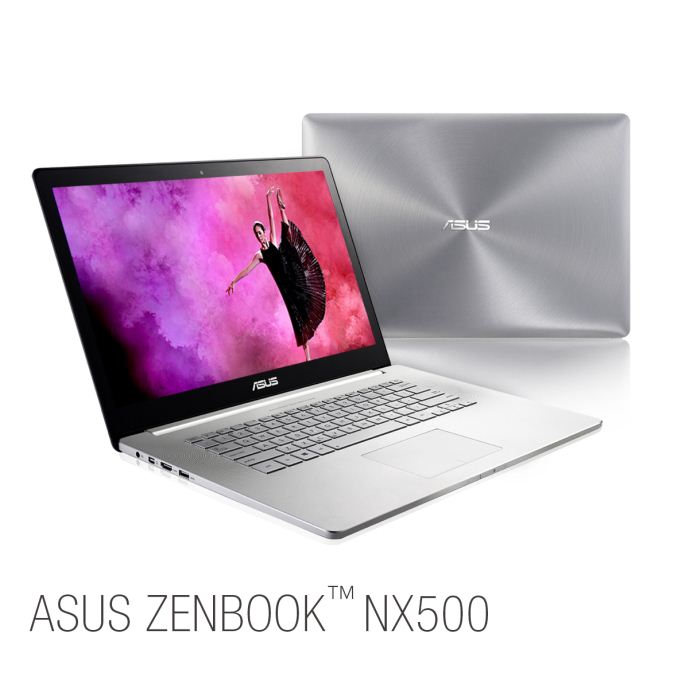
| 10:40a | Computex 2014: The ASUS Zenbook NX500, a 4K/UHD 15.6” Ultrabook
Last year at Computex we were excited by all the news revolving around 4K/UHD monitors coming to market. At that time I believe we were discussing 32” panels and waiting for something smaller to come along. Fast forward a year and that 32” is reduced to 15.6” in the form of an Ultrabook, in the NX500 from ASUS. For specifications, models up to Core i7 and GTX850M graphics were discussed, which marks a shift to discrete GPUs over the Zenbook UX301 we saw last year, which has (only) a 1440p display in a 13” form factor.
The NX500 will also be equipped with a Broadcom 3-stream 802.11ac solution, as well as PCIe x4 or RAID-0 SATA 6 Gbps storage options. The display is reported with a wide color gamut (100% NTSC, 108% Adobe RGB) with a factory calibrated color temperature. Audio gets the Bang&Olufson treatment, with ICEpower and SonicMaster technology over titanium-film speakers. The internal battery is listed as 96 Wh, compared to the 50.6 Wh in the UX301. Again, no official word on actual processor numbers, release date or pricing yet. | ||||||||||||||||||||||||||||||
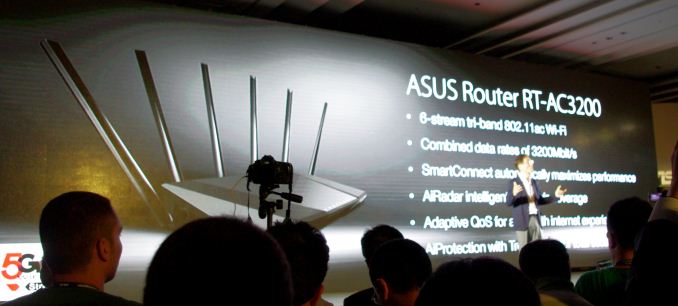
| 11:00a | Computex 2014: The ASUS RT-AC3200, a six-stream 802.11ac Router with MIMO
Part of the market in WiFi communications is calling out for more bandwidth. The advent of high-resolution video and the limitations of gigabit Ethernet mean that in an environment where media consumption is priority, bandwidth is a key element in that equation. Current 802.11ac devices are shipped with either a single or dual stream module (perhaps the odd one with a three-stream), which in return requires a receiver with a similar number of streams as a minimum to have the best connection. So at this point, ASUS has announced the RT-AC3200, a six-stream 802.11ac router capable of up to 3.2 Gbps.
The router also features tri-band MIMO, allowing the device to give full bandwidth to more than one device at a time as well as act as a repeater. Additional features on the router include beam-forming to strengthen connectivity, SmartConnect to adjust to the best band for clients and Adaptive QoS for traffic optimization. AiProtection with Trend Micro will provide protection from external attacks, and the RT-AC3200 is accessed via the ASUSWRT interface. As the number of streams increases in routers, what I would like to see is a similar increase in devices that use 802.11ac WiFi, especially in the desktop PC segment. This could be either as a PCIe card or as a built-in module, however someone will have to design a smart antenna in order to incorporate the whole thing at the rear of a desktop. Everyone loves knowing pricing and availability, which I hope to obtain later this week when visiting the ASUS booth. | ||||||||||||||||||||||||||||||
| 11:00a | Zotac Launches Fanless ZBOX C-Series mini-PCs
At Computex 2014, Zotac has launched four new passively-cooled mini-PCs. All of these C-series units are sized the same as Zotac's existing ZBOX nano lineup (127 mm x 127 mm x 45 mm). Compared to the U-series CPUs used in the current crop of NUC-type mini-PCs, Zotac has gone in for the Core-Y series members in their flagship models. The Core-Y series have a 11.5W TDP (and a 6W SDP), which make them ideal for passively cooled designs. The ZBOX C-series lineup also includes a Celeron N2930 model as well as an AMD A6-1450 APU model (which integrates an AMD Radeon HD 8250). As usual with Zotac, the PLUS series members come with 4GB of DDR3L memory as well as a 2.5" 64GB SSD. The details of the four different C-series members are provided in the picture below.
The galleries below show us the chassis design and available I/O for the Intel-based C-series models and the AMD-based C-series model respectively.
Gallery: Zotac ZBOX C-Series: CI540 nano
     
Gallery: Zotac ZBOX C-Series: CA320 nano
      Pricing for the four models has also been announced (barebones/PLUS format, in USD): | ||||||||||||||||||||||||||||||
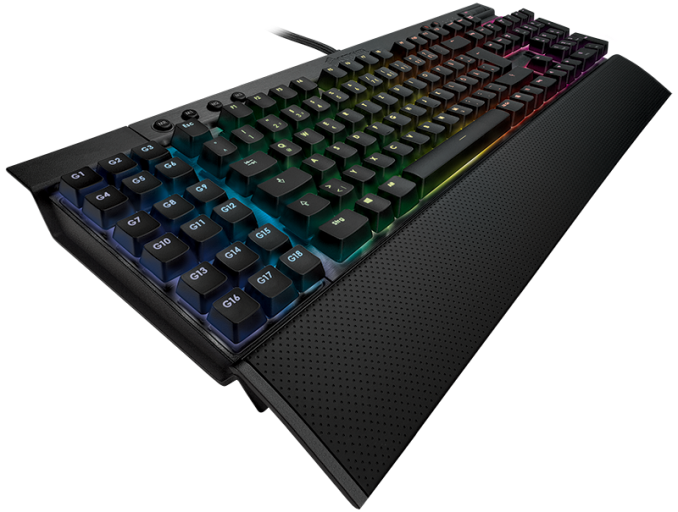
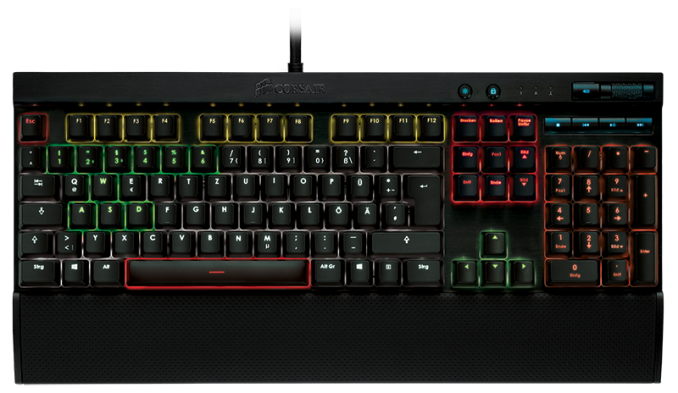
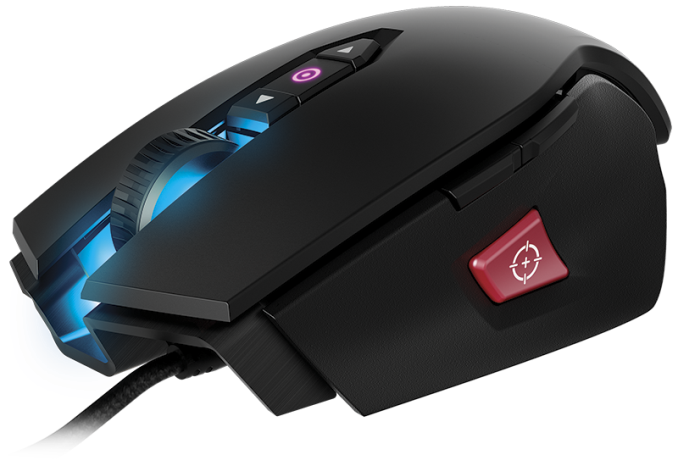
| 11:44a | Corsair Launches K70 and K95 Cherry MX RGB Keyboards, M65 RGB Mouse We initially covered Corsair’s preview of their Cherry MX RGB project at CES, but today Corsair is formally announcing their Cherry MX RGB range: two mechanical keyboards and a mouse. All three bring customization in the form of 16.8 billion colors, and will be coming to market in the late July to August timeframe. They keyboards are modified versions of the K95 and K70, both offering per-key lighting. The K95 is fully equipped with 18 macro keys with presets for 108 different combinations as well as 100% anti-ghost, full key rollover and a 1000 Hz reporting rate. The construction of the keyboard is in aircraft-grade black anodized aluminium, and Corsair offers a 2 year warranty. MSRP is set at $190 and the K95 will be available in red switches only.
The K70, one of the most popular mechanical keyboards on the market, follows the design of the K95 without the macro keys but will also be available in red, blue and brown mechanical key switches. The MX Red version will be available first in late July, with Blue and Brown coming in late August. MSRP for this non-macro version will be $170, with a similar 2-year warranty.
In the RGB lineup it makes sense to include a mouse, and Corsair has fitted its M65 with tri-zone RGB lighting for a full 16.8 million color customization. The aluminium unibody shell uses an 8200 DPI laser sensor with an adjustable weight system for personal preference and play style. The mouse also has eight programmable buttons as well as a dedicated sniper button. On the fly DPI switching is also possible. The M65 RGB will be available late August at an MSRP of $70.
Gallery: Corsair RGB
      | ||||||||||||||||||||||||||||||
| 12:21p | Apple WWDC 2014 Live Blog We are at Moscone West in San Francisco for Apple's World Wide Developer Conference. Our live blog begins at 10AM PT/1PM ET. | ||||||||||||||||||||||||||||||
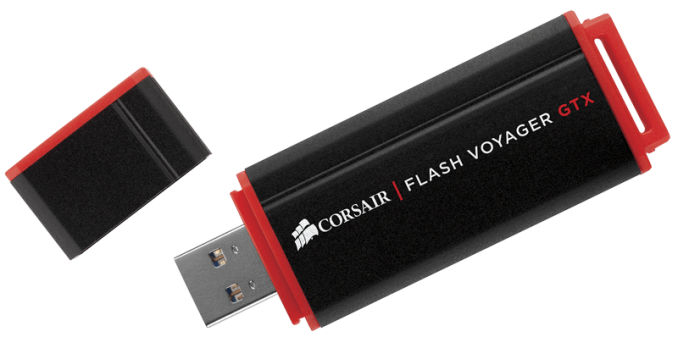
| 12:27p | Corsair Flash Voyager GTX Promises SSD-Level Performance
When you need an easy way to carry around a bunch of data you generally have two options: for fast storage you need an SSD with some sort of USB 3.0 (or eSATA) adapter; otherwise you’re stuck with a small and portable USB stick that likely has much lower overall performance. There have been a few companies offering faster USB stick alternatives, but of course the price tends to scale rapidly. Corsair is offering another entrant into this category with their new Flash Voyager GTX, available in 128GB and 256GB capacities. In terms of raw specs, the Flash Voyager GTX boasts read/write speeds of up to 450/350 MB/s. The drives feature support for USB Attached SCSI, SMART monitoring, and TRIM. Unfortunately, there’s plenty of information still missing; I’d like to see performance numbers for transferring lots of small files, and random I/O would be interesting as well; there’s no specific mention of the controller or NAND type either. That means we’ll have to wait for a full review before we can truly compare performance with that of SSDs. Given the storage capacity these are obviously slightly larger USB stick enclosures. Availability is scheduled for July, with an MSRP of $120 for the 128GB model and $200 for the 256GB model. | ||||||||||||||||||||||||||||||
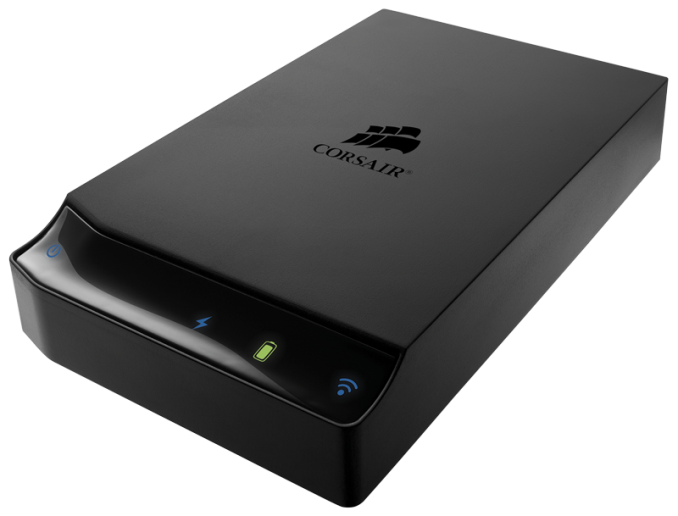
| 12:55p | Corsair Announces Voyager Air 2 Wireless Drive
If you need access to tons of movies, music, etc. on your iOS or Android device – or perhaps a PC or Mac as well – Corsair’s latest Voyager Air 2 wireless drive might prove useful. Featuring support for up to 1TB of storage and powered by a rechargeable battery that offers up to seven hours of battery life, the palm-sized device at its most basic level can function as portable USB 3.0 storage, but that’s not really taking advantage of the additional features. The Voyager Air 2 as you might guess from the name also supports 802.11n/g/n connections. Unfortunately, it looks like it’s only 2.4GHz connections, which means it won’t provide faster speeds for 5GHz 11n users and those equipped with 11ac users are also out of luck. On the bright side, the WiFi can connect to a wireless hotspot and provide wireless passthrough for Internet sharing, but again the 2.4GHz spectrum means this won’t be useful in crowded WiFi environments. The device also supports Airplay, DLNA, and cloud syncing with Corsair’s version 2.0 software. Airplay allows the device to work with AppleTV products, DLNA support means it can work with a variety of Blu-ray players, came consoles, and other devices, and the cloud syncing supports synchronization with Dropbox and/or Google Drive. The onboard media server will also automatically organize media files, allowing you to browse TV shows by name/season/episode and music by artist/album/title/genre. For Windows and OS X PCs/laptops, you can also access content on the device through a web interface. Availability is scheduled for June, with an MSRP of $180. That makes the new Voyager Air 2 less expensive than the 500GB Voyager Air, though the original Voyager Air also included Ethernet support. Other than a slightly modified enclosure and dropping the 500GB option, the Air 2 appears to be nearly identical in terms of specs to the original product. That’s not necessarily bad, as the Voyager Air received good reviews, but it would have been nice to see a few additional updates – most notably 802.11ac support. | ||||||||||||||||||||||||||||||
| 3:00p | Crucial MX100 (256GB & 512GB) Review Computex is officially kicking off today and unlike many of the products announced at trade shows, we actually have a full review of the Crucial MX100 that is launching today at Computex. The MX100 is Crucial's new mainstream drive, replacing the popular M500 while the M550 will continue to serve the higher performance market. With the MX100 Crucial is aiming even lower in terms of price per gigabyte by utilizing Micron's (i.e. Crucial's parent company's) state-of-the-art 16nm 128Gbit MLC NAND. Read on the see how the MX100 stands out with its new 16nm NAND! | ||||||||||||||||||||||||||||||
| 6:20p | Corsair Releases New PSU series: HX750i, HX850i and HX1000i
Corsair's HX PSU series is of special significance to the company, as it is the first PSU series that Corsair released back in 2006. Corsair today announced its upgraded successor, the HXi series, which brings 80Plus Platinum certified units with Corsair Link support. Corsair announced that the new HXi series would consist of three units, a 750W, an 850W and a 1000W model, thus reducing the audience of the new HXi series significantly, as the vast majority of home computers do not require anywhere near that much power.
Although the press release does not clarify whether the new series will completely replace the current HX series or exist alongside it, it would make little sense for both series to coexist with the current pricing scheme. As the table below depicts, the MSRP of the new HXi series is very similar to that of the older units, therefore the older units will need to receive a major price cut if they are to stay in production.
On paper, the new HXi units are strikingly similar to the current AXi series as well; fully modular, all-Japanese capacitors, Zero-RPM fan mode, 80Plus Platinum certified and covered by a seven year warranty. The only vital difference is the price, with the new HXi units being significantly cheaper, making the longevity of the current AX and AXi models questionable as well. Whether the new HXi units can also perform as well as the current AXi or even the HX series, we will find out once the first sample reaches our labs. The new HXi Series will be available at retail in August. | ||||||||||||||||||||||||||||||
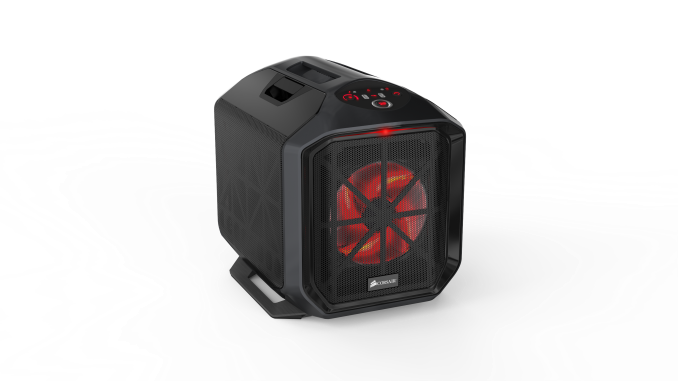
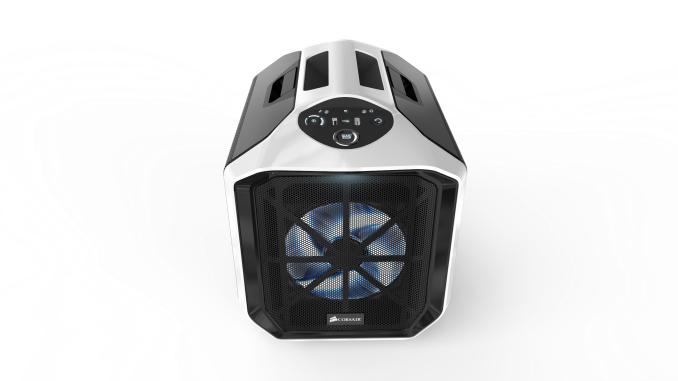
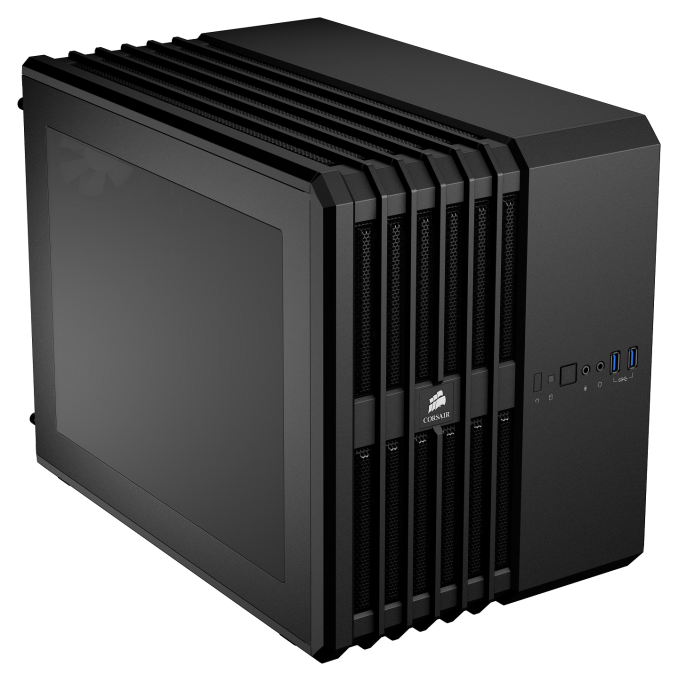
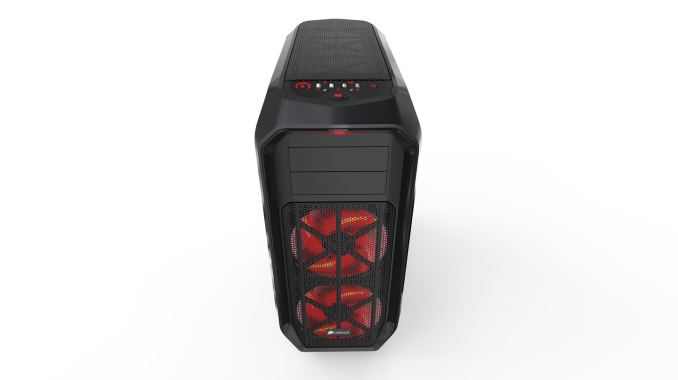
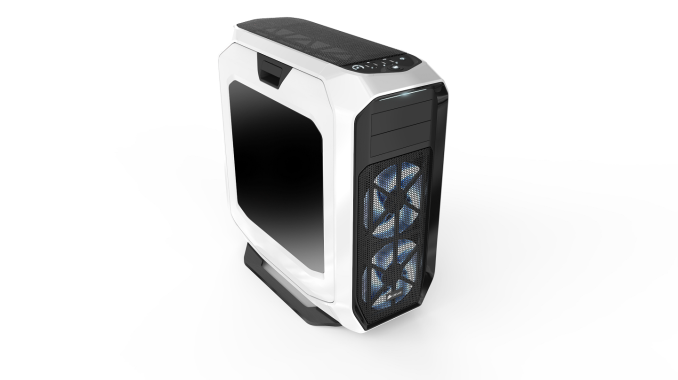
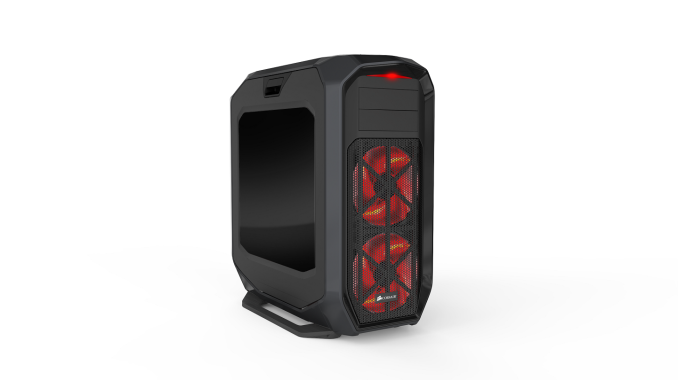
| 7:26p | Corsair Unveils Three New Cases: the Graphite 380T, the Carbide Air 240 and the Graphite 780T
Corsair went berserk with new releases today. Announcing nearly a dozen new products is somewhat shocking, even if some of them are upgrades of older successful products. The company also announced three new cases - the portable Mini-ITX Graphite 380T, the versatile Mini-ITX / Micro-ATX Carbide Air 240 and the massive Graphite 780T Full Tower case. The very shape of the Graphite 380T and the large handle instantly give away Corsair's intentions; the company aimed to create the ideal Mini-ITX LAN party machine. It is not the smallest Mini-ITX that we have seen but it can house a full size graphics card and advanced cooling options, allowing the creation of a compact yet rather powerful gaming system. With two fans (120 mm and 140 mm) already included, the Graphite 380T has clearly been designed with the presumption that a pretty strong gaming system will be installed inside it. Corsair will be supplying the Graphite 380T in two color combinations; black with red lighting or black/white with white lighting.
The Carbide Air 240 is like a small version of the Carbide Air 540, the very popular cubic case that Corsair released in 2013. Although it has been downsized and can now only fit Mini-ITX and Micro-ATX motherboards, Corsair claims that the Carbide Air 240 can store a lot of hardware, including full-size graphics cards and two 240 mm liquid cooling radiators. Much like its larger sibling, the drives are stored behind the motherboard tray, in the PSU compartment, although their exact number is currently unknown. Corsair announced that the Carbide Air 240 will be available in both black and white.
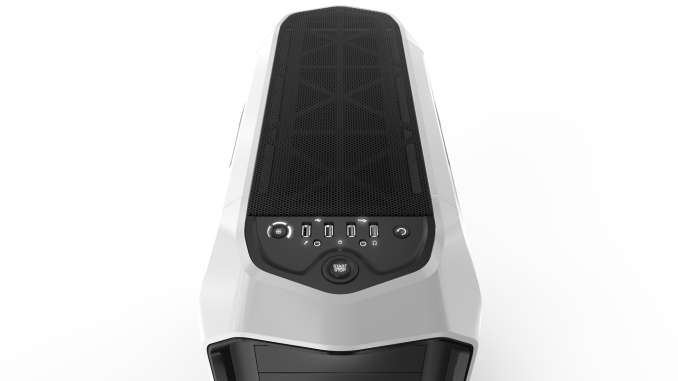
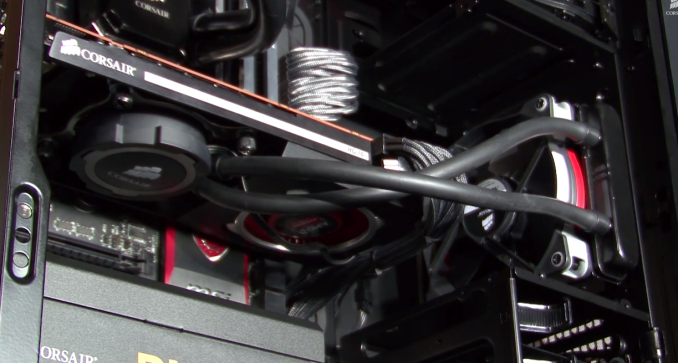
Last but not least, the new Graphite 780T Full Tower case is perhaps the most interesting addition to Corsair's line up of cases. It is based on a new aesthetic concept, not an older design, which looks very interesting from the 3D renders that Corsair supplied to us. We have no clear details regarding the size of the case but Corsair claims that it can fit nine hard drives and two 360 mm liquid cooling radiators, therefore its proportions will definitely be greater than any Mid-Tower case, or even the Graphite 760T.
The MSRP and expected release dates of the new cases are summarized below.
| ||||||||||||||||||||||||||||||
| 7:38p | Corsair Presents the Hydro Series HG10 GPU Liquid Cooling Bracket
In its endless rampage of new product releases today, Corsair has also presented the Hydro Series HG10 GPU cooling bracket, a solution for those that want to install an all-in-one (AIO) liquid cooling kit on a graphics card. This approach is not new, as other companies have presented similar solutions (some may remember our recent review of the NZXT Kraken G10); however, such solutions would focus on the GPU core and leave the VRM and RAM with just airflow from the fan installed on the bracket, which could become a problem if the VRM heatsinks of power-hungry cards are removed alongside the stock cooler.
Corsair's press release suggests that the Hydro Series HG10 will not only cool the GPU core but the VRM and RAM chips of your card as well. This is done by keeping the stock cooler's radial fan and parts of its body, which are still being powered by the graphics card's fan control circuitry. Essentially, the HG10 seems to be replacing parts of the stock cooler in order to add support for the liquid cooler core. Compatibility wise, there are both good and bad news. The good news are that the HG10 is compatible with all of Corsair's Hydro series, from the H55 and H80 to the H100i and H110; therefore, it will most likely be compatible with the vast majority of AIO liquid cooling kits from many companies. The bad news are that it requires specific card models, limiting its compatibility with only AMD Radeon R9 290X/290 reference cards (A1 Edition) or NVIDIA GeForce Titan, 780 Ti, 780, 770 cards (N1 Edition). Corsair hinted that there will be more versions for other AMD cards soon, although they did not specify for which models.
The first versions (A1 Edition) will be available this June for $39.99. | ||||||||||||||||||||||||||||||
| 8:00p | Smartphone Audio Testing - HTC One M8 and Samsung Galaxy S5 Since our initial testing of smartphone audio, I’ve had a lot more time to play with the APx582 from Audio Precision. I’ve also received far more feedback than I ever expected to on this subject. I have made a few changes to the testing method that I’m going to outline, along with discussing the reasons for the changes. | ||||||||||||||||||||||||||||||
| 8:30p | VESA Releases DockPort Specification
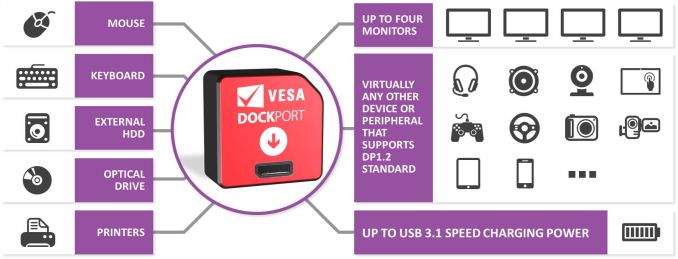
With Computex now in full swing this week has and will continue to be a flurry of product and standard announcements. To that end and kicking off their Tuesday, the VESA has sent us a status update on DockPort, the organization’s combined display/data/power cable and interface standard. The last time we talked to the VESA was at CES 2014. There, the organization announced that they were adopting AMD/TI’s Lightning Bolt specification as a VESA standard, and were in turn making it an official extension to the DisplayPort standard. At the time the DockPort specification was still in development, with a projected finalization of Q2’14. Catching up to Computex then, the VESA is announcing that they have finished the DockPort specification on schedule and are releasing the final specification to their members today. Since the provisional release earlier this year DockPort has seen a specification bump – it now carries USB 3.1 rather than USB 3.0 – a relatively minor change since USB is fundamentally just another interface being carried over the much faster DisplayPort cabling. Otherwise this is the expected next step in the development of the standard. With the final specification in hand, device makers can begin final design and production of DockPort capable controllers and devices, though the VESA does note that device manufacturers are going to have to wait a bit for compliance testing as the compliance test is not yet complete.
Along with today’s announcement of the finalized specification, the VESA has also released the DockPort logo. The logo will be used to identify DisplayPort devices with DockPort capabilities, as the physical DisplayPort basis means that while DockPort devices can fall back to DisplayPort-only operation, their enhanced abilities only work when both the source and the sink are DockPort capable. Meanwhile we’re still in the process of tracking down information on DockPort’s power delivery capabilities. Remember that DockPort will use new cabling (despite reusing DisplayPort itself), so there’s still the question about how much power source devices can provide and how much power the new cable can carry. The VESA’s own infographic lists “up to USB 3.1 speed charging power,” however as USB 3.1 has multiple power tiers it’s not clear which of those are going to be applicable. The VESA tells us that various vendors will be showing off early DockPort devices at Computex this week. If nothing else, we’d expect to see a further iteration of AMD’s Discovery concept tablet as that has been the DockPort proof of concept device thus far. Though if DockPort gains traction, then it would be the first of many such devices to make use of DockPort’s single-cable capabilities. | ||||||||||||||||||||||||||||||
| 9:29p | Computex 2014: Patriot Releases FUEL iON for Wireless Charging
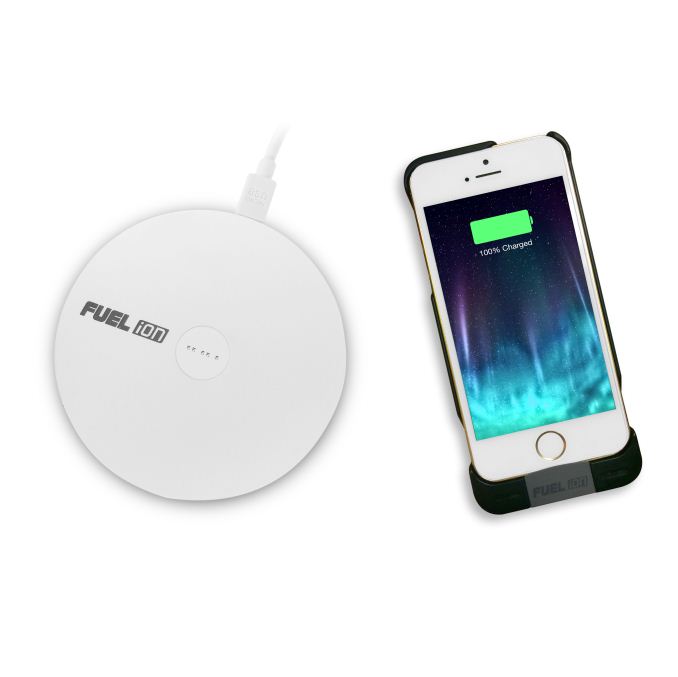
The FUEL range from Patriot is known for its range of charging products, but for Computex 2014 Patriot has accelerated into the wireless charging era with the FUEL iON range. The first two products in this range will be a set of cases for the iPhone 5/5s and the Galaxy S4. What Patriot has done to make these different from most other wireless charging pads is use a series of magnets in both the cases such that their charging pads ensure that the device stays on the pad, rather than slide off.
With the cases, Patriot are launching two compatible charging pads: one for the car which doubles as a holder, and one for the home.
The FUEL iON range will ship in July, with the cases set at $80, the car charger at $50 and $30 for the charging pad. While not explicitly mentioned, I would assume that all devices would adhere to the Qi wireless charging standard. We might see more when meeting with Patriot at Computex this week. | ||||||||||||||||||||||||||||||
| 10:00p | GeForce Experience 2.1 Released
It has been a bit over 2 years since NVIDIA first announced GeForce Experience, and while it took them a bit longer to get off the ground than they had planned on, since then they’ve been quickly iterating on the utility to add features and fix bugs. The previous release of GeForce Experience was April’s version 2.0, which added laptop functionality along with new ShadowPlay and GameStream features. Now NVIDIA is back with a smaller point update, releasing GeForce Experience 2.1 today. As is common for GeForce Experience point updates, 2.1 is a combination of small new features and bug fixes. On the feature side GeForce Experience is getting a little more FRAPSy, with the addition of an in-game framerate overlay for ShadowPlay. Note however that because this is a ShadowPlay feature, it only functions when ShadowPlay is enabled, so you’ll still want to keep around FRAPS (or your favorite overlay) if not using ShadowPlay.
Speaking of ShadowPlay, 2.1 also adds the ability to do desktop capture in ShadowPlay’s shadow mode. The desktop capture ability was introduced in 2.0, and previously only worked with manual recordings. Meanwhile ShadowPlay microphone recording functionality also gains a Push-To-Talk (PTT) recording mode as an alternative to the existing always-on recording mode. Finally, NVIDIA has increased the maximum ShadowPlay recording resolution from 1920x1200 to 2560x1600, so WQXGA and QHD users will finally be capture to capture at their native resolutions. As for the bug fix side, NVIDIA noted they have fixed a number of bugs. Twitch streaming stability and audio synchronization with Adobe Premiere are specifically mentioned among the fixed bugs. Finally, as always you can grab the latest version of GeForce Experience over at NVIDIA’s GeForce Experience download page. | ||||||||||||||||||||||||||||||
| 10:31p | Computex 2014: More Intel Tablets, the Dell Venue 7 and Venue 8
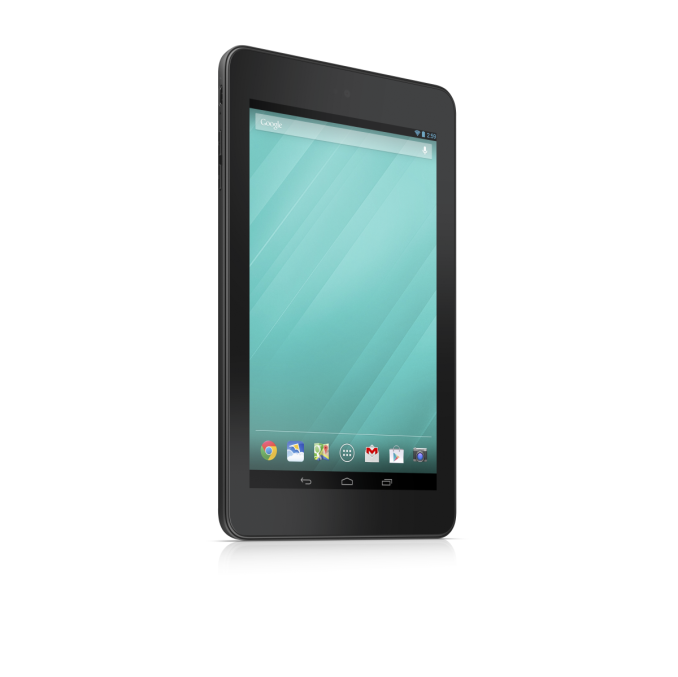
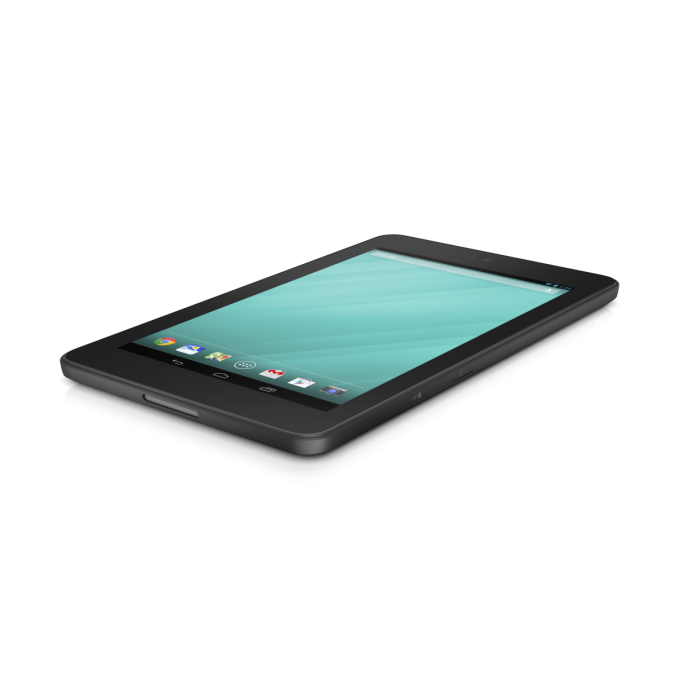
More releases of Intel based tablets this week at Computex, this time from Dell launching its updated Dell Venue 7 and Venue 8 models. The Venue 7 features a regular HD screen, is based on Android 4.4 and uses the Intel Atom Z3460, a dual core 64-bit Silvermont-based Merrifield processor at 1.6 GHz.
The Dell Venue 8 upgrades the screen to 1920x1080, and uses the faster Atom Z3480, another 64-bit dual core Silvermont-based Merrifield processor but at 2.13 GHz. Both tablets feature audio technology from Waves MAXXAudio Pro and an easy-grip design on the back.
Both models will be available in red and black from July 1st on the Dell website. The Venue 7 will retail for $160, and the Venue 8 at $200. Other information was relatively thin on the ground regarding connectivity, although on previous information both models use the PowerVR G6400 GPUs clocked at 533 MHz. Dell is also going to release a series of accessories for the Venue series. The Venue Cradle for the 8-inch model is designed to charge the device while in use, while a Duo Tablet Case will protect the device on the move. A wireless keyboard folio will also be available, as well as Bluetooth portable speakers. | ||||||||||||||||||||||||||||||
| 10:52p | ASUS ROG Press Conference Live Blog Kristian and I are here at the ASUS ROG Press Conference, going to start in a few minutes! | ||||||||||||||||||||||||||||||
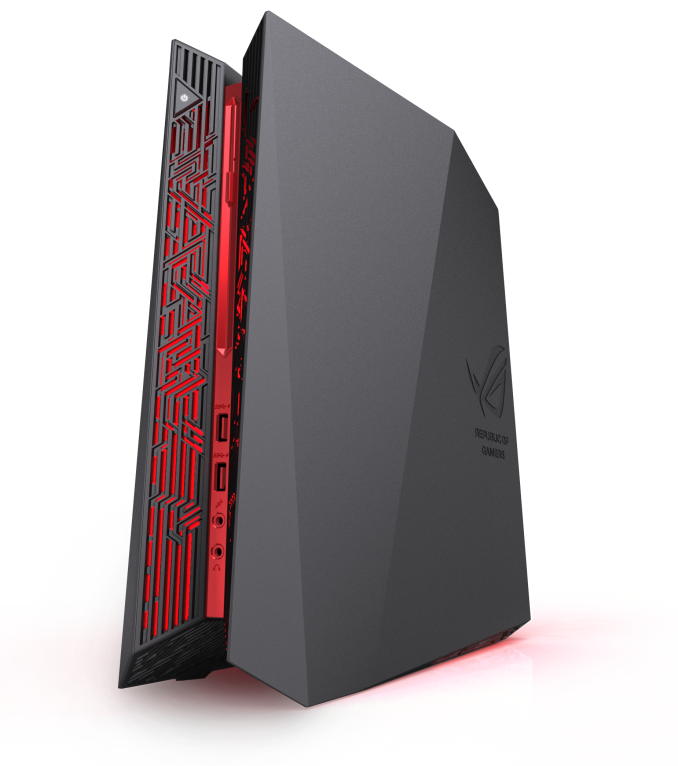
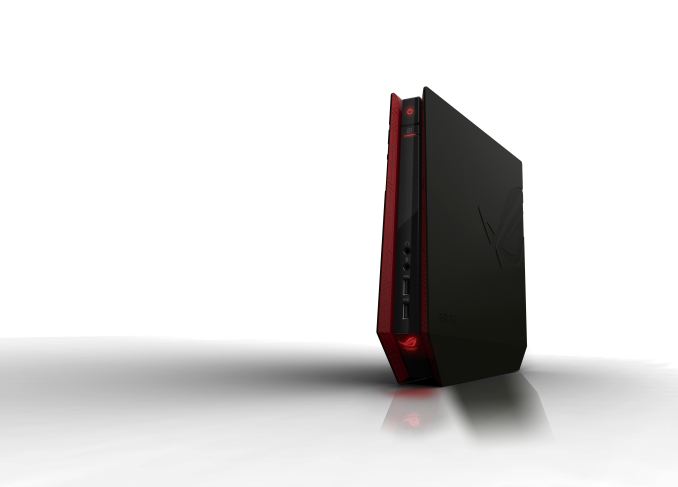
| 11:15p | ASUS Launches Two SFF ROG Gaming PCs: The G20 PC and the GR8 ‘Console’
Mini-PCs are currently one of the fastest growing desktop market segments, alongside all-in-ones and other small form factor (SFF) variants. While on the full desktop side most of the sales are still for ATX-sized devices, a lot of attention is put towards the growth of the mini-ITX market. To that extent, ASUS has designed and are bringing to market a pair of gaming PCs. ROG G20 Gaming Desktop The G20 Gaming Desktop, winner of a Best Choice Golden Award at Computex, uses a 12.5 liter chassis with no visible vents to support a Haswell Core i7 CPU with an NVIDIA GTX 780. The design uses ‘aggressive’ lines with a matte black finish in the red/black style of ASUS’ gaming range. The lighting on the outside of the case is split into three regions, each of which can be user controlled to 8 million different colors.
ASUS claim that the G20 offers efficient heat management and near-silent operation, giving 25dB at idle. I would assume that this, along with the note about having no visible vents, would suggest that ASUS has done away with CPU and GPU coolers and is using the case itself as a heatsink. This is not necessarily a new idea, but I cannot remember the last time I saw such a power hungry unit go along these lines. There is a small ‘hidden airflow tunnel’ to aid air-flow management (contains two ultra-quiet fans), which would make sense given that other elements in the system heat up as well. The G20 is also being advertised with an Eco Energy Mode, which reduces the power usage of the system to around 20W. It is unclear if this is an idle power draw, or the system is reduced in clocks (to idle) for constant use similar to what some motherboards do. There is no word whether the motherboard and GPU are custom built for the system, however as more details are released we hope to get some kind of inclination. Pricing will be dependent on what options are chosen, but ASUS expect it to be in the region of $800-$1700 with availability in Q3. ROG GR8 Console Gaming PC Text-speak aside (greeeeat), the GR8 equips an i7 with a GTX 750 Ti to provide a small form factor system designed for both gaming and streaming. Equipped with a Miracast receiver, the system will accept content from supported Android smartphones, tablets, Windows 8.1 PCs and WiDI 3.5+ devices.
The GR8 will initially be available in a Windows 8.1 configuration compatible with SteamOS, but a SteamOS configuration will be launched in alignment with Valve’s schedule. Behind the functionality we also have SupremeFX audio, optimized gigabit Ethernet, and upgradable storage/memory. The importance of such a device will be in the pricing, and users with wireless controllers might see this as a PC alternative to the console. No pricing is yet available, though the GR8 is expected to launch in North America in Q3 as well. | ||||||||||||||||||||||||||||||
| 11:25p | ASUS Launches the ROG GX500, a 4K UHD 15-inch Gaming Notebook
In recent months, screen resolutions have exploded on to the scene when users started wanting something more than a cheap 1080p panel. Notebooks typically have had higher pixel densities than desktop monitors, and with the recent string of cheaper 1440p and 4K panels to hit the market, it was only a matter of time before one of the notebook manufacturers put together a 4K panel inside a gaming chassis. The ROG GX500 is ASUS’ answer to such madness. Aside from the 3840x2160 screen measuring 15.6” (that is 280 PPI), this 2.2kg beast will feature i7 processors along with an NVIDIA GTX860M. One might argue that this mobile GPU is not powerful enough for 4K/UHD, and I would incline to agree. To this extent users might dial back settings, or use the system in 4K mode for desktop but 2560x1440 in gaming.
The laptop will be paired with VisualMaster technology for 100% NTSC, which ASUS is reporting as a world-first on a notebook. The system will measure just 19mm thick, but will use a dual-fan cooling system to manage the heat generation. No word on pricing as of yet, although I am enquiring regarding sampling in case we can get a review sample. Expected launch is in Q3. | ||||||||||||||||||||||||||||||
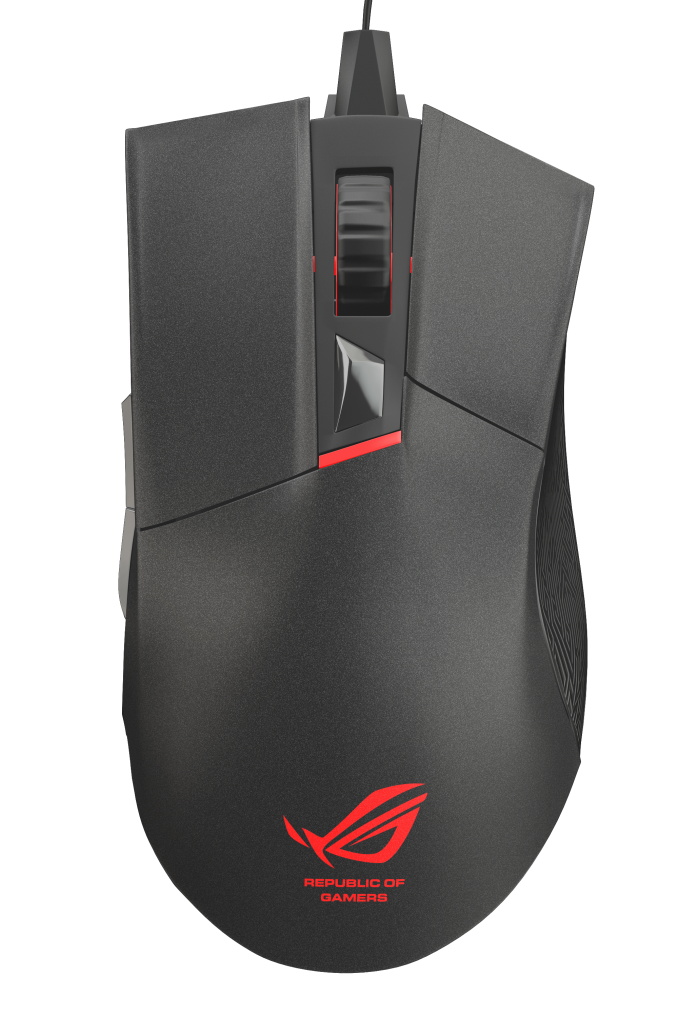
| 11:34p | Gaming Peripherals from ASUS Launched: The Gladius Mouse and GK2000 Keyboard
While we have not touched on many gaming peripherals in the past here at AnandTech, the market is a large one with major players including Logitech, Corsair, Thermaltake, Razer, Madcatz and others. No gaming brand would be complete without peripherals, and aside from the backpacks that have come out of ROG over the years, this time we get an updated ROG branded mouse and keyboard. ROG Gladius Gaming Mouse The ROG Gladius Gaming Mouse has been styled by a committee of gamers specifically for first person shooters with the reported emphasis on ergonomics, precision and customization. Unfortunately for southpaws (I will ask if another version will come to market), the Gladius is designed for right-handed gamers with a fingertip DPI selection, up to a peak of 6400 dpi via its optical sensor. The Gladius can poll at 200 Hz and is sufficient for up to 50G acceleration.
The Mayan-patterned grip aims to keep the users hand on the mouse during sweaty intense sessions, with all the buttons programmable. The Gladius also allows the two buttons on the mouse to be replaced in favor of new or favorite switches in a similar vein to mechanical keyboards. The cable is also detachable for easier transport. ROG GK2000 Gaming Keyboard The black art of designing the perfect gaming keyboard is almost impossible, mostly because so many users are different in their tastes. The GK2000 is ASUS’ answer, pairing Cherry MX Reds with a macro-capable system and built-in anti-ghosting technology.
ASUS in their coverage likes to point out the premium metal accents and red-backlighting, which they have programmed in for five different effects. No mention of release date or pricing as of yet, although typically these devices are sold more in Asia than in the Americas or in Europe. | ||||||||||||||||||||||||||||||
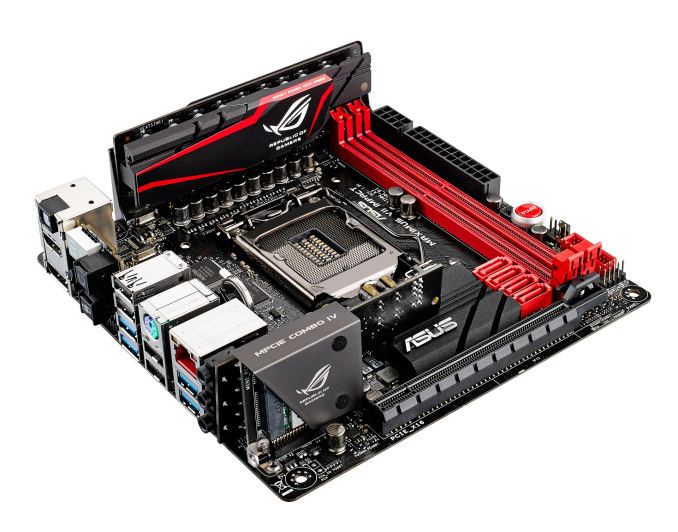
| 11:35p | New ASUS Z97 and FM2+ ROG Motherboards: Impact, Formula and Crossblade Ranger
As part of the ASUS ROG Press Conference today here at Computex, ASUS has announced two of the anticipated members of the Z97 ROG lineup along with an unexpected new ROG entry into the AMD APU market. The Maximus VII Formula and Maximus VII Impact are Z97 versions of their Z87 brethren, using the enhancements that Z97 brings such as SATA Express, M.2 and lower DPC Latency. The Formula use the full cover body plate similar to the previous version, although it is more styled in the power delivery heatsink area while still containing a combination air/water cooler. In order to reinforce structural rigidity, the rear of the motherboard also has a full cover body plate affixed at nine points around the motherboard.
The Maximus VII Formula uses dual SATAe (one from the chipset, one from an ASMedia controller) as well as ASUS’ mPCIe Combo III on the rear IO to give access to an mPCIe slot and an M.2 (x2 and SATA) slot. The power delivery is using higher specification components to the standard channel range, and the central element of the motherboard lights up when in use. Audio is from the SupremeFX solution, which uses SenseAmp to automatically adjust for headphones up to 600 ohms. The Maximus VII Impact builds on the VI Impact which we reviewed earlier this year and rewarded with good reason. The new version comes with an updated power delivery daughterboard (Impact Power II), an updated audio daughterboard (SupremeFX Impact II), and mPCIe Combo IV with 802.11ac + Bluetooth 4.0.
The new features include M.2 x4 as part of mPCIe Combo IV, which given the nature of the Impact and the array of extra features I would assume, like the Extreme6, this comes from the CPU. That would mean the PCIe 3.0 slot would reduce to x8, but as shown on the Extreme6 review, for single card gaming at 1080p, gaming frame rates reduce by sub-1%. It does mean that four lanes are unused however, which might not be ideal. Another new feature is the Impact CoolHub, a card connected to the motherboard with two 4-pin fan headers as well as an LN2 header for extreme overclockers. The Maximus VI Impact was a favorite among DRAM enthusiasts and holds several records for DRAM clocking, so these users should appreciate the additional features. The odd ball of the announcements is the ROG Crossblade Ranger. The last time ASUS designed an ROG AMD motherboard was the Crosshair IV Formula-Z for AM3+, and AMD APU enthusiasts have been requesting something similar to the Maximus series on the AMD side. The Crossblade Ranger takes a lot of cues from the Maximus VII range, especially in terms of color scheme, software, audio features and Ethernet.
The styling mimics that of the Maximus VII Ranger (one could assume that the chipset heatsink is the same due to the motif), using sharp angular edges in typical ROG style. Due to the AMD nature of the motherboard I would assume that there is no SLI, but there is SupremeFX audio, 8 SATA ports, Keybot, Slow Mode, LN2 Mode, voltage check points, and even an Intel NIC. Yes, an Intel NIC on an AMD motherboard. The Formula and Crossblade Ranger are expected in late July, with the Impact in Q3. Pricing will be determined closer to the launch date. | ||||||||||||||||||||||||||||||
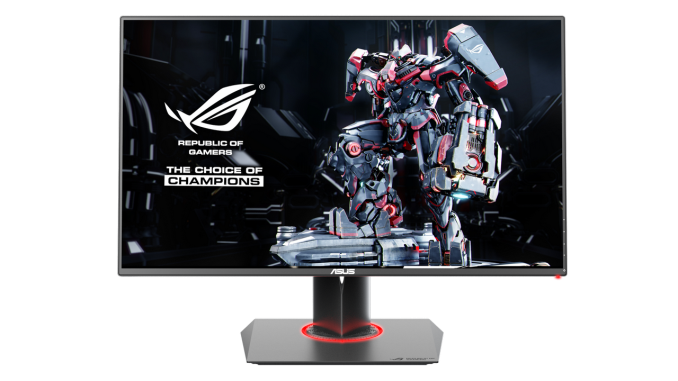
| 11:37p | ASUS ROG Swift PG278Q Launched: 1440p 144Hz panel with G-Sync
Monitor talk is crazy. In this modern era we have a choice between 4K panels, cheap Korean 1440p monitors, panels that cover wide gamuts those that refresh at 30 Hz, 60 Hz, 120 Hz and 144 Hz, as well as TN/VA/IPS panels with all the variants therein. The issue comes when putting as many of these features together - typically IPS panels at higher refresh rates are hard to come by, whereas TN panels can lack the wide viewing angles and color reproduction. So by saying that ASUS are paring a 27” 2560x1440 display with a high refresh rate and NVIDIA G-Sync, we open our arms to this kind of evolution. Anand reviewed G-Sync last year, and while it is the closest adaptive refresh technology to market, it does have its competitors. The ROG Swift PG278Q is going to be available from July, and should bring more G-Sync into the market. While other specifications are thin on the ground from the press release, we are inquiring into a more detailed list of data points for the monitor. The PG278Q also comes with a dedicated Turbo Key to allow users to adjust refresh rates on the fly from 60 Hz to 120 Hz to 144 Hz with one button, rather than adjusting the on-screen display. ASUS is quoting a 1ms GTG response time, with a 6mm bezel, VESA wall mount, a large range of stand adjustment, 1 DP port, two USB 3.0 ports and a 5-way joystick for the OSD. ASUS expects the PG278Q to be in the $800 region, with a full release in late July. | ||||||||||||||||||||||||||||||
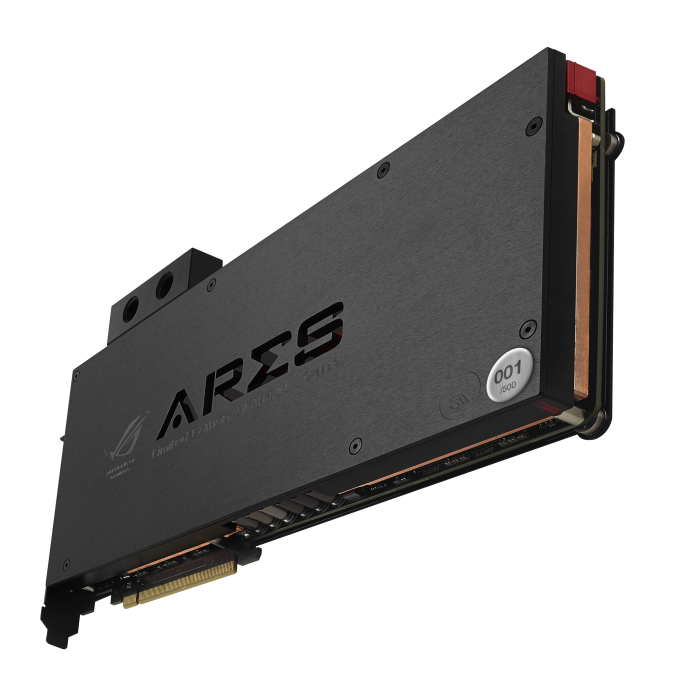
| 11:40p | ASUS Launches ROG Ares III for Water Cooling Builds
The Radeon R9 295X2, or any graphics card that comes pre-liquid cooled, comes up against a barrier. There will be a market segment that cares more about the card than the cooling, and would rather not have to spend the extra on the cooling because they want to apply their own, or a waterblock. Aside from the leaked images on the web showing a triple-slot air cooled version of the 295X2 from Powercolor, ASUS is going to address this issue with the Ares III for users building their own water cooling loops. The new card will come pre-fitted with a custom designed EK water block, and only 500 units will be made so expect this thing to be pricy. The two Hawaii XT GPUs are said to be ‘hand-chosen’ for the cards, and one would assume that the card comes with a decent overclock pre-installed. If not, the main purpose of the card would be for the user to overclock, or for the system to run as cool and quiet as possible. Based on internal testing, ASUS states that a 120x3 water cooling loop is recommended as a minimum. The GPU is single slot, meaning that the top of the card seems taller than the standard height of GPU. Pricing is not yet set but expect a release in Q3. | ||||||||||||||||||||||||||||||




_575px.png)














_575px.jpg)

_575px.png)
_thumb.png)
_thumb.png)
_thumb.png)
_thumb.png)
_thumb.png)
_thumb.png)






| << Previous Day |
2014/06/02 [Calendar] |
Next Day >> |