[Most Recent Entries] [Calendar View]
Sunday, June 8th, 2014
| Time | Event |
| 9:57a | Computex 2014: Plextor Announces M6 Pro SSD & PlexTurbo Software
While Computex is already over for this year, we still have a lot of stuff to go through and post. I stopped by at Plextor's booth earlier this week and Plextor showed me their brand new M6 Pro along with PlexTurbo software. Plextor showed the M6 Pro already at CES this year but now the drive is nearly ready for the official release. The hardware inside hasn't changed from CES and it's still uses the Marvell 88SS9187 SATA 6Gbps controller with Toshiba's A19nm NAND and the release is scheduled to take place next month, so we should be able to get samples pretty soon. In addition to just re-showing the CES products, Plextor also had something new to demo. PlexTurbo is software similar to Samsung's RAPID function and it leverages system RAM to increase transfer speeds. The key difference to RAPID is that PlexTurbo uses RAM as a write-through cache, which means that the data is written to both RAM and the SSD simultaneously. Samsung's approach is write-back based, which is more vulnerable to data loss as initially the data is only written to the cache and is not written to the SSD until the data in the cache is about to be modified. Both RAPID and PlexTurbo are limited to 1GB of RAM to ensure that the system still has enough RAM for standard operation. Plextor showed me a video of their internal testing comparing PlexTurbo with RAPID in case the drive is disconnected right after writing something. In the test Plextor used a Word file that they modified and unplugged the drive after saving the file. With RAPID the modifications were lost, whereas thanks to Plextor's use of write-through cache the modifications remained intact. Of course this test was designed to promote PlexTurbo’s approach and we will have to run our own tests to confirm the results but it looks like Plextor’s approach might be a bit more reliable than Samsung’s. PlexTurbo also appears to provide better performance as I saw speeds of up to 10GB/s when the settings were optimised for the software. Plextor did admit that the first generation of PlexTurbo was mostly designed for high benchmark scores, so I would take the results with a grain of salt, but the next version should focus more in actual real world performance. Either way, it’s certainly interesting to see how PlexTurbo stands up with RAPID. With SATA 6Gbps it’s getting very hard to differentiate in the market and providing software like PlexTurbo is one of the only ways, even though the real world gains are debatable.
Furthermore, Plextor announced an M.2 version of the M6e along with other SATA based M.2 SSDs. Currently the M6e has only been available with the half-height, half-length PCIe adapter, which is just added cost for users who are looking to upgrade the M.2 SSD in their laptops.
Plextor will also be bringing a notebook upgrade kit for the M6S. The kit includes a 2.5” chassis for the old internal drive, which can then be used as external storage for backups for instance. Finally, Plextor told me that they will be introducing M6V later this year. The V stands for value and this will be the budget drive from Plextor. I was’t able to get much details other than that it won’t use Toshiba NAND but this might as well be the TLC drive Plextor has been developing for years now. |
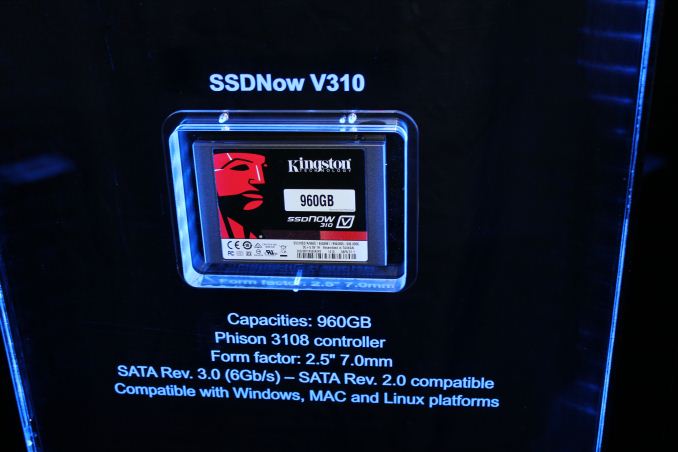
| 10:11a | Computex 2014: Kingston Announces V310 & HyperX Fury SSDs, Shows SF3700 And Marvell PCIe SSDs Unlike many manufacturers, Kingston didn’t have a booth or suite at Computex but instead they held a one-day HyperX gaming event on the top floor of one of Taipei’s many skyscrapers. In addition to the gaming event, Kingston had several upcoming products to show, ranging from Phison based V310 SSDs to PCIe 2.0 x4 SSD with a brand new Marvell controller.
The V310 will be the successor to V300 and is based on Phison S8 controller instead of the SF-2281 found in the V300. The NAND will be Micron’s 128Gbit 20nm MLC, which enables Kingston to go all the way to up to 960GB. Pricing should be quite similar to the V300 but the difference is that the V310 provides the same performance regardless of the data type (incompressible vs compressible). I was told that the official release should take place in about six weeks, so it looks like July will be a busy timeframe for new SSDs.
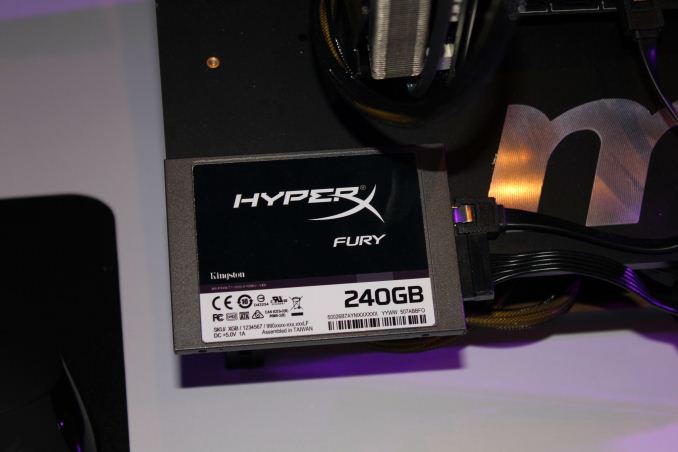
Kingston is also bringing a new model to their HyperX family: the HyperX Fury. This is yet another SF-2281 drive and similar to the V310 it utilizes Micron’s 128Gbit 20nm MLC NAND. This provides lower cost compared to the HyperX 3K and Kingston is aiming the Fury at the lower-end gaming segment. Capacities are limited to just 120GB and 240GB and the drives should be available soon.
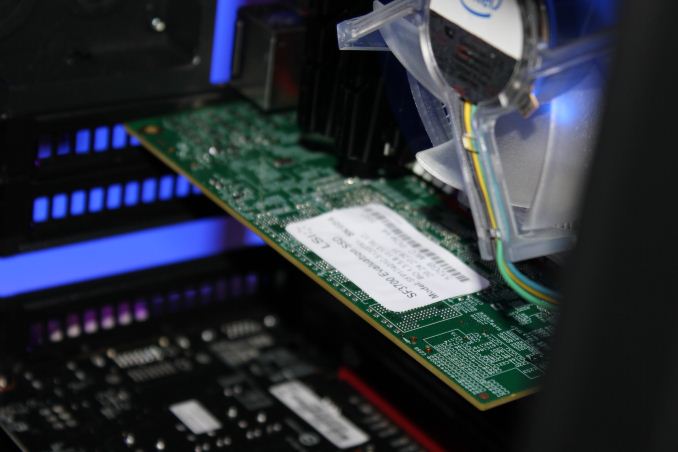
Now, the PCIe stuff. Kingston had two PCIe SSDs to show —one being the SF3700 based HyperX Predator that was already showcased at CES earlier this year and the other being a Marvell based PCIe 2.0 x4 drive. Similar to everyone else, Kingston couldn't really tell us anything new about the SF3700 but Kingston is still aiming for Q4 release. Kingston had the same 80/20 read/write demo to show that LSI showed us earlier but Kingston was able to tell me that the writes are not 100% compressible. Performance was the same 1.3GB/s that we saw earlier, so nothing new in the SF3700 front really.
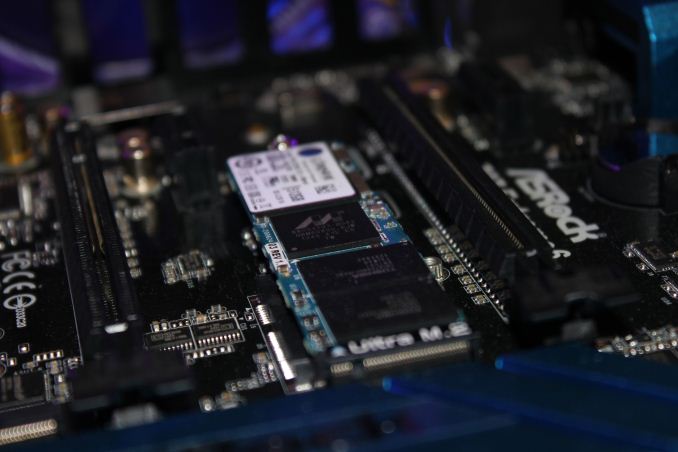
As for the Marvell based drive, this is the first time Kingston is working with Marvell and they actually had to hire a few engineers since the Marvell platform is different from the others. The firmware development is still in the early stages but Kingston had a live demo running that showed sequential read performance of nearly 1.4GB/s. Release timeframe is still up in the air due to firmware development but we will probably see the drive some time next year.
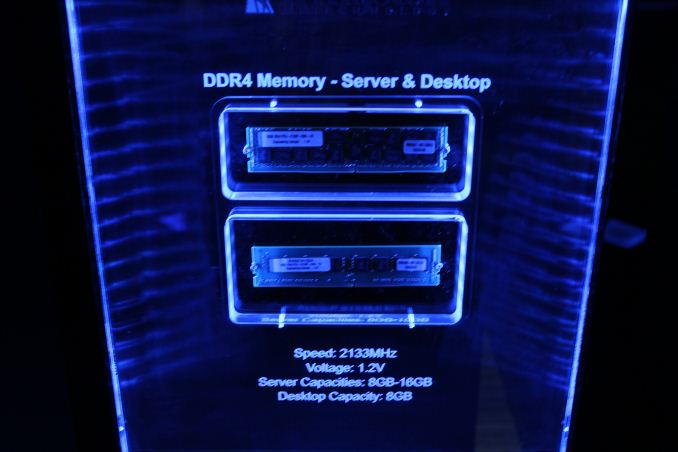
Kingston also had some DDR4 at their event but the details were very limited. They will have a full lineup ready when the X99 launches but at this point, they were not willing to discuss any details regarding speeds. The module they had at the show was a 2133MHz one (for servers I think) but we will likely see higher speeds for the desktop market. Desktop capacities will be limited to 8GB at launch while server DIMMs will be available in 16GB as well. |


| << Previous Day |
2014/06/08 [Calendar] |
Next Day >> |