[Most Recent Entries] [Calendar View]
Wednesday, August 6th, 2014
| Time | Event |
| 8:14p | ASUS Launches Crossblade Ranger for FM2+: ROG Comes Back To AMD at $160
Back during Computex this year, we were at ASUS’ ROG press conference when the Crossblade Ranger was announced. This was ASUS’ ROG brand returning to AMD at the request of their users, ever since the last AMD ROG motherboard, the Crosshair IV Formula-Z. Using the FM2+ platform and the A88X chipset, building a ROG motherboard for AMD CPUs is understandably difficult – no user plans to spend $400+ on an AMD motherboard, and as such any motherboard manufacturer would be restricted in terms of the additions over the base chipset. The Crossblade Ranger attempts to make some headway into this change by offering the new ROG styling, enhanced audio, enhanced power delivery, ROG Front Base support, voltage check points and other ASUS features.
The motherboard uses the red and black ROG color scheme, with the name of the motherboard located on the power delivery. Note this is the same as written on the Z97 ROG Ranger, perhaps suggesting that the single custom part can be used on both products. Several of the features from the Z97 ROG branding have made it on the FM2+ version.
Here ASUS has used an Intel Gigabit Ethernet with GameFirst III and LANGuard: GameFirst being the integrated Windows software for program prioritization (allowing games or VOIP to have network priority) and LANGuard providing electrostatic discharge protection.
The Crossblade Ranger also gets the SupremeFX audio treatment, which translates as an enhanced Realtek ALC1150 audio solution. This means an EMI shield for the codec, filter caps for both front and rear audio and PCB isolation of digital and analog signals to avoid interference. Sonic SenseAmp is a new technology on Z97 and FM2+ ROG which will detect if low or high impedance headphones are used and adjust automatically. Sonic SoundStage is a similar new technology which is designed to work similar to an adjustable OP-AMP by providing audio presets (FPS, racing, combat, sports) for different sorts of games. Users can adjust these presets to their own settings as they with via the software. We covered Sonic Radar in our review of the Z87 ROG Maximus VI Impact, but an updated version is supplied with the Crossblade Ranger.
For overclocking, ASUS has provided their Turbo Processing Unit IC along with an updated graphical BIOS for both automatic and manual overclockers. The new Z97 fan controls in the BIOS are present, with each of the five fan headers controllable via PWM or DC via Fan Xpert 3. ASUS is also running its new Keybot functionality, allowing users to assign macros to any key or key combination. We have not tested this feature yet, although if we get a new ROG motherboard in to test we will. The motherboard also uses eight SATA 6 Gbps ports and six USB 3.0 ports. The PCIe slots are color coded for two-way CrossFire setups or three-way CFX if the PCIe 2.0 x4 slot is of interest. For integrated graphics based setups, the HDMI, VGA and DVI-D ports are on the back panel.
The Crossblade Ranger will also come with the ASUS ROG Front Base dual-bay gaming panel. This is a toned down version of the OC Panel we saw with the Rampage IV Black Edition, focusing more on the interaction with the panel (such as OC, temperature readings or fan controls) rather than additional features on the PCB. MSRP for the whole package sits at $160, and should be available in NA by the end of the month. Source: ASUS |
| 9:00p | Pairing with a Game: Thermaltake announces Urban S71 World of Tanks Edition
The concept might come across and something strange. If a hardware manufacturer creates a product with a video game tie-in, then the product might only appeal to those that enjoy playing that particular video game and others need not apply. There also enters an issue about which direction the money is going – is the game distributor paying for the tie-in to compensate for the restricted appeal, or is the hardware manufacturer paying for the privilege to show trademarked images on their products to introduce that product to a new market? The details between Thermaltake and Wargaming Public Company Ltd have not been disclosed, but the Urban S71 case from Thermaltake is being relaunched as a World of Tanks edition.
Another question comes to mind is if there is something special that a WoT player gets from buying this case? More in-game credit, or is the chassis bundled with a special item that only users that purchase the model can use? From the press release for the Urban S71 WOT Edition, it would seem that the underlying case is still the Urban S71 but with a WoT themed frontage and a red strip light without anything extra specifically for the game.
The Urban S71 WOT Edition will still have a tool-less design, have a top mounted hot-swap port or 2.5” and 3.5” drives, be equipped with a read 120mm fan and two 200mm fans in the top and front and use a windows side panel. Thermaltake is also listing a USB dust plug for the top panel, where two USB 2.0 and two USB 3.0 ports are located. The entire case measure 534 x 213 x 584 mm and weighs 10.5 kg. CPU coolers are limited to 160mm in height, and GPUs are limited to 344mm in length. One of the biggest markets for World of Tanks is Russia, which is perhaps why the Urban S71 WOT Edition is set to be released there first. At this time we have no indication as to the price difference over the original Urban S71, or even if the S71 was released in Russia to begin with. Perhaps this is where the tie-in makes sense. Source: Thermaltake, Russian Thermaltake
|
| 9:05p | OWC and SoftRAID create ThunderBay 4 RAID 5 Edition
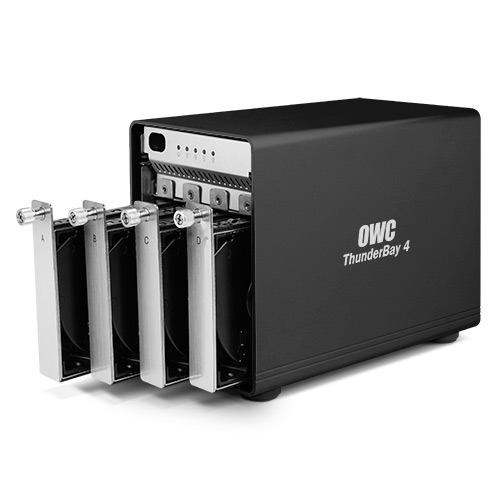
One of the most poignant uses for Thunderbolt has always been Direct Attached Storage (DAS). Alongside supporting high resolution displays, Thunderbolt is all about the daisy chaining of both storage and displays. Anand has previously looked at the Pegasus storage options, but OWC is delving more into the mix with a Thunderbolt based DAS using software based RAID 5.
The ThunderBay 4 RAID 5 Edition will support four drives up to 5 TB each (this may change depending on QVL), and is rated at 675 MB/s for sustained data rates. This number is not listed as either the read or write speed, and OWC is keen to point out that their software RAID 5 solution is up to 35% faster than other hardware solutions. If we get a unit in to test, we will let you know if that figure holds true.
Alongside RAID 5, the device will support RAID 0, 1, 4 or 1+0 using the software RAID solution. The software interface will also include drive monitoring, e-mail notification and rebuild capabilities. The dual Thunderbolt 2 ports and the software will allow users to create larger extended RAID arrays, with the example given in this press release showing 16 drives across four devices all in the same array. It would be interesting to see how that large array deals with a power failure in an intermediate device, depending on which RAID option is in place. OWC will sell the ThunderBay 4 RAID 5 Edition in either a version with the device by itself ($649) or with sets of four drives totaling 4 TB (4 x 1 TB, $870) to 20 TB (4 x 5 TB, $1770). Each model comes with a one meter certified Thunderbolt cable, and a three year limited warranty. Source: OWC
|
| 10:00p | More Fanless Bay-Trail: ASRock Releases Two Pentium J2900 Motherboards
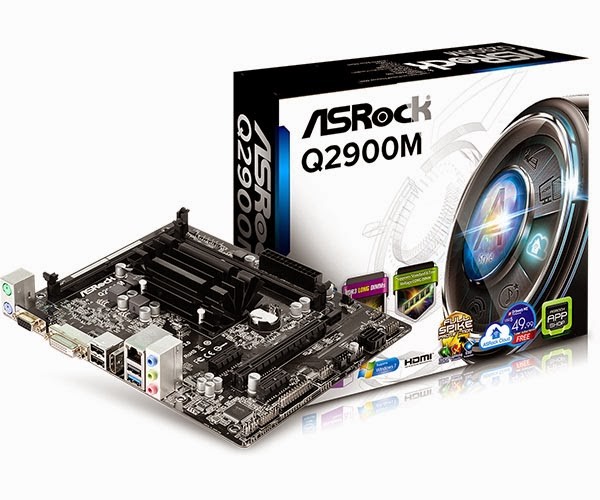
When we looked at AMD’s Kabini platform, AMD in its press materials pitted their high end APU against the Pentium J2900 in terms of price and performance. The only issue from the reviewer’s standpoint was the availability of the Pentium J2900 in a retail product. At the time, the J2900 was found only in OEM devices, or a single system was found through Google Shopping. Fast forward a few months and we are now seeing a small wave of J2900 motherboards coming to market for custom home builds. ASRock look poised to release the Q2900-ITX and Q2900M to meet that demand.
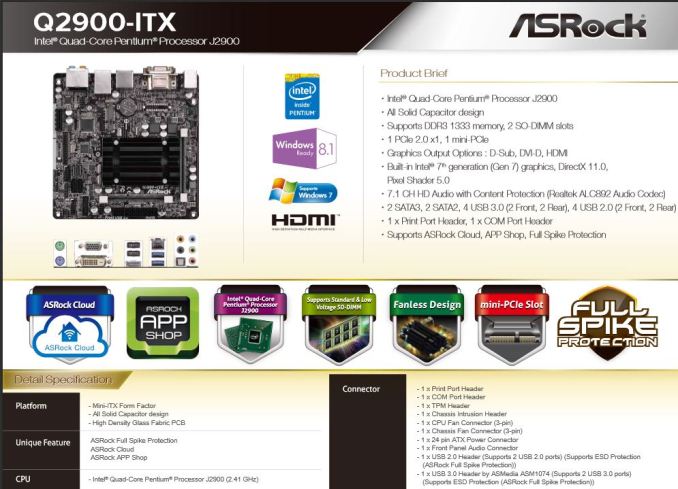
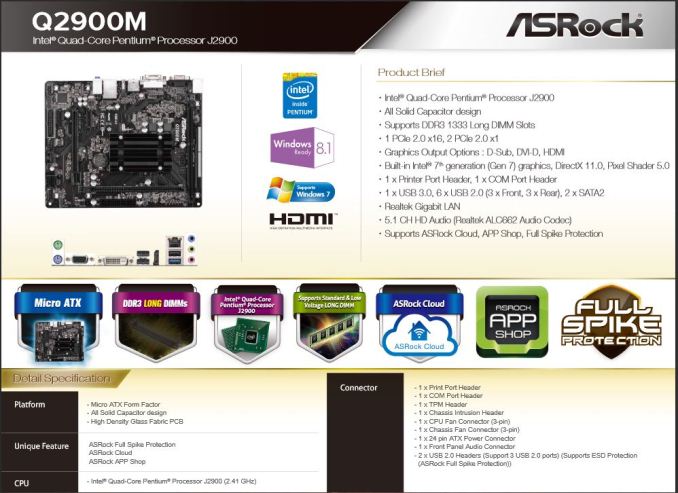
As both motherboards are using the quad core J2900 at 2.40 GHz (2.66 GHz turbo) and 10W, both are supplied with large fanless heatsinks to provide the cooling. The CPU is soldered on to the motherboard (this is an Intel limitation) meaning upgrading is not possible, but the CPU does offer dual channel DDR3, 2 MB of L2 cache and Intel HD graphics.
The Q2900-ITX is an ITX motherboard that relies on SO-DIMM DDR3 memory. The standard Atom chipset ports are here – two SATA 6 Gbps, two SATA 3 Gbps, four USB 3.0 ports, a PCIe 2.0 x1 slot, a mini-PCIe slot (for WiFi) and three standard video outputs (VGA, DVI-D, HDMI).
The Q2900M goes up to the micro-ATX size, which affords use of full-sized DDR3. Note how each of the DDR3 DIMMs are at right angles to each other, which comes across as really, really odd. The PCIe lane layout is a little different, giving a full sized PCIe slot capable of PCIe 2.0 x4. There is also two other PCIe 2.0 x1 slots, however judging by other motherboards of this ilk, using the PCIe 2.0 x4 will disable the other PCIe ports or vice versa. Pricing and availability is not yet announced. Source: XtremeHardware |




| << Previous Day |
2014/08/06 [Calendar] |
Next Day >> |