[Most Recent Entries] [Calendar View]
Thursday, August 7th, 2014
- DDR4-2133 15-15-15 (CAS/CL = 142)
- DDR4-2133 13-13-13 (CAS/CL = 164)
- DDR4-2400 16-16-16 (CAS/CL = 150)
- DDR4-2800 17-17-17 (CAS/CL = 165)
| Time | Event |
| 4:00a | ROCCAT Announces the Nyth Semi-Modular Mouse
The world of gaming peripherals is a tricky one. There are plenty of standard off-the-shelf peripherals that will do the basic job. In order to create a brand away from the cheap or ultra-cheap, each peripheral company has to add value to their product and introduce the feel of premium quality. This might mean using exotic materials, special lights, custom designs/aesthetics, or offer something that someone else cannot. ROCCAT believes it is doing something along those lines with their new Nyth MMO mouse.
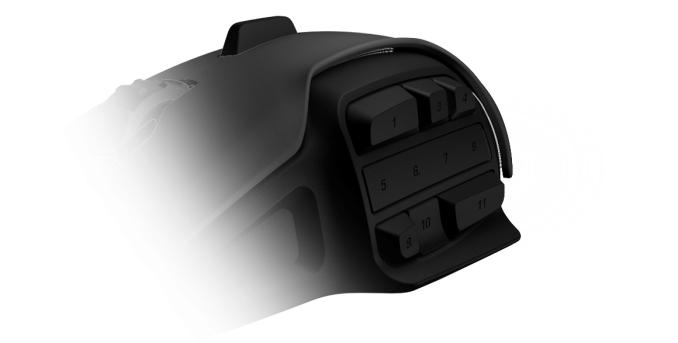
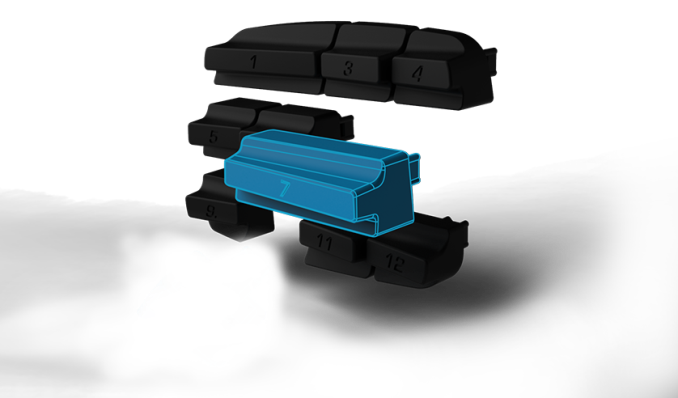
The mouse is designed around the concept of semi-modular system. If a user does not like the side-button arrangement, or it does not work with their particular game, then it can be changed. With the wealth of MMO mice on the market with fixed button arrangements, ROCCAT is attempting to offer a mouse which can be configured in terms of buttons and applications on a per-game basis, allowing the device to extend beyond its initial MMO design origins towards FPS or RTS.
One would assume that the device uses laser optics, although there is no indication whether the weight is adaptable as well. It seems that the device will only come in a wired version, and significant customization for each title will be performed via the included software. The Nyth MMO mouse will be on display at Gamescom later this month, with a full release later in the year. The price for the mouse or any add-ons has yet to be announced. Source: ROCCAT |
| 7:00a | ROCCAT Integrates Keyboard and Smartphone: The Skeltr
Alongside the Nyth, ROCCAT is also announcing another hybrid technology at Gamescom in the form of a keyboard called the Skeltr. The purpose of the Skeltr is to bring the smartphone as an add-on device for the keyboard, allowing apps to be developed that integrate with either the game being played or the on-screen action.
I remember importing one of the original Logitech G15 models from the US almost a decade ago. I had the original black-and-white model, and used the display mostly for Battlefield 2 / 2142 at the time. I must say that with all due respect, I did not use it that much. There was not much time while playing to glance down at the display to see what was going on, although I did look at it between rounds to see the extra statistics it had collected. The concept of the Skeltr is perhaps a step beyond this, allowing users of any smartphone to have an interactive (key word there) integration with their game. The keyboard will speak to the smartphone via Bluetooth, and use a sliding rail with a rotating holster fit to enable any size smartphone or tablet. This second screen will also allow the user to take calls, receive and make texts and other normal smartphone uses through the keyboard.
The initial issue I found with the Logitech G15 might rear its ugly head here: lack of app availability. It took a while before third-party developers were able to make interfaces for my favorite games back for the G15, but I believe ROCCAT might have more luck. Depending on whether users program using the proprietary ROCCAT application language or Android/iOS itself, the most popular games should be covered quickly by ROCCAT themselves or third-parties. With a full color display and direct interactivity, it might be a step forward as well.
The motherboard itself will feature RGB lighting (on a keyboard wide basis, not per key), a small selection of macro buttons and audio outputs. There is no indication if this is a mechanical keyboard as yet. Currently ROCCAT is only showing their prototypes at Gamescom later this month, and release dates/pricing will be announced later this year. Source: ROCCAT |
| 10:00a | MSI’s Next Haswell-E Teaser: X99S Gaming 9 AC
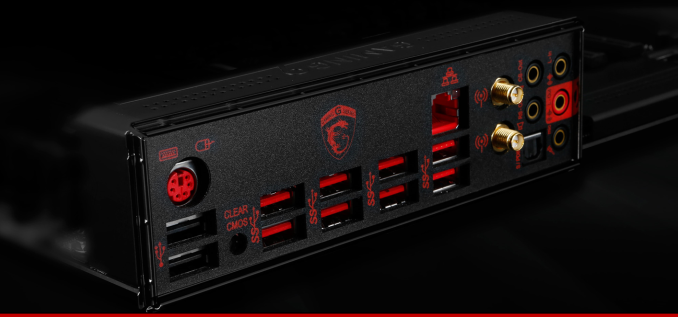
The increase in leaks and teasers regarding X99 makes for some compelling reading. Shortly after showing off their X99S SLI PLUS on Facebook, a couple of Gaming 9 AC renders seem to have been posted as well. The X99S Gaming 9 AC, as the name suggests, represents the top member of MSI’s gaming motherboard range if previous range identifiers are to be continued. Along with the 802.11ac support, the board looks like it will have eight DDR4 slots, five PCIe slots with SLI and Crossfire supported, an M.2 slot up to 2280, SATA Express, ten SATA 6 Gbps ports, eight USB 3.0 ports, upgraded audio and a Killer E2200 series network interface.
Right in the middle of the motherboard is a feature called ‘Streaming Engine’, which is plugged into what looks like a mini-PCIe slot. Current internet chatter is wondering if this is some new proprietary feature from MSI, or something akin to onboard WiDi allowing video streaming without wires. MSI is remaining tight lipped until the full release. It is interesting to see SATA Express and M.2 on X99, and we are still in the dark as to whether these features have shared bandwidth via the PCH due to Intel RST limitations or can be used concurrently. Pricing is unknown, and will most likely be in the higher echelons of the X99 price bracket in. If MSI is going to release an X99 XPower type of motherboard, it will be either the XPower or the Gaming 9 AC that would be the most expensive. Source: MSI US Facebook |
| 11:00a | ADATA Officially Launches XPG Z1 DDR4 Memory
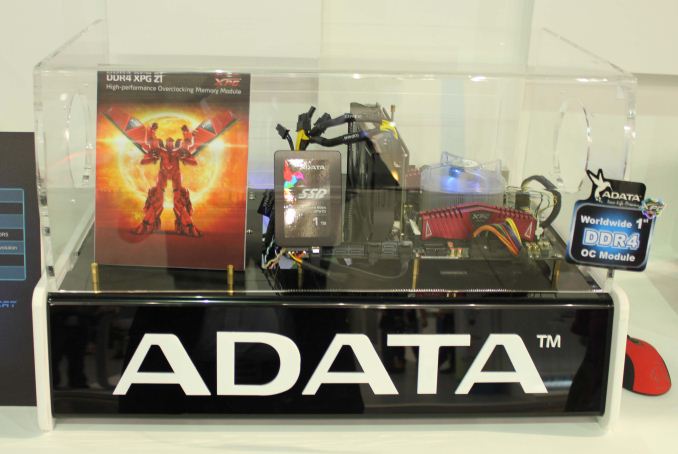
Given that the supposed release date of DDR4, according to a pre-order listing which suggests it is almost three weeks away, DRAM module manufacturers are slowly initiating press releases to tie in with which products they will be releasing. This is good news for the rest of us, as we will get to see what timings and pricings to expect when the full release happens. Today it is ADATA launching some of its higher performance kits under the XPG Z1 branding. If you followed our Computex coverage, you will notice a striking similarity to the modules we saw on display at ADATA’s booth.
Aside from the regular quotes about reducing the voltage from DDR3’s 1.5 volts to 1.2 volts, ADATA is stating that its XPG Z1 range will offer speeds up to 2800 MHz with timings of CL 17-17-17, all within the 1.2 volts standard. The press release would also seem to suggest that ADATA is equipping these modules with a plug and play system, by stating ‘the SPD of XPG Z1 allows direct application without changing settings in the BIOS’. I am going to follow up with ADATA to find out what they mean by this, whether it will be plug and play or they are just referring to JEDEC. The XPG Z1 design uses the angular heatsink tapering to a point, which underneath uses a 10-layer PCB with 2-oz copper layers. The heatsink is in direct contact with the ICs, and if the past serves me correctly this is mostly likely via an epoxy that is hard to remove. The full list of kit capabilities is listed at ADATA’s website. Kits will be available in dual (2x4/2x8) and quad (4x4/4x8) channel variants, all in red to begin with, using the following speeds:
No pricing information as of yet, but given ADATA’s previous press releases, we usually get it around two weeks after the kit being announced. Source: ADATA
|
| 2:30p | NEC EA244UHD Review The NEC EA244UHD is the first UltraHD (UHD) monitor from NEC. While it's not from their professional line, it has many of the features we've come to expect in their monitors: uniformity compensation, a wider color gamut but also sRGB and AdobeRGB support, and many user configurable settings. It also has a few things NEC has never done before including SpectraView calibration support on an EA-series model and full USB 3.0. Read on for our full review. |






| << Previous Day |
2014/08/07 [Calendar] |
Next Day >> |