[Most Recent Entries] [Calendar View]
Sunday, August 10th, 2014
- QVM Desk: Users have a window into any of the VMs running on the unit.
- Defense Desk: Users can access the Surveillance Station UI for monitoring the IP cameras being recorded on the NAS
- Local Display Desk: Users have access to the X-Windows session on the NAS, enabling access to apps such as XBMC, Chrome, YouTube, Spotify etc. - all of which are specific apps for the NAS. Obviously, the NAS can be administered from within this UI also
| Time | Event | ||||||||||||||||||||||||||||||||||||||||||||||||||||||||||||||||||||||||||||||||||||||||||||||||||||||||||||||||||
| 5:00a | QNAP Launches x53 Pro Bay Trail NAS for SMBs
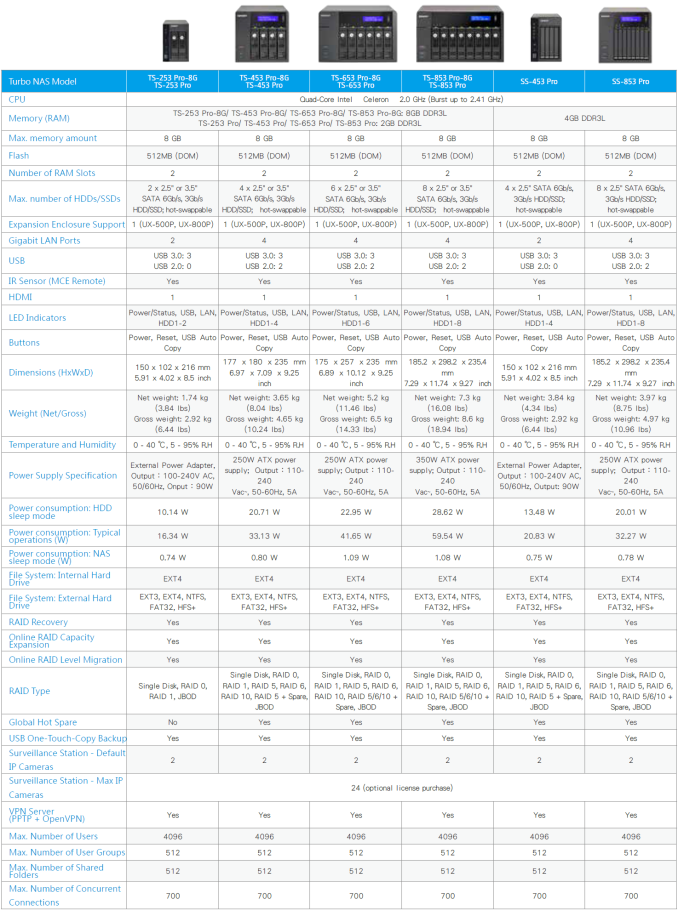
The launch of the QNAP TS-x51 series was covered in great detail. QNAP took the lead over other NAS manufacturers in opting for the 22 nm Atom SoCs. While we were expecting the first Silvermont-based NAS units to use either Avoton or Rangeley, QNAP surprised us by opting for Bay Trail-D with the Celeron J1800. The advantage was that the Celeron J1800 included the Quick Sync engine, which enabled some nifty multimedia features targeting home consumers. Fast forward a few weeks, and we have QNAP's play targeting business users using the same platform. The difference in the hardware relates to the choice of the Bay Trail-D part. Instead of the Celeron J1800 (which was a 2C/2T part), we have the Celeron J1900 (a 4C/4T part). While the 2-bay version comes with 2x GbE ports, the others come with 4x GbE ports. All the innovative features from the TS-x51 series (hardware transcoding and Virtualization Station, mainly) are present in the x53-Pro series too. Due to the availability of more resources, it is possible to run two VMs concurrently in the x53 Pro (compared to one in the x51). Since we have already touched upon the two main features in our x51 launch piece, we will not discuss them in detail here. QNAP has bundled all the business-oriented features of the x53 Pro under the QvPC umbrella. QNAP projects using the x53 Pro NAS as a business PC in addition to fulfilling the tasks of a SMB networked storage device. The display is driven through the HDMI port and the interface is through the HD Station package (Hybrid Desk). Three 'views' are made available: The HD Station package also supports touchscreen monitors. Since Virtualization Station is supposed to soon support Android VMs, this is going to be a nifty feature. Another SMB-targeted feature in QTS 4.1 is IT Management Station, based on Mandriva Pulse. It enables management of IT resources and applications for the whole business in a simplified manner. Tasks include inventory management, remote control, cloning, deployments and backup / restore. The x53 Pro series (like the x51 series) also supports the UX-500P / UX-800P expansion towers. Using these, consumers can add 5 or 8 bays to their existing NAS by connecting via an USB 3.0 port. The various models in the x53 Pro series, along with their specifications, are provided below.
Interestingly, QNAP has two SS- models which support only 2.5" drives. It looks like the market for NAS units which support only 2.5" drives is slowly taking off. Earlier this year, we saw the introduction of Synology's DS414slim sporting a Marvell ARMADA 370 SoC. However, these are based on Bay Trail Celerons, and definitely much more powerful. With SSDs becoming cheaper by the day, all-flash arrays will soon be within the reach of even SMBs. Units such as the SS-453 Pro and SS-853 Pro are well-suited to tap into that market. | ||||||||||||||||||||||||||||||||||||||||||||||||||||||||||||||||||||||||||||||||||||||||||||||||||||||||||||||||||
| 11:10p | NVIDIA FY 2015 Q2 Financial Results
On Thursday August 7th, NVIDIA released their results for the second quarter of their fiscal year 2015. Year-over-year, they had an excellent quarter based on strong growth in the PC GPU market, Datacenter and Cloud (GRID), and mobile with the Tegra line. GAAP Revenue for the quarter came in at $1.103 billion which is flat from Q1 2015, but up 13% from $977 million at the same time last year. Gross margin for Q2 was up both sequentially and year-over-year at 56.1%. Net income for the quarter came in at $128 million, down 6% from Q1 and up 33% from Q2 2014. These numbers resulted in diluted earnings per share of $0.22, down 8% from Q1 and up 38% from Q2 last year but beating analysts expectations.
The GPU business is the primary source of revenue for NVIDIA, and includes GeForce for desktops and notebook PCs, Quadro for workstations, Tesla for high performance computing, and GRID for cloud-enabled graphic solutions. This quarter, the GPU revenue rose 2% over Q2 2014 with $878 million in revenue. This is down 2% from the previous quarter due to the seasonal decline of consumer PCs. Revenue from the PC GPU line rose 10% over last year and was helped by the introduction of the GeForce GTX 750 and 750 Ti Maxwell based boards. They are also seeing growth in the Tesla datacenter business. Quadro revenue also increased, citing strong growth in mobile workstations. The mobile side of NVIDIA hasn’t seen as many product wins compared to Qualcomm, but the Tegra business is still growing strongly for NVIDIA. Tegra revenue was up 14% from Q1 2015, and 200% from Q2 2014 with a total revenue of $159 million for the quarter. Tegra continues to have strong demand in the automotive infotainment sector, with a 74% growth in that market year-over-year. This could be a lucrative market, with automotive systems generally locking in for at least several years compared to the mobile sector which might see a product replaced in less than a single year. The Tegra K1 has just come to market though, and it has shown itself to be a capable performer and may win some more designs soon. The last avenue of income for NVIDIA is $66 million per quarter in a licensing deal with Intel.
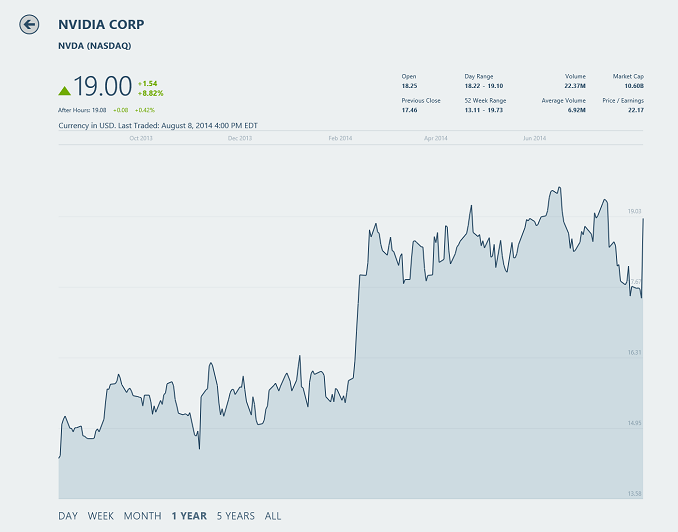
The company projected this quarter to be flat on revenue as compared to Q1, and they were exactly right. Projections for Q3 2015 are for revenue of $1.2 billion plus or minus 2%. During the quarter, $47 million was paid in dividends and NVIDIA purchased 6.8 million shares back from investors. This brings them to $594 million of the $1 billion promised to shareholders for FY 2015. The next dividend of $0.085 per share will be paid on September 12th to all stockholders of record as of August 21st. It was an excellent quarter for NVIDIA, and their stock prices jumped after the numbers were released. All segments of the company are growing at the moment, and with the recent release of the Tegra K1 they can only be hoping to have another strong quarter of mobile grown in Q3 after a great 200% jump in Tegra revenue since last year. The stronger than expected PC sales have helped their biggest business as well, with the GPU division up 2%. CEO Jen-Hsun Huang has worked to bring the company a more diversified portfolio, and with the recent gains in mobile and datacenter computing, the company has certainly had some recent success. | ||||||||||||||||||||||||||||||||||||||||||||||||||||||||||||||||||||||||||||||||||||||||||||||||||||||||||||||||||

| << Previous Day |
2014/08/10 [Calendar] |
Next Day >> |