[Most Recent Entries] [Calendar View]
Wednesday, August 27th, 2014
| Time | Event | ||||||||||||||||||||||
| 2:24a | HTC Announces Desire 510: First 64-bit Android Phone
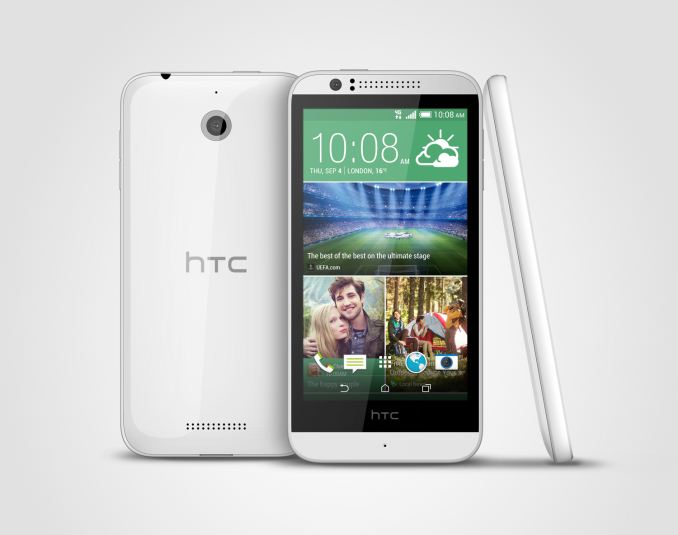
While normally one might expect high end phones to get the latest and greatest features first, this time we see a bit of a surprising reversal. The Desire 510 is HTC's first 64-bit phone, and the first announced device with Snapdragon 410. For those that aren't familiar with Snapdragon 410, it has four Cortex A53 CPU cores running at 1.2 GHz, along with an Adreno 306 GPU which suggests that it is a mild modification of the current Adreno 305 GPU that we see in the Snapdragon 400. Overall, this should make for a quite fast SoC compared to Snapdragon 400, as Anand has covered in the Snapdragon 410 launch announcement. While it may seem strange that ARMv8 on Android phones is first to appear on a budget smartphone, it's quite easy to understand how this happened. Looking at Qualcomm's roadmap, the Snapdragon 810/MSM8994 is the first high-end SoC that will ship with ARMv8, and is built on a 20nm process. As 20nm from both Samsung and TSMC have just begun appearing in shipping chips, the process yield and production capacity isn't nearly as mature as 28nm LP, which is old news by now.
At any rate, outside of the SoC the Desire 510 is a relatively standard budget phone. As this phone ships with Android 4.4 it's likely that it is running in AArch32 mode only, with AArch64 coming with Android L. The display is a 4.7" size, with FWVGA resolution (854x480) which makes for a rather low 208 DPI. This will be the cheapest LTE phone in HTC's product line, and also has support for a Dot View case. I've included the rest of the specs below, but for the most part the key point of interest is the SoC.
The only additional comment I have to make is that there is no 5 GHz WiFi. This is probably a WCN3620 part like the Moto G. While there's no word on pricing, HTC will have to price this near the price of the Moto G for it to be reasonably competitive. The Desire 510 should find its way to Europe, Asia, and the United States. | ||||||||||||||||||||||
| 7:00a | Seagate's Intel Rangeley NAS Pro 4-bay Review Seagate recently rebooted their NAS offerings, completely revamping their 2013 Business Storage lineup and dropping that software platform altogether. In its place, they adopted a Debian-based offering, NAS OS, development of which was started by LaCie prior to their acquisition by Seagate. In their 2014 lineup, Seagate has two classes of products, the NAS and the NAS Pro. While the former is suitable for workgroups of 1 to 25 clients, the Pro version pushes that up to 50. Read on for results from our evaluation of the 4-bay NAS Pro offering. | ||||||||||||||||||||||
| 9:15a | NVIDIA & VMware Preview GRID vGPU & Tegra K1 Chromebook Support
NVIDIA has been anything but shy about their GPU virtualization aspirations, making it a focal point for the company’s development since the launch of their first GRID cards back in 2012. The company sees GPU virtualization as becoming increasingly important for enterprises – just as CPU virtualization has over the last decade – and in the last 2 years has been working on executing a plan on break into the GPU virtualization market. Their hardware was in many senses the easy part, and served to solve the chicken and egg problem that many technologies face. The hard part? Bringing up the software ecosystem to make use of this hardware. Which is why the company is particularly excited about this year’s VMworld conference, VMWare’s annual virtualization technical conference. After seeding the market with hardware and spending their time working with major virtualization software developers such as VMWare and Citrix, NVIDIA’s efforts are finally coming to fruition as these products integrate support in their hypervisors for the GPU virtualization mechanisms required to make the most of NVIDIA’s hardware. To that end NVIDIA and VMWare are announcing a pair of NVIDIA-centric developments from this year’s show. First and foremost, GRID vGPU support on VMware’s vSphere product is nearing completion. With the final version expected to be launched next year, NVIDIA and VMware are now in the process of launching an early access program for existing users to begin end-user trials.
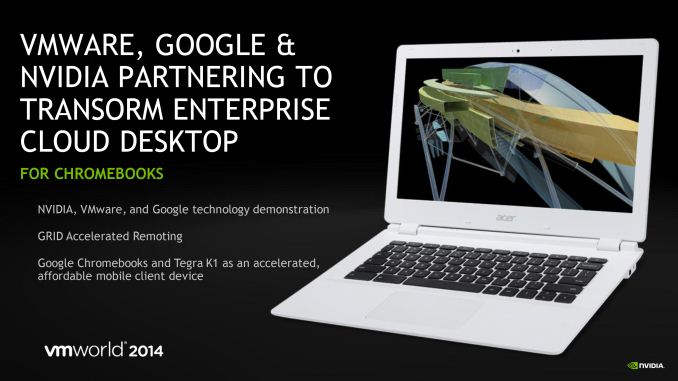
This program is targeted at existing GRID users who are already making use of VMWare’s more limited functionality vSGA and vDGA modes, which utilize graphics API wrappers or directly mapped (1:1) GPUs respectively. With vGPU support now up and running, clients can now experiment with time sharing the GPUs directly. This offers potentially much greater density than vDGA’s directly mapped GPUs, but is still going through real hardware and allowing full access to NVIDIA’s GPU drivers and features instead of the much more limited generic Direct3D 9ish feature set that vSGA offers. In NVIDIA’s world vGPU support doesn’t fully supplant either vSGA or vDGA, but it offers a middle ground between the high density of vSGA and the performance of vDGA, while also offering a higher density option that maintains full GPU access and functionality. Meanwhile NVIDIA’s second announcement of the day is focused on the client side of the usage model, specifically when it comes to Chromebooks. As previously announced by Google and VMware, the firms have been working to bring VMware BLAST support to Chromebooks, and today NVIDIA is announcing that they will be the hardware launch partner for this project. The company’s Tegra K1 SoC will be the first Chromebook SoC to support BLAST, with NVIDIA leveraging K1’s hardware video decoder to decode the BLAST video stream.
Acer’s recently announced K1-powered Chromebook 13 devices will in turn be the first Chromebooks out the door with this functionality. With the Chromebook software stack already bordering on being a thin client environment, NVIDIA, Google, and VMware believe using Chromebooks as actual thin clients is a natural extension of the device’s functionality. Meanwhile Chromebooks’ mass-market appeal means that the cost of these devices kept low due to their high production volume, allowing for what amounts to a 13” 1080p thin client laptop to sell for under $300, a much lower price than previous thin client devices.
Ultimately for NVIDIA this furthers their own efforts in a twofold manner. By providing a strong economic incentive for virtualization this helps server hardware sales, but it also means NVIDIA gets a piece of the pie through client hardware sales. Meanwhile for VMware this furthers the reach of their own virtualization platforms, both figuratively and literally by getting more laptop-style thin clients on to the market. Finally, as part of their keynote presentation, VMware has a short video from NVIDIA on the announcement, including a brief showcase of the Chromebook thin client in action.
| ||||||||||||||||||||||
| 10:20a | Dropbox Enhances Dropbox Pro With 10x the Storage and New Features
Dropbox was one of the first of the major cloud file storage and sharing services that still exist today. But since its inception, there has been increasing competition from other companies. One way that these companies have competed is on their features for creation and collaboration. Microsoft offers Office, and Google offers Docs, Sheets, and Slides. Another area of competition has been with pricing and storage. All these services offer their user a certain amount of free storage, with options to pay a monthly or annual fee to upgrade to a larger amount. For quite some time now there has been a disparity between the price per gigabyte of storage on Dropbox and the price on Microsoft OneDrive and Google Drive. Microsoft offers 1TB (defined as 1024GB) of storage plus a Microsoft Office subscription for a fee of $6.99 per month for a single user, or $9.99 per month for a family of up to five people to share plus 5 Microsoft Office installs. Google Drive also offers 1TB (defined as 1000GB) for $9.99 per month. Until today Dropbox Pro offered only 100GB to subscribers paying $9.99 per month, but with this update Dropbox is bringing their pricing in line with the competition and giving Dropbox Pro users 1TB (defined as 1000GB) of storage. This 1TB tier is now the only plan for Dropbox Pro, and I personally think some users would have appreciated a less expensive plan that maintained the old 100GB of space. The enhancements to Dropbox Pro also include new features on top of the greatly increased storage. Dropbox Pro users now have access to new sharing controls like passwords on shared links, shared links that expire after a certain amount of time, and view-only permissions on shared folders. A new remote wipe feature has also been created to be used in the event that a device is lost or stolen. It looks like competition in the cloud storage space is really paying off for users. With Dropbox, Microsoft OneDrive, and Google Drive all adopting essentially the same pricing it's now up to Apple to deliver their new iCloud pricing and replace their current price of $100 per year for a measly 50GB of storage. | ||||||||||||||||||||||
| 11:00p | LG Announces the G Watch R
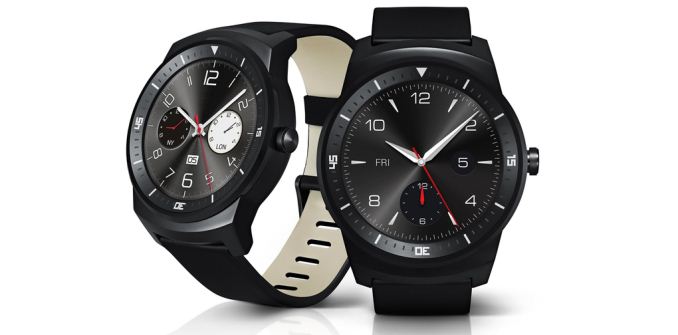
It looks like LG really isn't keen on waiting for IFA to reveal some of its new products. Yesterday we detailed the announcement of the LG G3 Stylus, and today LG is giving a sneak peak at its first smartwatch with a round face. It's called the LG G Watch R, and as you may have guessed, the R stands for round. At its core, the G Watch R is basically the same device as the original G Watch. It uses Qualcomm's MSM8096 quad Cortex-A7 part running at 1.2GHz, paired with an Adreno 305 and 512MB of RAM plus 4GB of NAND. It also retains the G Watch's IP67 rating for submersion in water up to 1 meter deep for 30 minutes. The battery receives a small 10mAh bump from 400mAh to 410mAh. A heart rate monitor has been added, taking away one of Samsung's points of differentiation with their Gear Live smartwatch.
The real changes come with the display and the build. The original G Watch has a square display. The G Watch R sports a 1.3" plastic OLED (P-OLED) display with a 320x320 resolution (which likely means the vertical and horizontal resolution at the watch's widest points in those directions) that takes up 100% of the watch face. This contrasts with the yet to be released Moto 360 which has a 1.5" rounded display but has a segment at the bottom which isn't part of the usable display area. The display is surrounded by a stainless steel bezel and frame, and comes with a leather strap. The G Watch R is the first smartwatch I've seen that really looks like a traditional analog watch. The Moto 360 is definitely up there with it, but for me the gap in the display on the Moto 360 takes away from it significantly. LG says that the G Watch R will be available in Q4 of this year. There's no word on pricing but it'll likely be higher than the standard G Watch which currently sells for $229. More details about the G Watch R will be revealed soon at IFA Berlin. Source: LG via Android Police | ||||||||||||||||||||||
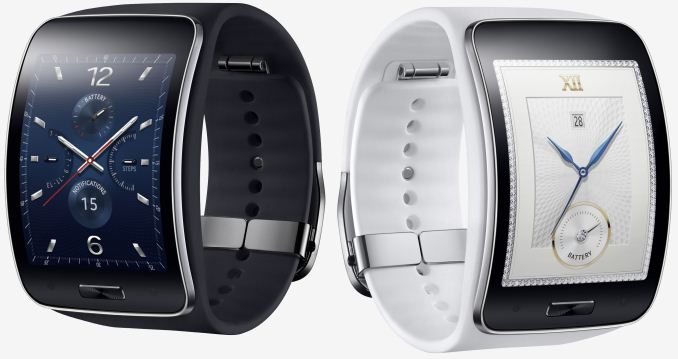
| 11:45p | Samsung Unveils the Curved Gear S Smartwatch With Tizen and 3G Connectivity
LG isn't the only company announcing a new smartwatch today. Samsung has announced a new device in their line of Gear smartwatches. Their latest watch is the Samsung Gear S, and it's one of the only smartwatches on the market that sports 3G connectivity. This allows it to function on its own without having to be forever tethered to a smartphone to access notifications and other content. The other unique feature of the Gear S is its 2" curved OLED display with a resolution of 320x480. Samsung believes that a convex display allows for a more ergonomic and comfortable smartwatch. With its curved rectangular display the form factor of the Gear S is like a cross between fitness bands and smartwatches. Inside it features an unnamed 1GHz dual core CPU paired with 512MB of RAM and 4GB of NAND. Samsung rates the 300mAh battery inside for two days of usage. Like most of Samsung's other smartwatches, it includes a heart rate sensor and IP67 dust and water resistance rated for 30 minutes of submersion in up to 1 meter of water. Unlike most other smartwatches, the Gear S runs Samsung's Tizen operating system rather than Google's Android Wear platform. It includes some of Samsung's software like S Health and their smartwatch music player. Between Tizen's built in applications and the watch's support for WiFi and 3G networking, the Gear S may be the first smartwatch that can act as its own device rather than an extension of a user's smartphone. Samsung will begin sales of the Gear S in early October. Pricing is yet to be announced. |




| << Previous Day |
2014/08/27 [Calendar] |
Next Day >> |