[Most Recent Entries] [Calendar View]
Wednesday, October 8th, 2014
- HTC One (M7)
- HTC One (M8)
- HTC One E8
- HTC One Mini
- HTC One Mini 2
- HTC One max
- HTC Desire 816
- HTC Desire 820
- HTC Butterfly 2
| Time | Event | ||||||||||||||||||||||
| 9:00a | MSI GT72 Dominator Pro: Performance Preview NVIDIA just launched their new GTX 980M/GTX 970M GPUs, and unfortunately we were unable to get a notebook in time for testing… which just changed a few hours ago. With an MSI GT72 Dominator Pro in hand, we're ready to see just how fast the GTX 980M is when it comes to playing games. Here's a hint: the 1080p display may prove to be the limiting factor in quite a few titles. | ||||||||||||||||||||||
| 3:00p | The AnandTech Guide to Video Card Overclocking Software Video card overclocking has become a very popular topic amongst gamers and PC enthusiasts these days. With the release of next generation games around the corner and the growing popularity of resolutions beyond 1080p, overclocking is becoming increasingly important to users looking to squeeze the most performance possible out of their video cards. It’s been more than a decade since video card overclocking was first introduced, and while the core concept remains the same, the software has improved to make it easier and provide additional features and functionality. If you're looking to boost performance on your GPU, we're rounding up the most popular utilities to find out their pros and cons. Read on for the full guide of GPU overclocking software. | ||||||||||||||||||||||
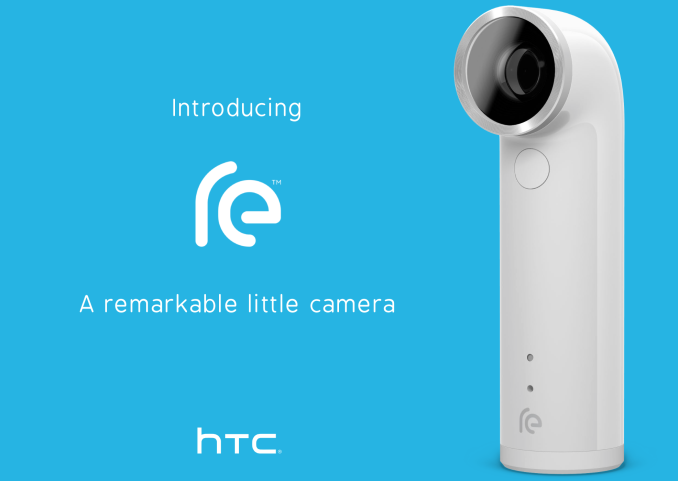
| 4:45p | HTC Announces RE, an Action Camera: Hands On
Today is HTC's camera-centric Double Exposure event in New York. In addition to announcing the new Desire EYE, HTC is announcing a new device that occupies it's own space in HTC's portfolio. It's a small camera called the RE. As far as cameras go, the RE is fairly unique. At first glance it looks like it could be something like a flashlight, but the large glass circle is really the cover for a 16MP camera housed inside. The device is shaped so it can be held and operated with a single hand. At 65.5 grams it's also very light. MicroSD is used exclusively for storage, with an 8GB card shipping by default and support for up to 128GB MicroSDXC. An 820 mAh (3.116Wh) battery provides up to 1200 captured photos or 100 minutes of continuous video recording.
The RE is the opposite of what HTC has done with their cameras in the smartphone space. HTC is also keen to emphasize that this doesn't compete with GoPros. They were one of the first companies to start putting manual controls for white balance, ISO, and shutter speed in their camera application. With the RE, HTC is trying to create a highly automatic photography experience where all that's required is the press of a button. To do this, HTC has eliminated as many buttons, toggles, and controls as possible. The RE has no on/off button. Instead, it has a sensor in the grip which detects when it is being held and turns the camera on which uses an MCU which is likely to be a Cortex M solution. The only buttons are the shutter button on the back where the user's thumb is placed, and a slow-mo video toggle on the front underneath the lens where the user's index finger is placed. There are no dials, and no viewfinder or LCD.
Composition is an essential part of photography. To allow users to take photos without any viewfinder, HTC has used a 16MP 1/2.3" CMOS sensor with an F/2.8 aperture and a very wide 146 degree field of view which is equivalent to 17mm. The camera's wide field of view means that as long as users have a rough idea of what is being captured by the camera and point in the direction of the subject, they can crop and align photos after they are taken without cutting off any essential details. In practice, the quality is passable, although hurt by the wide field of view which reduces peak resolution in addition to the half second or so of shutter lag. The gallery below has sample photos from the RE, although HTC cautioned that both the hardware and software were non-final and that there may be significant differences in the final product. Gallery: HTC RE Sample Shots
     
HTC has also announced a line of accessories for the RE, which are pictures above. The extended battery has a novel design, screwing into to the 1/4" tripod mount on the bottom of the RE and using a retractable micro USB plug. While the camera has an IP57 rating for dust resistance and immersion in 1 meter of water for 30 minutes, accessories like the extended battery do not. Users who plan on going deeper underwater should invest in the protection pack which includes a cap that improves water resistance to IP58 which allows for immersion in 3 meters of water for up to 2 hours.
While the camera can function on its own, it also integrates with Android and iOS devices that support Bluetooth 4.0 LE. The RE app that will be launching with the camera will work as a photo and video manager, and a live viewfinder. Photos can be easily shared with social networks, and automatically backed up to Dropbox or Google Drive. HTC plans to launch the RE in the United States by October, and will expand to other regions afterward. We expect pricing in the US to be around 199 USD at launch. While it remains to be seen whether the RE is the first of many new action cameras, HTC seems to be exploring new product categories instead of following prevailing industry trends. | ||||||||||||||||||||||
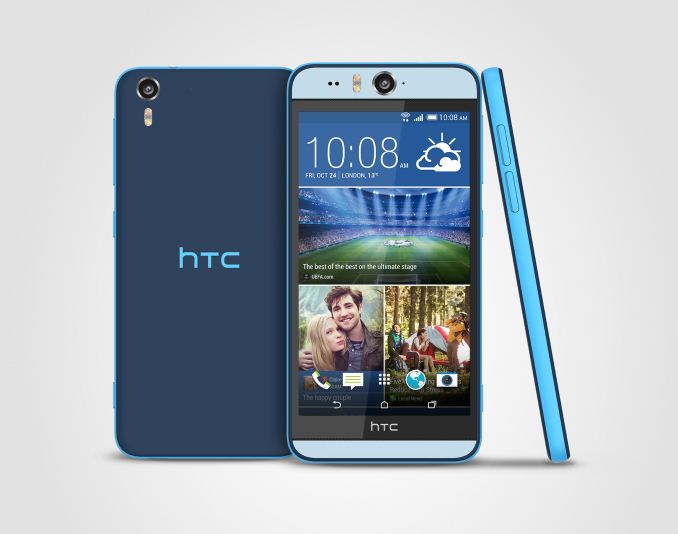
| 4:45p | HTC Announces the Desire EYE
Today at their Double Exposure event in New York, HTC has announced the Desire EYE. The major feature on the Desire EYE is its 13MP front facing camera which should hopefully take some of the best selfies of any smartphone. The internals are also an interesting story. While devices sporting HTC's Desire branding are typically more budget oriented devices, the Desire EYE packs significantly more powerful hardware than other Desire device. It has a 5.2" 1080p IPS display, and Qualcomm's Snapdragon 801. BoomSound continues to be present with two TFA9887 speaker amps. The full list of specifications has been laid out below.
Owing to its 5.2" display, the Desire Eye has a larger height and width than HTC's M8 and E8 phones. At 8.5mm it's 1.35mm thinner than both of them, and at 154 grams its mass sits between the lighter E8 and heavier M8. Also similar to the E8 and M8 is its hardware platform which includes Qualcomm's MSM8974AB at 2.26GHz, 2GB of LPDDR3 RAM. The finish on all color variants is matte plastic throughout, and the two-tone "Doubleshot" finish really makes for an even better design than what we saw in the E8. The power button has also been moved to the side, and we see a new two-stage camera button. The latter is definitely useful, but the pressure needed to trigger the second stage is a bit too high in my experience.
The Desire EYE also sports water resistance, rated for immersion in 1 meter of water for up to 30 minutes. HTC has gone the extra mile here by implementing water resistance without annoying plastic flaps that are easily torn off. Instead, we see rubber gaskets around key areas and "short protection" on the USB port. 802.11ac isn't present, and the battery is on the small side, but overall the Desire EYE has solid specifications.
Like I mentioned in the beginning, the major marketing and selling point for the phone is definitely the front facing camera. The Desire EYE uses the same Sony IMX214 sensor for the front and rear cameras. IMX214 is formidable as a sensor for rear cameras, and this is the first time we're seeing it also implemented as a front-facing camera. By using two separate cameras instead of a rotating upper section like on the Oppo N1, HTC has been able to customize the cameras for their intended use case. The rear camera has a wider F/2.0 aperture and a longer 28mm focal length than the front-facing camera. The front-facing camera is optimised for a wider 87 degree field of view with its shorter 22mm focal length. Both cameras have a max ISO of 3200 and a max exposure time of 1/9s. In some casual testing it seems that there is a bit of color noise in low light, but it's otherwise well-suppressed. Detail is definitely good but there're noticeable sharpening kernels at the base settings which is a bit disappointing. The rear camera seems to have detail similar to the Butterfly 2, which is comparable to most 13MP cameras in flagships today.
HTC is including a number of software features that add additional camera functionality, collectively called the HTC EYE Experience. HTC's face tracking keeps the user's face in focus and crops the image to frame it. Up to four people can be tracked and framed at the same time. HTC's Split Capture feature combines simultaneously taken photos or videos with the front and back cameras into a single image or video. Voice Selfie allows the front camera to take a photo by smiling, and to take a video by saying "action" or "rolling" HTC is also bringing over features that were introduced earlier this year with the Desire 820. Face fusion allows the user to merge their face with that of their friend or another person. Live makeup allows the user to adjust the level of skin smoothing with a live preview before capture. Some of the HTC EYE Experience features will roll out to the following HTC devices in the coming months: HTC plans to roll out the Desire EYE on carriers in Europe, the Middle East, Africa, Asia, and the United States from October onward. Pricing is said to be around that of the One (E8), and should supersede the One (E8) in those markets. | ||||||||||||||||||||||
| 7:00p | AMD Appoints Dr. Lisa Su as President & CEO, Rory Read Steps Down
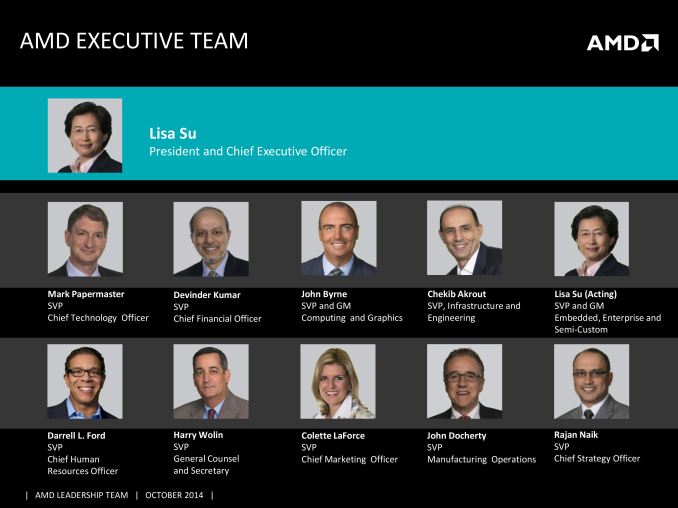
As part of AMD’s broader restructuring efforts, back in June the company announced a business reorganization that would see the company organized into two major groups, the Computing and Graphics Business Group, and the Enterprise, Embedded and Semi-Custom Business Group. Furthermore at the time AMD promoted Dr. Lisa Su to the position of Chief Operating Officer (COO), a position that previously had been unfilled at AMD for some time. Now 4 months later it turns out that Lisa’s time as COO will be a short one. Today AMD has announced that effective immediately, current CEO Rory Read will be stepping down. In his place Lisa is being promoted to President and CEO of the company, making her the 5th CEO in the company’s history.
With Lisa’s previous promotion to COO, she had essentially already been promoted to AMD’s second-in-command under Rory, so this is a straightforward promotion over at AMD. More significantly, given the resurrection of the COO post there has been good reason to suspect that Lisa was bound for a promotion to CEO sooner than later. And now that AMD has finally promoted Lisa to CEO, they are confirming that the above was exactly the plan, and that Rory has been preparing her for the CEO role for some time. For his part, the retirement of Rory signifies that AMD’s transition is nearly complete and that his role is coming to an end. Rory was brought on in 2011 to restructure and stabilize the company after its struggles late in the last decade and at the start of this one, with an emphasis on diversifying the company beyond its traditional (and troubled) x86 and graphics products. While AMD remains significantly vested in those products, they now have a sizable business presence in other fields/technologies such as ARM processors and semi-custom IP designs, which as part of AMD and Rory’s plans ensure the company isn’t overexposed to any single business. And on the financial side AMD is unfortunately still operating at a loss, but if all goes according to plan that should be coming to an end this year. Though AMD has never called Rory a transitional CEO, his actions overhauling AMD over the last 3 years and now stepping down as CEO after the fact serve to cement the fact that Rory was brought on board to execute the necessary restructuring rather than to lead the company in the long term. AMD is still in the process of developing some of the silicon that will be the basis of these business plans – including the x86 and ARM versions of the K12 processor – so it will be a bit longer yet until the company can fully execute on their ambidextrous plans, but on the business and development side they have completed the necessary changes to allow that. With those changes behind them AMD is now ready to move out of their transitional phase and in to their new position as a diversified IP designer, which is what has led to Rory’s retirement and Lisa’s promotion. Internally for AMD and its product lineups, Lisa’s promotion should not result in significant changes. She has already been overseeing much of AMD throughout her career there – first as SVP of Global Business Units and then as COO – meaning that although the CEO is changing, the person overseeing much of AMD’s product lineup is not. Working alongside AMD’s CTO, Mark Papermaster, AMD’s product leadership is more or less unchanged.
Meanwhile the transition from Rory to Lisa means that AMD is also once again being led by an engineer (and a very capable one at that), which AMD leadership is treating as a great strength going forward. Lisa holds a doctorate in electrical engineering from MIT and has previously held positions at IBM and Texas Instruments, including semiconductor research and development, and is much of the reason she joined the company at the SVP level in 2012. Being the CEO is about business as much as it is about technology, but with AMD’s business situation settled by Rory, this should give Lisa a chance to settle in and focus on driving and improving AMD’s technological situation, which is ultimately what will make or break the company. AMD now has a number of very capable engineers leading the company at multiple levels, including Lisa, CTO Mark Papermaster, and K12 designer Jim Keller, so the company should be in a good position going forward. Finally, this promotion means that AMD’s executive lineup has been slightly shuffled once more. The COO position was recreated for Lisa and now it seems just for Lisa; it will not be filled now that she is CEO, and those responsibilities will be staying with her. Meanwhile AMD is also noting that while Rory is stepping down as CEO effective immediately, he will be staying with the company in an advisory role to help see out the company through the rest of 2014. |






| << Previous Day |
2014/10/08 [Calendar] |
Next Day >> |