[Most Recent Entries] [Calendar View]
Tuesday, January 6th, 2015
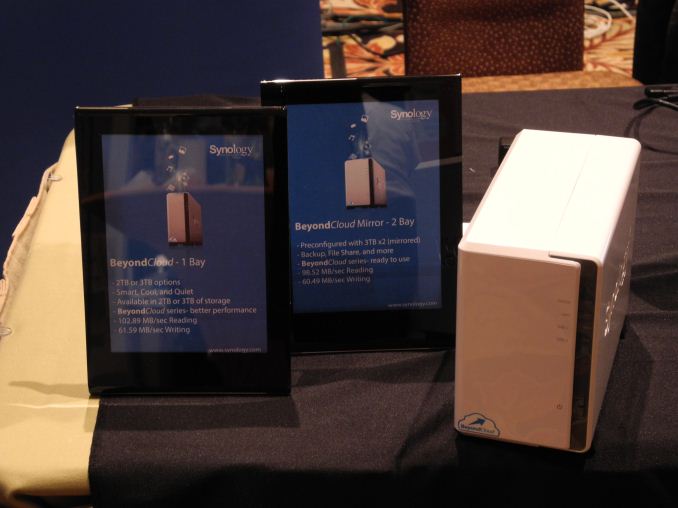
- BC115j 1200: 1-bay, 2TB hard disk pre-installed for $180
- BC115j 1300: 1-bay, 3TB hard disk pre-installed for $240
- BC214se 2300: 2-bay, 2x 3TB hard disks in RAID-1 for $370
| Time | Event | ||||||||||||||||||||||||||||||||||||||||||||||||||||||||||||
| 10:00a | Zotac ZBOX CI320 nano Review: A Fanless Bay Trail-M mini-PC Over the last couple of years, mini-PCs in the ultra-compact form factor (UCFF) have emerged as one of the bright spots in the troubled PC market. Zotac is no stranger to this segment. In fact, their nano xs units came to the market before the Intel NUC, even though the NUC is credited with kickstarting the UCFF trend. Intel's Bay Trail family of SoCs has proved to be an affordable and low-power candidate for UCFF PC units. We have already evaluated a couple - an actively cooled GIGABYTE BXBT-1900 and and the fanless ECS LIVA. This review provides some insights into what the passively cooled Zotac ZBOX CI320 nano brings to the market. | ||||||||||||||||||||||||||||||||||||||||||||||||||||||||||||
| 10:30a | Synology's BeyondCloud Series - NAS Units made User-Friendly
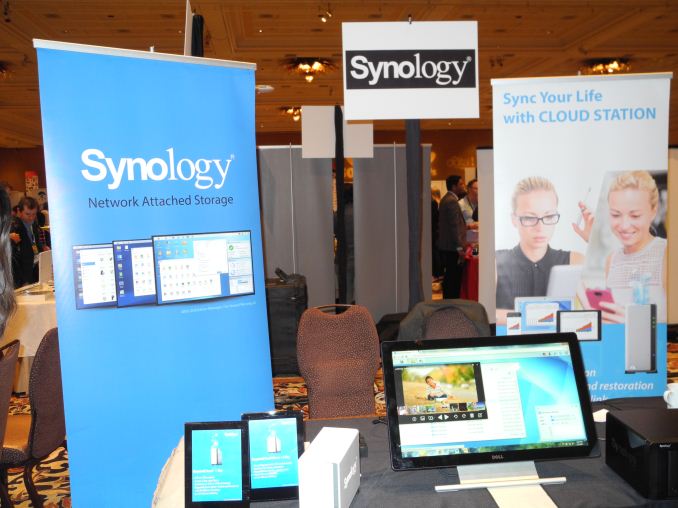
Synology has put out some interesting updates (both expected as well as unexpected) in the lead up to the new year. At CES 2015, the focus is on a new series of NAS units to complement the traditional Disk Station (DS) lineup. The BeyondCloud (BC) package takes the traditional DS unit, preconfigures it with disks and sets up an appropriate volume. Certain packages (such as the multimedia-focused Photo Station and Video Station) are also pre-installed. Newly purchased BeyondCloud NAS units are up and running immediately after purchase. As I have mentioned before in previous Synology reviews, setting up a JBOD or RAID-1 volume with fresh raw disks involves optimization of the configured file system. It often takes the better part of a day. The BeyondCloud series manages to hasten the setup process, and it is particularly useful for SMBs and busy tech-savvy users On the other end of the spectrum, we have this new lineup making NAS units more friendly to the average consumer - those who are not comfortable with aspects such as shared folders and mapping network drives. In this area, I think Synology has a chance to jostle for space with the Western Digital EX2, Seagate Personal Cloud, LenovoEMC EZ Backup and Media Center and other such products which come with disks pre-installed and target home users. Given the ease of use of the DSM UI, home consumers should find the BC series a welcome competitor in this space. The BC series currently has three members: The units are based on the DS115j and the DS214se. Both of them have a Marvell ARMADA 370 as the main SoC. The concept is great (albeit one that Western Digital and Seagate have already implemented in their consumer-focused personal cloud solutions). Synology can differentiate a bit by offering higher-end systems (4- and 5-bay ones) in a BeyondCloud configuration.
We met up with Synology at Pepcom, and they had the units on display, along with the SMB-focused DS2015xs and the DS414slim. On the CES show floor, they will also be having demonstrations of the new Surveillance Station (which doesn't require Java on the client systems anymore) as well as other features of the latest DSM.
| ||||||||||||||||||||||||||||||||||||||||||||||||||||||||||||
| 12:00p | Corsair Unveils New Flash Storage Solutions
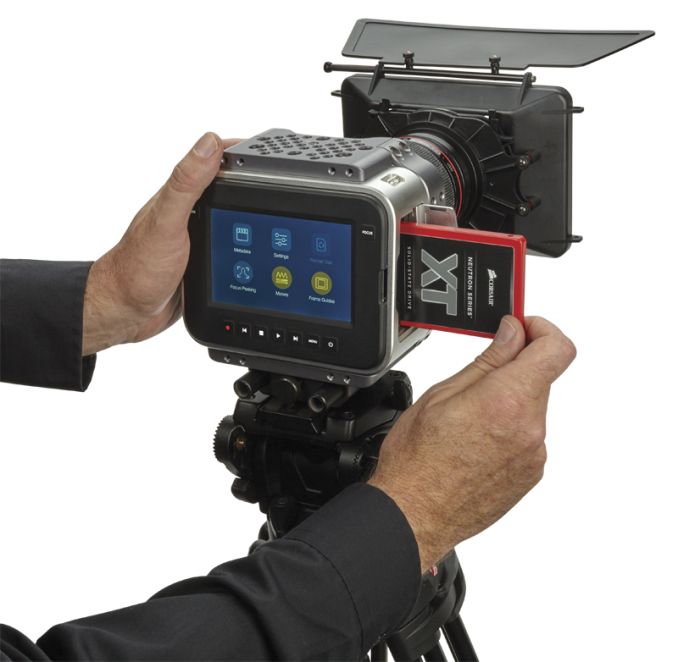
In their long list of new product announcements today, Corsair is also upgrading their top performance SSD drives lineup with the release of the Neutron XT SSDs. We already reviewed the drive and all of its available capacities (240GB, 480GB & 960GB) roughly two months ago, so this announcement is merely for the availability and MSRPs. For those who need a quick refresher, the Neutron XT is the first commercially available SSD with Phison's S10 contoller, which is equipped with Toshiba's A19nm NAND. The Neutron XT didn't set any new records in our tests, but it was a solid middle-class performer and I've been told Corsair is looking into new firmwares to further improve the performance in the future. The Neutron XT will be available immediately with MSRPs of $150 for 240GB, $270 for 480GB and $540 for 960GB. I would have liked to see a bit more aggressive pricing because the Neutron XT isn't fast enough to compete with the 850 Pro and Extreme Pro, but as it stands the Neutron XT is a decent option for those who seek for something in between the value and high-end drives. Gallery: Neutron XT
      Furthermore, Corsair performed a major overhaul of their USB 3.0 drives. The company released two new USB 3.0 flash drive families, the Flash Voyager Slider X1 and Flash Voyager Slider X2, and upgraded the Flash Voyager GS and Flash Voyager GTX families. The Flash Voyager Slider X1 and X2 are visually similar and both are available in capacities between 16GB and 256GB. The difference is their maximum speed, with the X1 and X2 capable of maximum read speeds of 130MB/s and 200MB/s respectively. Of course, both drives are backwards compatible with USB 2.0 equipment but their performance will be limited by the USB 2.0 interface.
Flash Voyager Slider X1 Flash Drive
Flash Voyager Slider X2 Flash Drive
Corsair also upgraded the Voyager GS and Voyager GTX series and reduced their price a little. The Voyager GS is the high capacity series of the company, with the drives ranging from 64GB up to a whooping 512GB. Voyager GS drives have read speeds of up to 260MB/s and write speeds of up to 105MB/s. The Voyager GTX on the other hand is the performance-oriented series. Only two Voyager GTX drives are available, a 128GB and a 256GB version. Both drives have an integrated SSD data controller that allows them to reach read and write speeds up to 450MB/s and 200MB/s respectively.
Flash Voyager GS Flash Drive
Flash Voyager GTX Flash Drive
| ||||||||||||||||||||||||||||||||||||||||||||||||||||||||||||
| 12:00p | Corsair Debuts the Hydro H110i GT AIO Cooler and HG10 N780 Edition GPU Cooling Bracket
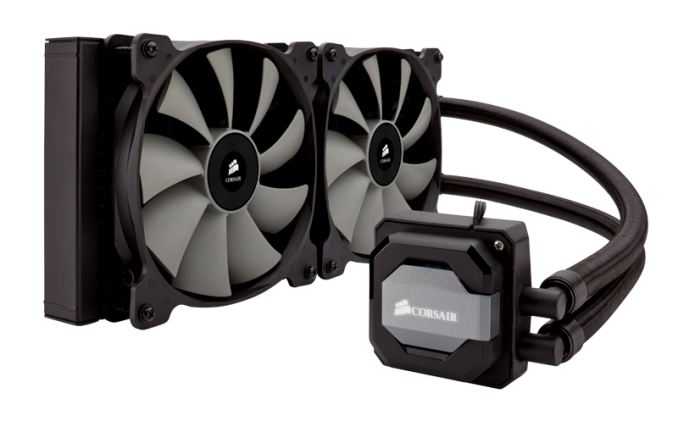
Corsair decided to up the stakes in the AIO liquid cooler market and is releasing the Hydro Series H110i GT cooler, an upgraded version of the H110 that we tested a year ago. The new H110i GT appears to be a mix of the 140mm X 280mm radiator from the H110 and the block-pump assembly from the H100i. There are aesthetic improvements as well, with logo inserts on the block and radiator, lighting of the logo on the pump and sleeved tubing. Finally, it will feature Corsair Link support and will have an MSRP of $129.99.
The company also presented an adaptation of the HG10 GPU Cooling Bracket for NVIDIA GeForce GPUs. The core concept of the HG10 N780 remains unchanged, as it has been simply modified in order to be compatible with reference design NVIDIA GeForce GTX 770, GTX 780, GTX 780 Ti, Titan and Titan Black graphics cards. The HG10 N780 is compatible with every Hydro Series AIO cooler. The HG10 N780 is compatible with every Hydro Series AIO cooler. Much like the normal version, the HG10 N780 will not only cool the GPU but the VRAM and VRMs of the latest NVIDIA cards as well. It will be available with an MSRP of $39.99. | ||||||||||||||||||||||||||||||||||||||||||||||||||||||||||||
| 12:00p | As mainstream as it gets: Corsair announces the Carbine 100R case
Two years ago, Corsair released the Carbide 200R and the $59 case proved to be a remarkable budget-friendly solution. Back then we were wondering "how low can you go" and the Carbide 200R served as the least expensive enclosure Corsair had in their ranks for a long time. That changes today, as Corsair announced the 100R, a slightly smaller version of the 200R that has a MSRP of $49. The small 100R can still hold normal ATX motherboards and PSUs, as well as 5.25" devices and up to four 3.5" drives.
The 100R will be available in two versions. The windowed and windowless (silent) versions will have an MSRP of $49 and $59 respectively. No, that is not a typo, the windowless version is a little more expensive because it includes a layer of sound-dampening material. Visually, the 100R is very similar to its larger, older brother, the 200R. From the pictures that Corsair provides with their press release, we can tell that the major differences lie with the drive cages; there is one less 5.25" bay and the 3.5" cage has been remodeled to use plastic trays. The top exhaust fans are limited to 120mm as well, but they ought to be more than sufficient for a budget-level system.
"The Carbide 100R shatters the stereotype that budget-friendly cases have to be gaudy and poorly designed, " said George Makris, Product Manager for Cases and Cooling at Corsair. "Now gamers and PC enthusiasts have a subtle, functional, and affordable foundation for their next PC." A presentation of the 100R by George Makris can be seen in the following video. | ||||||||||||||||||||||||||||||||||||||||||||||||||||||||||||
| 1:00p | MHL Consortium Announces superMHL: New Standard & New Cable To Drive 8K TV
When the Mobile High-Definition Link (MHL) was introduced in 2010, it was created to solve a simple but none the less daunting problem: how to get power in and digital video out of cell phones and other mobile devices without requiring additional (or more complex) ports, such as what would be required for HDMI. The solution developed by Silicon Image and the MHL Consortium members was the ultimate piggy-back solution, devising a method to handle power and video using just 5 pins (the number of pins in a mini/micro-USB 2.0 connector) and connecting it to MHL-compliant TVs via their HDMI ports. MHL had no port or cable to call its own, but it had an altered protocol based on the same TMDS technology behind HDMI that made it possible to get video off of mobile devices. Flash forward a few years, and while there have been successive versions of MHL – the most recent being MHL 3 – all of these have built on the original design principles of MHL, focusing on the Mobile part of Mobile High-Definition Link while improving the specification. For this reason it came as quite a surprise to us this week when we found out that the MHL consortium was planning on taking MHL beyond its mobile roots and moving into the TV space, greatly extending the features and use cases in the process. With a mandate to provide a cable for 8K video at up to 120fps, MHL is no longer aiming low; with today’s announcement of superMHL, MHL is now aiming for nothing less than the top. superMHL in a nutshell is a pair of improvements to the MHL specification to further improve mobile connectivity and to enable 8K video. First and foremost, the protocol itself is being improved: superMHL doubles the amount of bandwidth available over a single lane to allow for 4Kp60 video, along with defining support for deep color modes (10/12/16bit) and newer color spaces. This alone would be a notable improvement to MHL, especially as H.265 capable phones being to hit the market and the H.265 backers are pushing 4Kp60 video and 10-bit color themselves, necessitating a video interface capable of delivering that data.
However the more dramatic change is in the second improvement coming to superMHL, which is the introduction of the superMHL cable and connector. This unusual development was spurred on by the television manufacturing members of the MHL Consortium, who in developing their future 8K (7680x4320) televisions wanted a single cable that could carry the enormous amount of data required for 8K video with deep color and high frame rates. Compounding matters, the usual TV connector of choice, HDMI, was not going to be ready for the job, as HDMI 2.0 was only planned for up to 4Kp60 video. Consequently TV manufacturers turned to the MHL Consortium, who became tasked with developing a cable and connector standard for 8K video.
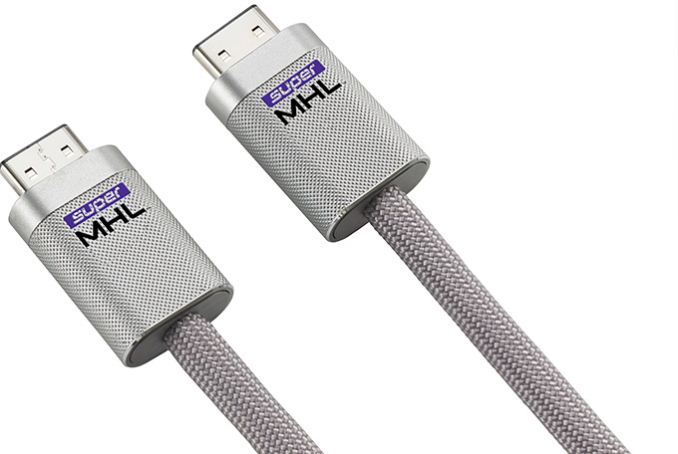
The Consortium’s solution was the suitably named superMHL connector. A reversible connector containing 32 pins, the superMHL is among the densest digital video connectors ever devised, packing those 32 pins in a space roughly the same size as the 19 pin HDMI Type-A cable. With 32 pins the superMHL connector would be capable of carrying 6 lanes of MHL data as opposed to 1 lane on a traditional MHL setup, providing the necessary bandwidth for 8K video, and capable of carrying it two to three meters over a standard (passive) cable. By going this route the MHL standard now serves two masters, mobile and the home, and consequently the standard now covers a much wider range of use cases and potential configurations. superMHL-to-superMHL cables will be the cable necessary for 8K video, and meanwhile USB to HDMI cables will continue to support mobile devices.
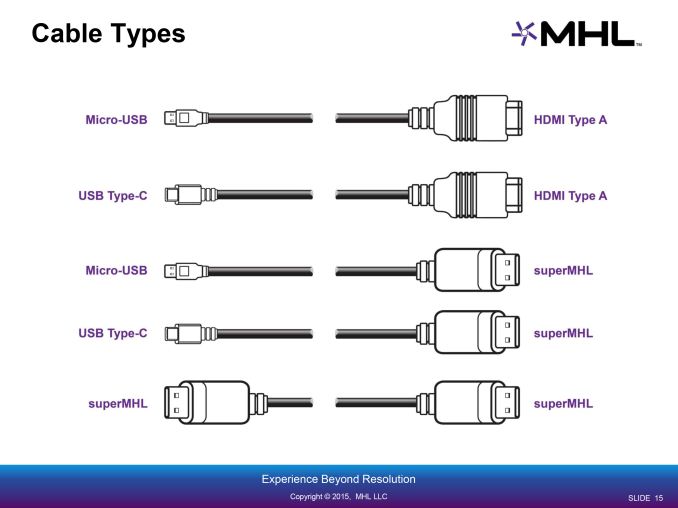
Overall the superMHL standard allows for ether the traditional HDMI connector or the new superMHL connector as a “sink” connector, and no fewer than 3 “source” connectors. Joining the regular micro-USB as a source, USB type-C and the superMHL connector are now supported as source connectors as well. Of these combinations we expect superMHL to superMHL and USB to HDMI will be the most common, especially since 4K TVs can still go ahead and implement superMHL protocol support for 4Kp60 video without using a superMHL port. However if superMHL ports on TVs gain traction, then direct USB to superMHL would become increasingly viable. Meanwhile for USB Type-C in particular, thanks to the Type-C’s alternate mode support, Type-C to superMHL will be able to support 2 or 4 MHL data lanes (versus 1 for micro-USB), leaving the door open to potential mid-bandwidth use cases in the future. Finally, along with the changes to the MHL protocol and physical interface, for superMHL the standard is also having its power and multi-display limits increased. superMHL power delivery will allow for up to 40W (20V @ 2A) versus MHL 3’s 10W, which will allow MHL connections to carry enough power to not just run tablets but to charge them as well. Meanwhile, though currently rarely used in any form, superMHL increases the number of displays allowed in an MHL multi-display configuration to 8 displays, thanks in large part to the bandwidth increases.
Ultimately today’s announcement from the MHL Consortium marks an interesting turn of events in what has otherwise been a complementary relationship between MHL and HDMI. Though this doesn’t make the standards competing standards – especially not when both are based on TMDS technology and both have TMDS owner Silicon Image among their members – this does for the first time create a real degree of overlap between the two. MHL’s place in mobile is as secure as it ever was, but what will come of their home/TV efforts remains to be seen.
At least in the short term superMHL will be the only option for 8K TV, and in fact Samsung already has an 8K TV with superMHL up and running for CES. But how long it superMHL remains the only option for 8K is another matter entirely. Even outside of its higher bandwidth support, superMHL has some other technological advantages such as the reversible connector and the ability to carry power which give it an advantage over HDMI for 4K video, but for most cases this is not going to be a massive advantage. In any case, ignoring the HDMI overlap for the time being, superMHL should still bring tangible benefits for both of its primary markets. With an upgraded protocol capable of supporting 4Kp60, MHL is better than ever for traditional mobile applications. Meanwhile with the new superMHL cable and connector, TV manufacturers eager to get 8K TVs out the door will finally have a single cable standard to drive those TVs with. | ||||||||||||||||||||||||||||||||||||||||||||||||||||||||||||
| 4:17p | HTC Announces the Desire 826
Yesterday at CES, HTC announced the newest device in their lineup of Desire smartphones. Years ago, HTC's flagship devices fell under the Desire brand. In recent years, the Desire brand has been shifted to more budget oriented devices. This new HTC smartphone is the Desire 826, and it follows in the footsteps of the Desire 816 and Desire 820 that came before it. Although it isn't HTC's flagship smartphone, it still has respectable specifications, and in many ways is not far off from today's flagship devices. I've laid out the key specifications of the Desire 826 below.
The Desire 826 has a lot in common with the Desire 820 that was released in September 2014. Both devices use Qualcomm's Snapdragon 615 with 2GB of LPDDR3 memory, 16GB of NAND, and 2600mAh (9.88Wh) battery. However, the Desire 826 has a maximum clock speed of 1.7GHz on its high-power A53 cluster, while the Desire 820 was limited to 1.5GHz. Being an Android 5.0 Lollipop device, the Desire 826 will also be 64-bit enabled out of the gate, while the Desire 820 had to operate in 32-bit mode due to a 64-bit version of Android being unavailable. I still believe having two clusters of Cortex-A53s is silly, but HTC weren't the ones making that decision so it's not something I can really fault the phone itself for.
There are some other notable improvements over the Desire 820. The Desire 826 has a significantly sharper display due to HTC's move from 1280x720 to 1920x1080 on the same panel size. The front-facing camera is the other significant difference between the two devices. While the Desire 820 used an 8MP front-facing sensor, the Desire 826 uses a 4MP UltraPixel sensor with an f/2.0 aperture for the front-facing camera in most markets. This should significantly improve low-light camera performance. In certain unspecified markets, the Desire 826 will use a 13MP f/2.0 sensor instead. Like all of HTC's recent devices, the Desire 826 ships with HTC's Eye Experience software for the camera. The Desire 826 will be available in the Asia-Pacific region by the end of this month, and will expand to other markets afterward. It comes in multiple colors, including but not limited to white, purple, and blue. There is currently no word on what to expect for pricing, but it should be similar to the launch price of the Desire 820. | ||||||||||||||||||||||||||||||||||||||||||||||||||||||||||||







| << Previous Day |
2015/01/06 [Calendar] |
Next Day >> |