[Most Recent Entries] [Calendar View]
Wednesday, January 7th, 2015
| Time | Event | |||||||||||||||||||||||||||
| 3:31a | TP-LINK's Networking Solutions at CES 2015
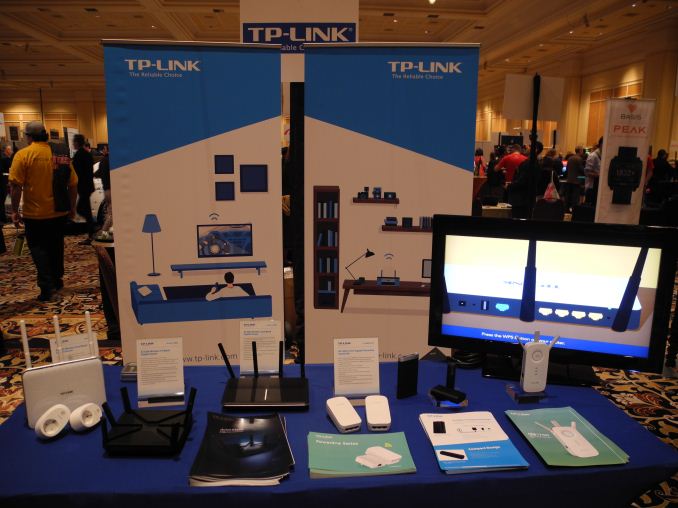
TP-LINK is one of the leading networking solutions vendor in the Asian market. They have been slowly trying to build up a presence in the US, but there has always been a bit of a delay between the launch in the North American market compared to the Asian one. TP-LINK has traditionally worked closely with Qualcomm Atheros, often being one of the first vendors to prepare solutions based on the QCA platforms. At CES 2015, TP-LINK became one of the first vendors to launch a 4x4 MU-MIMO-capable 802.11ac router with the QCA9980 platform. As of the end of last year, Quantenna was the only vendor with a shipping 4x4 MU-MIMO solution. However, this CES has seen the launch / customer shipment of 4x4 MU-MIMO 802.11ac solutions from Qualcomm Atheros, Broadcom and Marvell. We will have a separate piece comparing the various solutions. With reference to TP-LINK, the QCA9980 finds a place in the Archer AC2600. The unit also sports USB 3.0 ports, and other features are what is standard for a flagship model. The Broadcom Xstream platform does find a place in the Archer AC3200. With two 5 GHz radios and a single 2.4 GHz radio, this is the same platform that other vendors are already using (Netgear seems to have had an exclusive for a few months with the Nighthawk X6 R8000). On the powerline side, TP-LINK is staying with Qualcomm Atheros for the AV1200 HomePlug AV2 with MIMO solution. The TL-PA8030 can deliver 1.2 Gbps of throughput theoretically and sports three gigabit ports. It can use all three prongs (power, ground and neutral) for data transmission. The announced products are slated to appear in the market in Q3 2015.
| |||||||||||||||||||||||||||
| 10:15a | Seagate and LaCie at CES 2015
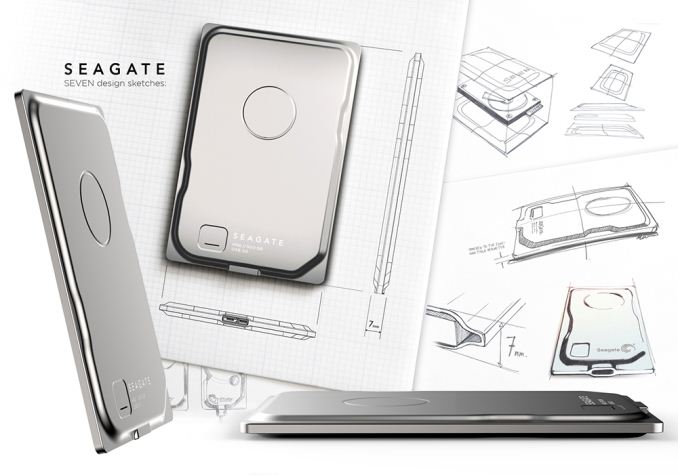
Seagate acquired LaCie a couple of years back. We saw some complementary product lineups last year, but this time around, the integration seems to be well and truly complete. Amongst the new products introduced at CES 2015, the most interesting seemed to be the 7mm thin external USB 3.0 hard drive.
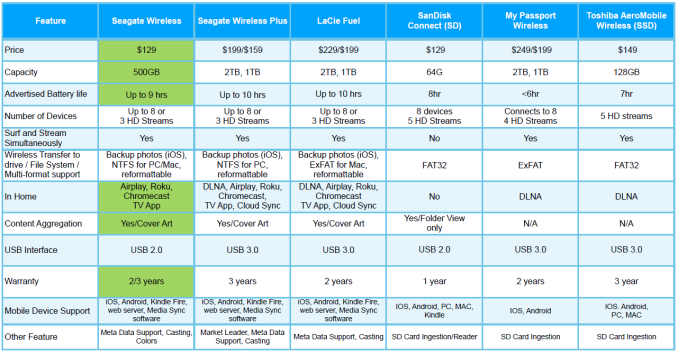
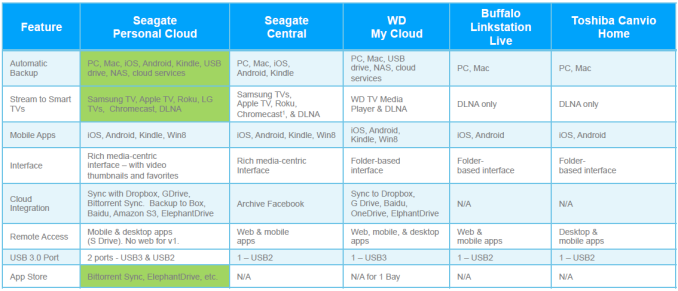
The Seagate Seven is based on a 500 GB 5mm 2.5" Angsana drive (two platters). The SATA-USB 3.0 bridge has been integrated on the main board. A premium steel enclosure creates a unique and striking product at a reasonable $100 price point. The Seagate Wireless product is an low-cost entry update to the wireless mobile storage lineup for smartphones and tablets. The USB 3.0-based Seagate Wireless Plus and the LaCie Fuel will continue to exist. The new product is USB 2.0-based and has only one available capacity point - 500 GB. It is priced at $129. Unlike the My Passport Wireless that we reviewed late last year, this one doesn't have a SD card slot - the content consumption side is the target market here. Seagate had a handy comparison table in their briefing.
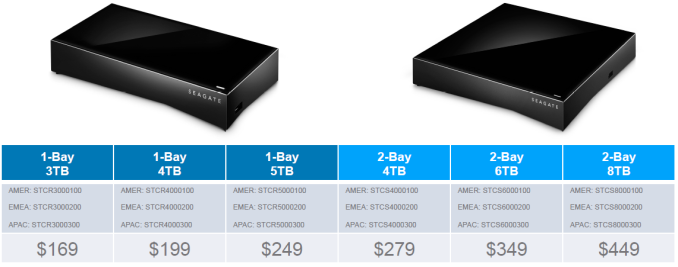
The Seagate Personal Cloud is a NAS lineup targeted towards the average home consumer. It comes in 1 and 2-bay varieties. The mobile apps are the focus here - primary target market being owners with media libraries that need to be streamed to a variety of devices. Seagate operates relay servers with end-to-end encryption so that access to the content on the device is available from anywhere in the world. The various models and price points, as well as the competitive positioning are reproduced below.
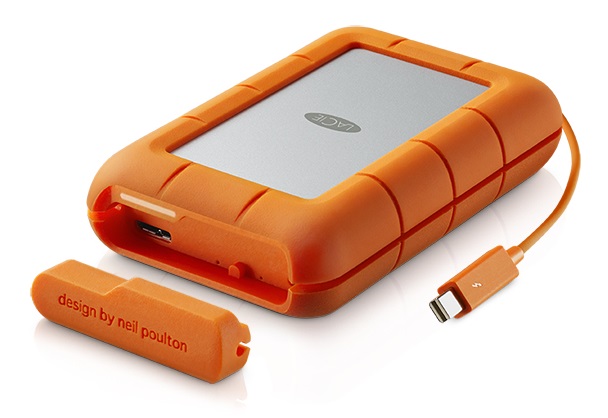
On the LaCie side of things, we had the usual fashion statement in the LaCie Mirror - an external 1TB 2.5" USB 3.0 drive that can double up as a mirror. It carries a premium, as usual, with the pricing set at $280. The more exciting product from a technical viewpoint was the LaCie Rugged RAID. The industrial design is almost the same as the LaCie Rugged Thunderbolt that we had reviewed last year. The thickness is more to accommodate two 2.5" drives, and there is a switch to move between RAID 0 and RAID 1 for the internal volume. The device comes with two hard drives. A dual SSD option was ruled out since Thunderbolt and USB 3.0 don't support more than 10 W over the bus.
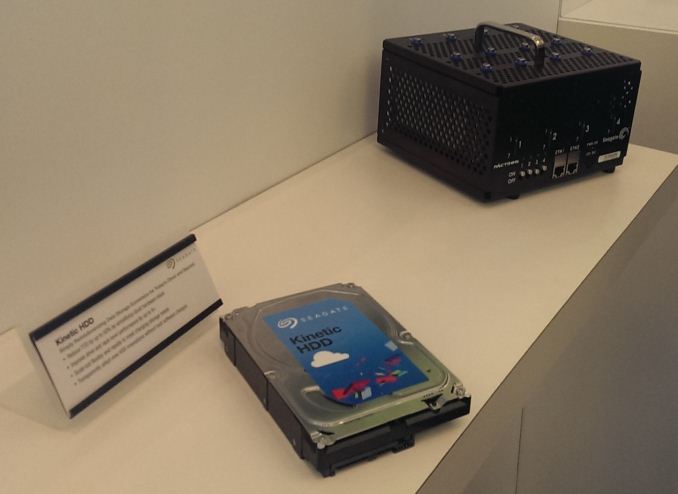
The pricing of the 4TB version (2x 2TB drives inside) will be $450. Advertised performance numbers include speeds of over 240 MBps in RAID 0. Similar to the Rugged Thunderbolt, the unit is shock, dust and splash-proof, and carries an IP54 rating. On the enterprise side of things, we finally got a look at the Seagate Kinetic Ethernet-Attached Hard Drive. As a quick introduction, the unit does away with the need for a separate NAS server by presenting two Ethernet links over what looks like a SATA connector. Object-based storage removes lots of overhead. Seagate indicated a growing number of chassis vendors with support for these drives. We hope to do a more detailed investigation into Kinetic in the near future.
Seagate also had a demonstration of a ClusterStor unit from their Xyratex acquisition. Kristian will be covering updates from the SandForce division later this week. | |||||||||||||||||||||||||||
| 11:31a | Intel Announces Curie: Tiny Module for Wearables
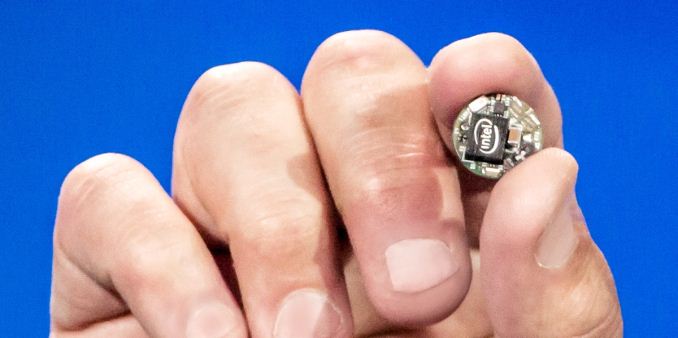
Yesterday, Intel announced a new module targeted to wearable technology: Intel Curie. This module continues Intel's push into IoT and wearable technology started with the Intel Edison. While we thought Edison was small, at just above the size of a US postage stamp, Curie goes even further. Intel has not revealed exact dimensions, but the overall package appears to be the size of a US dime, or small button. The circular PCB shape is also fairly unique and novel. Curie is so small it could theoretically be integrated into rings. Despite its size, Curie packs in a reasonable amount of functionality. Curie is headlined by a new SoC Intel claims is their first purpose-built for wearables: the Quark SE. Curie was only just announced so we do not have complete specifications yet but I have compiled what is available.
Intel did not specify if the Bluetooth antenna was built into the PCB or needs to be added on. As Curie integrates sensors and a battery charging PMIC directly whereas Edison provides interfaces to connect to those same features, it is clear Intel designed Curie to be stand alone. Therefore, accounting for the other hardware that needs to be built around Edison, the size difference grows. Intel's Curie does not include an applications processor and instead relies entirely on the MCU. This may seem limiting compared to powerful Galaxy Gear or Android Wear devices, but there are many devices such as Fitbit and even the Microsoft Band that also exclude an applications processor. This should enable Curie to be exceptional for battery life, however Intel provided no power consumption figures. Curie will ship in 2H 2015 and be bundled with Intel IQ Software Kits. Intel IQ is a set of algorithms, device software, smartphone apps, and cloud integration (management, analytics, user and company portals) and breaks down into two components: Body IQ and Social IQ with corresponding biometric and connectivity focuses. | |||||||||||||||||||||||||||
| 11:50a | CES 2015 Lenovo Hands On
Lenovo launched several new devices at CES with a push to Broadwell across the lineup of PCs. The ThinkPad X1 Carbon, X250, T550, T450s, E550, E450, and L450 all got bumps to Broadwell-U. The ThinkPad Yoga also got a spec bump, and several more versions of it were announced. Likely the most exciting announcement from Lenovo was the LaVie launch. We got a chance yesterday to look around the Lenovo booth and get some hands on time with the devices. The first thing in the Lenovo room is the 100 millionth ThinkPad ever built – a ThinkPad X1 Carbon named Eve. The ThinkPad brand has been around a long time, so congratulations to Lenovo on the achievement.
Next we got to check out the ThinkPad Carbon X1. While mostly a spec bump over last year’s model, Lenovo did get rid of the adaptive function keys and brought back the TrackPoint buttons which should make fans for the series happy. The ThinkPad Yoga line got a large boost in numbers, moving from just a single 12.5” model to three models, with a 14” and 15” model made available. The 15” model is downright massive for a Yoga, but it does come with an optional Intel RealSense 3D camera system. While applications that leverage the camera system are sparse right now, in order for there to be an ecosystem around it, the hardware needs to be there. Lenovo did have some demo software which showed how the camera system could track points on your fingers in real time.
Lenovo has often offered an active digitizer on many of its models, and they also demonstrated some new software that they are developing to extend the use of the pen when it is in use. They feel that if you are using the pen, you should be able to use it as the primary input method so they were working on software to do character recognition with the pen in places like the search box. Although the software was in early stages, it did eliminate the touch keyboard taking up a large portion of the screen when text entry was needed. Also new to the ThinkPad Yoga 15 was the Intel RealSense 3D camera system which was demoed.
The Yoga 3 series was also released, and this series is a slightly less expensive take on the Yoga 3 Pro. We got a chance to see both the Yoga 3 11 and Yoga 3 14. As with most 2-in-1 models, the large displays can make them a bit unwieldy when being used as a tablet but are generally better than the smaller models when used more like a traditional notebook. I will never complain about having more options though and personally I find the stand mode very useful. Gallery: CES 2015 Lenovo Hands On
    Moving away from the Yoga series, we can still see its impact on the rest of the Lenovo lineup. The Flex 13 is a low cost version of the Yoga, with lower specs, but keeps the 360 degree hinge. Also on the consumer side Lenovo showed off its S41 and U31 models, which both have a white metal finish and 14 and 13 inch displays respectively. Likely the most exciting thing at the Lenovo booth was the new LaVie series. The models on display are branded as NEC (NEC and Lenovo partnered on these) but they will be branded as Lenovo in other parts of the world. It was fairly stunning to pick one up and see just how light a 1.7 lb laptop is. The lower end version is rated by Lenovo at 5.9 hours of battery life, while the slightly heavier 2-in-1 version was rated up to 9 hours. The 2-in-1 version on display did have the 360 degree hinge, but it did not support Stand mode. It does have a gyroscope so it would seem likely this will be added on when it is closer to release.
Hopefully we will be able to get some of these in for review. Stay tuned! | |||||||||||||||||||||||||||
| 5:54p | MediaTek Demonstrates 120 Hz Mobile Display
While we often don’t deeply discuss MediaTek as a company, they are a major force in the mobile space. Their SoCs are widely used in the mid-range and budget segments of the mobile market, and they have widespread OEM adoption due to their turn-key reference designs. However, despite this mid-range positioning we saw an interesting demo of 120 Hz mobile displays at their CES press event, which can be seen below. While the video is in slow motion to demonstrate the difference, in practice the benefit of the higher refresh rate is still quite visible. Text scrolling and motion was visibly clearer and more fluid, although it’s possible that displays with poor refresh rates wouldn’t see nearly as much benefit. MediaTek claims that this feature would increase display power consumption by about 10%, although it’s unclear whether this is with dynamic refresh rate adjustment or constant refresh rate. Features like this seem to be part of MediaTek’s new strategy of bringing value to the mid-range, and it will be interesting to see if MediaTek’s focus on Asia will continue to pay off. | |||||||||||||||||||||||||||
| 9:00p | Dell CES Hands On
We got a chance to gets some hands on time with the new Dell products yesterday. Likely the biggest announcement was the Dell XPS 13, with what Dell is calling an Infinity Display. The Dell Venue 8 7000 tablet also has the Infinity Display. It was a great looking piece. Also on display was the Alienware products, with the top of the line Area 51 showing prominently. The Alienware 13 was also on display, with the external graphics amplifier. New to the lineup is the slimmed down versions of the Alienware 15 and 17, both of which also support the external graphics amplifier. The Area 51 is Alienware’s top gaming desktop, available with X99 based CPUs and multiple graphics cards. It was announced a couple of months ago, and the first thing anyone will notice is the distinct shape and styling of the case. The internals are mounted on an angle, which is said to enhance cooling.
Next we got to check out the laptops from Alienware. The 13 was previously announced but the new models are the 15 and 17, both of which share styling with the 13. They are much thinner than their predecessors. As seems to be the case with Alienware, almost everything has backlights including the trackpads. It is an interesting effect, and is fully customizable and owners can set the lighting to whatever color they like, or disable it if they prefer. On top of this, if someone wants more graphics power than their internal GPU can handle, the graphics amplifier allows pretty much any graphics card to be leveraged to power either the internal display or external monitor if you want more of a dock experience. Gallery: Dell CES Hands On Alienware
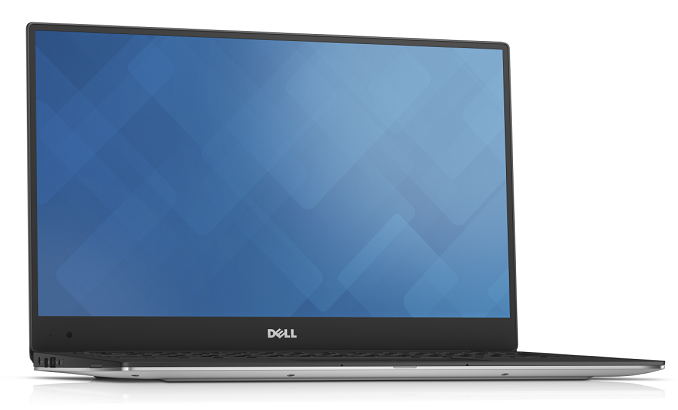
      To me the most exciting thing from Dell was the new XPS 13. Dell basically managed to fit a 13” display into an 11” chassis, and the result is a super thin bezel which Dell calls Infinity Display. It was striking to look at, and according to Dell’s representative the display is IGZO, which should mean that it has the standard RGB stripe. Broadwell is the name of the game this CES, and the XPS 13 is powered by the new Intel CPU. Also on display was the updated XPS 15, which is now sporting a 4K display.
Also on the show floor was a couple of tablets from Dell. Dell’s Venue line is divided between Windows and Android with the “Pro” name. Dell’s recently launched Venue 11 Pro was available to see, and this 11” tablet is offered with either Atom or Core-M processors.
The Venue 8 7000 tablet was a striking to see in the dark room, with its 2560x1600 OLED display packing quite a punch and having the incredible blacks that OLED is known for. It is Intel powered, and performance was quite good. This will be Bay Trail of course, with Cherry Trail just now shipping to OEMs.
Dell has some great new products coming out, and I love to see how coordinated the styling is getting among the manufacturers. We look forward to getting some of these in for review to dig into them some more. |





| << Previous Day |
2015/01/07 [Calendar] |
Next Day >> |