[Most Recent Entries] [Calendar View]
Thursday, April 2nd, 2015
| Time | Event | |||||||||||||||||||||||||||||||||
| 3:00a | HTC Launches the One M8s
Today HTC is announcing a new smartphone that sits somewhere between their mid-range smartphones and their flagship ones. This new phone is the One M8s, and even with a quick glance you will notice that it looks very similar to HTC's previous flagship smartphones, the HTC One M8. In fact, the two devices are essentially identical in terms of their appearance and construction, with HTC's official specifications showing only a 0.2mm difference in maximum thickness between the two. Despite being nearly visually identical, the specifications of the M8 and the M8s differ in several ways, and I've compared them in the chart below.
At least on paper the M8s shares its chassis, cellular connectivity, and display with the M8, although it remains to be seen if it indeed uses the exact same LCD panel. WiFi and Bluetooth connectivity is also similar, although the M8s ships with Bluetooth 4.1 capable firmware out of the box. Beyond these specifications is where the differences between the two devices begin to arise. The first major difference is obviously the SoC. While the One M8 used Qualcomm's Snapdragon 801 with four Krait cores at 2.26GHz, the M8s opts for Qualcomm's Snapdragon 615 which has two clusters of four Cortex A53 cores at 1.7GHz and 1.0GHz respectively. It will be interesting to see how Snapdragon 615 compares to 801 with regards to performance as well as power consumption. On that note, the M8s is also able to fit a higher capacity battery in the same chassis as the original M8. The last major difference between the two are the cameras. While the One M8 used HTC's 4MP "UltraPixel" sensor, the M8s opts for a 13MP sensor. Despite this, it retains the secondary depth camera which enables HTC's duocam post processing effects like depth of field and refocusing photos.
The comparison to the original One M8 is really just to show how the two devices differ inside since they share the same appearance. While the M8 was HTC's flagship smartphone, the M8s is not quite at that level. It seems to sit somewhere between the HTC Desire 826 and the HTC One M9, with a more premium design than the 826 but very similar specifications. As far as availability is concerned, the HTC One M8s will be launching in several parts of Europe. Pricing will vary from region to region, but the cost in the United Kingdom has been confirmed at £379.99 outright which gives some idea as to how much the HTC One M8s will cost compared to the One M9 and Desire 826 that sit above and below it respectively. | |||||||||||||||||||||||||||||||||
| 8:00a | The State of Wireless Charging Standards in Mobile A look through the various competing wireless charging standards, their advantages, disadvantages, and where the future leads to. | |||||||||||||||||||||||||||||||||
| 8:00a | SanDisk SSD Deployment Case Study
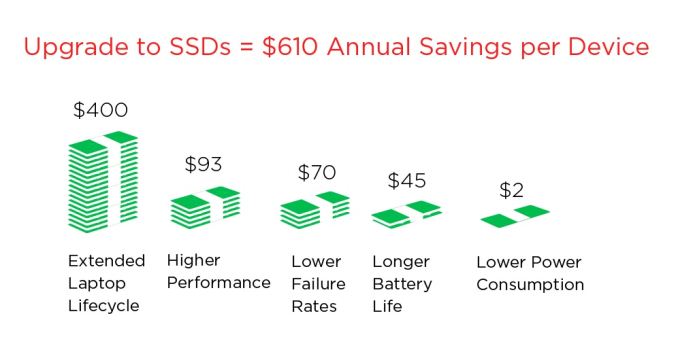
Last year SanDisk introduced the SanDisk Tech Assisted Refresh (STAR) program for enterprises to ease the transition from hard disk drives (HDDs) to SSDs. SanDisk gained valuable experience from its internal upgrade program where 4,600 employees’ laptops were migrated from HDDs to SSDs and with STAR program SanDisk is bringing the benefits of its internal program to all enterprises. The core benefit of STAR program is that it requires no resources from the customer company. One of the main obstacles of SSD upgrades is the fact IT managers cannot abandon their daily routines and perform SSD upgrades on hundreds, or even thousands of computers, and hiring temporary workforce is both risky and expensive. In SanDisk’s STAR program, the upgrade and migration is fully done by SanDisk’s technical specialists, who will come onsite and perform the data migration and SSD installation overnight, resulting in zero downtime for the employees. For any company, one of the most important financial metrics is the Total Cost of Ownership (TCO). By upgrading existing laptops with SSDs, companies are able to extend the lifecycle of a laptop from 3-4 years to 4-5 years, which results in annual savings of approximately $400 per laptop. For a company with 1,000 corporate laptops, that is deferred savings of $400,000 by simply extending the lifecycle of the laptop with an SSD. Additionally, SSDs have higher reliability and lower failure rates when compared with traditional HDDs because SSDs are not susceptible to mechanical wear or crashes due to jarring motion. With less failures, there is less downtime for employees and the IT managers can also focus on other duties rather than replacing failed HDDs and reimaging the system data. Furthermore, SSDs offer significantly higher performance and battery life, which allows the employees to work longer and more efficiently. When considering all the advantages, SanDisk estimates that an SSD equipped laptop results in total annual savings of $610 per laptop. For full details and customer experiences of SanDisk’s STAR program, please refer to the STAR SSD Upgrade Program whitepaper. | |||||||||||||||||||||||||||||||||
| 9:00a | Digital Storm Launches The Upgraded BOLT 3 SFF Gaming System
Normally when one thinks of a gaming system, a Small Form Factor (SFF) computer is not what you would expect. Gaming, especially when done with some of the top end components, can generate a tremendous amount of heat which can be difficult to cope with in a small chassis. However this is quite a popular segment, and the advantages of a SFF device can be quite compelling. Gaming can move from the office to the living room, and small form factor cases can be tucked away with the other A/V components. Digital Storm is certainly not the only company in this space, but they are launching a new model today which builds on their successes with their previous models. Today they are launching the BOLT 3, which is their third generation SFF gaming system.
Aesthetics are very personal, but quality of materials can more easily be commented on. The BOLT 3 case is constructed entirely from brushed aluminum, with an anodized black finish. The side panel is made of glass to allow a glimpse inside the case. Looking inside, you can see some unique features. The BOLT 3 features a custom liquid cooling system to cool the processor, and below the motherboard is a GPU which sits parallel to the board, rather than perpendicular, to allow the case to be much smaller in height while keeping a full GPU. The case dimensions are 18.3 x 15.1 x 5.8 inches. And speaking of the GPU, Digital Storm offers quite a range from the GTX 960, all the way up to the Titan X. Processor options include Intel Core i5-4590, i5-4690K and i7-4790K choices, and the systems can be configured with 8 to 16 GB of memory. This should allow for almost any gaming scenario to be covered, assuming your pockets are deep enough.
Attention to detail was paid to upgradability as well, with the GPU being placed away from other major components to allow basically any GPU to fit in this case. The power cables and cooling tubes have been placed to allow for an easier time with replacing components in the future. Gallery: BOLT 3
     If you are interested in a pre-built SFF gaming PC, you can check out all of the options and pricing for the different models at http://www.digitalstormonline.com/bolt-3.a Source: Digital Storm | |||||||||||||||||||||||||||||||||
| 12:00p | Intel SSD 750 PCIe SSD Review: NVMe for the Client Ever since our SSD DC P3700 review, there's been massive interest from enthusiasts and professionals for a more client-oriented product based on the same platform. With eMLC, ten drive writes per day endurance and a full enterprise-class feature set, the SSD DC P3700 was simply out of reach for consumers at $3 per gigabyte because the smallest 400GB SKU cost the same as a decent high power PC build. Intel didn't ignore your prayers and wishes though and with today's release of the SSD 750 Intel is delivering what many of you have been craving for months: NVMe with a 'consumer friendly' price tag. | |||||||||||||||||||||||||||||||||




| << Previous Day |
2015/04/02 [Calendar] |
Next Day >> |