[Most Recent Entries] [Calendar View]
Wednesday, July 8th, 2015
- Dr. Ian Cutress: Host, Senior Editor
- Kristian Vättö: SSD Editor
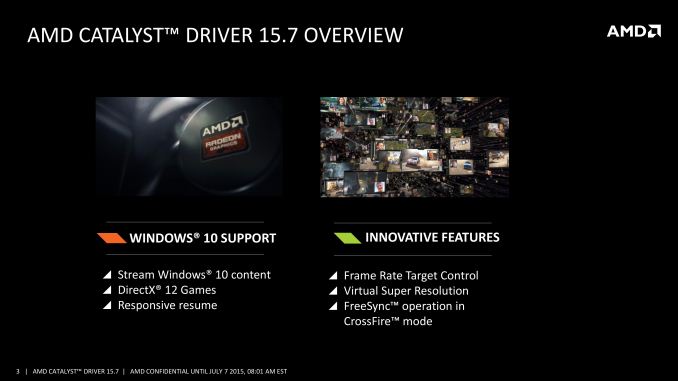
- Performance improvements for older cards
- Frame Rate Target Control for older cards
- Virtual Super Resolution has been extended to the 7000 series and AMD APUs
- Crossfire Freesync is now supported
- Preliminary “technical preview” Windows 10 support (WDDM 2.0)
| Time | Event |
| 12:01p | The AnandTech Podcast: Episode 33 - Computex 2015
AnandTech Podcast #33 - Along with CES in Vegas in January, one of the two biggest PC hardware shows in the world is held every year is Computex in Taipei, usually in the first week of June. Throughout the show both Ian and Kristian were present getting the interesting news about releases and products, and it certainly ends up exhausting. After the show Ian and Kristian recorded a podcast about the releases at the show as well as some of the esoteric elements on display. [Note this was recorded before E3 and AMD’s announcement of the R9 Fury X]
The AnandTech Podcast - Episode 33 iTunes Total Time: 1 hour 25 minutes 25 seconds Outline mm:ss 0:00 – Intro Apologies for the delay in posting this podcast, I'm now back after almost a month on the road; we have already recorded the next one with Josh and Andrei, and Josh has plans for another one after that. I also want to get Ryan on one to talk about the recent updates in the GPU space as well. -Ian |
| 5:05p | Microsoft Announces Mobile Restructuring With Up To 7,800 Job Cuts
A little more than a year ago Nokia officially ceased to exist as a mobile phone manufacturer. Nokia's efforts to reverse their decline in the mobile space by adopting Microsoft's Windows Phone operating system were unsuccessful, and eventually the company decided to exit from the mobile phone market entirely by selling their devices business to Microsoft. Former Microsoft CEO Steve Ballmer had stated that Microsoft was evolving from a traditional software company to become a devices and services company. With that mindset, the acquisition of Nokia made sense in order to acquire manufacturing, design, and software talent that had already been working on Windows Phones for quite some time. Unfortunately, it appears that the purchase of Nokia's devices division has not worked out as well as Microsoft had hoped. New CEO Satya Nadella has also reversed course on the Devices and Services mantra and is instead focusing on software and services, but with first party hardware to showcase the software. After laying off 12,500 former Nokia employees last year, Microsoft has announced that will be eliminating up to 7,800 positions, with most of the cuts coming in areas of Microsoft focused on phones. In addition to the job cuts, Microsoft will be writing off 7.6 billion dollars which is essentially the entire value of the Nokia acquisition. There will also be a $750-$850 million restructuring charge. All-in-all, it's a big hit to their bottom line, and even companies that make billions every year have to answer to investors about charges like this. It is an even bigger write down than they took on the AQuantive deal a few years ago. In an email to employees regarding Microsoft's future in the mobile business, CEO Satya Nadella stated “In the near-term, we’ll run a more effective and focused phone portfolio while retaining capability for long-term reinvention in mobility.” One could interpret this as Microsoft consolidating their phone lineup which has arguably become a bit too large and filled with devices that only differ from each other in small ways. It's likely that the launch of Windows 10 for phones will be accompanied by more information about the future of Microsoft's phone business, but for the time being it appears that Microsoft is taking a step back from their role as a major devices company. |
| 5:15p | Build-A-Rig Round 1: The $1500 PCs and Interviews from Corsair and Zotac Last week we introduced our new Build-A-Rig project. At a high level, we ask two or three companies in the PC industry each round to configure a system to a budget. Then, with our partners Newegg, we build and test each system in glorious battle, along with interviewing the participants about how they approach the industry. Regardless of the winner, all the systems built are given away to our lucky readers. Imagine Top Gear UK’s ‘Star In A Reasonably Priced Car’, but instead of celebrities racing around a track, we let the configured PCs do the racing where both style and performance count. In this first round, we chose Corsair Memory and Zotac as the first head-to-head. |
| 7:40p | AMD Releases Catalyst 15.7 WHQL Drivers: Crossfire Freesync, Win10 Support, & More
After a brief detour for AMD’s driver team where they diverged their drivers for the Radeon 300 series and R9 Fury X launch, AMD has reunified their drivers with the release of Catalyst 15.7. The WHQL release, the first such release from AMD since Catalyst 14.12 in December, includes a number of major feature additions and performance improvements relative to both the previous 15.6 drivers for AMD’s older cards, and the even older 14.12 WHQL drivers. Overall here are the major additions to AMD’s drivers that Radeon owners will want to be aware of: The driver build, 15.20.1046, is based off a slightly newer branch than the one used for the 300 series launch (15.15). As that driver already incorporated most of these improvements, for new 300 series owners the changes compared to the 15.15 launch driver will be minimal other than the fact that WDDM 2.0 drivers are now available.
As for existing Radeon owners, this means that the functionality that was previously limited to the latest Radeon products has finally been backported. Frame Rate Target Control, which allows capping framerates between 55fps and 95fps, is now available on most GCN cards. And Virtual Super Resolution, previously only available on certain members of the 200 series, has been backported to all Bonaire, Pitcairn, and Tahiti GPUs, meaning that the R7 260 Series, HD 7790, HD 7800 series, and HD 7900 series all support VSR. So do AMD’s latest APUs, with the 7400K and above getting VSR support. Meanwhile Crossfire Freesync, after being held back by AMD earlier this year due to outstanding issues, has finally been enabled. We have not had a chance to test this yet to see how well it works, though AMD notes that it’s working for DirectX 10 and higher (which implicitly excludes DX9 and OpenGL applications). As for performance for older cards, we’re still running numbers, but for the games in our benchmark suite it looks like there are consistent performance gains in The Talos Principle, with further minor upticks in performance in Total War: Attila, and in the minimum framerates for Shadows of Mordor. AMD’s notes also mention a number of new Crossfire profiles, though this is relative to the 14.12 release. Finally, since I’ve had a few people ask me about this, according to AMD’s notes they have not yet resolved the anti-aliasing corruption issues with Crossfire in The Witcher 3. Last but not least, AMD has also released a Windows 10 driver package that includes WDDM 2.0 and DirectX 12 support. While earlier driver releases were available through Windows Update, this is the first external WDDM 2.0 driver release for the company, and the first WDDM 2.0 driver to support recent products like the R9 Fury X. For the moment AMD is covering their bases and calling this a “technical preview” driver, with official driver support to come on the 29th when Windows 10 launches. The driver is for all GCN video cards, as older Radeon 5000 and 6000 products will not be getting WDDM 2.0 support and will continue using the existing WDDM 1.x drivers on Windows 10. Finally, for this driver release you’ll want to check out AMD’s master driver download page. The company has released individual driver packages for Windows 7, Windows 8.1, and Windows 10 (in both 32-bit and 64-bit varieties), so you’ll want to grab the right package for your operating system. |

| << Previous Day |
2015/07/08 [Calendar] |
Next Day >> |