[Most Recent Entries] [Calendar View]
Tuesday, July 28th, 2015
| Time | Event | |||||||||||||||||||||||||||||||||||||||||
| 9:00a | The Rosewill Hive 850W PSU Review Most of our US and Canada based readers are likely familiar with Rosewill. The company started as a subsidiary of Newegg and they were initially focused on producing simple bits and hardware at competitive prices. As the company grew larger and diversified into other segments of the market, they eventually fledged into a stand-alone manufacturer, with myriads of products filling their ranks and exports outside of the North American markets. Our latest review of their products was that of the Photon 1050W PSU a few months ago. Today we are having a look at another one of their PSUs, the Hive 850W. The Hive is an 80Plus Bronze certified semi-modular PSU designed to impress mainstream users with its competitive price tag, all the while delivering plenty of power for higher-end gaming systems, which makes the PSU an interesting intersection between value and high-power performance. | |||||||||||||||||||||||||||||||||||||||||
| 10:25a | Motorola Announces the New Moto G
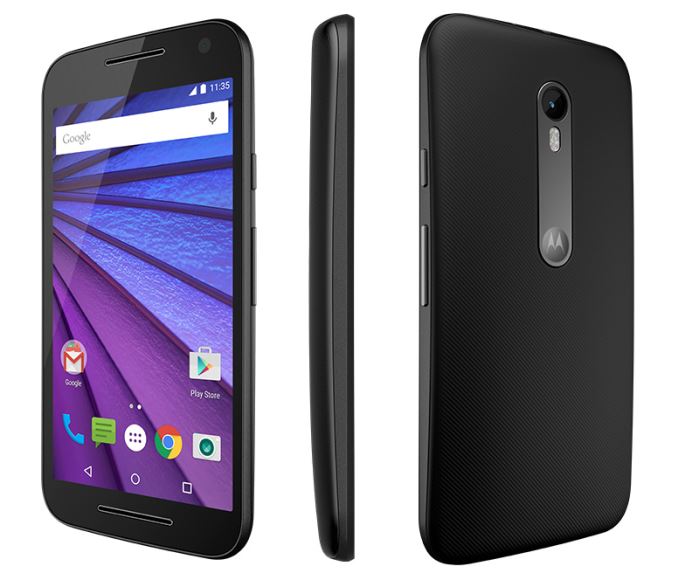
Today, Motorola announced the successor to their Moto G, which has been their most successful phone in recent memory. It’s still called the Moto G, but this is the 2015 model which brings some long-needed updates to keep the Moto G fresh. These changes are far-reaching, and range from the SoC to the camera and design. In order to understand the new Moto G at a high level I’ve attached the specs below for those interested.
Although specs are important, one of the most immediate changes to the Moto G this year is the new design. Instead of the all-plastic design that we were accustomed to with the previous two Moto Gs, the new Moto G has a metal frame with a new, grippier plastic back cover. The generally refreshed design helps a lot with distinguishing this model from previous years, and generally helps to increase the value proposition associated with the smartphone. Outside of design, there are a few key changes at a high level such as the camera, SoC, more RAM on the 16GB SKU, and water resistance. The battery is also bigger, at 2470 mAh compared to 2070 mAh of the last generation.
When it comes to the camera, it seems that this unit is directly shared with the Nexus 6’s camera, although it doesn’t seem to have the more expensive voice coil motor that is needed to enable OIS. There’s also a 5MP FFC, which should is a big step up from the 2MP FFC of the previous generation. The SoC moves from the Snapdragon 400 of previous generations to the Snapdragon 410, which means a move to the Cortex A53 on the CPU side. Given just how much higher the IPC is for the Cortex A53, general computing performance should improve here much like we saw with the Moto E moving to A53. The move from 1GB to 2GB of RAM is also a huge boon for multitasking performance, although this is only available on the more expensive 16GB variant. The 8GB variant will remain with 1 GB of RAM. The addition of IPx7 water resistance should also help greatly against water damage, as this means that the Moto G 2015 should be able to spend 30 minutes under a meter of still water without damage, although I still wouldn’t recommend trying to test that functionality.
The new Moto G is available online today from Motorola, Best Buy, and Amazon. The 8GB variant will start at 179.99 USD, and the 16GB variant will be available from Motorola’s website. The new Moto G will also support Motomaker, which allows for extensive color and material customization of a new smartphone. | |||||||||||||||||||||||||||||||||||||||||
| 10:50a | Motorola Announces the Moto X Style
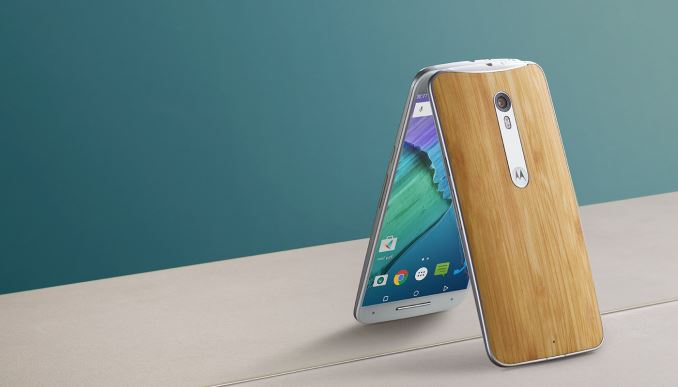
Today, Motorola also announced their new flagship phone, the Moto X Style. Following the trend of larger screen sizes, it seems Motorola has taken this trend to its logical conclusion by cramming a 5.7” display into the phone, which really places this squarely in the phablet space rather than smartphone space despite the 76% screen to body ratio. The design has also been refreshed for this year to distinguish this device from the previous Moto X if size wasn’t enough of a differentiator. As always, the spec table is below to provide perspective on the changes between each device.
Other than the display and the dimensions, one of the most obvious changes is really the camera. Motorola is really focusing on camera this year as a key point of differentiation, going as far as to proclaim that their camera is superior to the iPhone 6 and 6 Plus during their launch event. It seems that their first step to doing this is to equip the Moto X Style with a 21MP camera. Although not stated in the launch event, it isn’t a far leap to guess that this is either OmniVision’s OV21840 or Sony’s IMX230 as both are of similar spec.
At a high level, there are also significant changes to the SoC as we see a bump to Qualcomm’s Snapdragon 808 and a bump in RAM to 3GB to improve multitasking and memory management. It seems that Motorola’s NLP and sensor hub remain, although it isn’t disclosed whether this is still a TI solution for NLP and an STM sensor hub.
The display is also a major shift in Motorola’s component choices, as the 5.7” 1440p display is actually an LCD panel rather than AMOLED, which is what Motorola usually favors with their high-end smartphones. There are also dual front-facing stereo speakers mounted above and below the display, with the extra bezel for display drivers mounted directly below the top speaker to accommodate the on-screen buttons comfortably.
Overall, the Moto X Style is a significant departure from the Moto X (2014), which in turn was a major departure from the Moto X (2013). It remains to be seen whether Motorola’s bet on a phablet-sized phone will pay off, but it certainly could be a major competitor with phablets launching in the near future.
The Moto X Style will be available in September, and will be offered on Motomaker. A Pure Edition that works on all 4 US carriers will be offered for sale unlocked in the US as well. The standard colors will be white and black, with options for customization via Motomaker for leather, wood, and silicone finishes. The price will start 399.99 USD for the Pure Edition. | |||||||||||||||||||||||||||||||||||||||||
| 11:20a | Motorola Announces the Moto X Play
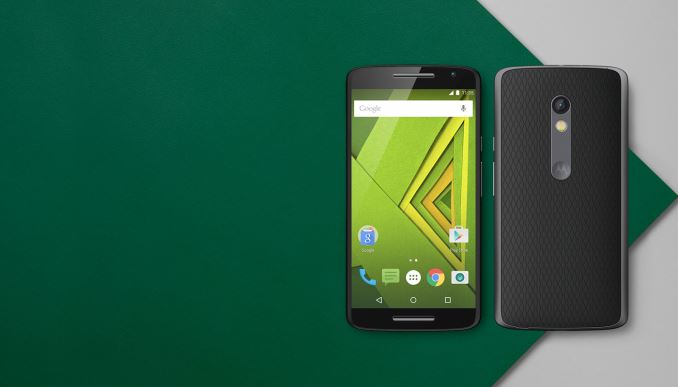
In a somewhat interesting twist, Motorola has announced a new version of the Moto X designed to slot in between the Moto X’s traditional flagship position and the Moto G’s mid-range position. As a result, this is probably the closest thing to a competitor to the OnePlus Two and similar phones in the 300-400 USD price range. To figure out what you gain or lose in the move from the high-end Moto X Style to the Moto X Play, I’ve placed the specs below to provide some perspective.
As one can see, the Moto X Play seems to fit somewhat squarely between the Moto G and Moto X Style. Rather than a Snapdragon 808 SoC or Snapdragon 410 SoC, the Moto X Play has a Snapdragon 615 SoC. However, due to the octa-core Cortex A53 CPU and Adreno 405 GPU the Snapdragon 615 SoC is arguably closer to an upgraded Snapdragon 410 rather than a detuned Snapdragon 808. There’s also less RAM at 2GB, but this shouldn’t have an enormous effect on the experience. The display is also smaller and lower in resolution at 5.5” and 1080p, respectively. However, the Moto X Play retains the 21MP camera with dual color temperature flash, but this seems to have a different module as there’s no mention of PDAF and the aperture is slightly smaller at f/2.25. It is nice to see that the NLP and sensor hubs are shared across the two versions, although it isn’t clear whether there are using the same SoC. One major advantage of the Moto X Play over the Moto X Style is likely to be battery life, as the 3630 mAh battery is 21% larger. There’s also no dual stereo speaker system like the Moto X Style, which makes it a bit more like the Moto X (2nd gen) with its single front-ported speaker.
Overall, the Moto X Play seems to a reasonably cut down version of the Moto X Style, but the cuts are relatively even all around rather than any critical loss in a single area. Of course, it will take a review to see just exactly what was lost. The Moto X Play will go on sale in August, but it doesn’t seem like there are plans to bring this device to the US. Given the fierce competition in this segment with companies like OnePlus, it remains to be seen if this device will be a success. |





| << Previous Day |
2015/07/28 [Calendar] |
Next Day >> |