[Most Recent Entries] [Calendar View]
Thursday, August 6th, 2015
| Time | Event | |||||||||||||||||||||||||||
| 8:00a | Basemark & Crytek To Develop New VR Benchmark
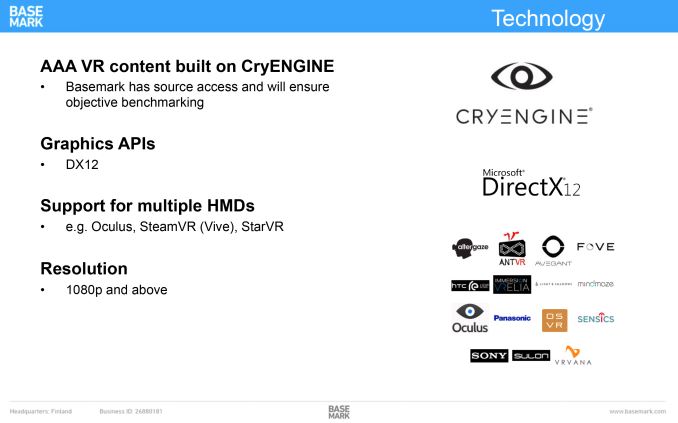
After a very public development process over the last couple of years, this year we have seen the consumer release of virtual reality headsets become a matter of when, not if. The launch of the first generation of consumer VR headsets is now just a quarter away, and as software and hardware developers move out of the experimentation phase and into the production phase, we are seeing the complete VR ecosystem take shape. The hardware is coming along, the games are in development, and now the first benchmarks are being announced. This morning benchmark developer Basemark and game engine developer Crytek are announcing that the two of them are partnering together to develop a new dedicated VR benchmark. In a presentation aptly named “Can it Run VR?” Basemark and Crytek have laid out their goals for the benchmark, which will be built around Crytek’s CRYENGINE. The two companies will be developing a full AAA quality VR benchmark for PCs running on top of DirectX 12, with the end product to be a “real-world” benchmark thanks to its use of a commercial game engine. Crytek for their part are no strangers to VR, with CRYENGINE already powering the Back to Dinosaur Island VR Tech demo.
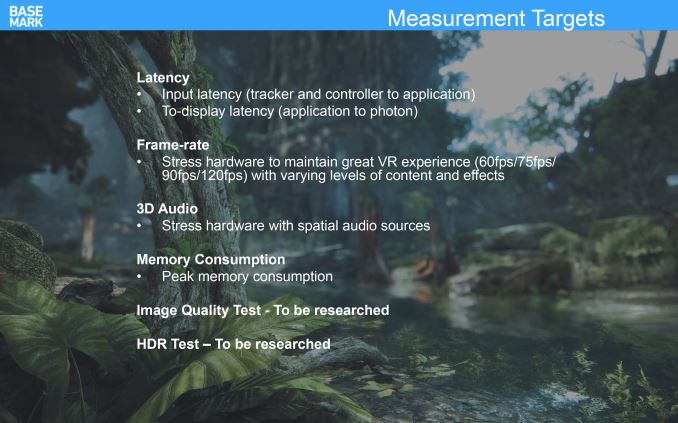
For their benchmark, Basemark and Crytek are looking to evaluate several aspects of VR. Along with the expected look at framerates – Oculus has been pushing 90Hz – Basemark has also stated that the VR benchmark will have the capability to measure latency, both for inputs and displays. Latency has been a big focus point for the first generation headsets due to the fact that it is so crucial in causing/combating motion sickness, so the fact that the benchmark will incorporate testing for it may very well be the most important feature of this benchmark. Having a neutral 3rd party provide a standardized latency test will go a long way towards not just comparing headsets, but helping manufacturers improve them as well. Meanwhile, Basemark and Crytek have also mentioned that they will be looking at additional tests further down the line, including headset image quality and dynamic range.
Finally, while the benchmark is being announced today, the nature of the announcement makes us believe that the benchmark is still in early development. As part of their press release Basemark is including a call to action, inviting interested companies to sign up and participate in the development of the benchmark. As a result no firm date is attached to the project right now, but it’s a safe bet that this is going to be a 2016 release. Gallery: Basemark VR Benchmark Presentation
      | |||||||||||||||||||||||||||
| 8:00a | The Origin PC BlackWidow Chroma Mechanical Keyboard Review Most of our US and Canada based readers that are involved with PC gaming are highly likely to have heard of ORIGIN PC, the company that specializes on building custom systems exclusively focused on gaming. They are also known for their US-based operation and support. Our first review of their products systems was the Genesis gaming PC, over four years ago. Ever since then, Origin PC expanded to the design of professional systems and laptops, as well as the marketing of gaming peripherals. It is one of these new peripherals that we will be having a look at in this capsule review, the Origin PC BlackWidow Chroma gaming mechanical keyboard. | |||||||||||||||||||||||||||
| 10:00a | Corsair and Cherry Introduce New, Quieter Mechanical Keyboard Switches
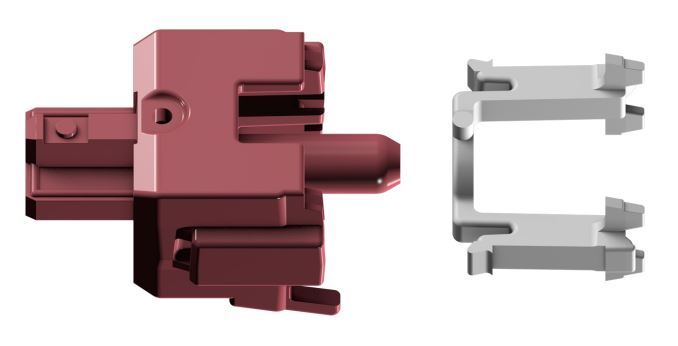
After languishing in relative obscurity for a few decades, mechanical keyboards have exploded in popularity in recent years. Almost every maker of input devices for computers has joined the trend with at least one or two mechanical keyboards, several new suppliers have introduced their own brands of key switches, and the existing players have updated their products to suit the needs of their new customers. The leading supplier of mechanical keyboard switches is Cherry, whose MX switches have been on the market since 1983. The different variants of MX switches offer differences in stiffness, tactile response, and audible clicking. All the switches share common interfaces for mounting the switches to the keyboard and attaching the keys themselves to the switches, so a keyboard manufacturer can easily produce several similar products to suit different tastes. The switch variants are identified by the color of the plastic stem that key caps attach to; blue, brown, black, and red are the most common. This week Cherry is introducing quieter versions of some of their switches. In these quieter switches the colored plastic slide at the heart of the switch will now be made with a double-shot injection molding process to integrate a shock absorber made from a rubbery thermoplastic elastomer. This will soften the impact and dampen the noise produced when the key stroke bottoms out or springs back to the top. Previously, users bothered by the noise of bottoming out could add rubber O-rings or foam pads around the key stem to catch the key on its way down, but installing them as an aftermarket modification is tedious and it slightly reduces the key's range of travel.
The Cherry MX Silent switches will reduce or eliminate the need for O-rings and also provide the first effective way to reduce the click that can occur when a key is released. Cherry will initially be making Silent versions of the MX Black and MX Red switches, both of which feature a linear actuation force, with activation thresholds of 60 cN and 45 cN respectively. The Silent switches will be available with both the traditional opaque plastic housing and the newer translucent housing designed to allow surface-mounted LEDs to shine through on boards that offer customizable RGB backlighting. Key travel is reduced from 4mm to 3.7mm, but the other specs are unchanged, including the rating for 50 million actuations.
Corsair was Cherry's exclusive partner for the introduction of the Cherry MX RGB switches in 2014, and for this launch Corsair gets six months of exclusive access to the Silent switches. The first product using the new MX Silent switches will be the Corsair STRAFE RGB Silent, which will be available for pre-order this month with a MSRP of $159.99 and will ship in October. | |||||||||||||||||||||||||||


| << Previous Day |
2015/08/06 [Calendar] |
Next Day >> |