[Most Recent Entries] [Calendar View]
Thursday, August 13th, 2015
| Time | Event | ||||||||||||||||||||||||||||||||||||
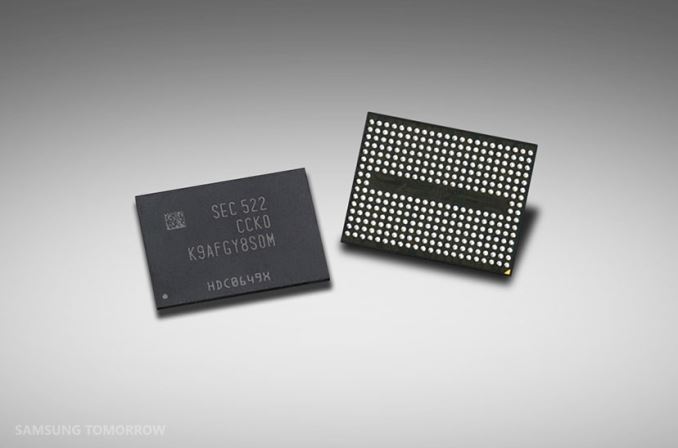
| 8:30a | Samsung SSD Update: 48-layer 256Gbit TLC 3D NAND & Three New TLC SSDs Announced
When Samsung took the stage at the 2015 Flash Memory Summit, they admittedly didn't deliver any bombshell announcements on the scale of the Intel/Micron 3D XPoint surprise, but they still had a lot to talk about. We knew that Samsung's third generation of V-NAND/3D NAND was on the way with mass production scheduled for the second half of this year. Samsung has now disclosed that mass production is starting this month, and that it's a 48-layer design with a 256Gb TLC being the first die announced. Samsung's current second-generation 3D NAND is a 32-layer design available as 128Gb TLC or 128Gb MLC. With mass production imminent, Samsung has ensured that neither SK Hynix nor the Toshiba/SanDisk joint venture will be able to leapfrog them with their respective 48-layer 3D NAND designs, both scheduled for mass production starting in 2016. Samsung says the new 256Gb TLC will have about 30% lower power consumption than an equivalent capacity of their current 128Gb TLC, and a switch to a dual-plane organization ensures that one 256Gb die will perform at least as well as a pair of the current 128Gb dies. Density is improved by about 40% while production costs only increased slightly, so price per GB will be going down. At FMS, Samsung is pushing the idea that their 3D NAND TLC is ready to replace MLC for most uses, and they're optimistic about scaling up their 3D NAND layer count past 100.
Samsung also shared information about three upcoming drives, all using TLC though not necessarily the new 48-layer parts. The PM1633 Enterprise SAS drive was previewed at CES in January and is intended for read-heavy workloads. A follow-on PM1633a model was mentioned to use the new 48-layer TLC to reach 15.36TB capacity, but we don't have any other information about that update. The PM953 is a general-purpose NVMe drive in M.2 or 2.5" form factors, and is the intended successor to the MLC-based SM951. Meanwhile the PM1725 is a fast multi-TB PCIe expansion card that Samsung intends to use to challenge the assumptions about what uses TLC is suited for. Relatively speaking it appears to be intended for workloads that aren't very write-heavy, but it still manages 120k IOPS for writes. That just looks small compared to 1M IOPS for reads and a sequential read speed of 5.5GB/s. All three drives are intended for OEMs, but the PM953 will probably find its way into the retail channel just like the SM951. Finally, along with Samsung's new 3D NAND appearing in the afformentioned new drives, it will also be appearing in at least one of their existing drives. The 850 EVO, Samsung's current consumer TLC drive, will apparently be getting an update to use the new 48-layer TLC, though it's not clear if this will be new capacities and/or a wholesale NAND update. | ||||||||||||||||||||||||||||||||||||
| 11:00a | Hands On With the Samsung Galaxy Note 5 and Samsung Galaxy S6 edge+ Today, Samsung is announcing the next generation of their Galaxy-brand phablets, the Galaxy Note 5 and the Galaxy S6 edge+. Samsung’s phablets have been one of their greatest smartphone success stories, finding traction in a market when many thought there wouldn’t be a place for such a large phone. And while you will never see some competitors directly admit to it, products like the Note series have legitimized the phablet form factor and required that the competition catch up as well, making the phablet form factor as much of a home court for Samsung as there can be. Starting with the 2014 models, Samsung introduced two different phablets, the Note 4 and the simply titled Note Edge. This year Samsung is retaining the dual phablet approach, however in the case of the Edge product Samsung has shifted gears on what they want to do. For 2015 Samsung seems to be going after a new audience in the form of the Galaxy S6 edge+, which is a more distinct derivative of the Note 5 platform with some greater feature changes than just a curved screen. To understand what I mean, read on for the full article. | ||||||||||||||||||||||||||||||||||||
| 9:00p | NVIDIA Releases 355.60 Drivers; GameWorks VR Now In Beta
As the week starts to wind down NVIDIA is back with another driver release, 335.60. This latest release is notable for a few different reasons. Officially NVIDIA is releasing this as their preferred Game Ready driver for the Ashes of the Singularity tech demo, which is due later this month. Ashes is a large-scale RTS being developed by Oxide Games and Stardock, the former of which is likely better known for their Star Swarm tech demo. Built on the same Nitrous engine, Ashes will be the first DirectX 12 enabled consumer software to be released, though in very early form as a tech demo ahead of its 2016 launch.
Meanwhile this driver is also the first release from NVIDIA’s R355 branch. At this point we don’t know a great deal about this new driver branch – NVIDIA’s release notes are thin on both new features and bug fixes – though I suspect this is one of those cases where we’ll find out more later. That said, the one major addition we do know about for this driver is that it enables support for NVIDIA’s GameWorks VR technology in a consumer driver. Along with this driver release GameWorks VR is being promoted from alpha to beta status, and with the release of a new beta SDK is being opened up to more developers and wider testing. NVIDIA has been heavily investing in VR, seeing it as a potential new market to not only further grow sales, but as a market that will require more powerful and expensive GPUs than standard consumer system builds. As usual, you can grab the drivers for all current desktop and mobile NVIDIA GPUs over at NVIDIA’s driver download page. | ||||||||||||||||||||||||||||||||||||

| << Previous Day |
2015/08/13 [Calendar] |
Next Day >> |