[Most Recent Entries] [Calendar View]
Tuesday, September 1st, 2015
- Milestone Surveillance - The Arcus VMS is being supported on the My Cloud devices with two free camera licenses (more can be purchased via the WD store)
- PLEX - This media server app has already been available on My Cloud for quite some time.
- Adobe - For the cloud-based subscription to Creative Suite, Adobe is allowing users to store media locally on a My Cloud device instead of going to the cloud for that purpose.
- Enterprise Capacity 3.5 HDD v5
- Enterprise NAS HDD
- Kinetic HDD
| Time | Event |
| 3:00a | Western Digital Updates My Cloud Mirror NAS, Releases My Cloud OS 3
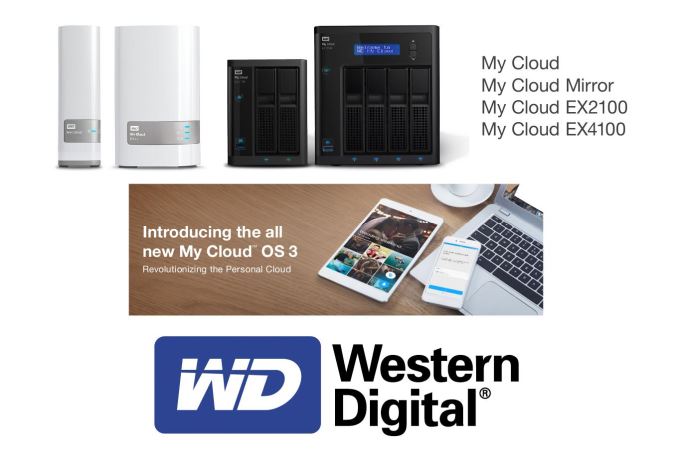
Western Digital markets their NAS lineup under the 'Personal Cloud' category. This is further sub-divided into three markets, the 'Consumer Series' (the MyCloud units), 'Expert Series' (the EX units) and the 'Business Series' (the DL units). At IFA 2015, WD took the opportunity to announce some updates to their NAS units. On the hardware side, there is a refresh of the My Cloud Mirror (2-bay version) with an updated internal platform. On the software front, the next major version of My Cloud OS (v3) with plenty of interesting features is being made available for download. In the conference call to discuss this announcement, WD presented plenty of interesting facts - 50% market share amongst 1- and 2-bay NAS units in the US and 30% amongst all consumer NAS units in the EMEA regions. Surprisingly, they also indicated that more than 1.6M My Cloud and My Cloud Mirror units have My Cloud OS 3The number one feature that My Cloud OS 3 brings to users is the 'Sync' capability. It works similar to Dropbox. In the NAS market, it can be thought of as an equivalent feature for Synology's Cloud Station or QNAP's QSync.
Sync allows data in a given PC's folder to be mapped on to a sync folder on the WD My Cloud NAS. The data here can be automatically kept synchronized with a folder on another PC that also has the WD Sync program running. The Sync program also allows for versioning on the synced files. My Cloud OS 3 continues the ease of use of the cloud access from an external network - either through port forwarding or a relay connection via WD's servers. The My Cloud mobile app can also backup photos and videos from an iOS or Android device to the My Cloud NAS. My Cloud OS had decent support for multimedia - photos and videos could be streamed like an album. OS 3 brings in a completely new feature 'My Cloud Albums' - it is possible to share a particular folder on the NAS with a group of friends.
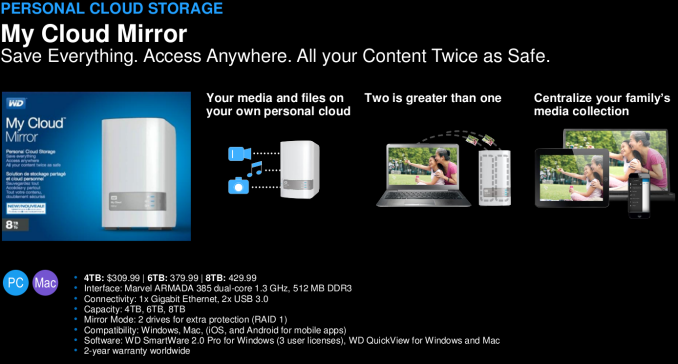
The settings on the mobile app with everyone in the group can be configured to upload all photos taken withing a particular timestamp into the shared common folder. WD is also launching a developer program with two approaches. A My Cloud API is being provided to access content on a My Cloud device. A My Cloud SDK can be utilized to write an application that can run on a My Cloud device using Docker. A list of partners is also being announced for the My Cloud OS: My Cloud OS 3 will be made available for download on September 21st. My Cloud Mirror Gen 2The My Cloud Mirror has been one of the popular members of the Consumer series, and WD is bumping up the specs of this 2-bay NAS today. The Gen 2 device is based on a Marvell ARMADA 385 dual-core 1.33 GHz solution sporting 512 MB of RAM. External features include a single GbE link and two USB 3.0 ports. The unit comes factory-configured in RAID-1. This is a step up from the ARMADA 370 single-core 1.2 GHz solution in the Gen 1 version.
The units are available for pre-order now, and in stores on September 30th. The 4TB, 6TB and 8TB units come in at $310, $380 and $430 respectively. WD also includes 3 user licenses for SmartWare 2.0 Pro with the My Cloud Mirror Gen 2. It is heartening to see Western Digital put efforts and focus into the NAS market. They may have a lot of catching up to do to be technically on par with vendors such as QNAP or Synology. However, their channel presence as well as the focus on not overwhelming the lowest common denominator customer bodes well for their continued success in the consumer NAS space. |
| 8:00a | Seagate Announces a Trio of 8TB Drives for Enterprise Applications
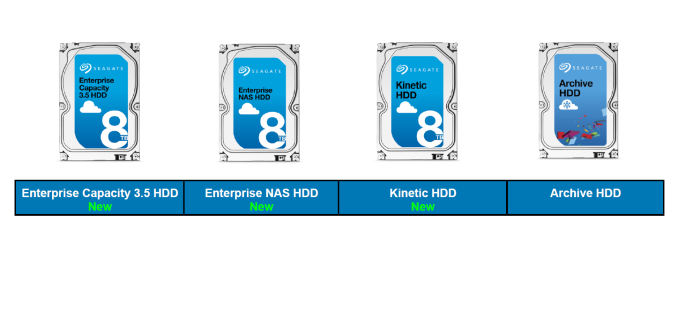
Seagate was the first hard drive vendor to launch a cost-effective 8TB hard drive. The Archive HDD v2 (ST8000AS0002) uses Shingled Magnetic Recording (SMR) to drive up the areal density of the platters and the 8TB version used six 1.33TB platters. The only other 8TB drive currently in the market is the HGST Ultrastar He8, which uses helium filled sealed drives with seven platters. Seagate is announcing their plans for three new 8TB drives today, mainly targeting enterprise usage. The three 8TB models that join the already existing Archive HDD are: The Enterprise Capacity 3.5 HDD v5 uses traditional PMR (perpendicular magnetic recording) and targets applications such as web, e-mail and SMB servers as well as areas requiring bulk storage. The design uses 6 platters (1.33TB/platter) pointing to an increase in areal density over competing drives. Thanks to the 256MB cache, it provides 100%+ faster random read-writes over the last generation Enterprise Capacity 3.5 HDD v4. The other interesting aspects of the Enterprise Capacity 3.5 HDD v5 include power loss protection (needed in part due to the larger cache) and a PowerBalance feature. The latter offers optional trade-off in performance for saving power. However, the firmware programming necessary to activate this feature will be made available only to OEMs and not small scale end customers.
The Enterprise NAS HDD family is also getting the capacity boost to 8TB. The target market is medium to large business customers with requirements for 24x7 enterprise-class storage for mid-range NAS, RAID and cloud applications. This is the same target segment as before (1-16 bay tower / rackmount enclosures). The power consumption of the Enterprise NAS HDD is lower than the corresponding nearline drives. The Enterprise NAS HDD comes with a 5-year optional 'Rescue Data Recovery' service that was discussed in our coverage of the Enterprise NAS HDD launch last year. Like the Enterprise Capacity HDD v5, the Enterprise NAS HDD 8TB version is also based on PMR / 1.33TB/platter technology. The MTBF, workload ratings and other important characteristics of the various drives offered by Seagate are summarized in the table below.
I had already talked about Kinetic HDDs in our coverage of Seagate at CES 2015. As a recap, the Kinetic HDDs do away with the need for a separate NAS server by presenting two Ethernet links over what looks like a SATA connector. Seagate is sharing some updates today regarding the Kinetic lineup. It is important to note that Kinetic is not a Seagate-only initiative, as Toshiba has also pledged support as a drive vendor for this ecosystem.
As part of the updates, Seagate shared the planned release of the Kinetic OneStor, a 5U 84-bay storage pod, in November this year. In January 2016, the Kinetic HDD 8TB will launch. Unlike the other two 8TB drives being announced today, the Kinetic HDD 8TB will be based on SMR technology.
The two PMR 8TB drives will be available towards the end of October. Seagate did not disclose any pricing information. |
| 8:00a | The Mobile CPU Core-Count Debate: Analyzing The Real World Over the last 5 years the mobile space has seen a dramatic change in terms of performance of smartphone and tablet SoCs. The industry has seen a move from single-core to dual-core to quad-core processors to today’s heterogeneous 6-10 core designs. This was a natural evolution similar to what the PC space has seen in the last decade, but only in a much more accelerated pace. While ILP (Instruction-level parallelism) has certainly also gone up with each new processor architecture, with designs such as ARM’s Cortex A15 or Apple’s Cyclone processor cores brining significant single-threaded performance boosts, it’s the increase of CPU cores that has brought the most simple way of increasing overall computing power. This increasing of CPU cores brought up many discussions about just how much sense such designs make in real-world usages. I can still remember when the first quad-cores were introduced that users were arguing the benefit of 4 cores in mobile workloads and that these increases were just done for the sake of marketing. I can draw parallels between those discussions from a few years ago and today’s arguments about 6 to 10-core SoCs based on big.LITTLE. While there have been some attempts to analyse the core-count debate, I was never really satisfied with the methodology and results of these pieces. The existing tools for monitoring CPUs just don’t cut it when it comes to accurately analysing the fine-grained events that dictate the management of multi-core and heterogeneous CPUs. To try to finally have a proper analysis of the situation, for this article, I’ve tried to approach this issue from the ground up, and not relying on any third-party tools. |
| 11:05p | The Intel Skylake Mobile and Desktop Launch, with Architecture Analysis Intel’s 6th Generation of its Core product line, Skylake, is officially launching today. We previously saw the performance of the two high end Skylake-K 91W processors, but that was limited in detail as well as product. So it is today that Intel lifts the lid on the other parts from 4.5 W in mobile through Core M, to 15W/28W in Skylake-K, 45W in Skylake-H and then the 35W/65W mêlée of socketed Skylake-S parts. For today's formal launch we will be taking a look at the underlying Skylake architecture, which was unveiled by Intel at their recent Intel Developer Forum this August. |




| << Previous Day |
2015/09/01 [Calendar] |
Next Day >> |