[Most Recent Entries] [Calendar View]
Monday, October 5th, 2015
| Time | Event | ||||||||||||||||||||||||||||||||||||||||||||||
| 8:00a | The Acer Aspire S7-393 Review: Broadwell Comes To Acer's Ultrabook The last time we got a chance to try out the Acer Aspire S7, it was back in 2013. At the time it was a big step up from Acer, and the Ivy Bridge based S7 came with one of the slimmest and lightest bodies of that era. That was 2013. In 2015, the competition in the Ultrabook space has not sat idly by. One thing is for certain in the technology sector. No matter what kind of lead you have, if you stand still, you will be passed. | ||||||||||||||||||||||||||||||||||||||||||||||
| 6:30p | Software Guard Extensions on Specific Skylake CPUs Only
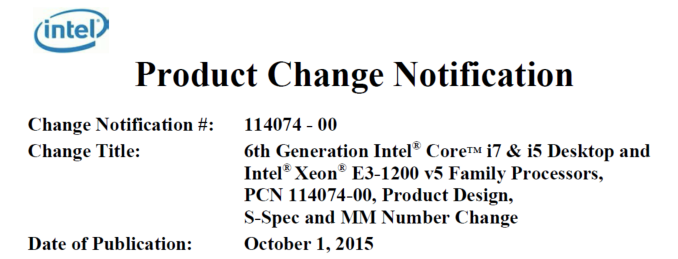
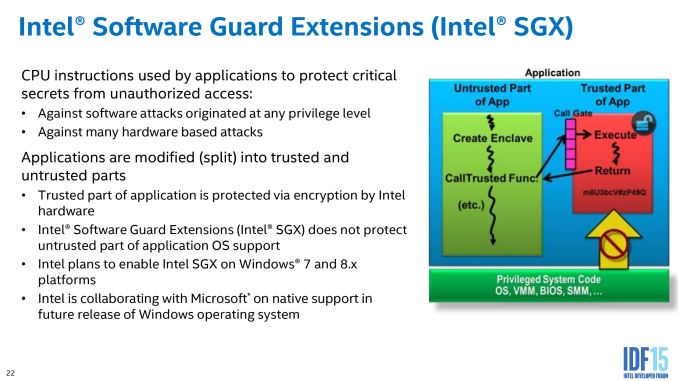
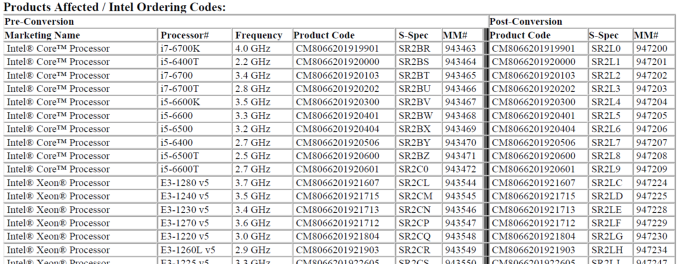
Through the staggered release of Intel’s 6th Generation Core processors, known as Skylake, we reported in our architecture deep dive that Intel would be introducing a raft of known features, including Software Guard Extensions (SGX) among others. These extensions would allow programs to allocate a set of DRAM, resources and a runtime environment (known as an enclave) specifically for that software alone, such that other programs could not access its functions or violate its memory area through 0-day intrusions. At the time we were under the impression that the SGX extensions would be enabled across all Skylake CPUs (or at least a specific subset, similar to TXT) from day one, but some sleuthing from Tech Report has determined this is not the case. As described in a Product Change Notification, which is basically a PDF released via the website and to major partners involved, only certain upcoming versions of Skylake processors will have SGX capabilities enabled. Rather than changing the commonly used nomenclature in order to identify these processors (Core i7, i5 etc), the ones with SGX enabled will have a different S-Spec code. This code is a series of letters and numbers printed on the processor (and the box it came in) to indentify the processor for Intel’s internal database. So while the outer-ring name might not change (e.g. i7-6700K), the S-Spec can change for a number of reasons (stepping, updates or source) and this will not be readily apparent to the end-user unless they get a chance to see the code before purchasing the product. The S-Spec change should be seamless, meaning no BIOS or microcode updates required for existing systems, which makes it harder to confirm without opening an SGX enabled detection tool or if it appears in the instruction list for SGX.
Normally with this sort of change we would expect a difference in the stepping of the processor, e.g. a move from C-0 to C-1 or something similar, but Intel has not done this here. As a result it could be speculated that an issue with the first few batches of processors rendered this part of the silicon non completely viable or consistent, and tweaks to the process (rather than creating new masks) has brought the issue under control for manufacturing. Many users have noted that sourcing Skylake processors is still rather difficult outside the two overclockable versions and their non-K counterparts, and this might have something to do with it, if Intel was waiting for the full extension set to be enabled. It might not be considered that big of a deal, despite the fact that SGX has been part of Intel’s software mantra since at least 2013. We would imagine that specific enterprise software packages from vendors would be expecting these extensions to go live with certified systems since the launch of Skylake, meaning there might be some confusion if two identical named processors are not separated by the S-Spec code. As far as we know from Intel, we are also expecting a relevant update to current operating systems to allow SGX to work.
To that extent, Intel has said in the PDF which specific processors will have the change, which covers the Skylake Core i7, i5 and Xeon E3 v5 parts in both OEM and boxed processors. These new parts will be available to customers from October 26th, and in systems by November 30th, without the need for requalification. For non-business and non-enterprise use, we imagine that sets of parts will be in the chain for a good while, although one would imagine that Intel would solely be creating the SGX enabled parts from now on. Source: via Tech Report | ||||||||||||||||||||||||||||||||||||||||||||||
| 8:50p | Google’s Chromecast 2 is Powered By Marvell’s ARMADA 1500 Mini Plus - Dual-Core Cortex-A7
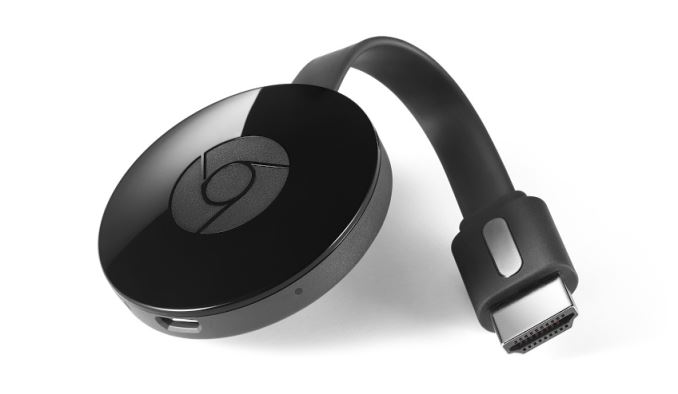
When Google originally announced the second-generation Chromecast last week, in typical Google fashion they focused on features and uses over specifications. Given the capabilities of the new product we knew that there had to have been some changes – at a minimum the wireless component has changed – and thanks to a press release from Marvell we finally know what chips are in the new media receiver. The Chromecast 2 is powered by Marvell’s ARMADA 1500 Mini Plus (88DE3006), one of Marvell’s lower-end “digital entertainment processors.” The Mini Plus is the successor to the ARMADA 1500 Mini (88DE3005), which in turn was first introduced for the Chromecast 1 back in 2013. Like the original Mini, the Mini Plus is essentially tailor-made for the Chromecast, as it’s geared to be a low-cost solution for simple streaming devices.
Unfortunately in-depth details on the Mini Plus are hard to come by at the moment – and Marvell never published all that much about the original Mini either – but we do know that unlike the original Mini, Marvell has put in a bit more customization work into the Mini Plus. The original Mini was in a few ways a cut down version of Marvell’s more powerful Cortex-A9 based chips, such as implementing just a single CPU core versus multiple cores. This time around the Mini Plus drops the single Cortex-A9 for a dual-core Cortex-A7 implementation, and is the only ARMADA product utilizing A7. Officially Marvell isn’t specifying clockspeeds, however they are advertising that the Mini Plus gets “up to 4900 DMIPS”. This is notable since we know that the Cortex-A7 has an estimated DMIPS/MHz ratio of 1.9, with puts the maximum CPU clockspeed at roughly around 1.3GHz (4900 DMIPS / 2 cores / 1.9 ratio = ~1289). Meanwhile according to Marvell’s press release the Mini Plus is supposed to deliver 2.5x the CPU perf of the Mini, which is especially interesting because A7, though not too far off of A9, is still a simpler part with lower IPC. So the fact that CPU performance is ahead of the A9-based Mini even after factoring out the second CPU core (1.25x) bodes well that Google hasn’t traded an immediate multi-threaded performance cap for a single-threaded performance cap. Curiously this implies that the Mini in the original Chromecast was clocked quite low (~800MHz), but for the moment these are the numbers we have to work with.
As for the GPU, Marvell is stating even less, only that it’s an OpenGL ES 2.0 part. ES 2.0 parts are still very common in pure media streaming devices and TVs, as for the most part you don’t need much more GPU performance than is necessary to do basic drawing and compositing at 1080p. All of the other ARMADA 1500 parts have using Vivante GPUs, and I expect the story is the same for the Mini Plus. The bigger question on the video processing side is whether the Mini Plus has HEVC support or not. All ARMADA 1500 parts launched since mid-2014 have included HEVC support, however as the Mini Plus is a low-cost part, it remains to be seen whether Marvell was willing to spend the die space and licensing costs on support for HEVC in a device only designed for 1080p in the first place. By and large, HEVC is being utilized by media streaming firms for 4K media rather than 1080p. Finally, Marvell’s press release also opens up on the wireless networking chip used in the Mini Plus. Here Marvell has dropped the 3rd party AzureWave solution for their own Avastar 88W8887 solution. The Avastar 88W8887 (ed: that’s a lot of eights) is a “quad radio” solution, offering support for WiFi, Bluetooth, NFC, and FM radio receive. In the case of the Chromecast 2, Google is only making use of the WiFi functionality, where the 88W8887 supports 802.11ac with 1 spatial stream, allowing it to transfer up to 433Mbps over 5GHz. Otherwise it’s interesting to note that of all of the technical changes that come with the switch from the Mini to the Mini Plus, it’s the improved WiFi capabilities from the 88W8887 that have seen the most promotion from Google itself. | ||||||||||||||||||||||||||||||||||||||||||||||

| << Previous Day |
2015/10/05 [Calendar] |
Next Day >> |