[Most Recent Entries] [Calendar View]
Wednesday, January 6th, 2016
| Time | Event | ||||||||||||||||||||||||||||||||||||||||||||||||||||||
| 1:37a | Wi-Fi HaLow: Long-Range, Low-Power Wi-Fi for Internet-of-Things Devices
There are more than 6.8 billion devices with Wi-Fi technology in use today, but the number of devices that need to share data or access the Internet wirelessly will grow exponentially in the coming years because various wearables, driverless cars, smart sensors and other devices that belong to the Internet-of-Things (IoT) world. The Wi-Fi Alliance this week announced the IEEE 802.11ah standard, which was developed specifically for IoT devices. The tech will be formally called the Wi-Fi HaLow. The 802.11ah operates in 900 MHz band, which helps to cut down power consumption, extend transmission range, improve propagation (the ability to transmit in the presence of many interferences) and penetration (the ability to transmit through various barriers, such as walls or floors). It is expected that the radius of a Wi-Fi HaLow device will be twice that of modern Wi-Fi standards (i.e., 500 meters in case of the 802.11n) and up to one kilometer, which can be further extended using relay. Actual data-rates supported by the 802.11ah will not be too high: the tech uses 802.11a/g spec with up to 26 channels that provide up to 100 Kb/s throughput. The Wi-Fi HaLow technology was designed to enable communications between devices at longer distances and/or in challenging environments (with many barriers) using relatively low amounts of power. The tech could challenge both Bluetooth and cellular networks eventually since it combines the best of both worlds: low power operation as well as relatively long range. Moreover, unlike Bluetooth and other short-range radio technologies, the 802.11ah can connect devices directly to the Internet.
Since many devices supporting the Wi-Fi 802.11ah will also be able to operate in 2.4 and 5 GHz bands, they will also support traditional 802.11n/ac technologies and will be able to send and receive data at higher transfer-rates when possible. The WiFi HaLow will unlikely replace Bluetooth completely due to the vast ecosystem that already uses the technology. However, it will compete against Bluetooth in the future. It will also not be able to replace cellular networks because they are ubiquitous. The Wi-Fi HaLow 802.11ah technology has a lot of potential and is something that IoT needs. The 802.11ah will enable communications both for tiny battery-operated wearables as well as for various applications that cannot connect using today’s Wi-Fi technology. For example, the Wi-Fi HaLow can connect all personal health trackers at a hospital to its central servers, or enable communications between various machines at a large agriculture or industrial facility. The Wi-Fi Alliance claims that its technologies operate in unlicensed spectrum; therefore, the Wi-Fi HaLow should not interfere with existing wireless technologies. Nonetheless, it should be noted that 900 MHz band is licensed in some countries. Therefore, the tech may not work everywhere, which will likely slowdown its adoption by the industry. At present, the Wi-Fi 802.11ah is still a draft specification. Later this year it will be approved by the IEEE Std P802.11ah working group. | ||||||||||||||||||||||||||||||||||||||||||||||||||||||
| 2:20a | Honor Launches The Honor Band Z1
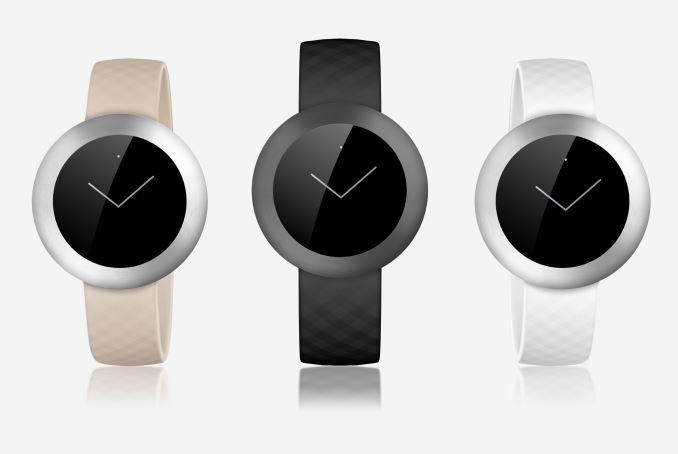
Today during their pre-CES launch event honor announced a new smartphone as well as a new fitness tracker called the honor band Z1. I found interest in the honor band Z1 because of the fact that it acts as a fitness band but doesn't follow the rectangular form factor that many fitness devices such as the Microsoft band have adopted, while allows it to also act as something similar to a typical circular watch. The honor band Z1 sports a 1.06" 128 x 128 PMOLED display. This is obviously a much lower resolution than high end smartwatches, but for the intended applications of the honor band Z1 it makes sense in order to preserve battery life. The stainless steel case has a diameter of 38mm, a thickness of 9.5mm, and a mass of 25 grams. It's powered by a Cortex M4 based STM32F411 CPU from STMicroelectronics, which is paired with a 70 mAh internal battery. Honor states that the battery will last for 3-4 days of normal use, including daytime fitness use and sleep tracking. Like most wearables, the honor band Z1 is IP68 certified. In addition to fitness tracking, the honor band Z1 does support some forms of communication, including notification mirroring and caller ID. It connects to your smartphone via Bluetooth 4.1, and supports iOS 7.0 and newer, as well as Android 4.4.4 KitKat and newer. The bands come in black, white, and cream finishes, with the black band model also coming with a black steel finish. It will retail for $79.99 USD when it goes on sale at the end of the month. | ||||||||||||||||||||||||||||||||||||||||||||||||||||||
| 2:28a | Hands On With the Huawei Honor 5X
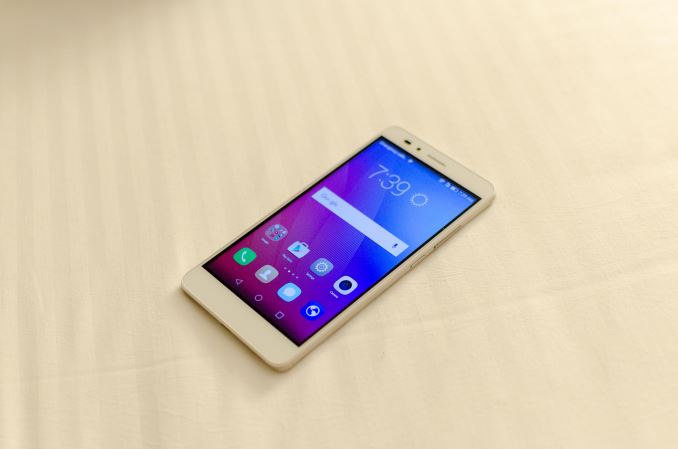
We’ve reviewed Huawei Honor devices before, but by and large they were designed to target China and similar markets. There were also a number of growing pains as seen in our Huawei Honor 6 review. However, in the time since that review Huawei has done quite a bit of growing up when it comes to resolving some of their weaknesses and improving upon their strengths. Their Kirin SoCs started off with some notable issues in implementations, but with the Kirin 950 we’ve seen a major leap in performance and power efficiency. To keep their momentum going, Huawei Honor is bringing their first phone to the US, the Honor 5X.
The basic specs aren’t really going to be all that fascinating at this point as Snapdragon 615 is a known quantity. Huawei continues their trend of shipping odd WiFi configurations as this device only supports 2.4 GHz 802.11b/g/n WiFi. The rear camera is a rather well-understood Sony IMX214 sensor and the front camera sensor is a similarly common OmniVision OV5648 sensor.
However, the Honor 5X actually manages to hit the right point for price and features. The display is a 5.5” 1080p LCD, with an aluminum unibody design. There’s also the usual dual SIM capabilities along a decently sized battery and an FPC1020 fingerprint scanner shared with the Ascend Mate7. At 200 USD, this has the potential to beat out the Moto G for best value smartphone in that price range.
Subjectively, the in-hand feel and overall build quality is shockingly good for the price. The Ascend P8 Lite that we reviewed last year was pretty much par for the course when it came to materials and in-hand feel for a ~200 USD phone, so to go from some rather hard and cheap-feeling plastic to an aluminum unibody that is basically comparable to the HTC One M9 in feel is quite a leap in the course of less than a year. The comparison to the One M9 is rather apt in this case, as the design of the phone is such that the phone has a brushed finish that can be seen, but not really felt in the hand.
Unfortunately, the performance of the Honor 5X is a bit wanting. I suspect that Cortex A53s alone aren’t quite enough to get the amount of performance needed to make Android run perfectly smooth, as while in some cases the phone was perfectly smooth in some transitions like opening and closing app folders I saw noticeable frame drops and similar issues.
Casual use of the fingerprint scanner was also quite impressive, as the Honor 5X behaves pretty much identically to the Ascend Mate7 in how the fingerprint scanner will automatically detect and scan a fingerprint even when the screen is off, so with fingerprint unlock set up it’s possible to unlock the phone by simply placing a finger over the fingerprint scanner and waiting for the phone to wake up and unlock automatically.
As previously mentioned, Huawei is selling the Honor 5X for 199.99 USD. It will be available for preorder starting January 6th, and will have general availability starting January 31st on HiHonor.com and Amazon. Although it would have really been exciting to see something like Snapdragon 650 show up in this phone, at the price it’s going it could be a viable option if Huawei has managed to nail down the details without show-stopping issues. | ||||||||||||||||||||||||||||||||||||||||||||||||||||||
| 6:31a | ZOTAC to Expand Lineup of SSDs with PCIe Offerings
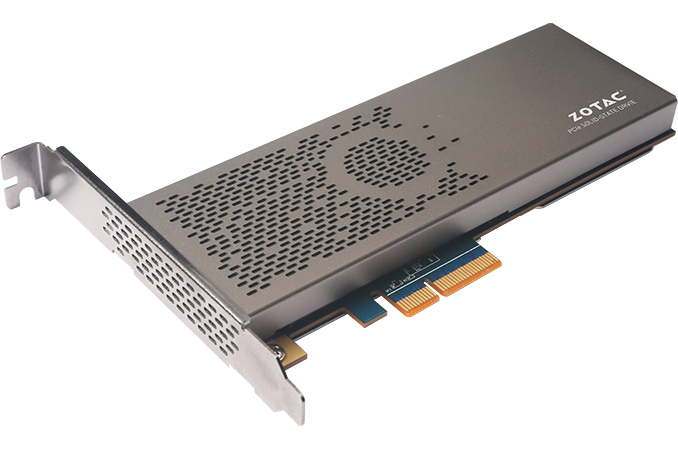
ZOTAC is primarily known for its NVIDIA GeForce-based video cards, but in the recent years, the company started to sell motherboards, small form-factor personal computers and various accessories. Last year ZOTAC introduced its entry-level solid-state drives to add another revenue stream. At the International CES 2016, ZOTAC announced its new-generation PCIe SSDs, which are expected to address higher-end market segments. The new solid-state drives from ZOTAC will be powered by Phison’s PS5007-E7 controller as well as multi-level cell (MLC) NAND flash memory produced by Toshiba. ZOTAC claims that its new SSDs will have sequential read performance of up to 2400 MB/s and sequential write performance of up to 1200 MB/s. The new solid-state drives from ZOTAC will come in half-length half-height PCI Express 3.0 x4 card form-factor and will fully support the NVMe protocol. The first model in ZOTAC’s PCIe SSD lineup will feature 480 GB capacity and will be available sometimes in February, according to the manufacturer.
ZOTAC does not reveal too many details about its new solid-state drives, but since they are based on the Phison PS5007-E7 controller, expect support for the NVMe 1.2, error correction with 120-bit/2KB BCH code, NVMe L1 power sub-states, end-to-end data path protection, advanced global wear-leveling, an AES-256 engine and so on. The AIC form-factor also means that the controller will be able to use all of its eight transfer channels, thus, maximizing performance. Since the Phison PS5007-E7 controller was developed not only for gaming PCs, but also for enterprise and datacenter applications, it can enable SSDs with up to 350,000 4KB random read IOPS (input/output operations per second) and up to 250,000 random write IOPS. While consumer SSDs featuring the PS5007-E7 may not hit maximum IOPS performance, they will definitely be considerably faster than any previous-generation solid-state drives.
ZOTAC’s first-generation SSDs were arguably a business experiment for the company and its parent, PC Partner Group, which specializes on production of graphics cards, motherboards and other similar products, but not on storage devices. ZOTAC’s initial SSDs use Serial ATA interface and deliver moderate levels of performance. The cautious approach makes a lot of sense. Nowadays the end-user demands SSDs with maximum durability and reliability. ZOTAC yet has to become a well-known maker of solid-state drives and if its products are not rock-solid, its brand will be harmed. As a result, the company decided to focus on maximum quality rather than on maximization of sequential reads and writes. With its new PCIe SSDs, ZOTAC plans to deliver rather extreme levels of performance. ZOTAC’s solid-state drives with PCI Express 3.0 x4 interface may not be as fast as Samsung’s 950 Pro (at least, on paper), but if the price and performance have the right balance, many end-users will gladly buy them. | ||||||||||||||||||||||||||||||||||||||||||||||||||||||
| 9:00a | Razer Launches The Stargazer Webcam With Intel RealSense3D At CES 2016
The webcam market may seem fairly pedestrian, but Razer is trying to kickstart it with a new webcam designed for the modern game streamer. Many of the major game streaming sites have begun the move to 60 FPS video, but the modern webcam is basically stuck at 30 FPS. Razer is directly targeting this market with the Stargazer webcam. The 60 FPS video capture can be done at 720p, and the camera also supports 1080p at 30 FPS. It also features automatic a noise-cancelling, dual-array microphone.
The Stargazer is powered by the Intel RealSense SR300 camera, which means that it also brings 3D to the mix. This may sound like a waste, but it brings quite a few benefits. The first obvious one is Windows Hello support, for facial recognition in Windows 10. The part that Razer is most excited about though is the Dynamic Backround Removal capability, which means that the 3D camera can filter out the entire image except for the person. Traditionally when doing game streaming, the game is on most of the screen with the person playing as a box in one of the corners, but with the 3D camera Razer can focus on just the gamer, eliminating the required video box and just leaving the person. This has generally required an elaborate green-screen for gamers to invest in, and the Stargazer brings a similar result for much less cost. On the other side of gaming, the Stargazer can be used to scan real objects into a digital world, for use as in-game assets, potentially speeding up development.
Finally, the Stargazer supports gesture and facial recognition with up to 78 points on the face and 22 points on each hand. Developers can leverage this for in-game actions, and it is something that Intel is promoting with it’s RealSense camera system, so we’ll have to see if it gains traction with developers. It may be just a webcam, but as one of the first Windows Hello compatible devices launched, it already has a place with some people. The game streaming crowd will gain the bulk of the benefits for this, and that market is growing quite a bit. The Stargazer will be available staring in Q2 for $199.99 USD. Source: Razer | ||||||||||||||||||||||||||||||||||||||||||||||||||||||
| 9:01a | Razer Launches The Razer Blade Stealth Ultrabook And Razer Core At CES 2016
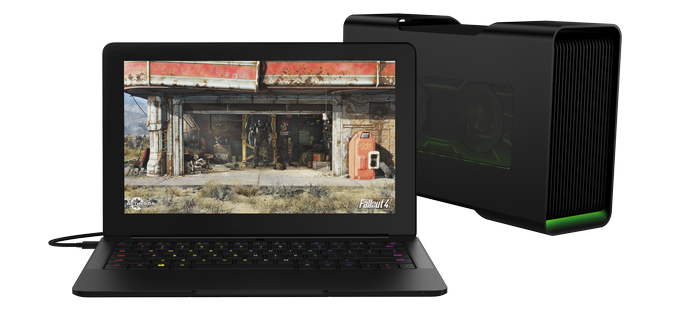
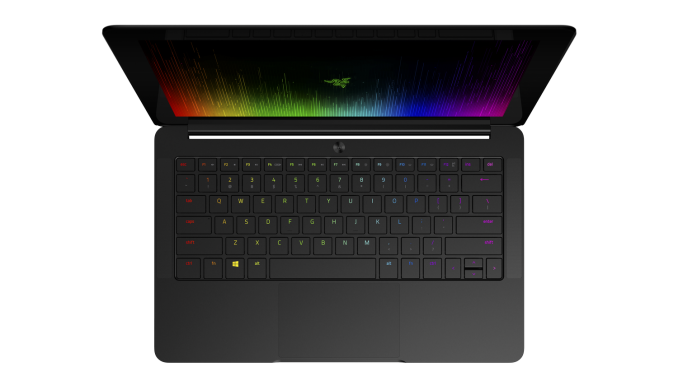
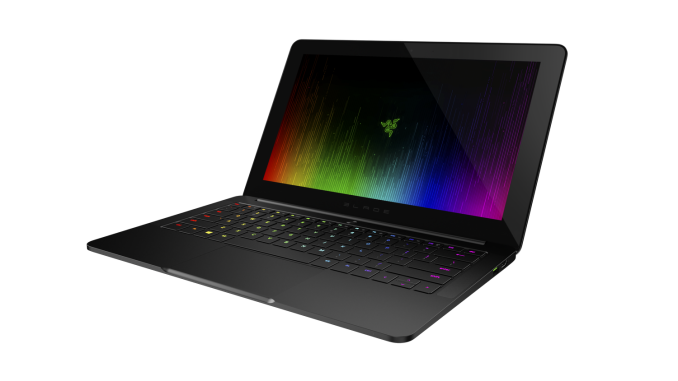
Today we have some news that is kind of unexpected. Razer, the company known for gaming peripherals and gaming laptops such as the Razer Blade, has decided to enter the Ultrabook market with the launch of the Razer Blade Stealth. Not only is an Ultrabook not something expected from Razer, it is also priced very competitively and undercuts the competition on price. Razer did not cut any corners either when designing the Stealth. Just like it’s more powerful and higher priced siblings, it is built out of a CNC-milled aluminum chassis, which is a designing feature of Razer laptops. But despite the solid frame, the laptop is still only 0.52-inches thick and weighs in at just 2.75 lbs. On the styling front, it keeps the black finish of other Razer laptops, but also outdoes them with a full “Chroma” keyboard with individually lit RGB keys. I’ve been hoping that they would do this for a while when reviewing the Razer Blade, so it’s great to see the RGB keyboard come to the Stealth model.
The 12.5-inch display comes in two options. The base model is a QHD (2560x1440) resolution, but you can also opt for a UHD (3840x2160) model with full Adobe RGB color gamut. I need to check in with Razer on how they are going to handle the wider color gamut, and will let you know after we get some hands-on time on the show floor. The Stealth, as an Ultrabook, is going to be powered by Ultrabook class components, which in this case is the Intel Core i7-6500U processor. This Skylake chip features two cores, hyperthreading, and a base/turbo frequency of 2.5 GHz / 3.1 GHz. I was hoping that Razer would also offer a model with Intel’s Iris GPU, but that won’t be the case, at least at launch. The only memory option is 8 GB of LPDDR3-1866, and storage options range from 128 GB to 256 GB of PCIe storage on the QHD model, and 256 GB to 512 GB on the UHD model. The battery life will need to be tested, but the laptop has a 45 Wh battery, so it’s not going to be class leading in that regard.
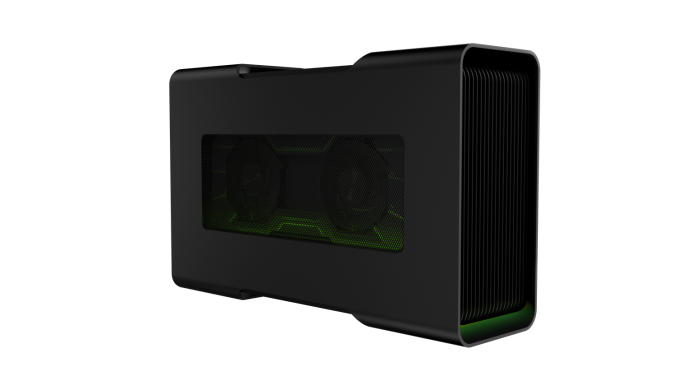
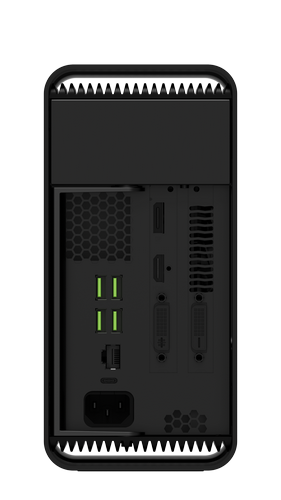
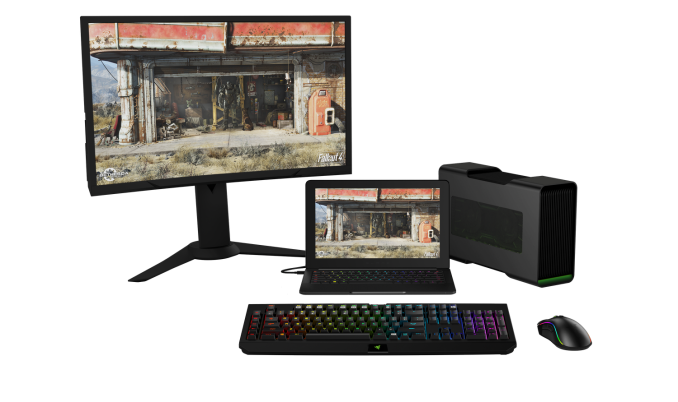
For connectivity, the Stealth will have two USB 3.0 ports, and a USB 3.1 Type-C connector with Thunderbolt 3 support. The Thunderbolt is a key component to the Stealth, thanks to the accessory that Razer is also launching. The Razer Core is a Thunderbolt 3 connected external GPU, which also acts as a docking station for the Stealth. With a single cable connection, the laptop can power an external display, all of the docking connections with four USB 3.0 ports and Gigabit Ethernet, and support for a 375W GPU.
The Core features a built-in 500W power supply, and the GPU support is for any single card which is full-length and double-wide, which means pretty much any GPU out there. The Core also features two additional Chroma lighting zones so that you can tailor it to your liking. Razer has not yet announced any updates to the Razer Blade or Razer Blade Pro, but I would expect that both of these will also feature support for the Core when they do get their next refresh.
The Core supports plug and play with validated graphics cards, without the need to reboot. The addition of the Razer Core brings back some of the gaming performance that Razer has been known for, although with a U series CPU it will be interesting to see what level of GPU is required to become CPU bound, especially with DX 12. If we can track down a review unit, we’ll try to sort that out.
The Razer Blade Stealth will be on-sale starting today, with a starting price of just $999. Considering the high resolution panel and Core i7, this undercuts most, if not all, of the Ultrabook competition on price. The top end 4K model with the UHD display and 512 GB of storage will be $1599. Source: Razer | ||||||||||||||||||||||||||||||||||||||||||||||||||||||
| 10:00a | Imagination Announces PowerVR Series7XT Plus Family - Rogue Gets Improved Compute
A regular sight at CES at most years is a new PowerVR graphics announcement from the crew over at Imagination, and this year is no exception. Shortly before CES last year we were introduced to the company’s PowerVR Series7XT family, a significant iteration on their base Rogue architecture that added full support for the Android Extension Pack to their GPUs, along with specific improvements to improve energy efficiency, overall graphics performance, and compute performance. Imagination also used Series7XT to lay the groundwork for larger designs containing more GPU clusters, giving the architecture the ability to scale up to a rather sizable 16 cores. After modernizing Rogue’s graphics capabilities with Series7XT, for their follow-up Imagination is taking a slightly different path. This year they are turning their efforts towards compute, with while also working on energy and memory efficiency on the side. To that end the company is using CES 2016 to announce the next iteration of the Rogue architecture, PowerVR Series7XT Plus. With Series7XT Plus, Imagination is focusing first and foremost on improving Rogue’s compute performance and compute capabilities. To accomplish this they are making two important changes to the Rogue architecture. First and foremost, Imagination is upgrading Rogue’s integer ALUs to more efficiently handle smaller integer formats.
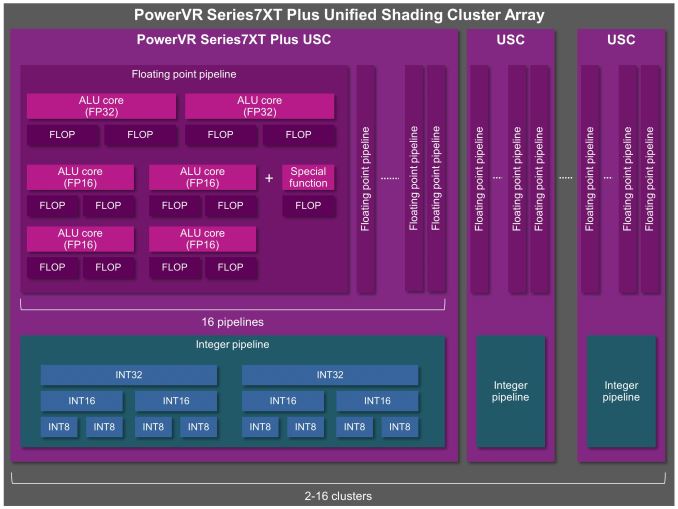
Though Imagination hasn’t drawn out the integer ALUs in previous generations’ architecture diagrams, the architecture has always contained INT32 ALUs. What has changed for Series7XT then is how those ALUs handle smaller INT16 and INT8 formats. Previously those formats would be run through the integer ALUs as INT32s, which though practical meant that there were few performance gains from using smaller integers since they weren’t really processed as smaller numbers. Series7XT Plus significantly changes this: the integer ALUs can now combine operations into a single operation based on their width. One ALU can now process 1 INT32, 2 INT16s, or 4 INT8s. Imagination’s press release doesn’t offer a ton of detail in how they are doing this, however I suspect that they have gone with the traditional (and easiest) method, which is to simply bundle like-operations. An example of this would be bundling 4 INT8 adds into what is essentially one large INT32 addition operation, an action that requires minimal additional work from the ALU. If this is the case then the actual performance gains from using and combining smaller operations will depend on how often these operations are identical and can be bundled, though since we’re talking about parallel computing, it should be the case quite often. From an architecture perspective this is an interesting and unexpected departure from Imagination’s usual design. One of the traditional differences between PowerVR and competitor ARM’s Mali designs is that Imagination went with dedicated FP16 and FP32 ALUs, whereas ARM would combine operations to fill out a 128-bit SIMD. The dedicated ALU approach has traditionally allowed for greater power efficiency (your ALUs are simpler), but it also means you can end up with ALUs going unused. So for Imagination to go this route for integers is surprising, though I suspect the fact that integer ALUs are simpler to begin with has something to do with it. As for why Imagination would care about integer performance, this brings us back to compute workloads. Rather like graphics, not all compute workloads require full INT32/FP32 precision, with computer vision being the textbook example for compute workloads. Consequently, by improving their handling of lower precision integers, Imagination can boost their performance in these workloads. For a very low precision workload making heavy use of INT8s, the performance gains can be up to 4x as compared to using INT32s on Series7XT. Pragmatically speaking I’m not sure how much computer vision work that phone SoCs will actually be subjected to – it’s still a field looking for its killer apps – but at the same time from a hardware standpoint I expect that this was one of the easier changes that Imagination could make, so there’s little reason for Imagination not to do this. Though it should also be noted that Rogue has far fewer integer ALUs than FP ALUs - there is just 1 integer pipeline per USC as opposed to 16 floating point pipelines - so even though smaller integers are now faster, in most cases floating point should be faster still. Moving on, along with augmenting their integer ALUs, Imagination is also bringing OpenCL 2.0 support to their GPUs for the first time with Series7XT Plus. Previous PowerVR parts were only OpenCL 1.2 capable, so for Imagination 2.0 support is a big step up, and one that required numerous small changes to various areas of the Rogue architecture to support 2.0’s newer features.
We’ve already covered OpenCL 2.0 in depth before, so I won’t go too deep here, but for Imagination the jump to OpenCL 2.0 will bring them several benefits. The biggest change here is that OpenCL 2.0 adds support for shared virtual memory (and pointers) between CPU and GPU, which is the cornerstone of heterogeneous computing. Imagination of course also develops the MIPS architecture, so they now have a very straightforward path towards offering customers a complete heterogeneous computing environment if they need one. Otherwise from a performance perspective, OpenCL 2.0’s dynamic parallelism support should improve compute performance in certain scenarios by allowing compute kernels to directly launch other compute kernels. This ultimately makes Imagination just the second mobile SoC vendor to announce support for OpenCL 2.0, behind Qualcomm and the Adreno 500 series. Aside from compute improvements, for Series7XT Plus Imagination has also made some smaller general improvements to Rogue to further improve power efficiency. Of particular note here is the Image Processing Data Master, a new command processor specifically for 2D workloads. By routing 2D operations through this simpler command processor, Imagination can save power by not firing up the more complex pixel/vertex data masters, making this another example of how mobile GPUs have slowly been adding more dedicated hardware as the power is more important than the die size cost. Meanwhile Imagination’s press release also notes that they have made some memory system changes, including doubling the memory burst size to match newer fabrics and components (presumably this is an optimization for DDR4), and tweaking the caches and their respective sizes to reduce off-chip memory bandwidth needs by 10% or so.
Overall these efficiency changes don’t appear to be as extensive as what we saw with Series7XT – and Imagination isn’t treating them as nearly as big of a deal – so the jump from Series7XT to Series7XT Plus shouldn’t be as great as what came before. Series7XT Plus in that regard is definitely a more incremental upgrade of Rogue, with Imagination focusing on improving a few specific use cases over the last year.
Finally, along with announcing the overarching Series7XT Plus family and its architecture, Imagination is also announcing two initial GPU designs for this family: GT7200 Plus and GT7400 Plus. As alluded to by their names, these are Series7XT Plus versions of the existing two-cluster GT7200 and four-cluster GT7400 designs. That imagination is only announcing smartphone designs is a bit odd – both of these designs are smaller than the GT7600 used in number-one customer Apple’s A9 smartphone SoC – though as Apple is the only customer using such a large design in a phone, for Imagination’s other customers these designs are likely more appropriate. In any case, while Imagination does not formally announce when to expect their IP to show up in retail products, if history is any indicator, we should be seeing Seires7XT Plus designs by the end of this year and leading into 2017. | ||||||||||||||||||||||||||||||||||||||||||||||||||||||









| << Previous Day |
2016/01/06 [Calendar] |
Next Day >> |