[Most Recent Entries] [Calendar View]
Friday, January 8th, 2016
| Time | Event |
| 7:00a | Zeiss Smart Optics: Discreet Smart Glasses
With Google Glass, one of the major barriers to adoption was just how glaringly obvious it was that you were wearing Google Glass. The display was a field sequential color LCoS with a simple projection system to make the display visible at a short distance away from the eye. Unfortunately, the problem with this system was that the display was completely obvious and wasn’t really integrated into traditional thin lens glasses. It was also pretty obvious when the display was active, as you could see light coming out of the LCoS array without getting uncomfortably close to the person wearing Glass.
Some of the other systems I’ve seen for projecting a display for smart glasses have also been pretty obvious to spot such as any of ODG’s smart glasses, although those aren’t really designed to be subtle in any way as they try to pack a full tablet of hardware into something head-worn. Sony’s SmartEyeGlass gets closer to something subtle, but it’s still glaringly obvious that you’re wearing something odd.
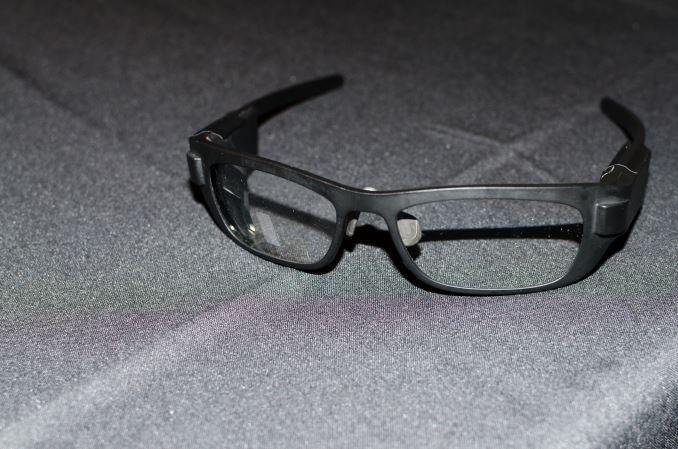
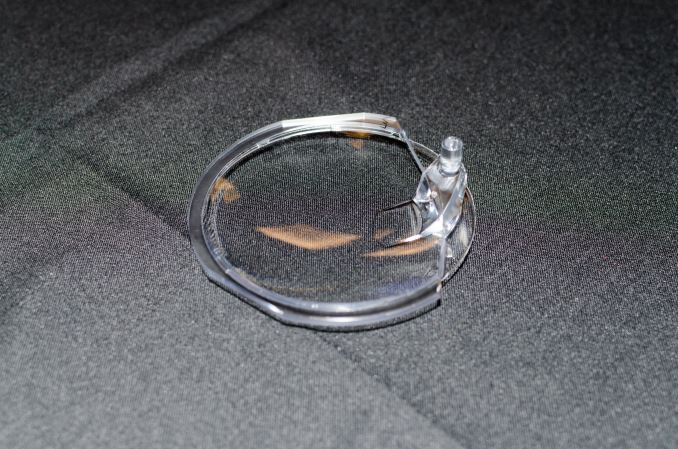
Zeiss identified this as an issue, and in response they created an internal team to try and make an optical system that resolves all of these issues. Their solution is what they’re now calling Smart Optics. This optical system takes a display mounted at the edge of the lens and can project it directly into the eye at an arbitrary position on the lens, with an arbitrary focus to either place the displayed image a short distance away from the eye (~2m), or even at infinity to create a true HUD.
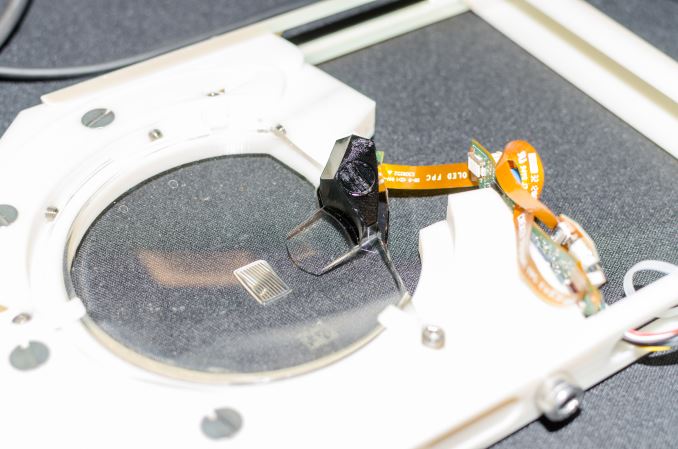
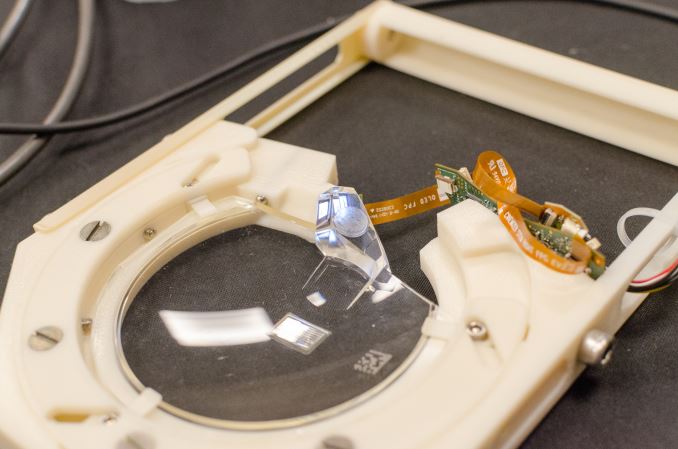
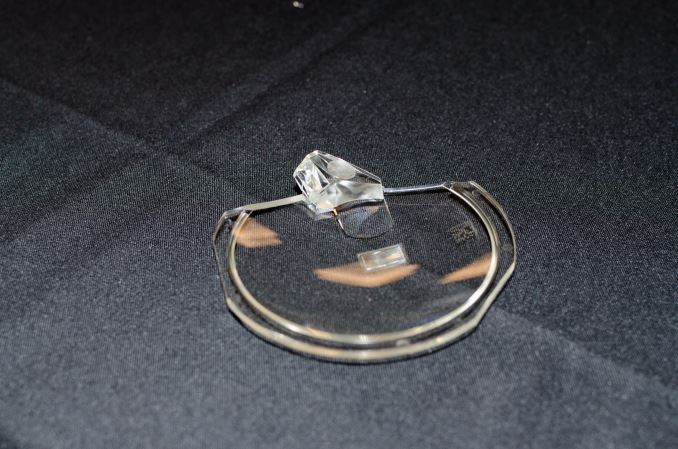
In essence, this optical system relies upon total internal reflection and a Fresnel structure to transmit the light from the display through the lens into the eye. A complex prism design reflects the light from the display at the edge of the display into the lens, where the Fresnel structure then reflects the light in the lens out into the eye. The Fresnel structure is index-matched with the lens itself, which makes it almost invisible to the eye unless you have the right lighting to highlight the structure.
The entire design is made from injection-molded polycarbonate, which means that it’s capable of being mass-produced in a method similar to most current glasses. Based on discussions with those that worked on this project, the prism in particular was especially difficult to create as its shape is complex and voids and other defects would appear in the polycarbonate as it cooled. Zeiss also emphasized that their design was covered with over 250 patents to drive home the difficulty of making this optical system work.
Zeiss showed off an early prototype, which even at this stage was impressive as there was no visible translucency that could occlude vision and the projection worked flawlessly. Unfortunately, as the design is supposed to be made with a prescription for those that need one I couldn’t quite get the full experience as the corrective lenses that they had for the prototype weren’t quite strong enough for my eyes, but their rapid prototyping rig worked well and showed acceptable resolution and luminance.
I wasn’t really able to get much in the way of details regarding whether any devices with this optical system were imminent, but it sounds like Zeiss is working with partners that can put their optics to use. Based upon a lot of the discussions I’ve had with various people working with wearables it sounded like smart glasses were at least 5-10 years out, but with technologies like this I wouldn’t be too surprised to know that by the 7nm node that smart glasses using this technology will start to reach mass consumer adoption. |
| 11:30a | AMD Reveals Wraith: Next-Generation Cooler for Microprocessors
Both AMD and Intel bundle cooling solutions with their microprocessors. Such coolers are inexpensive, they are rather reliable and they do their job. They are not supposed to enable great overclocking results, or be utterly quiet, unlike premium thermal solutions from the third parties. The two CPU developers are gradually working to improve their own coolers and this week AMD unveiled its new “Wraith” cooling system for its current and future chips. At present, AMD equips its boxed FX-series central processing units (CPUs) with a rather small air cooler called the AMD D3. The latter is made of aluminum, is equipped with four heat-pipes as well as a 70-mm fan. The thermal solution can remove up to 125W of heat, but at the cost of a lot of noise (up to 51 dbA, according to AMD). The vast majority of enthusiasts, who buy AMD FX CPUs, usually obtain their thermal solutions from companies like Corsair, Noctua or Scythe. However, certain PC makers utilize bundled coolers, which may not be a very optimal decision since they get rather loud when CPUs get hot. AMD’s high-end accelerated processing units (APUs) can dissipate up to 95W, but their boxed versions are also equipped with rather tiny and noisy coolers, which is not a problem for power users (who use third-party solutions anyway), but is not exactly good for PC makers.
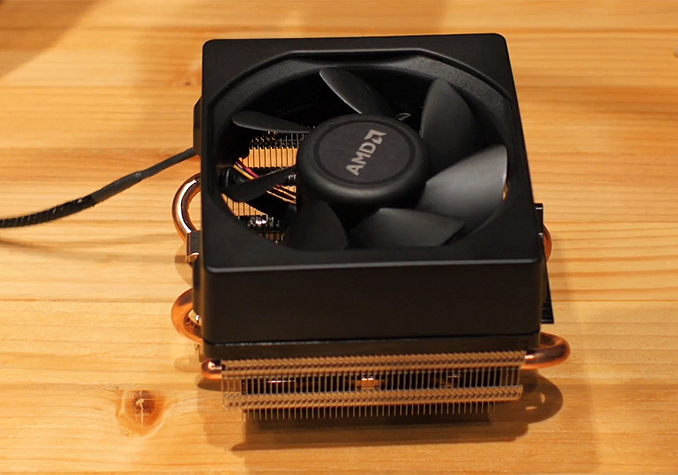
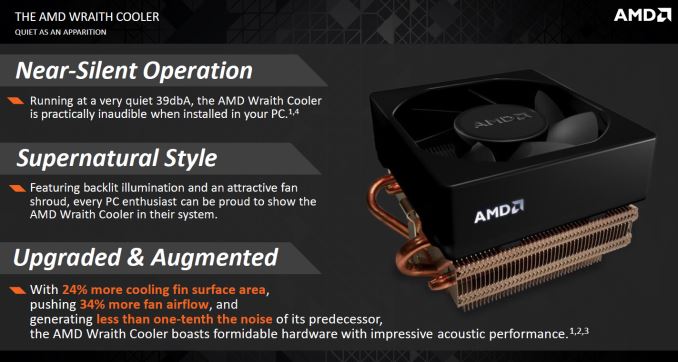
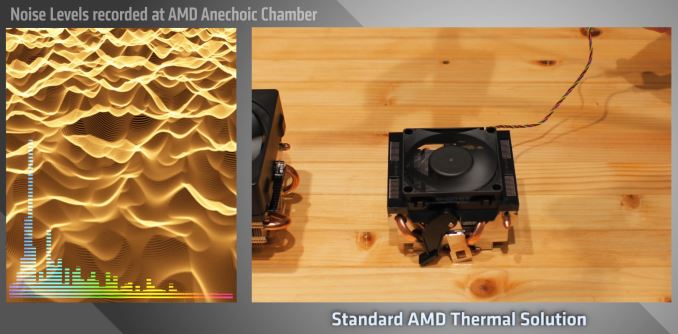
Apparently, AMD plans to offer better coolers with its microprocessors going forward. This week the company revealed its Wraith thermal solution, which will be used to cool down both current and upcoming chips from the company. The AMD Wraith, which was designed to take away around 125W of heat, features a rather large aluminum heatsink with ultra-thin fins, four heat-pipes as well as an 80-mm fan. AMD claims that the Wraith features 24% more cooling fin surface area (179,730.1mm2) compared to its predecessor (144,397.8mm2), which seems like a significant improvement. Contemporary 80-mm fans can generate significant airflow while staying rather quiet. According to AMD, the new fan pushes 55.78 cubic feet of air per minute (CFM), or 34% more than the predecessor (41.6 CFM). The maximum noise level generated by the Wraith cooler is around 39 dBA (based on what AMD says), which is quieter compared to the current-generation D3 cooler from the company, but is significantly louder than noise levels generated by advanced coolers from companies like Noctua or Scythe (20 – 32 dBA). Overall, the new cooler from AMD seems to be rather efficient for an in-box solution, but only real-world tests will show how good the Wraith cooling system actually is. While AMD did not disclose all details about its new thermal solution, it did show it in action on its YouTube channel. The new cooler is noticeably larger than the AMD D3. It is also noticeably quieter, but it is clearly not noiseless like 120mm low-RPM fans used on giant coolers.
The AMD Wraith cooling system will be bundled with select microprocessors going forward and will also be sold separately. The Wraith should be compatible with all recent AMD sockets (e.g., FM2+, AM3+, etc.), but we are not sure about the upcoming AM4 at this point. Since changing mounting mechanism of a cooler is not that hard, it looks like AMD’s Wraith will cool down the company’s chips for quite some time.
While enthusiasts will continue to use third-party coolers with AMD’s current and future central processing units, for many PC makers new thermal solutions will mean that AMD-based systems will get considerably quieter (which means generally more competitive). Since the Wraith is not large, it will fit into small form-factor systems. As a result, it will soon be possible to build an inexpensive SFF PC based on a high-performance AMD APU that will be relatively quiet. AMD did not reveal when exactly it plans to start bundling the Wraith cooler with its chips, but expect the new thermal solution to show up in the coming months. |



| << Previous Day |
2016/01/08 [Calendar] |
Next Day >> |