[Most Recent Entries] [Calendar View]
Thursday, January 14th, 2016
| Time | Event | ||||||||||||||||||||||||||||||||||||||||||||||
| 12:35a | Conexant Announces New Audio Processing Solutions At CES
At CES, Conexant gave me a demo of some of the audio processing technology that they've been working on. Conexant is a company that probably has their technology in a product you own without you knowing it, and they focus a lot on SoCs for doing audio processing in everything from TVs, to smartphones, to IoT devices. One of the most interesting demos shown by Conexant is of their 4 microphone voice system to provide 360 degree direction detection. The company's CX20924 DSP enables this, and in their demo it worked quite well regardless of the angle you were at, and it even worked properly with multiple users speaking at the same time. While many devices can do this kind of detection, they often require arrays with 6-8 microphones, which can be cost prohibitive. Conexant claims that the system can work at a range of up to five meters, and it's able to tune out background noise in order to properly interpret your voice. This system could be used to drive down the cost of voice-activated devices by reducing the amount of hardware needed, and in my mind I can think of products like the Amazon Echo being brought to lower price points without sacrificing functionality. The second major announcement from Conexant is their CX20926 audio and sensor SoC. The chip consists of a Cortex M0+, along with Conexant's own audio DSP for voice processing. This chip is aimed at IoT applications and other battery powered devices like smartphones where a vendor is looking to implement always-on voice detection with minimal idle power consumption. The last announcement from Conexant is their RoomAware Optimizer sound processing for televisions. This feature has been included on LG's 2016 OLED and QD TVs, under the name Magic Sound Tuning. The technology uses microphones to analyze the acoustic characteristics of the room in order to tune the sound produced by the TV's speakers. While I wasn't able to get a demo of this feature, the fact that Conexant has already gotten adoption from LG shows that there's clearly interest in this type of tech from manufacturers and consumers. | ||||||||||||||||||||||||||||||||||||||||||||||
| 5:05a | Compulab Rolls-Out Passively-Cooled Airtop Systems
Compulab, a maker of miniature and small form-factor computers, is introducing its first desktop system called Airtop today. The new computer can be equipped with rather high-performance components, but is completely fanless and only uses the company’s proprietary natural air-flow (NAF) cooling technology. Compulab’s Airtop is a compact 7.5-liter desktop system that can dissipate up to 200W of heat using only passive cooling methods. The Airtop utilizes various industry-standard components and can be configured as a gaming PC, a server or a workstation. The system is based on a proprietary motherboard featuring Intel’s C226 platform controller hub (PCH) designed specifically for the Airtop with NAF cooling. The mainboard places CPU socket, DIMM slots, PCI Express x16 slot and other components in a way to enable the most efficient dissipation of heat. To eliminate hot components from the case, the Airtop uses an external PSU with a mini-DIN connector.
The proprietary Airtop mainboard is compatible with Intel Core i7 and Intel Xeon E3 v4 microprocessors based on Intel’s Haswell or Broadwell micro-architectures (LGA1150 packaging) as well as various graphics cards, including NVIDIA’s GeForce GTX 950 and Quadro M4000.
The Airtop can be equipped with up to 32 GB of DDR3-1866 memory, four 2.5-inch Serial ATA HDDs/SSDs, one M.2 solid-state drive and one mSATA solid-state drive. The system features two Gigabit Ethernet network controllers (four more may be added using an extension card), a 802.11ac Wi-Fi card with two SIM card sockets, four SMA antennas, four USB 3.0 ports on rear panel, six USB 2.0 ports in total, three RS232 ports, multi-channel audio and so on. While the system utilizes its own mainboard, all the other components are industry-standard and can be upgraded when and if needed.
The NAF heat-exchange system uses two special side-panels, each of which can dissipate up to 100W of heat. The side-panels are equipped with traditional flat copper heat-pipe arrays (with micro-channels) that take away heat from the hottest components (i.e., the CPU and the GPU) and spread it across the side-panel. The heat from the heat-pipe arrays is removed by the special air-tube panels consisting of 14 tubes with air inside. Once the air gets hot, it starts to rise up, removing heat from the side panels (see Compulab's video for details). Everything happens naturally (via convection) and completely silently. The air tubes are open on both ends and efficiency of convection depends on the movement of air through them. For efficient cooling, owners of Compulab’s Airtop will have to ensure that the tubes are not clogged with dust, which is common in industrial and other environments. While Compulab’s Airtop is in many ways unique, it reminds us of Zalman’s TNN 500 and TNN 300 fanless cases released about a decade ago. Those cases were considerably bigger and acted like giant heatsinks with a lot of heat-pipes inside, but they combined the same cooling techniques as the Airtop.
Compulab claims that it took years to develop the NAF heat-exchange technology and three years to design the Airtop system. Right now, the desktop is only compatible with previous-generation Intel microprocessors and does not support modern technologies like NVMe or USB 3.1, but eventually the company could develop a more advanced motherboard for the latest-generation Skylake and the upcoming Kaby Lake chips in LGA1151 packaging. The Airtop is relatively small, its dimensions are 10 cm (w) x 30 cm (h) x 25.5 cm (d) – 4” (w) x 12” (h) x 10” (d). The weight of the PC depends on configuration and can be between 4 and 7 kilograms.
The Compulab Airtop is available as a pre-configured system or as a barebone SFF PC for DIY enthusiasts. Since the system is unique and uses numerous components designed specifically for the Airtop, it naturally is not affordable. The Airtop barebone costs $1128, the Airtop-S passively-cooled server (featuring the Intel Xeon E3-1285L v4 CPU) starts at $1810, the Airtop-G gaming PC (with the Intel Core i7-5775C and the NVIDIA GeForce GTX 950 graphics card) is priced at $1968, whereas the Airtop-W workstation (with Intel’s Xeon E3-1285L v4 chip and NVIDIA’s Quadro M4000 graphics adapter) costs $2999. The systems will be available in Q1 2016. | ||||||||||||||||||||||||||||||||||||||||||||||
| 6:40a | Samsung Announces 14LPP Mass Production
Today Samsung Semiconductors officialy announces mass production for its second generation 14nm FinFET manufacturing node. Early last year we saw Samsung announce mass production of its first generation FinFET process that was used in the Exynos 7420 which powered last year's flagships from Samsung Mobile and Meizu. "We are pleased to start production of our industry-leading, 2nd generation 14nm FinFET process technology that delivers the highest level of performance and power efficiency” said Charlie Bae, Executive Vice President of Sales & Marketing, System LSI Business, Samsung Electronics. "Samsung will continue to offer derivative processes of its advanced 14nm FinFET technology to maintain our technology leadership." The second generation process called 14LPP (Low-Power Plus) is advertised as bringing performance as well as power improvements over the 14LPE (Low-Power Early) predecessor. The new node is described as being able to increase switching speed of up to 15% and decreasing power consumption by up to 15%. The improvements are made possible via transistor structure changes and process optimizations, for example we see usage of a taller fin height compared to that of 14LPE. Samsung has also improved silicon straining and describes usage of fully-depleted FinFET transistors being able to bring enhanced manufacturing capabilities. The 14LPP process is confirmed to be used in Samsung LSI's own Exynos 8890 as well as Qualcomm's Snapdragon 820 SoCs, which we should be seeing more of in devices coming in the next months. As GlobalFoundries licenses Samsung's process node as we should also see CPU and GPU products from AMD produced on the new manufacturing node. | ||||||||||||||||||||||||||||||||||||||||||||||
| 8:00a | The Intel Compute Stick (Cherry Trail) Review The success of ultra-compact form factor (UCFF) PCs have made vendors realize that small and power-efficient computing platforms are here to stay. ARM SoC manufacturers, finding that the tablet market had reached practical saturation, kick-started a new product category in the form of 'HDMI sticks'. As a computing platform, they were smaller than the ultra-compact form factor PCs and looked like an oversized USB key. Intel joined the game in CES 2015 with the Bay Trail Compute Stick. The first iteration was, to put it kindly, a bit underwhelming. However, Intel showed its commitment to the form factor by announcing three new Compute Stick models at CES 2016. They included one Cherry Trail (Atom) and two Core M models, all aiming in that 2-4.5 watt SoC space. The Intel Compute Stick we are reviewing today is the Cherry Trail model that comes with Windows 10 Home (32-bit) pre-installed, making it ready to roll right out of the box. Read on for a performance review and our thoughts on the product. | ||||||||||||||||||||||||||||||||||||||||||||||
| 9:01a | CES 2016: MSI’s 27-inch 4K Gaming AIO with Full Sized Discrete GPU, the 27XT 6QE
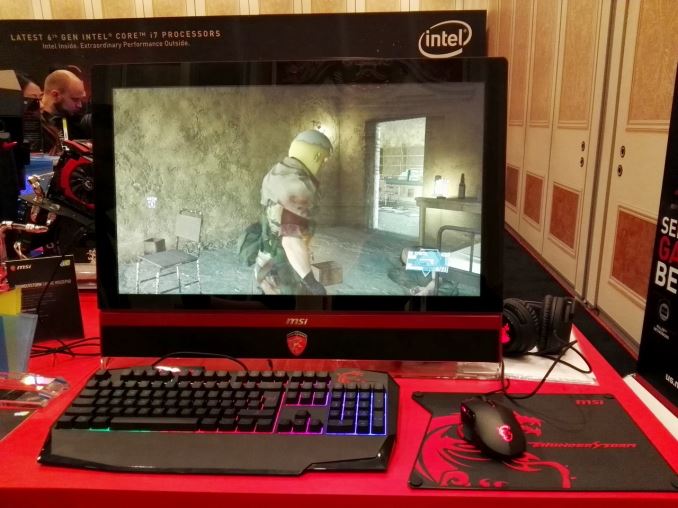
Back at Computex in 2015 we saw and reported on MSI’s first design ideas surrounding an all-in-one computer (where the PC is essentially in the frame of the monitor and not a separate ‘machine’) with a discrete GPU attached. At that time, it was more a proof of concept – they housed a mini-ITX system in the monitor chassis using a custom PCB and heatsink arrangement, and then extended the PCIe 3.0 x16 connection out to a bay on the back of the monitor that housed a discrete graphics card. This is more basic that something like Thunderbolt where you have to worry about hotplug, but you get a full PC in a monitor. This year at CES we saw the concept in the final stages of design, and spoke to the key product managers behind this new 27XT 6QE model.
The unit on display was a H170 system with a Core i7-6700 processor, with support up to 64GB of DDR4-2133 using SO-DIMMs and graphics card support up to a GTX 980 Ti 6GB or Titan X 12GB – the graphics card requiring an external power brick that comes with the machine. The LCD panel will come in two forms – either 1920x1080 at 144 Hz, or 4K, featuring anti-flicker and subdued blue-light functionality with 10-point touch on some models. The system can house two PCIe M.2 SSDs in RAID as well as a full 3.5-inch drive.
Gallery: MSI Gaming 27XT
      It is the design ID though which stands out. The clear plastic stand attached the VESA mount is sturdy, although does not allow much room for tilt/pitch/rotate. This is because the monitor is actually elongated at the bottom to accommodate the hardware inside – but MSI uses this extension to their advantage with the design, which means the system would look odd at 90 degrees. The rear housing for the GPU is in typical MSI Gaming style, mirroring the design patterns of their SLI bridges. The AIO supports alternative inputs or DP outputs to other monitors, in case you want to run another monitor alongside. I assume these are routed from the GPU for extending the display, with the inputs from other sources being handled by the monitor.
Pricing was not given, although put together a 27-inch 4K or FHD 144Hz with an i7-6700 and a GTX 980 Ti and we are approaching $2000 quite easy. MSI did not say if they will sell certain configurations at retailers, or if users will be able to configure, or if it will be sold as a barebones. I would imagine that system integrators could speak to MSI to create custom designs around it. | ||||||||||||||||||||||||||||||||||||||||||||||
| 12:03p | Intel: For Mainstream Gamers, Our IGPs Are Equivalent to Discrete GPUs
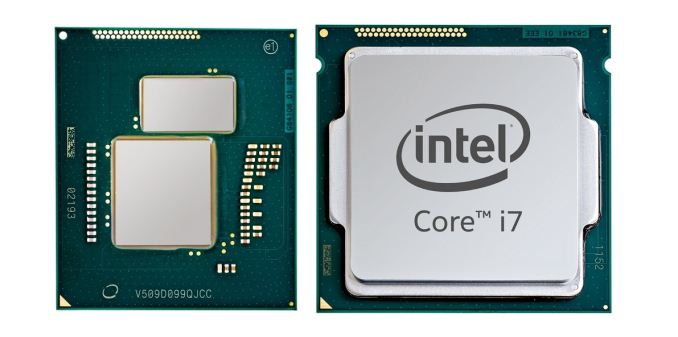
Intel’s integrated graphics processors (IGPs) are the most widespread PC-class graphics adapters on the planet. Enthusiasts of high-performance personal computers do not use Intel’s IGPs, but the world’s largest developer of microprocessors says that for mainstream and casual gamers its graphics solutions offer performance, which is comparable to that of inexpensive discrete graphics cards. “For the mainstream and casual gamer, we have improved our Iris and Iris Pro graphics tremendously,” said Gregory Bryant, vice president and general manager of the desktop client platforms at Intel, at the J.P. Morgan Tech Forum at the 2016 International CES. “We have improved our graphics performance [by 30 times] from where it was five years ago. We believe that the performance of Intel’s integrated graphics today, what we offer in the products […], is equivalent to the performance of about 80% of discrete [GPU] installed base.” Intel has been improving its integrated graphics cores rather rapidly after the company cancelled its discrete graphics processing unit code-named Larrabee in 2010. Thanks to timely transition to newer process technologies, Intel could increase transistor budget of its central processing units significantly every couple of years. As the company did not increase general-purpose core count of its mainstream CPUs for desktop and mobile computers in the recent years, the lion’s share of that additional transistor budget was spent on IGP-related improvements.
Intel considers its code-named Clarkdale and Arrandale processors as its first-generation CPUs with integrated Intel HD Graphics core (which is not entirely correct since these CPUs had two dies: the processor die as well as graphics and integrated memory controller die). Back then, Intel’s most advanced IGP featured 12 execution units (EU) with peak compute performance of around 43 GFLOPS. Since then, the architecture of Intel’s integrated graphics processors has evolved to accommodate new features and gain performance. Today, each EU features two ALUs that can execute up to four 32-bit floating point or integer operations per cycle (in fact, one of the two ALUs within Intel’s Gen8 EU also supports double precision 64-bit floating point operations). Intel’s latest microprocessors — Broadwell with GT3e and Skylake with GT4e graphics cores — have Iris Pro IGPs with 48 and 72 EUs as well as peak compute performance of 883 and 1152 GFLOPS, respectively.
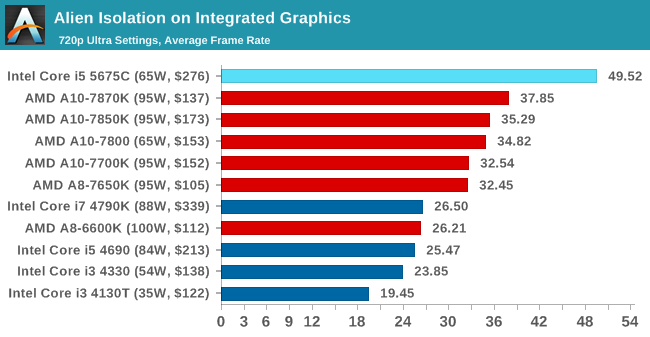
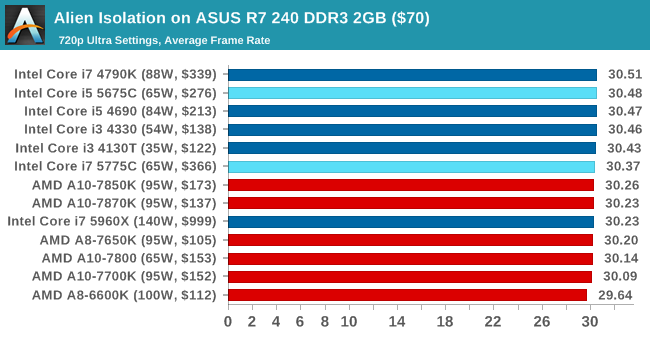
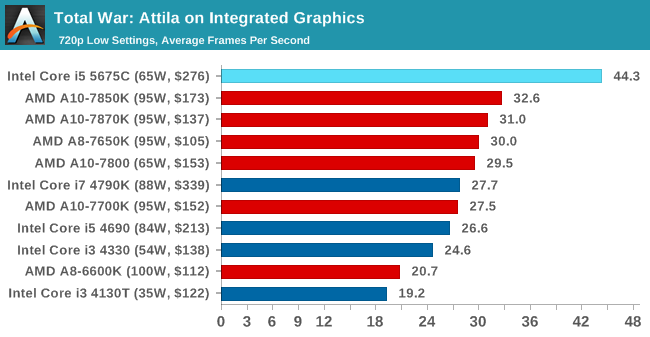
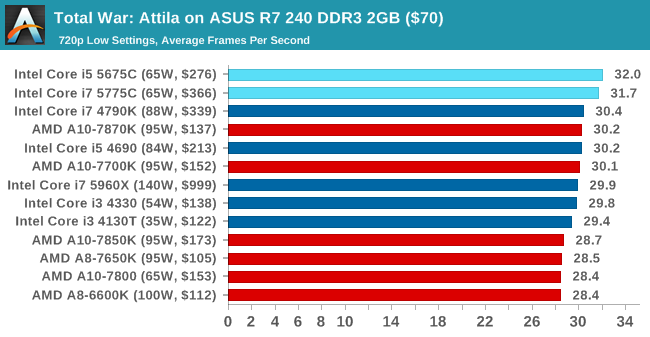
While Intel did not define what it considers to be installed base of discrete graphics cards, it is obvious that the company compares its recent Iris and Iris Pro integrated graphics processors to discrete graphics adapters sold in the last five or even more years and which are currently in use. Such comparison generally makes sense since the Iris Pro 6200 (the most powerful IGP of Intel’s Broadwell processor with 48 execution units) offers performance, which is higher than that of AMD Radeon R7 240 graphics card (Oland GPU, 320 stream processors, 20 texture units, 8 raster operations pipelines, 128-bit memory controller), based on our findings published in June, 2015.
Intel’s latest integrated graphics processor found in Skylake chips — the Iris Pro 580 with 72 execution units and 1152 GFLOPS compute performance — should outperform even more advanced discrete graphics processors. In fact, AMD's latest integrated graphics core also outperforms the low-end graphics card (albeit, by a small margin).
Since many people do not play demanding games, performance of Intel’s modern IGPs may be enough for them. Moreover, since casual and even some mainstream gamers buy low-end graphics adapters, performance offered by Intel’s Iris Pro 6200 and Iris Pro 580 could be the same or higher compared to video cards owned by such people. It is not clear whether 80% of discrete graphics boards currently in use belong to the entry-level segment, but it evident that contemporary IGPs are somewhat better than cheap video cards. While demanding gamers will continue to use discrete graphics cards, rapid evolution of Intel’s IGPs may significantly improve their popularity going forward even among those, who need more or less high graphics performance. Even though enthusiast gamers do not use Intel’s high-end IGPs, the company continues to thrive because of PC gaming. According to the chipmaker’s management, sales of its Core i7-series microprocessors set records in Q2 2015 despite weak demand for personal computers overall. Moreover, Intel claims that sales of high-end enthusiast-class hardware in general is at all-time high and growing. Intel sells not only powerful Core i7 CPUs with unlocked multiplier to demanding gamers, but also chipsets, solid-state drives, various controllers and other components for high-end PCs. As a result, the company takes advantage of increasing demand for powerful personal computers by PC gamers. | ||||||||||||||||||||||||||||||||||||||||||||||
| 1:00p | CES 2016: 34-inch 3440x1440 AIO Hands-On at GIGABYTE
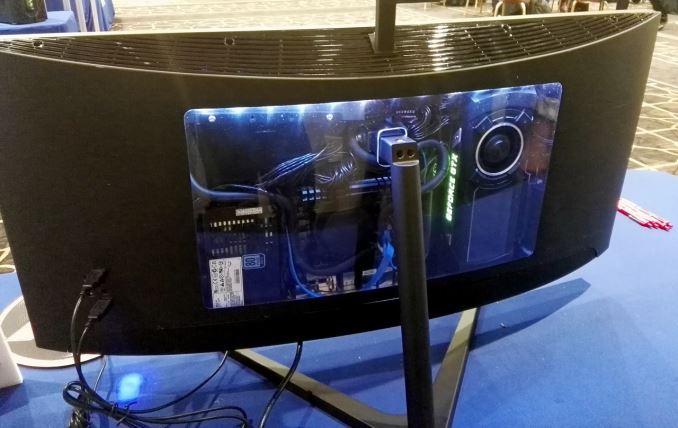
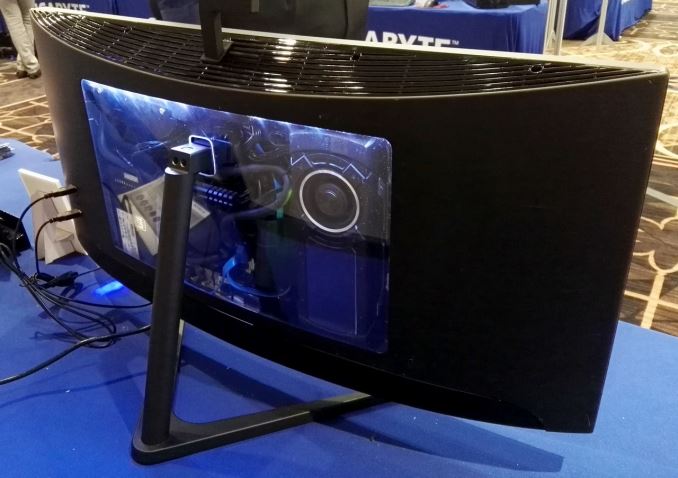
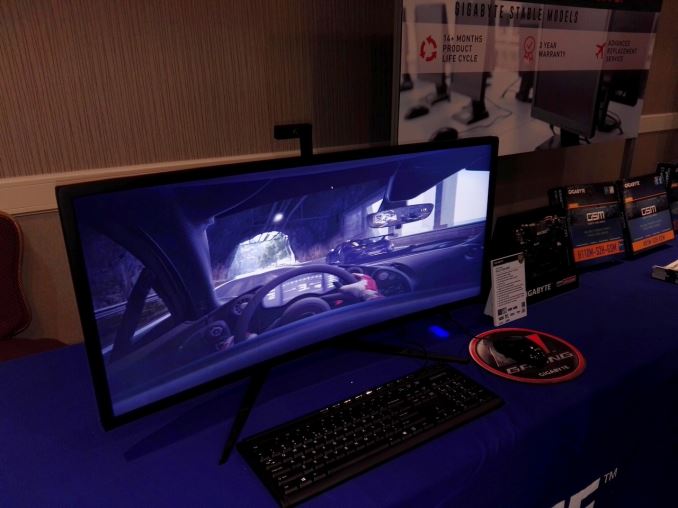
One of the notable elements of CES this year has been the march of the 34-inch 21:9 3440x1440 all-in-one PC. An all-in-one is what it says on the tin: the PC is for all intents and purposes attached to the back of the monitor, either as a separate box screwed in to the VESA mount or a special chassis developed specifically to have both monitor and PC in one. Several companies showed off their 34-inch AIO builds (there seems to be one single ODM supplying the chassis and panel called Loop to all of them), and I had some time with the one at GIGABYTE’s booth.
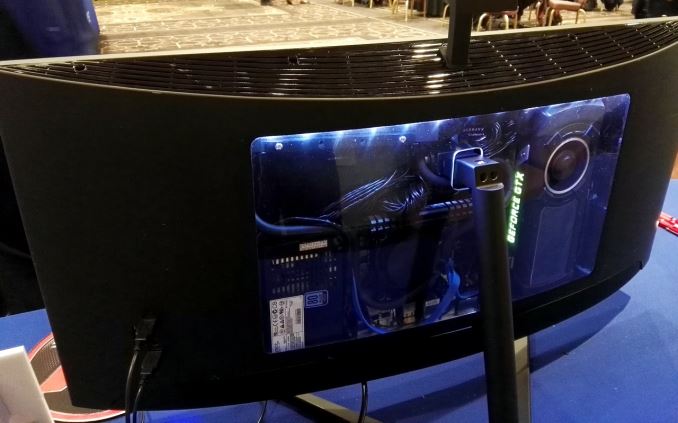
We were told this was a quick and dirty run of something that might be built, as due to time contraints the actual product path hasn’t been planned yet, but the hardware is all PC components – a 600W SFX power supply, a mini-ITX motherboard (not thin mini-ITX) with a Skylake processor, liquid cooling, DRAM, and a full sized GPU in there for good measure. In this case we were told that this unit had the Z170N-WiFi motherboard, a Skylake i7, 16GB of DDR4-2400 and a GIGABYTE branded GTX Titan X inside.
That is a lot of hardware in a small space, and it shows – this transparent panel does not do it justice about how much wiring is being routed everywhere. It also doesn’t show the heat coming off the top of the device, especially around the GPU, and needs a thermal camera. Not too hot to touch, but it would certainly keep the room warm in winter.
Something clicked in my mind while having a go that we have come a long way. I remember back even in 2004 going to local LAN events with a big CRT monitor, a full sized gaming tower running the latest Athlon X2 processor and X1900XTX combo, and then complaining that people forgot to update Steam and we didn’t have an onsite Ethernet connection, requiring one-by-one people take their rigs to the house down the road with a connection. Back then we had a massive setup with cables going everywhere. Now we can arguably get to that point, and have a great gaming experience on the latest hardware, by having just one cable into the unit and using a wireless keyboard/mouse. One cable. It’s the future.
We spoke to GIGABYTE, and based on the timing they had not sorted out what configurations would come to market, or if people could configure, or if they would be sold barebones for modders to play with. I will say that the unit was so beta that when I picked the system up a couple of inches to feel the weight and then set it back down, a nice small black line appeared on the panel. Oops. Despite due care and attention, I broke something. I think it was fixed before I left the booth though. If we consider a 34-inch 21:9 panel at 3440x1440 currently selling around $600-800, then add in a system powerful enough to run that at 60 FPS for most games (i5-6500, GTX 980 Ti, 256GB SSD, closed loop cooler), then we should expect the $2000 mark pretty easily if the OEMs like GIGABYTE are going to add special functionality with software and everything else. I’ve put my name in for a review unit, and I promise I’ll try not to break this one. | ||||||||||||||||||||||||||||||||||||||||||||||
| 1:19p | The Silver Lining of the Late AMD Opteron A1100 Arrival
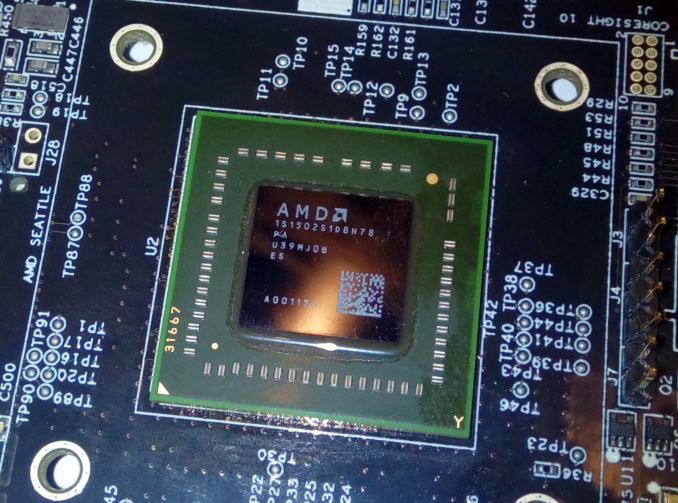
AMD announced their ARM server SoC plans at the end of 2012. At the beginning of 2014, AMD was ready "to accelerate the ARM Server Ecosystem with the first ARM-based server SoC" with a development kit. Around March 2014, the A1100 SoCs started sampling. But the quad core dev kits were not only expensive ($3000!), they also had quite a bit of teething problems as performance did not meet expectations, some of the peripheral hardware did not work properly and the software ecosystem was far from ready. We were expecting to see Opteron A1100 based servers at the end of 2014, but instead we got more than a year of almost complete silence. Frustratingly long for anyone who was hoping that AMD would finally bring something competitive to the server world. Today, AMD is finally announcing that their Octal core Opteron A1100 server SoC and platform is fully ready, "a right sized option for the edge of the datacenter". A few smaller partners are even shipping it but there is no sign of tier 1 OEMs yet. Most people following this part of the semiconductor part are thinking "too little, too late". We are pretty sure that includes you, dear reader. But there is more than meets the eye or we would not bother to write this article. | ||||||||||||||||||||||||||||||||||||||||||||||
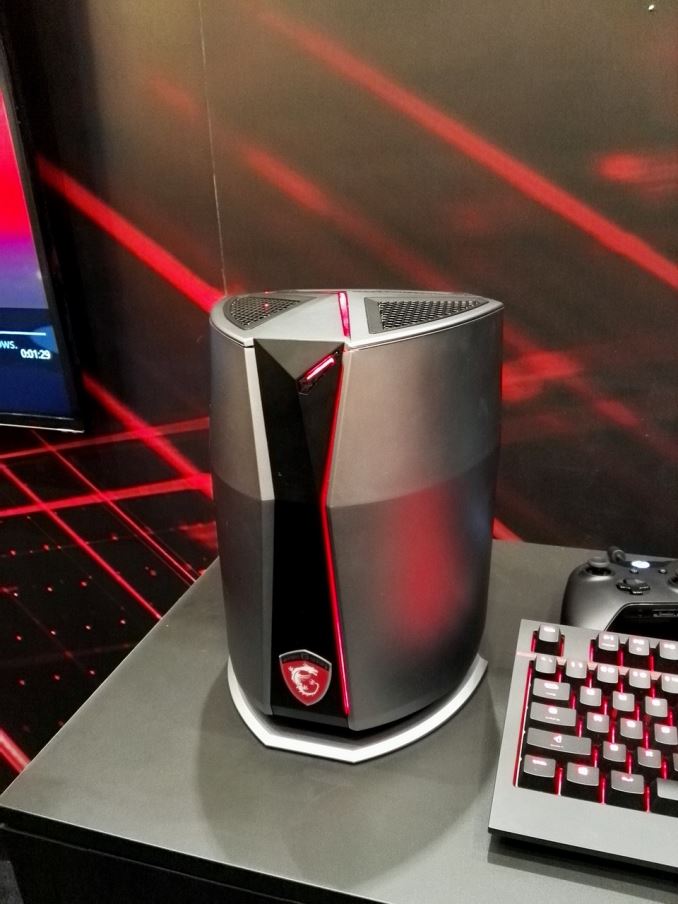
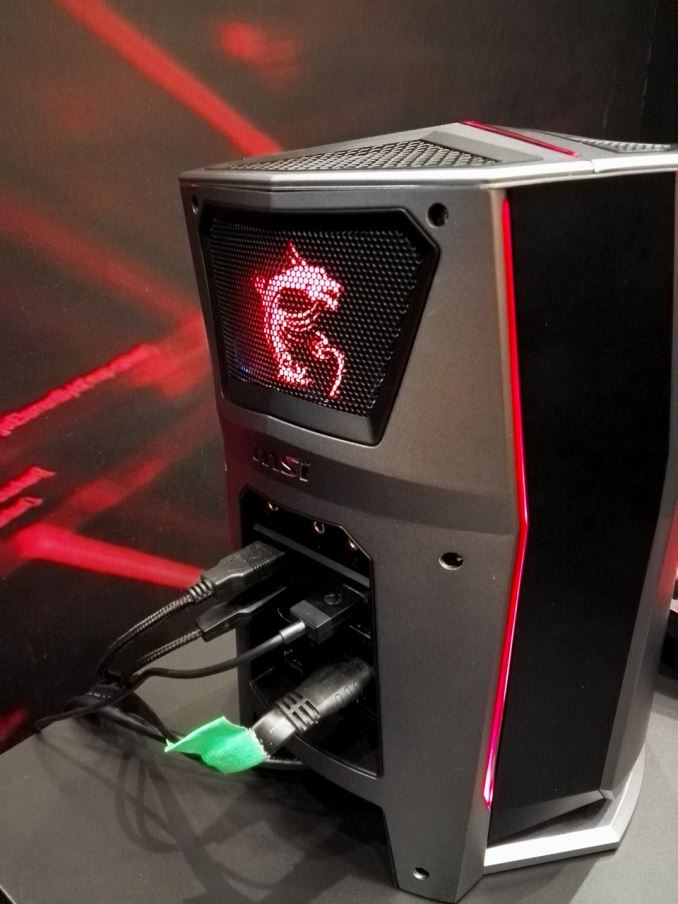
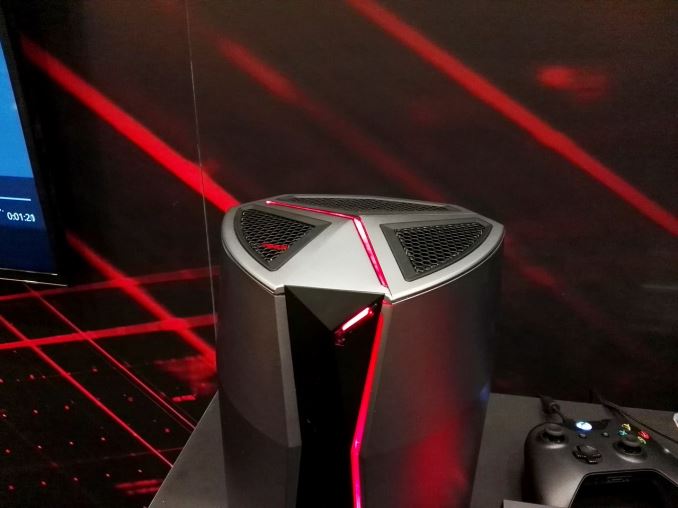
| 4:00p | CES 2016: MSI’s Vortex Gaming PC on Display and It Looks Almost Like a Mac Pro
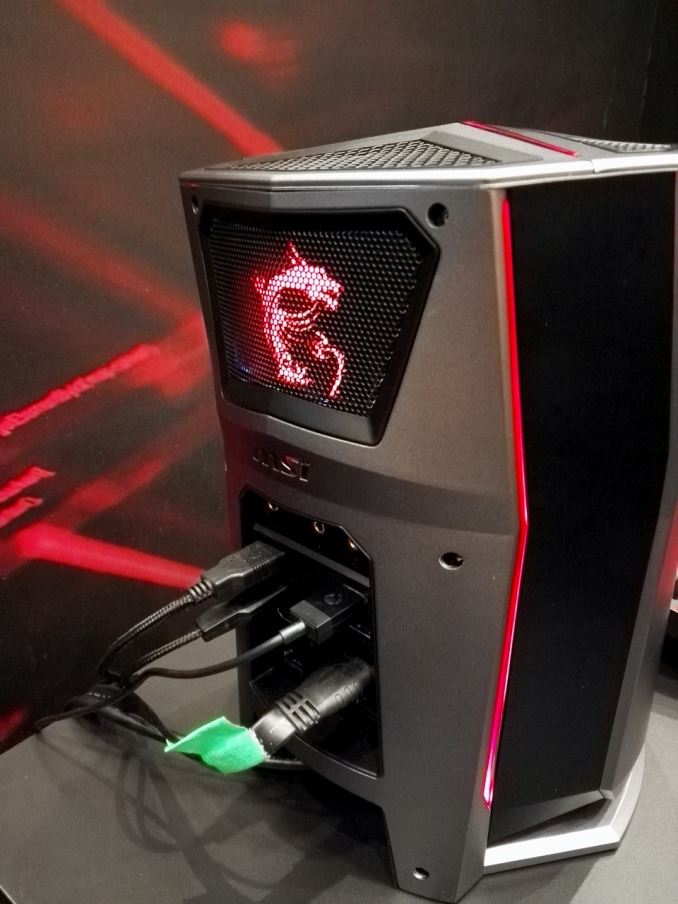
One of the most interesting PC designs to come out in recent years was that of the Mac Pro. Sure, it looked like a cylinder into which one might throw discarded objects, or its size/power limitations has meant it can’t extend into that high end workstation that some users require, but in terms of performance per liter, it caused quite a stir. Well it turns out that MSI has done something similar, but this time focused on the gaming community.
The Vortex isn’t new for CES, and there have been murmurings and images floating around for a while, although I must admit it has not been on my radar as of late and it wasn’t even mentioned when I visited MSI’s headquarters last year during Computex. But the design is similar to the Mac Pro – a custom internal design with one CPU and two GPUs in a triangle arrangement, sharing a heatsink arrangement that uses a single fan to extract the heat generated. I was told that the final designs would feature SLI configurations using GTX 960s, GTX 980s and GTX 980 Tis, and I would assume at this point there would be a high end Intel CPU using the Z170 chipset (because you can’t get SLI on other chipsets).
Connectivity is also similar to the Apple product, in that we have multiple Thunderbolt chips in play. These are combined with HDMI 2.0 to give three displays or users can daisy chain out to hubs and storage. The device looks plastic, but I am told is actually a thin metal despite that fact it also feels like plastic. But regardless of the material, the design is fetching for a ‘mini’ gaming machine. It is about the same size as the Mac Pro, and is stepped up from the ground to give an entry point for air to be drawn up through the device.
Because the fan is on top blowing up, there is no real fan filter to speak of. I postulated to MSI that my cat might sit on the top because it is warm, or during extended periods of ‘off’ time that dust would fall in and settle. I was told it shouldn’t be an issue, but the engineer did have a good think about it. If MSI have done all their work internally, it shouldn’t be too difficult for them to create a professional variant of this with ECC and FirePro/Tesla cards in an aluminium chassis for the prosumer ground. I would like to get some hands on with the internals, and have requested a test unit along with the VR headset they were promoting alongside it, just to see how far a machine this size could push some of the more demanding VR titles. On pricing, if they do intend putting in dual GTX 980 Tis, we could easily see the top model push $1600-$2000, depending on the other internals. | ||||||||||||||||||||||||||||||||||||||||||||||
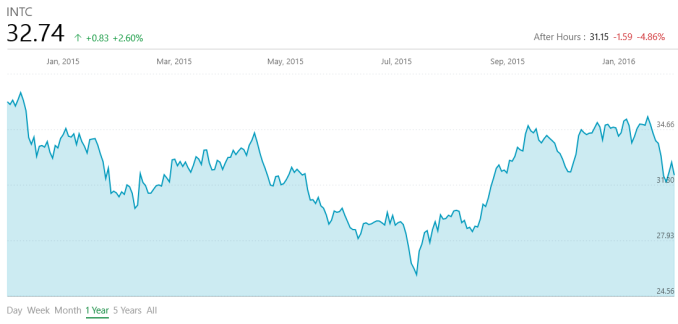
| 10:00p | Intel Reports Q4 FY 2015 Results: Record Revenue For Q4
Today Intel announced their earnings for the fourth quarter of fiscal year 2015. The year ended strong, with record revenues of $14.9 billion. This is up 1% of Q4 of 2014, and up 3% over last quarter. Intel’s margins did drop a 1.1%, but are still a healthy 64.3% for the quarter. Operating income for the last quarter of the year was $4.3 billion, and net income came in at $3.6 billion. These results are down 3$ and 1% respectively, compared to Q4 of 2014. Earnings per share was flat at $0.74 per share. For the full fiscal year 2015, revenues were $55.4 billion, which is down 1% compared to 2014. Gross margin was down 1.1% to 62.6% for the year. Operating income was $14.0 billion, down 9% compared to 2014, and net income was down 2% to $11.4 billion.
For the full year, Intel’s largest division, the Client Computing Group, was down 8% in revenue to $32.2 billion, but for Q4 2015 the group was down just 1% year-over-year. Intel is currently shipping 14 nm parts based on Skylake, and as of November, 14 nm parts made up over 50% of the Client Computing Group’s revenue. The move to 14 nm has been pretty slow by Intel’s standards, and even many of the Skylake chips are in short supply still. With the drop in the overall PC market, it’s not too surprising that this group has dropped, but although total device numbers have dropped, average selling price has increased.
Intel’s record revenue came from the Data Center group, which had record revenue for FY 2015 of $16.0 billion, up 11% compared to 2014. For the quarter, Data Center revenue grew 5% year-over-year to $4.3 billion. The move to cloud computing is going to drive some growth here, and offset some of the weakness in the PC market for companies like Intel. Margins are generally better in this group, so it is less difficult to offset the PC drop with a high margin area like Data Center. Intel is pretty much unchallenged in this space for a lot of computing needs, at least at the moment. There was some struggle in China's market, but the overall market was enough to overcome this. Internet of Things also had record revenue for the fiscal year. For FY 2015, this segment’s revenue was up 7% to $2.3 billion. It’s still pretty small potatoes compared to the other segments of Intel, but this is one area where they are keen to not fall behind ARM like they did in the mobile space. There is a lot of room for growth here, although it’s going to be at a much lower margin than Intel is accustomed to. For Q4, this division grew 6% year-over-year to $625 million. Software and Services, which consists of products like McAfee Antivirus, was down 2% for the full year to $2.2 billion. For Q4, revenues were down 3% compared to Q4 2014, coming in at $543 million. The final segment is Non-Volatile Memory Solutions, and for 2015 this segment had record full-year revenue, up 21% compared to 2014. Unfortunately, Intel does not break this out individually, but it on the conference call they announced revenues of $2.6 billion for FY 2015. Intel announced their 3D X-Point memory, and shipments should start later this year.
For the full year, Intel paid $7.6 billion back to shareholders, with $4.6 billion in dividends and $3.0 billion used to repurchase stock. Intel has announced an increase in dividends to $1.04-per-share on an annual basis. Intel also announced that they have completed the acquisition of Altera and they took on about $9.5 billion in debt to finance this. Looking towards FY 2016, Intel is expecting mid to high single digit revenue growth as a percentage compared to 2015, which is an increase over their guidance issued in November. This increase is being attributed to the FPGA business which they have just acquired through Altera. Gross margin is expected to be 63%. Source: Intel Investor Relations | ||||||||||||||||||||||||||||||||||||||||||||||














| << Previous Day |
2016/01/14 [Calendar] |
Next Day >> |