[Most Recent Entries] [Calendar View]
Monday, January 18th, 2016
| Time | Event | |||||||||
| 8:00a | New GIGABYTE Server Motherboards Show Xeon D Round 2
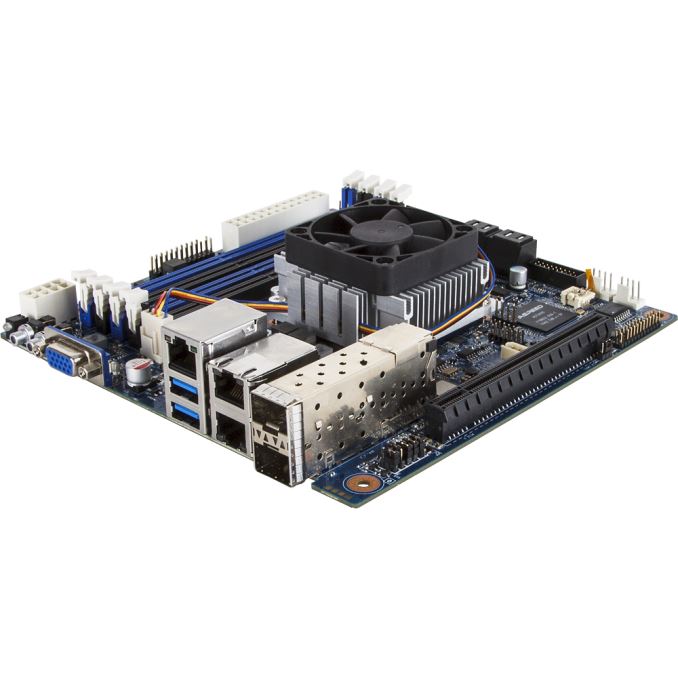
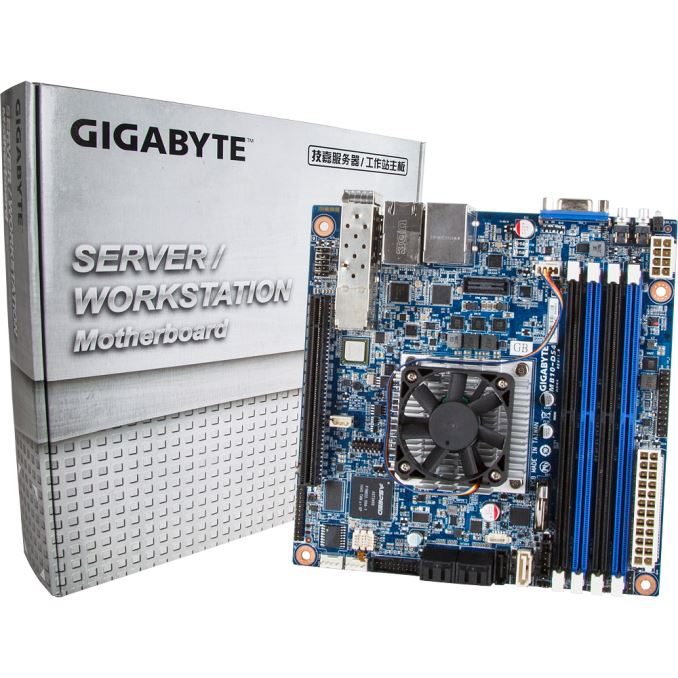
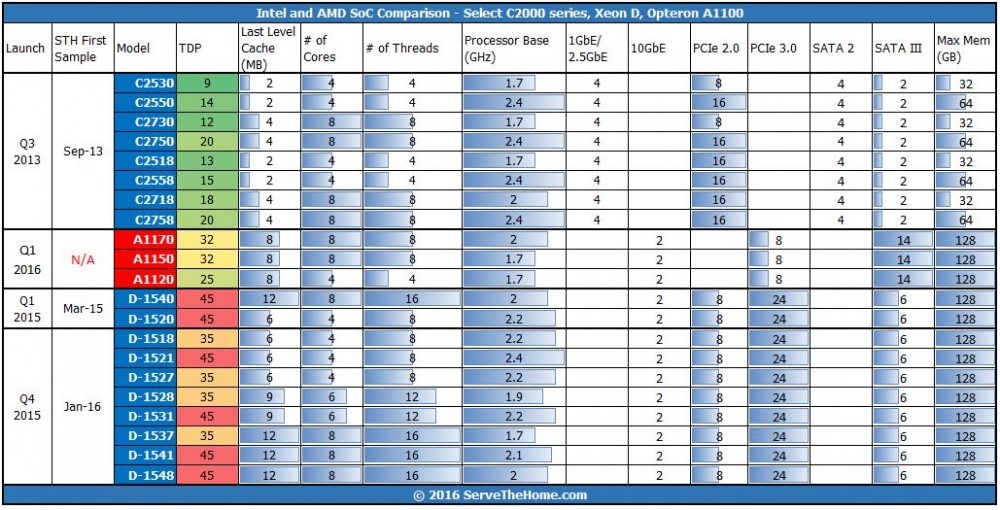
The Xeon D platform, as reviewed by Johan back in June, put together eight Broadwell cores, 24 PCIe 3.0 lanes, dual 10 Gbit Ethernet and USB/SATA control all into one SoC within a 45W TDP design. It almost sounded too good to be true (I’ve run some benchmarks my side, to be in a review later), as this is the only real way to get eight 14nm cores into a single die. Even at 2 GHz, Johan’s piece showed that the Xeon D based on Broadwell aims to fit between the Xeon E3 and Xeon E5 in terms of performance and power efficiency, and to quote Johan ‘Xeon D is probably the most awesome product Intel has delivered in years, even if it is slightly hidden away from the mainstream’. There is interest both server side and NAS side for this, and with the next wave of Xeon D parts being introduced GIGABYTE Server is one of the first to announce some new models. Technically, the four motherboards being launched are a single base design, but with either a different SoC or different networking:
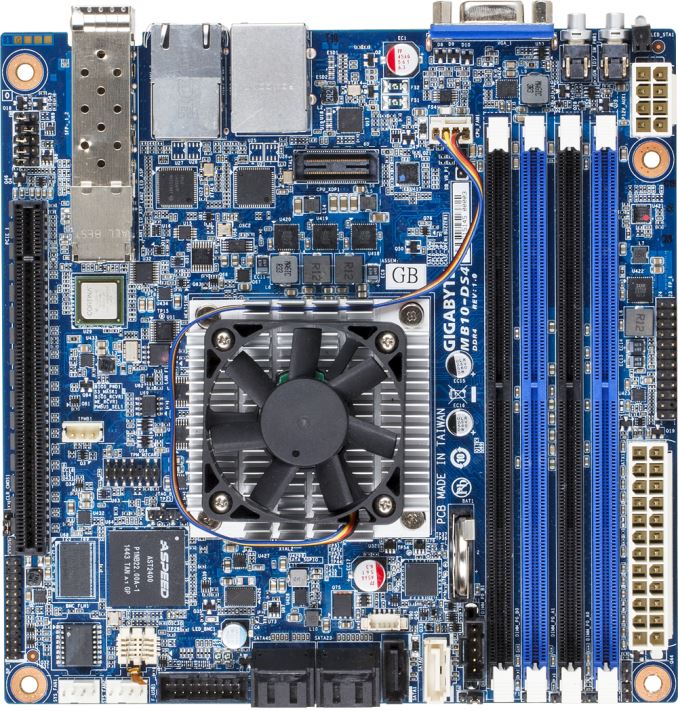
The image above is the top end MB10-DS3 model, featuring the Xeon D-1541 processor with 8 cores, 16 threads, running at 2.1/2.7 GHz for base and turbo frequencies. This is a mini-ITX board aimed at the typical 1U chassis, with four RDIMM/UDIMM DDR4 slots for up to 128 GB RDIMM support in ECC or non-ECC fashion. As mentioned before, the differentiator on this model aside from the SoC is the networking, and here we get dual Intel I210-V gigabit Ethernet paired with dual Cortina CS4227 10GbE SFP+ LAN ports to either route teamed to an SFP+ switch or to different switches althogther.
The motherboard uses a single PCIe 3.0 x16 slot which can be used for compute, and storage comes via five SATA 6 Gbps ports and another similar port that also supports SATA DOM. With it being a server motherboard, the onboard Aspeed AST2400 provides an IPMI interface for management as well as a 2D acceleration video chip. There are two extra fan headers on board, as well as a USB 3.0 header and a TPM header. The SoC here has a list price of $581 on its own, and given that this is a server part I’m not too sure we will see these set of boards actually up at retail, although I do know that GIGABYTE Server is trying to push more product through that distribution channel. Businesses interested in the platform will have to enquire to their local GIGABYTE office to find out more information on pricing and availability. As part of the second wave of Xeon D processors, Intel seems to be releasing a number of 35W and 45W models, from four cores to eight cores (with Hyperthreading), varying otherwise by speed and last level cache in-line with core count. I imagine that as more of these trickle through into the hands of OEMs, we will see more products through 2016.
Table of Xeon-D processors from ServeTheHome | |||||||||
| 10:30a | D-Link Demonstrates Innovative Networking Solutions at CES
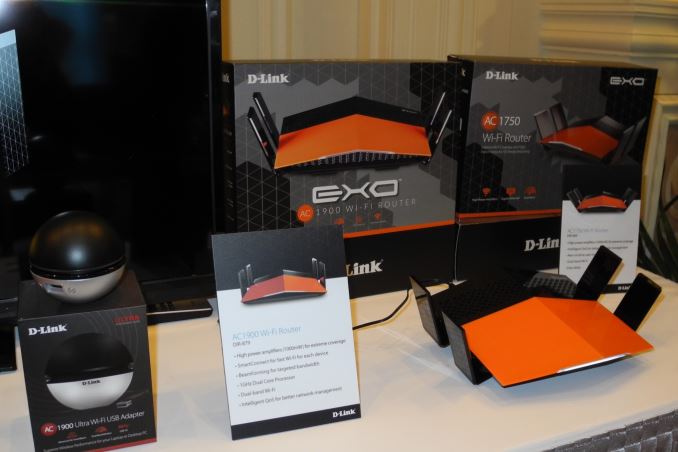
D-Link had two major core networking announcements at CES along with a host of updates for their home automation product line. There are a number of things to discuss with respect to the core networking announcements. So, I will get the minor home automation stuff out of the way first. D-Link has been offering a set of home automation products with unified cloud-based control using the mydlink Home app. At CES, they announced the integration of the IFTTT (If-this-then-that) service with the app, allowing more customization in the home automation experience. It is slated to appear in the free app later this quarter. IFTTT integration has been a staple of many home automation products (including the Belkin WeMo) for some time now. So, it is good to see D-Link putting the effort to integrate with IFTTT with their own cloud back-end. The other home automation-related announcement was a new product - a Wi-Fi based alarm detector. Simply put, this device plugs into a wall outlet and connects via Wi-Fi to the Internet. A microphone in the device is set to trigger an alarm if the sound of a smoke alarm or carbon monoxide alarm is heard. This allows legacy smoke and CO detectors to become part of the smart home - definitely more cost effective than installing completely new smoke alarms (like what Nest suggests). D-Link indicated that, in the future, it might also be able to make the microphones in their IP cameras do the same job. Moving on to the core networking announcements, we first have the EXO series of routers. This series has two members, the AC1750 DIR-869 and the AC1900 DIR-879. Both have a 3x3 configuration in the 5GHz band for 1300 Mbps of theoretical bandwidth. However, the DIR-879 does 600 Mbps in the 2.4GHz band and the DIR-869 does 450 Mbps in the same. The DIR-869 will retail for $130 and the DIR-879 will retail for $150 when they go on sale later this quarter.
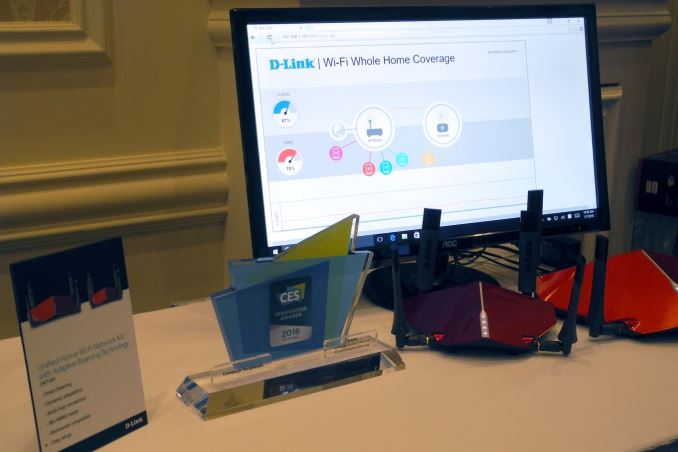
In order to achieve this lower price, D-Link has opted to not integrate a USB port on either model. Both have a hardware toggle switch to move between router and extender modes. However, the devices do have high-performance power amplifiers (1000mW). The interesting aspect here is the core platform. While vendors such as Amped Wireless have gone in for the integrated Qualcomm Atheros 2x2 solution for their $130-price point router, D-Link has moved to Realtek for the same. The SoC used is the RTL8198C with a 620 MHz MIPS-based dual-core host processor and 5 GbE ports integrated. The WLAN chips are RTL8814AR for the 5GHz radio and RTL8194AR for the 2.4GHz radio. The most innovative demonstration in D-Link's suite was the Unified Home Wi-Fi Networking Kit with Adaptive Roaming Technology (DKT-891). This is a router-extender kit that will retail at $370when it launches in Q2. The DKT-891 consists of two products - the DIR-891L, an AC4300 tri-band MU-MIMO router, and the DAP-1655, an AC1300 gigabit Wi-Fi extender. The DIR-891L seems to be the first tri-band 4x4 router based on a Qualcomm Atheros chipset. With two 5GHz 4x4 radios, each band can support 1733 Mbps (for a total of 3466 Mbps). The 2.4 GHz band can support 800 Mbps with the 256-QAM feature. This gives a total bandwidth of 4266 Mbps, enabling classification as a AC4300 class router. The DAP-1655 provides 867 Mbps in the single 5GHz band and 450 Mbps in the 2.4GHz.
The Unified Home Wi-Fi Networking Kit with Adaptive Roaming is based on Qualcomm's Wi-Fi S.O.N technology (video). At their CES suite, D-Link demonstrated 'Smart Steering' - clients moving from the router to the extender automatically (depending on which one was providing a better signal). They also showed 'Dynamic Adaptation' - clients moving inbetween the 2.4 GHz and 5 GHz bands for load balancing purposes. All of this was done without any end-user intervention. Even though the demonstration looked market ready, it is likely that more 'interoperability' testing will be needed. Getting 'Smart Steering' and 'Dynamic Adaptation' to work across multiple client platforms will definitely be a challenge. Gallery: D-Link at CES 2016
     In addition to the above new announcements, D-Link also showed their currently-shipping Broadcom-based Ultra series of routers. the 3x3 DWA-192 USB 3.0 AC1900 WLAN adapter and some IP cameras (including the Komfy switch launched in November). | |||||||||
| 1:00p | Supermicro Quietly Launches the C7Z170-OCE: Multi-GPU focused with PLX8747 for $300
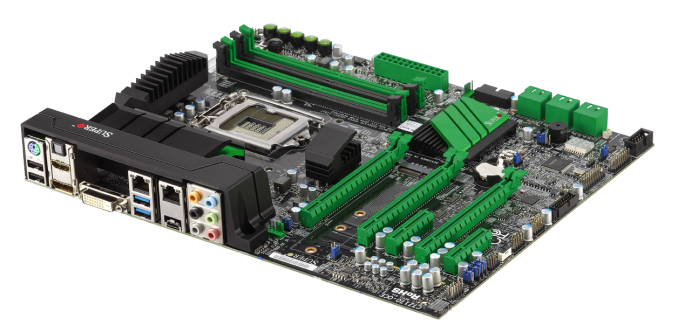
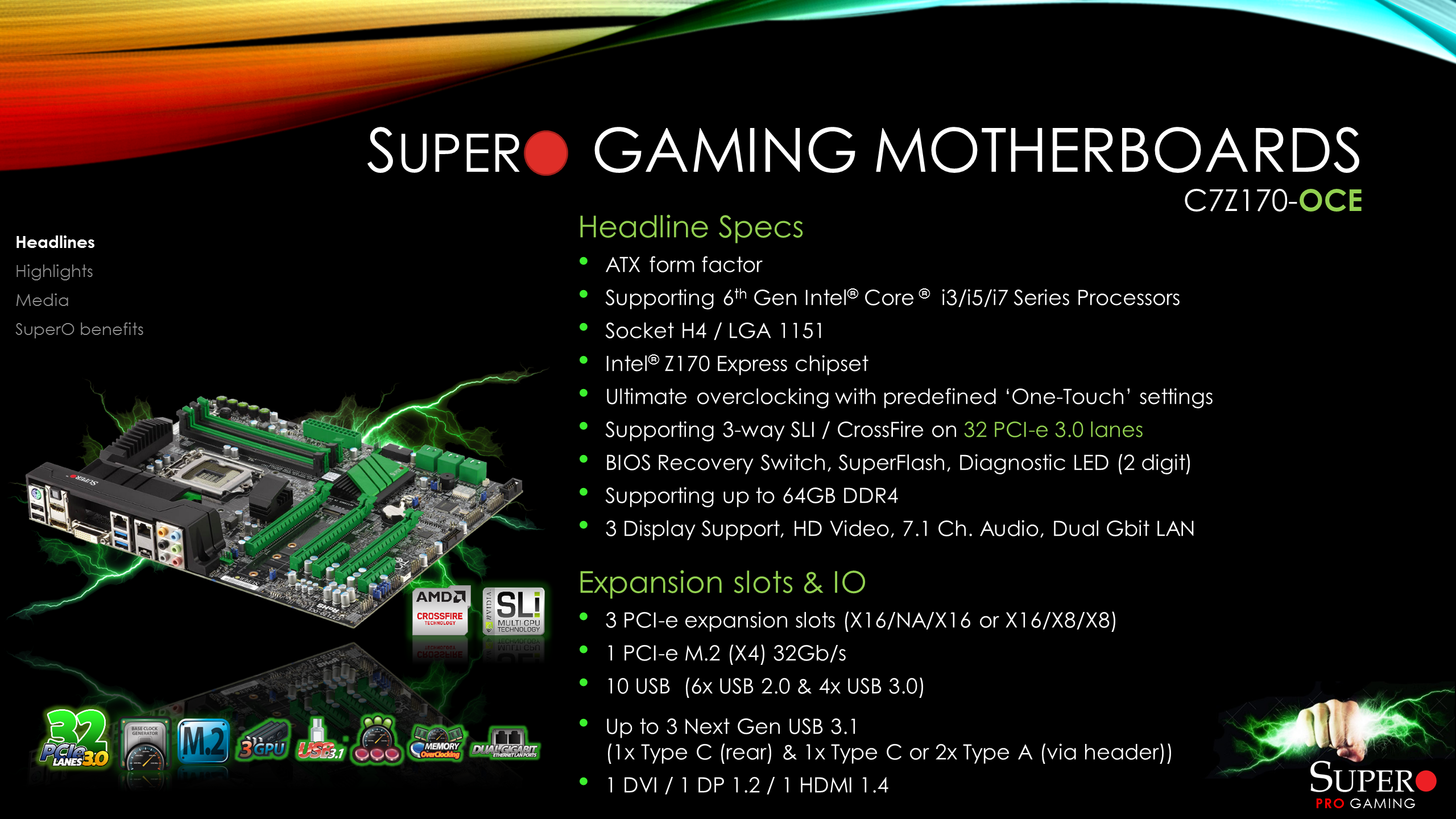
One of the biggest changes to the motherboard scene since the release of Skylake is the distinct lack of motherboards designed to cater for more than two PCIe cards using CPU-based lanes. Back in the era of the Z77 chipset, I gathered four motherboards that had the PLX8747 PCIe switch installed, allowing for >2 GPUs, and we really went to town on the detail and benchmarking. But with Z170, the use of the this chip has severely diminished for two reasons. Firstly, GPUs are getting powerful enough to drive 1440p gaming by themselves fairly easily, and secondly, Avago bought PEX, the company that makes these switches, and the price for them essentially doubled overnight. As a result, only a few motherboards for Z170 will have them, such as the Z170-Gaming G1 we reviewed at the end of last year, because of the consumer price concerns and the market to which they are aimed. The GIGABYTE model we reviewed was $500, and featured all the bells and whistles such as Thunderbolt 3 – the Supermicro motherboard announced last week with this PLX chip is the C7Z170-OCE but slides in at $300.
This motherboard aims to be ‘green’ in more than just the aesthetics. Supermicro’s value add to the community, and the part that they aim to be the differentiating factor, is their long standing role in the server space. They want to use this reputation to promote their use of server grade components on consumer platforms. This will come through in their regular consumer motherboard segments (such as the C7H170-M which we’ve nearly finished testing) and their gaming motherboard line, which now has a name: SuperO.
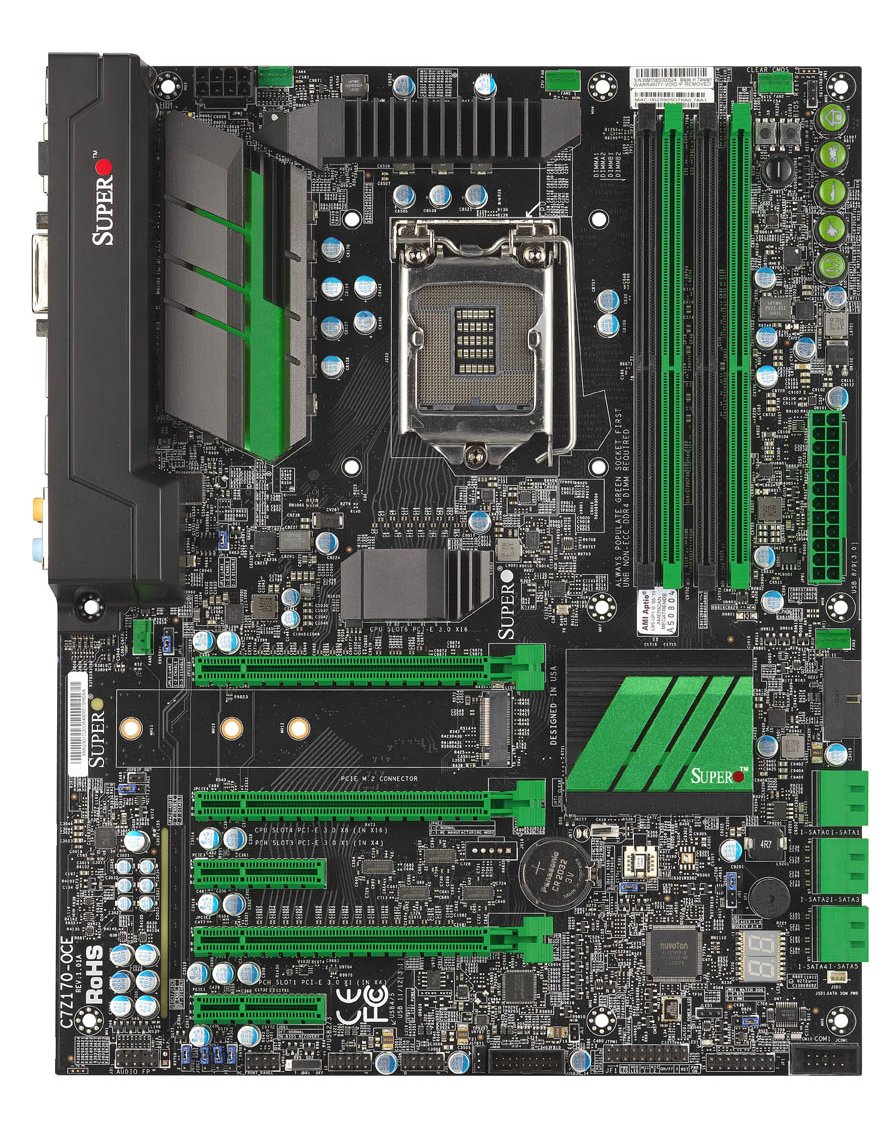
The C7Z170-OCE is aimed squarely at the three-GPU user on Skylake. The PLX8747 chip splits the PCIe lanes into x16/0/x16 or x16/x8/x8, leaving the chipset enough space to add in an M.2 slot for up to PCIe 3.0 x4 bandwidth and plenty of space on the bottom to make sure all the headers can still be used when dual slot cards are in play. We have tested the PLX8747 before, and found that the chip does not noticeably (sub-1%) reduce performance when in use. As SuperMicro is still feeling its way around the consumer motherboard space, we are seeing features that enthusiasts are used to being promoted as positive points. So for example this board also gets some buttons for pre-overclock modes in the top right, and promotes features such as ‘SuperFlash’ which other motherboards have had for almost half a decade. Nonetheless, the fact that these exist now is still a plus.
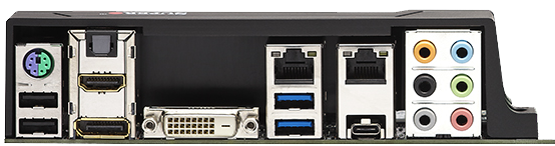
Audio is provided by a Realtek ALC1150, and networking via Intel I219-V and Intel I210-AT controllers. Due to the use of dual Intel controllers, Supermicro lists teaming, fail over and load balancing as features of this combination. USB 3.1 is given on the rear in a Type-C configuration through the ASMedia ASM1142 controller, although it seems a little odd that only one port of this controller is being used. There is another ASM1142 onboard near the bottom, which is connected to a USB 3.0 header – the motherboard is advertised as having a USB 3.1 (10 Gbps) header, but this standard isn’t finalized so we are looking into whether Supermicro is actually validating this header at double the data rate than normal. (It turns out this header will support two USB 3.0 or one USB 3.1, but it requires the right connectors/ports which will not be included in the bundle.)
On the software side, our upcoming C7H170-M review will go into an interesting feature called SuperDoctor 5, which is a pseudo server-like web interface for motherboard features and monitoring. At this point, the C7Z170-OCE will be the cheapest tri-PCIe focused (both SLI and CrossFire) on the market for Skylake at $300. Also anyone wanting to build a green machine will love the aesthetic. I am told it should hit the shelves by the end of January. Source: Supermicro |

| << Previous Day |
2016/01/18 [Calendar] |
Next Day >> |