[Most Recent Entries] [Calendar View]
Thursday, January 21st, 2016
| Time | Event |
| 8:00a | Silicon Motion at CES: 3D NAND support for SM2246EN and roadmap update
2015 was a great year for SSD controller designer Silicon Motion. Their SM2246EN controller was at the heart of some of the best mainstream and value SATA SSDs, while their DRAM-less SM2246XT and their TLC-compatible SM2256 each had several design wins for even more affordable SSDs. At CES, Silicon Motion showed off their full range of products and shared some of their plans to stay competitive through 2016.
The most important development for the SSD market in 2016 will almost certainly be the availability of 3D NAND from companies other than Samsung (who's been shipping 3D NAND since 2014 and will be rolling out their third generation of it this year). Silicon Motion has updated their firmware for the SM2246EN controller to support 3D MLC NAND, and they showed off drives using 3D NAND flash sourced from Intel, Micron, and Hynix. This demonstrates that Silicon Motion is ready for the transition to 3D NAND and that we can expect drives to be hitting the shelves as soon as the flash itself is available in bulk on the open market. It's also nice to have independent confirmation that both IMFT and Hynix are on track with their 3D NAND development. Conspicuously absent from the lineup was 3D NAND from the Toshiba and SanDisk joint venture. We already expected them to be last to ship 3D NAND due to their fab for it not being scheduled to begin mass production until this year, so it's no surprise if they're keeping things under wraps for a little longer. To support 3D TLC NAND, Silicon Motion will be releasing a SM2258 controller as the successor to SM2256, but this new controller was not on display and we don't have information on what other changes it may bring to the table. SM2258 should be ready by the middle of the year, so it shouldn't be too long before we have more details.
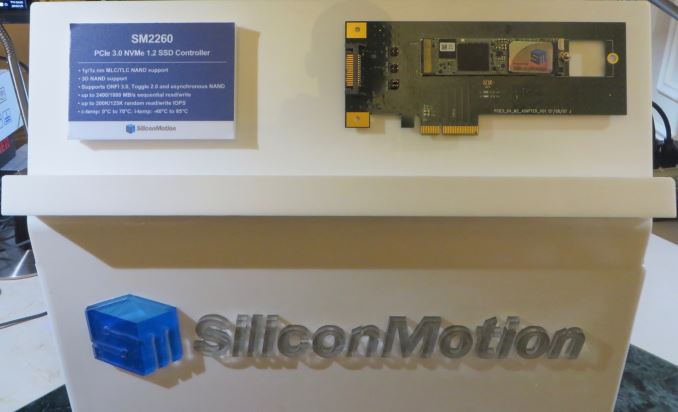
The last big update concerns the SM2260 PCIe SSD controller. A launch date hasn't been announced, but we were told to expect a more interesting demo at Flash Memory Summit, suggesting it will be ready to ship in the second half of 2016. The expected performance specifications have changed slightly from what we last heard in June 2015: sequential read speed is up from 2200 MB/s to 2400 MB/s while sequential write is down from 1100 MB/s to 1000 MB/s. Random read and write ratings remain at 200K and 125K IOPS respectively. With the exception of random write those numbers are a bit below what Samsung advertises for the 950 Pro, but close enough that SM2260-based drives can probably be competitive by just undercutting Samsung's pricing by a little bit. 3D NAND support has also been added to the feature list, and NVMe version 1.2 will be supported. To make use of the higher speeds of the PCIe 3.0 x4 interface, the SM2260 uses a dual-core ARM processor instead of the single-core ARC processor used by Silicon Motion's SATA SSD controllers and the SM2260 has 8 NAND interface channels compared to 4 channels for SM2246EN and SM2256. Silicon Motion still has no direct successor planned for the DRAM-less SM2246XT controller but they confirmed that all of their controllers could be used in a DRAM-less configuration with appropriate firmware, so a DRAM-less TLC SSD could be built using SM2256 if somebody thought the cost savings were worth the firmware development efforts. Silicon Motion was also showing off their current lineup of solutions for USB flash drives including Type-C and Lightning port support, as well as their eMMC and single-package SSD products intended mainly for industrial, automotive and other embedded applications. Gallery: Silicon Motion at CES 2016
      |
| 11:00a | CES 2016: Phison previews upcoming SSD controllers
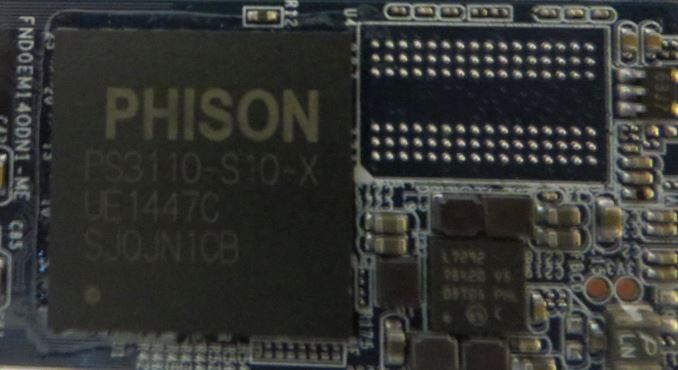
Phison may not be a household name, but they're a major player in the SSD market. Where Marvell's SSD controllers are typically sold to drive vendors who then pair them with custom or third-party firmware, and SandForce and Silicon Motion controllers are typically bundled with firmware, Phison's controllers are mostly sold as part of a turnkey drive platform that's ready to be put into a branded case and put on store shelves. This business model has made Phison the favorite supplier for new players in the SSD market with no existing drive manufacturing infrastructure, and for established brands that need to update their product line but can't stomach the high R&D costs of staying competitive with custom controllers or firmware. For 2016, the mainstay of Phison's controller lineup will continue to be the PS3110-S10, which has been used in drives sold by OCZ/Toshiba, Mushkin, Corsair, Zotac, Patriot, Kingston, PNY and others, and paired with both TLC and MLC NAND. Squeezing in below the S10 and more or less displacing the S9 will be the new PS3111-S11 low-cost SATA controller with the option of operating as a DRAM-less controller and providing only two NAND channels but also the first Low Density Parity Correction (LDPC) support from Phison. Thanks to SLC caching support its peak performance numbers only suffer slightly and its support of capacities up to 1TB should be sufficient for this year's value SSDs, but don't expect the S11 to sustain great performance on heavy workloads.
The much more exciting product is Phison's PCIe 3.0 x4 NVMe SSD controller, the PS5007-E7. The E7 controller is very close to launch and we've already seen numerous product announcements based on that platform. The E7 is aiming to be the highest performance consumer SSD controller and will be competing directly against Samsung's 950 Pro. The controller hardware has been finalized and the firmware is in the last stages of performance optimization. Phison plans to finalize the firmware in February and drives should be on the shelves in March. We've previously seen prototypes of the E7 controller from G.Skill at Computex last year and from Mushkin at CES 2015. Since Computes the write performance specifications have improved slightly: sequential write is up from 1400MB/s to 1500MB/s, and random write is up from 200k IOPS to 250k IOPS. Sequential read and random read speeds published by Phison match what G.Skill said at Computex: 2600MB/s sequential read and 300k IOPS for random read, though Phison notes their random performance numbers as being burst performance. They also are claiming a sustained random performance of 36k IOPS, presumably referring to steady-state random writes. Those numbers are all for planar MLC NAND, but the E7 controller also supports TLC and 3D NAND. Given the imminent availability of 3D NAND, Phison is also able to declare support for capacities up to 4 TB where G.Skill's demo only promised up to 2TB.
Phison E7 drives will be available in a variety of form factors. M.2-2280 has been the most popular choice for client PCIe SSDs, but some E7-based drives will be opting for the longer M.2-22110 size. This will provide room for 8 flash packages instead of 4, allowing for higher capacities or cheaper NAND packaging by stacking fewer dies per package. Most importantly, the larger M.2 card will make it possible to populate all 8 channels on the E7 controller while still using standard off the shelf flash packages. The longer M.2 size won't be usable with as many motherboards and will have even more trouble in the notebook market, but many SSD vendors targeting the enthusiast market are willing to make those compromises. Several vendors will also be selling drives in a PCIe half-height half-length add-in card form factor. This relatively spacious PCB allows for the highest capacities and better passive cooling with or without a heatsink. Phison's reference model also included power loss protection capacitors on the card, though they won't be present on all retail models—Patriot's Hellfire AIC didn't have the capacitor bank populated. Phison also showed a 2.5" U.2 model, but we didn't encounter any vendors that were showing off that option.
The add-in cards and U.2 drives may be more popular in the enterprise market, which Phison is confident they can break into. However, Phison teamed up with Kingston and Liqid to demonstrate an add-in card that puts four M.2 drives under a heatsink and provides power loss protection capacitors. This can allow for better density and utilization of PCIe slots than a single-controller PCIe x4 add-in card and drop-in compatibility for server platforms that don't have U.2 backplanes, so even in the enterprise space M.2 might win out. Gallery: Phison E7 drives at CES 2016
      |
| 12:00p | Corsair and G.Skill Introduce 128 GB (8x16 GB) DDR4-3000 Memory Kits
An average personal computer nowadays is equipped with 8 GB or less of DRAM, according to analysts from DRAMeXchange. Due to the requirements of Microsoft Windows 10 operating system, 8 GB may be enough for general-purpose computing. But there are PCs, particularly at the high-end desktop and workstation level, which need a lot of memory either for software, computation, RAM disks or even RAM caches to the point where motherboard manufacturers are now including such software in their bundles. To fulfill demand from owners of high-end desktops, Corsair and G.Skill this month unveiled their 128 GB quad-channel DDR4 memory kits consisting of eight DRAM modules.
Corsair and G.Skill's 128 GB DDR4 memory kits are rated to run at 3000 MT/s per pin data-rate (DDR4-3000) and are subsequently designed for Intel's X99 platform where the quad memory bus allows for up to 96 GB/s of bandwidth with 4 or 8 DIMMs. These quad-channel kits consist of eight 16 GB unbuffered memory modules, which are based on 8 Gb DRAM chips made by Samsung using its 20 nm fabrication process. The memory sticks fully support Intel XMP 2.0 SPD profiles and can automatically set their clock-rates when installed into appropriate PCs.
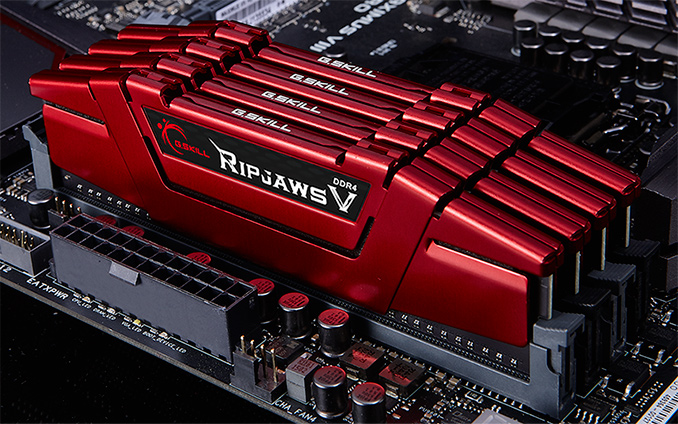
Corsair’s Black Vengeance LPX 128 GB DDR4-3000 memory kit comes in with CL16 18-18-36 latency settings as well as the higher specification 1.35 V voltage for DDR4. The modules are equipped with black aluminum heat-spreaders to aid with cooling. Corsair also supplies their Vengeance Airflow cooling system, a removable 40mm fan cooling bracket, with the kit. Corsair’s Black Vengeance LPX 128 GB DDR4-3000 kit costs $1174.99 without tax and is currently available from the company’s online store with the official name of CMK128GX4M8B3000C16. Meanwhile G.Skill’s Ripjaws V 128 GB DDR4-3000 set of DRAM modules for high-end desktop features surprisingly low latencies of CL14 14-14-34, as well as the higher 1.35V voltage. G.Skill’s Ripjaws V memory come with black or red aluminum heat-spreaders, and we assume these kits also come with extra fan cooling similar to G.Skill's other high end kits. G.Skill’s Ripjaws V 128 GB DDR4 memory kit will be priced at $999.99 when it becomes available later this month under the SKU name F4-3000C16-16GVK.
It is noteworthy that despite of more aggressive timings and potentially higher real-world performance, G.Skill’s 128 GB DDR4 memory kit costs less than Corsair’s 128 GB DDR4 set of modules. The two companies are addressing a relatively small segment of the market with their 128 GB DRAM kits, hence, the competition between Corsair and G.Skill is inevitable. The reason for the high price for both kits comes down to binning - the ICs used for these are typically sold by the IC manufacturer as a certain bin (e.g. DDR4-2400 low voltage) and then they are individually tested by the memory stick manufacturer to fit within certain frequency ranges. At DDR4-3000 C14 for example, the process of testing might only produce one memory kit per 10000 ICs tested (educated guess) - and then the modules have to be tweaked to ensure they run together. We always recommend buying a single kit for a PC, especially of high speed memory, because the modules are designed to work together, whereas two separate kits hold no guarantee, especially if the secondary and tertiary sub-timings are close to the grain (typically these are slightly loosened for larger kits). At present both Corsair and G.Skill market their 16 GB DDR4-3000 memory modules as solutions for overclockers because highest JEDEC data rate validated by Intel’s Haswell-E processors is 2133 MT/s. As JEDEC’s DDR4 memory standard supports data-rates up to 3200 MT/s, eventually we might see high-speed 16 GB+ memory sticks becoming normal for workstations with memory speed-limited workloads. Source: Corsair, G.Skill |
| 2:00p | CES 2016: ASRock Shows mini-STX 5x5 for Business and Education
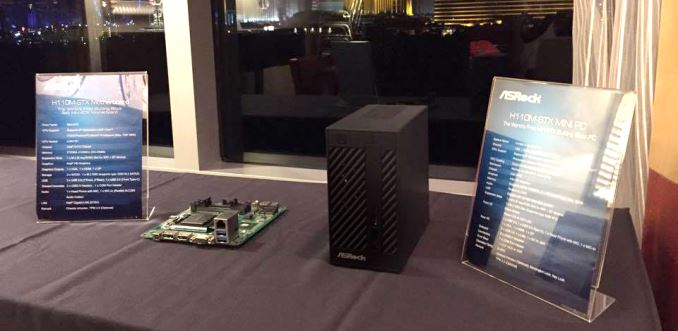
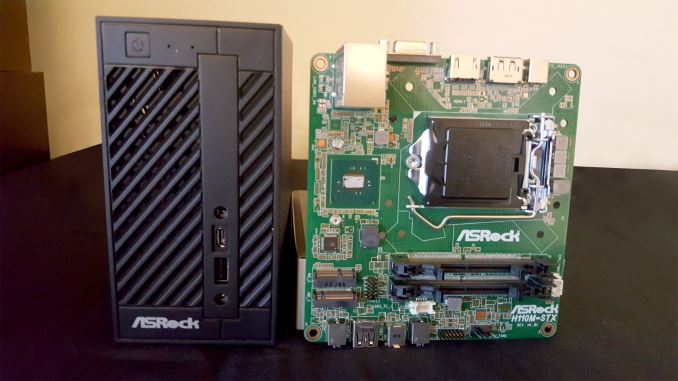
Ever since Intel announced their 5x5 platform (that’s 5-inch by 5-inch), we have had several requests from users saying ‘when?’. At the time of the announcement, it was difficult where Intel was trying to place the platform – the goal seemed to show something for embedded platforms that also had a socketed processor. This would allow customers to choose how much processing power they needed up to 91W if it is built for it, or potentially upgrade later down the line. This is compared to the NUC, which runs mobile processors in an even smaller form factor. Despite the interest from end-users, it has always come across as a non-consumer play. ASRock’s showcase at CES pushes it further into that B2B market with specific verticals in mind. We learned that 5x5 now has an ‘official’ name in Mini-STX, similar to mini-ITX which is 6.7-inch square. But on display from ASRock were a singular motherboard, the H110M-STX, and a prebuilt system called the H110M-STX Mini PC.
As the H110 name implies, this system is for Skylake processors and built on the H110 chipset. The motherboard uses a three-phase power delivery, rated at 65W, and memory comes via two DDR4 SO-DIMM slots supporting up to 32GB of DDR4-2133 (we wouldn’t really expect anything higher than 2133 in this form factor anyway). The socket area pushes right up against what would be the rear IO panel because of space, and the ports here have a low z-height to ensure cooler compatibility. Storage comes via an M.2 2280 slot supporting SATA 6 Gbps – the specifications say it also has two SATA 6 Gbps ports, but unless they’re available through a breakout cable I can’t see the traditional way to connect these to a motherboard. Network connectivity is through the Intel I219-V NIC as well as an M.2 2230 slot for WiFi and BT. Video output is designed to come through the processor (so Intel HD Gen 9) and the rear IO has a VGA, HDMI and DP port for use. There are two USB 3.0 ports on the back as well as one on the front, two USB 2.0 headers, and a custom USB-C header for the H110M-STX Mini-PC. Audio comes via a Realtek ALC283 codec using the onboard header. TPM 2.0 is also included.
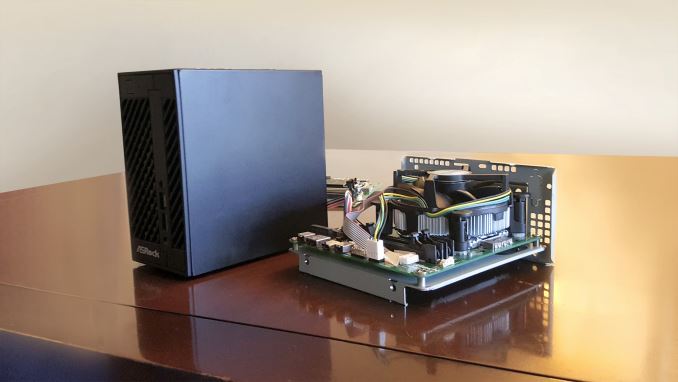
As for the Mini-PC system ASRock showed, this is designed specifically for this motherboard only and comes in at 1.92 liters (155 x 155 x 80 mm). It will be boxed with the Intel stock fan, and come with a 2.5-inch drive bay as well as a Kensington Lock. Separate SIs will have to decide what CPUs, DRAM and WiFi modules to use, as well as the M.2 slot for storage. Power for the system is provided by a DC-In port on the rear of the system, and given that the socket is designed for up to 65W in this case, I’d imagine that the power brick should be in the 90W range. It is also worth noting that to use the VGA connector, there seems to be a long cable from that odd port next to the DRAM to the VGA connector on the rear. We saw a few other 5x5 systems on display at CES, although they all pretty much aim for the same business crowd – either verticals such as education or digital signage/gambling, which is essentially what a lot of NUCs end up in. 5x5 is clearly a play for more performance, attempting to reduce costs, but it seems Intel is letting its partners get the first bite of the cherry – we did see a 5x5 from ECS, who plays a big part in Intel’s NUC production. Then on the other side we have people like Zotac, who end up doing their own custom designs anyway. But for now, it seems ASRock is keeping this as a B2B play and testing the water. We’ve not heard if this is going to be worldwide or a specific market play, but as a result pricing will be relative to the market and interest, meaning interested parties should contact their local ASRock sales offices. Source: ASRock |








| << Previous Day |
2016/01/21 [Calendar] |
Next Day >> |