[Most Recent Entries] [Calendar View]
Wednesday, January 27th, 2016
| Time | Event | ||||||||||||||||||||||||||||||||||||||||||||||||||||||||||||||||||||||||
| 8:00a | The Cherry MX Board 6.0 Mechanical Keyboard Review We frequently review mechanical keyboards here in AnandTech. Over half of them come with mechanical switches from Cherry, and for good reason. If you are keeping track of our recent reviews, you should have noticed that Cherry's switches generally are more consistent than any other type we have tested to this date. Cherry is virtually the inventor of the modern mechanical keyboard switch (not to be confused with the classic buckling spring), manufacturing and marketing them since nearly three decades ago. It is only because their patent expired that other manufacturers were able to copy their switch designs. With all of that said, Cherry is not only supplying their switches to other keyboard manufacturers. As a matter of fact, the company has a significant line-up of their own keyboard and mouse products. On the other hand, Cherry's products are almost exclusively aimed towards professionals and for specific applications, such as keyboards with biometric or magnetic card readers for security. Considering the target market of their products, naturally their keyboards were using just plastic black or beige parts and never looked like anything special. However, Cherry is taking a huge leap of faith and releasing a new keyboard, the MX Board 6.0, which a mere glance upon it is enough to reveal that it is nothing like their previous products. | ||||||||||||||||||||||||||||||||||||||||||||||||||||||||||||||||||||||||
| 9:40a | Intel and Tsinghua University to Co-Develop Semi-Custom Solutions for Servers
At present, investors state that Intel controls 98% of the server processor market with its Xeon CPUs, but the server market is changing. Intel's acquisition of Altera is telling - many companies these days require chips with specific features and functionality, and as a result Intel has been making strides to add custom features to its processors. In an extension of this, this month Intel agreed to jointly work with Tsinghua University and Montage Technology to develop custom server platforms for servers used in China. Under the terms of the agreement, Tsinghua University will develop a reconfigurable computing processor (RCP) module, as well as system software, that will work with a standard Intel Xeon CPU to add features that address requirements for specific applications in various market segments in Asia. The RCP will be made by outsourcing to a maker of semiconductors and it is likely that the government-controlled university may prefer to make the chip in the country or through a subsidiary. The computing solution proposed consists of an Intel Xeon and a custom RCP, but will not be a multi-chip-module package designs like Intel’s Xeon processors with integrated Altera FPGAs. Instead we are told it will involve a different kind of packaging. Unfortunately, at present it is unclear whether Intel’s Xeon and Tsinghua’s RCP will communicate using known standards (such as the PCI Express interface, QPI, or other), or a custom protocol.
Intel, TU and Montage did not disclose a lot of technical details about their joint semi-custom solution for Chinese datacenters, but re-configurability of processors implies that the final product could address a broad range of market segments. We postulated that the RCP is just another name for an FPGA, although our sources were unable to confirm this. Intel will ensure that its chips work with RCPs, and will supply CPU dies to Montage Technology which will market the whole solution to interested parties. Montage plans to sell the final product, which will consist of a standard Intel Xeon CPU, a reconfigurable computing processor developed by Tsinghua, as well as software, in 2017. There is no information about specifications of the Xeon processor lines that will be used, nor the capabilities of the RCP, which still leaves the question of what range of CPUs are being discussed, if it is sub-25W or 90W+. The collaboration between Intel, Tsinghua University and Montage is aimed to better address demands of Chinese state-owned and other datacenters. Since China is one of the world’s largest markets for servers, the importance of jointly working with local companies is something that is becoming very important not only for Intel, but for all developers of server CPUs, especially as news emerged last year about how Intel and others can or cannot sell to various entities. Intel has arrangements similar to this already in place, such as the Rockchip engagement for some smartphone-based SoCs to be made and sold by Rockchip in Asia, as well as arrangements with Spreadtrum (which is owned by Tsinghua Unigroup, to which Tsinghua University has sole investment). | ||||||||||||||||||||||||||||||||||||||||||||||||||||||||||||||||||||||||
| 1:07p | NVIDIA’s Partners Roll-Out GeForce GT 710 to Fight Integrated Graphics
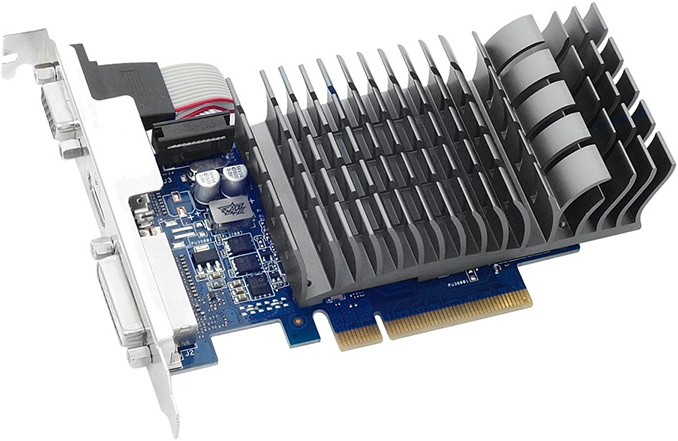
Advancements made by iGPUs by AMD and Intel in the recent years essentially destroyed the market of inexpensive discrete video cards. High-performance iGPUs can outperform low-end standalone graphics adapters these days and for a lot of users performance of integrated graphics is enough. Nonetheless, there's still a smaller market for low-end add-in boards - notably as upgrades to true entry-level PCs - and to that end NVIDIA’s partners this week released a new breed of low-end graphics cards targeting entry-level PCs. The new NVIDIA GeForce GT 710 video cards are based on a cut-down version of the company's existing GK208 GPU, with 192 stream processors, 16 texture units and 8 ROPs. As this is a Kepler architecture product, you'll find baseline support for Direct3D feature level 11_0 but not newer features found in the Maxwell generation such as HDMI 2.0, which is likely why NVIDIA opted to launch this as a 700 series product. Peak compute performance of the GPU when clocked at 954 MHz is around 366 GFLOPS, which is below that of contemporary higher-end iGPUs by Intel or AMD. The GeForce GT 710 graphics cards are equipped with 1 or 2 GB or DDR3-1800 memory featuring 14.4 GB/s bandwidth.
Makers of graphics cards position their NVIDIA GeForce GT 710 boards as solutions for entry-level PCs running Intel Celeron or Intel Pentium processors with mediocre iGPUs, and these are typically the comparisons you'llsee vendors make as it doesn't take much to surpass low-end iGPUs. That said, while the GeForce GT 710 can indeed be considerably faster than outdated integrated GPUs, it is unlikely that it can enable decent performance in demanding video games, and this is more likely to be pitched as a card for MOBAs and similar low-impact games. From a sales perspective, since the GK208 GPU is not a new graphics chip - having been launched back in 2013 - it is somewhat surprising to see that virtually all partners of NVIDIA decided to release their new video cards powered by the GPU. The market for such adapters is very limited these days because 100% of entry-level PCs use iGPUs. Moreover, even in countries like China, where inexpensive hardware is sold in large quantities, more and more gamers are adopting higher-end discrete video cards, according to media reports. Meanwhile from a technical perspective, as the GeForce GTX 710 are designed for low-end PCs, many of such video cards come in half-height/half-length form-factor. Typical for low-end cards (especially those expected to sell well in the APAC market), all of the GT 710s we've seen so far feature D-Sub analogue monitor output for compatibility with older monitors, along with the more typical DVI and/or HDMI/DP connectors. Meanwhile GT 710 is rated for a TDP of just 20 W, so many of the cards use passive cooling solutions, while the rest feature small fans. The NVIDIA GeForce GT 710 graphics cards are available from companies like ASUS, EVGA, Galax, Gigabyte, Inno3D, Palit Multimedia, Manli, MSI, ZOTAC and some others. Prices of the GeForce GT 710-based graphics adapters vary, but typically such cards cost from $30 to $50 in the U.S.
| ||||||||||||||||||||||||||||||||||||||||||||||||||||||||||||||||||||||||
| 7:00p | Windows 10 Mobile Has A Cellular Data Eating Bug
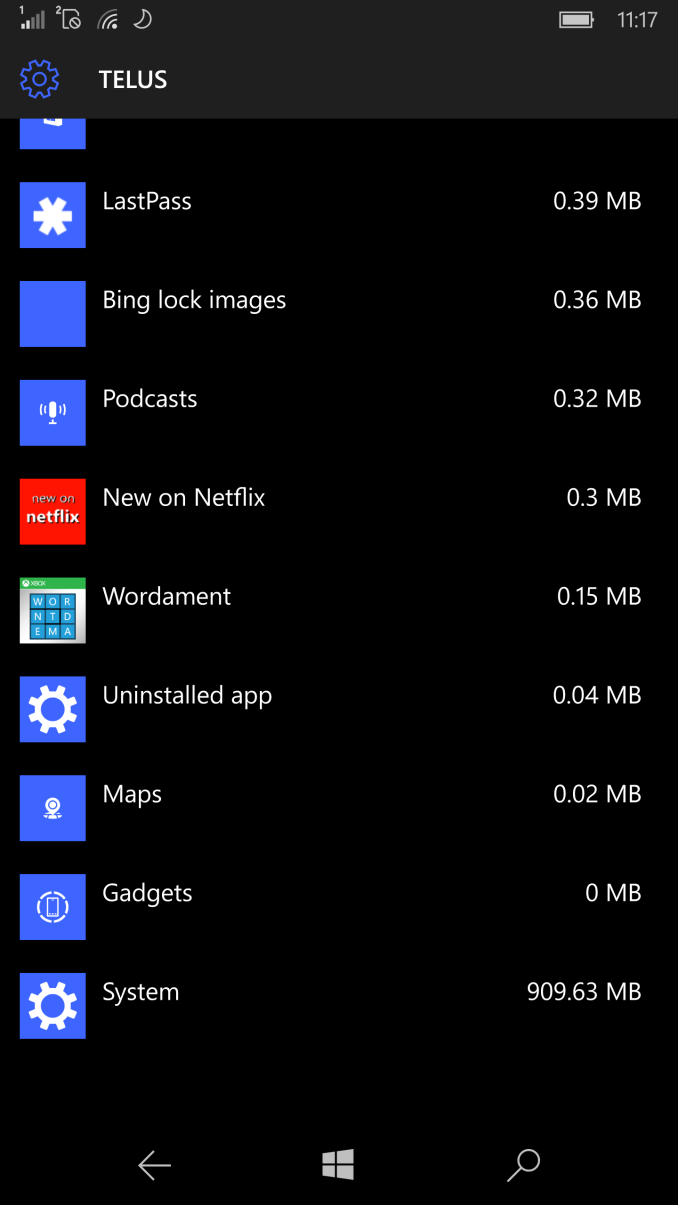
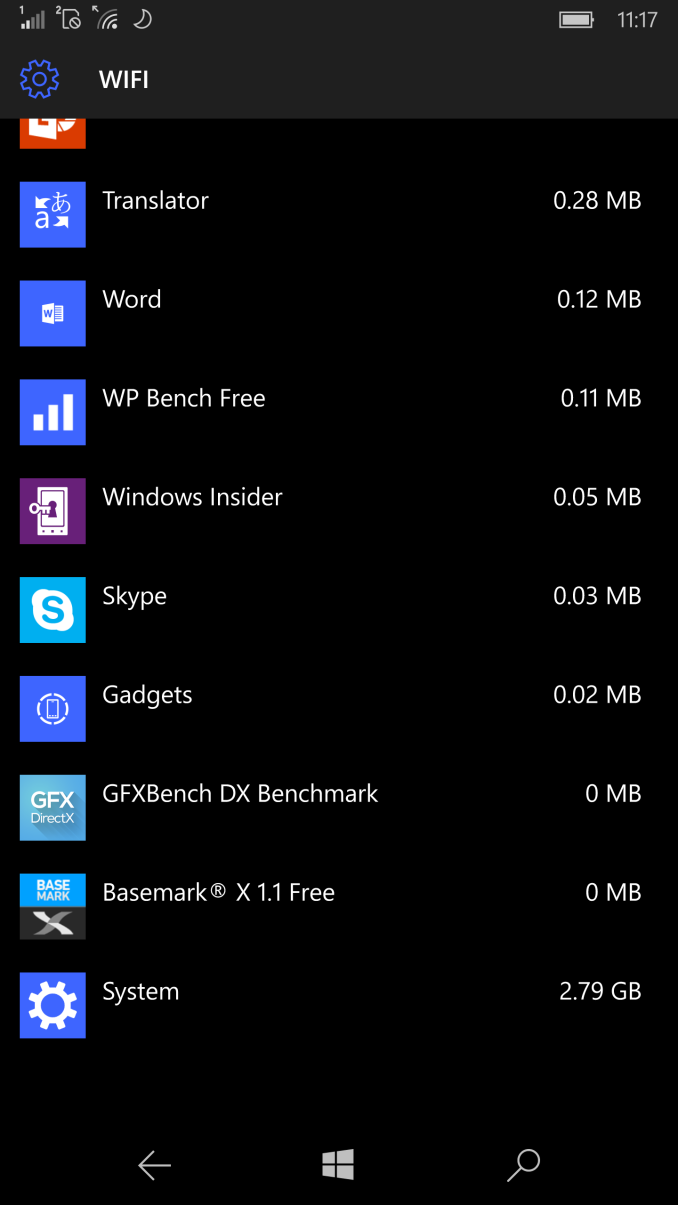
Although Windows 10 has got off to a great start by pretty much any metric, Microsoft’s mobile version of Windows 10 has had a pretty bumpy road. Originally thought to be an update for current phones sometime late last year, Windows 10 Mobile is still not available unless you purchase a new Lumia 950, 950 XL, or the budget Lumia 550, all of which were announced in October in New York City along with the Surface Pro 4 and Surface Book. That does not preclude people from using the new mobile operating system on their existing handsets, because Microsoft offers people in the Windows Insider program access to the pre-release software. Windows 10 Mobile is available for quite a few Lumia handsets, as well as a couple of others like the HTC One M8 for Windows. For those either with one of the newer Lumia phones, or if you are running on the pre-release version of Windows 10 Mobile on an existing handset, one nasty bug caught me out this month. Windows 10 Mobile includes Data Sense, which originally came back with Windows Phone 8.1, and this system tool monitors all network traffic and reports back usage over WiFi and Cellular. On my own Lumia 950 XL, I noticed I had used more cellular data in January than I had ever used in a single month before. Data Sense let me know that a process called “System” had used over 900 MB of cellular data in just 17 days. Beautifully vague as all bugs are. Speaking with some other people that use Windows 10 Mobile, I found that it was not an isolated incident. Other users had been reporting the same issue, and in some cases they had used quite a bit more data than this. The culprit, it seems, is a setting which is on by default that backs up text messages to OneDrive, so that you can get them back if you get a new phone or wipe your current phone. It’s a feature that has been part of Windows Phone for some time, and I’ve always left it enabled. Disabling this setting reduces the cellular data usage back to normal. In the messaging app main window, hit the … in the bottom right corner, choose Settings, and turn off Message Sync. To be clear, backing up the text messages should only use a small amount of data, and really it should do it over WiFi only. This is a feature I will re-enable when the bug is resolved.
System used 909 MB on Cellular and 2.79 GB on WiFI in 17 days In addition, Windows 10 Mobile offers a new feature which will back up install apps to OneDrive as well, and that can be disabled too since it may also contribute to cellular data usage, even if things like the Store are set to download updates only over WiFi. This setting is found under Backup settings. I reached out to Microsoft to see if they were aware of this issue. In the current age of mobile data caps, this can and has caught people out, causing them to have to pay overage charges with their cellular providers. A Microsoft spokesperson said: “We have received some customer feedback regarding unexpected mobile data usage and are looking into this.” The fix provided here is unofficial, in that it hasn’t come directly from Microsoft PR but rather through a Microsoft employee on Reddit thread found by Paul Thurrott of Thurrott.com, but it has appeared to fix the issue I was having. In the last 24 hours, my System process has only used 0.5 MB of data. If you are running Windows 10 Mobile, I would suggest you check into this to avoid racking up any charges on your bill. | ||||||||||||||||||||||||||||||||||||||||||||||||||||||||||||||||||||||||




| << Previous Day |
2016/01/27 [Calendar] |
Next Day >> |