[Most Recent Entries] [Calendar View]
Thursday, January 28th, 2016
| Time | Event | |||||||||||||||||||||||||||||||||||||||||||||||||||||||||||||||||||||||||||||||||||||||||||||||||||||||||||||||||||||||
| 12:15a | NVIDIA releases 361.75 WHQL Game Ready Driver
With both the new release of Rise of the Tomb Raider and the upcoming Tom Clancy’s The Division beta, NVIDIA has diligently prepared a new game ready driver to bring their optimizations for Geforce card owners. Alongside that we have the usual bug fixes and even the long awaited beta feature of Thunderbolt graphics. This driver update brings us to version 361.75, and also brings a small list of fixes. Along with stability changes such as fixing notebooks crashing in Photoshop CC 2015 and the NVIDIA control panel failing to launch, NVIDIA has brought their fix for GPU clock speeds remaining above idle on 144Hz monitors to SLI configurations on all versions of windows since Vista. In my opinion the bigger news this time around is report of beta support for running GeForce GTX GPUs externally over Thunderbolt 3 has been included in this release. Supported cards include the Geforce GTX 750 and 750Ti, the GTX 900 series, and the Titan X. If all goes well this feature will open up some new and possibly exciting use cases for many consumers that need an ultraportable machine and want a good gaming setup, but either don’t have the space for a gaming tower or can’t get a secondary machine for gaming. Lastly we have the reason for today’s release. This driver update also brings game ready optimizations for both Rise of the Tomb Raider and the upcoming Tom Clancy’s The Division beta. So GeForce owners who are interested in either of these titles will want to take note. Anyone interested can download the updated drivers through GeForce Experience or on the NVIDIA driver download page. | |||||||||||||||||||||||||||||||||||||||||||||||||||||||||||||||||||||||||||||||||||||||||||||||||||||||||||||||||||||||
| 11:30a | Das Keyboard Unveils Its First Gaming Peripherals
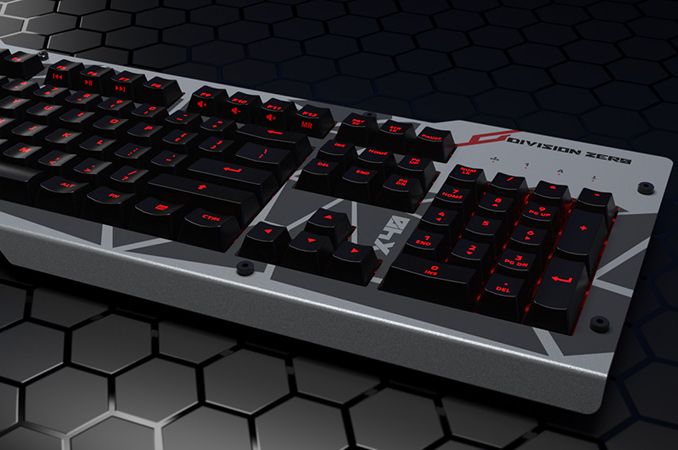
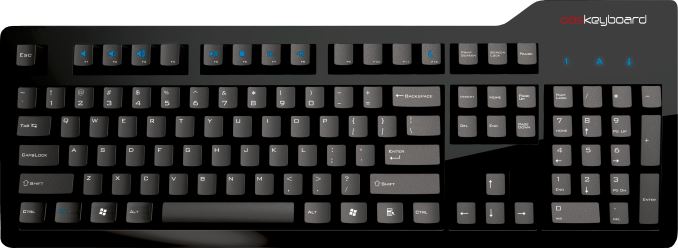
The Das Keyboard trademark is best known for mechanical keyboards designed for the combination enthusiast and professional. For many years Metadot, the owner of the brand, has been going through the process of improving its keyboard design in a bid to bolster comfort for those who type a lot. However, the rising popularity of PC gaming and growing popularity of high-end gaming peripherals means that companies are developing solutions for this market segment. This week Metadot introduced Division Zero by Das Keyboard, the family of products designed for gamers. From Pro to GamingThe history of Das Keyboard began in 2005 when Daniel Guermeur, the owner of Metadot, decided to create a keyboard with blank keycaps in order to speed up his typing and remove the imbalance of printed or embossed keys. The first version of Das Keyboard resembled IBM model M keyboard and did not feature mechanical switches. Nonetheless, it became relatively popular among enthusiasts. In 2006, the second iteration of Das Keyboard emerged: it featured similar design with blank keycaps, but mechanical switches with tactile feedback. At the time, mechanical keyboards were rare, so the second-gen Das Keyboard turned out to be more popular than the first. The third version of the Das Keyboard was launched in 2008 and it was vastly different from its predecessors. The new keyboard sported a minimalistic X40 design, a built-in USB hub, blank or marked keycaps as well as Cherry MX switches (originally introduced in 1984) with improved tactile feedback. The third iteration of Das Keyboard appealed to gadget gurus, gizmo elitists, touch-typers as well as average professionals searching for quality hardware (i.e., the higher-end of the mass market). The keyboard is still commercially available, which is a testament of its commercial success.
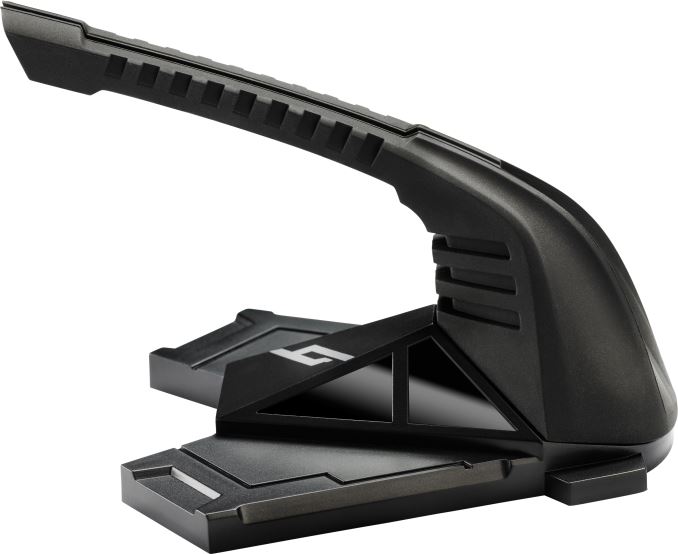
The Das Keyboard III gave the brand a voice among broader audiences, but also popularized Cherry MX switches among gamers and professionals by showing advantages of such switches over then popular dome and buckling spring switches. One could argue that the Das Keyboard III largely rejuvenated mechanical keyboards on the mass market. Since 2010, many makers of accessories for gamers have released their keyboards with Cherry MX switches. Moreover, both Razer and Logitech have even developed their own mechanical switches for keyboards. However, even in its fourth generation released in early 2014, the Das Keyboard itself remained an item for professionals. With the introduction of Division Zero by Das Keyboard, Metadot enters a new territory. The initial product lineup of Division Zero consists of the X40 keyboard, the M50 mouse, a gaming mouse bungee (cord management), mousepads, top panels for keyboards as well as a bag. The inclusion of a mouse bungee as well as mousepads into the family implies that the lineup is designed for users who want not only advanced functionality, but 'stylish design' too. The Division Zero X40 Keyboard
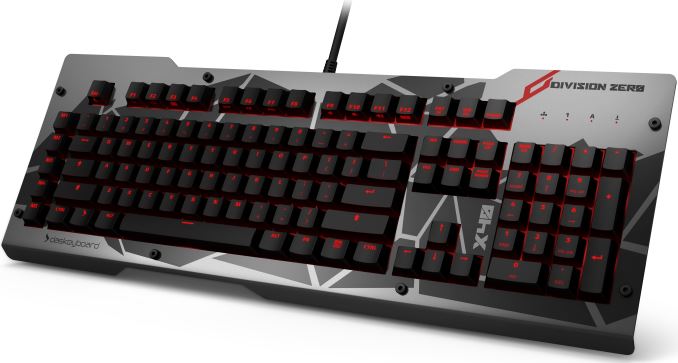
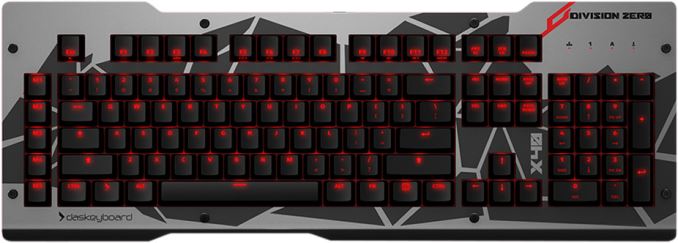
The Division Zero X40 keyboard uses Metadot’s own Alpha-Zulu switches developed, according to the company, specifically for gaming keyboards. The AZ switches have different specifications than the Cherry MX as well as the Razer Green: they have higher actuation point (1.7 mm) and slightly longer advertised lifespan (60 million switches compared to the 50m of Cherry MX linear ones), which, makes them slightly faster and more durable compared to rivals on paper. The differences may seem noticeable (23% shorter actuation distance in theory means 23% higher typing/striking speed), but the real-world benefits of the Alpha-Zulu switches compared to competing switches are yet to be found (which is not an easy thing to do given how fast gamers press keys).
Since there are two different types of Alpha-Zulu switches, and gamers will be able to choose their keyboards based on their preferences.
Just like competing keyboards for gamers, the Division Zero X40 is also equipped with adjustable red LED backlighting, five programmable macro gaming keys, a special 2 meter long braided fiber USB cable combined with audio and mic cables, a USB port (with pass through support) as well as audio-out/mic-in jacks. The keyboard also supports full n-key rollover, features media controls via Fn keys, as well as interchangeable aluminum top panels. The X40 keyboards are available for $149, a custom cover costs another $39. Gallery: Division Zero X40
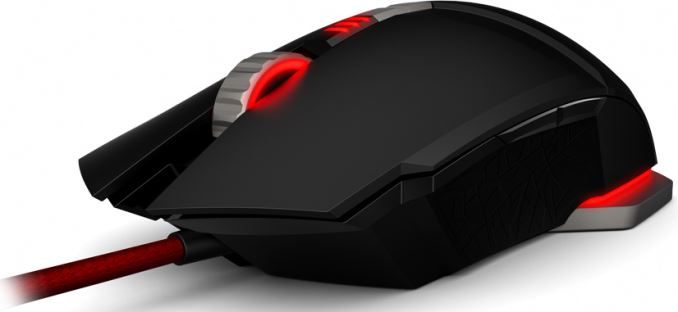
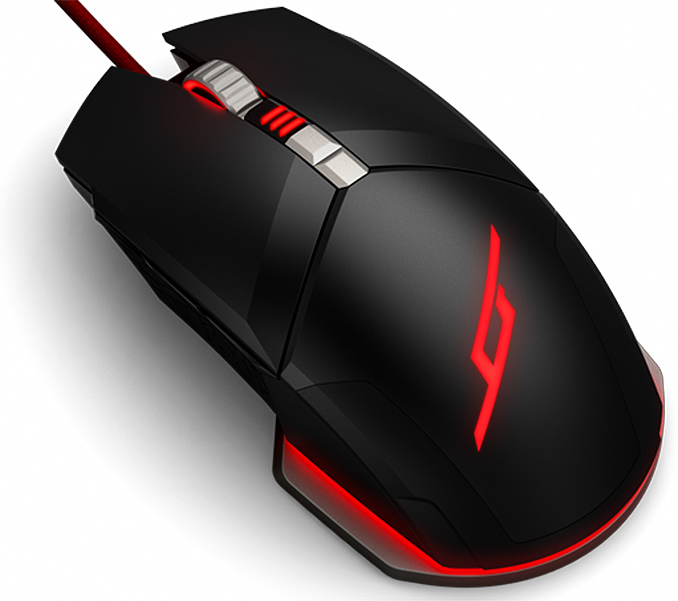
      The Division Zero M50 MouseMetadot is not known for mice, but if you want to compete for gamers, you have to offer a complete product stack, not just one keyboard. Specifications of the M50 are comparable to those of other mainstream gaming mice and the company does not reveal whether the part utilizes any specially-developed hardware.
The Division Zero M50 is an ambidextrous mouse with an adjustable 6400 dpi 4G laser sensor, a metal tilt wheel, 1000 Hz polling rate, nine programmable buttons and red LED lighting. The pointing device has its own microcontroller and memory that can store presets. The M50 Pro can handle up to 300 clicks per minute and has a 20-million primary buttons click life cycle. The mouse comes with a 2.1-meter long cable, which can be managed with Division Zero’s bungee cable management.
The M50 is made of plastic with a hydrophobic coating and a fingerprint resistant coating of primary buttons and a metal bottom. The mouse has low-friction metal Teflon feet, similar to competing products from other manufacturers. The mouse weighs 0.38 lbs/172 grams. The weight of the mouse cannot be adjusted.
The design of the M50 resembles that of Razer’s Taipan, but since Metadot’s product has dissimilar dimensions and weight as well as a different sensor, the M50 does not seem to be a rebadged mouse developed and made by another manufacturer, but a product designed in-house.
The Division Zero M50 costs $79, the bungee is available for $19 and mouse pads are priced at $19 or $29. Gallery: Division Zero M50
     Only The BeginningThe market of gaming peripherals is highly competitive, making it very diverse in order for individual firms to find a niche. Companies like Razer and Logitech offer a lot of different products to meet requirements of different users as a result. Metadot recognizes this and has been offering various versions of Das Keyboard with different types of switches and with different designs for some time now. The Division Zero product lineup consists of essentially three products: one keyboard with two types of switches, and a mouse. It will be interesting to see whether the Division Zero family will expand. It remains to be seen whether the Division Zero by Das Keyboard family will actually make Metadot a viable competitor to Corsair, Razer, Logitech and other on the market of gaming peripherals. Nonetheless, I find it nice to see a well-respected producer of professional keyboards entering the market of gaming devices. The new models will filter through distribution to etailers such as Amazon over the coming weeks, or can be found on the daskeyboard.com website directly. | |||||||||||||||||||||||||||||||||||||||||||||||||||||||||||||||||||||||||||||||||||||||||||||||||||||||||||||||||||||||
| 5:15p | Microsoft Releases Q2 FY 2016 Results: Lower Results Despite Cloud Growth
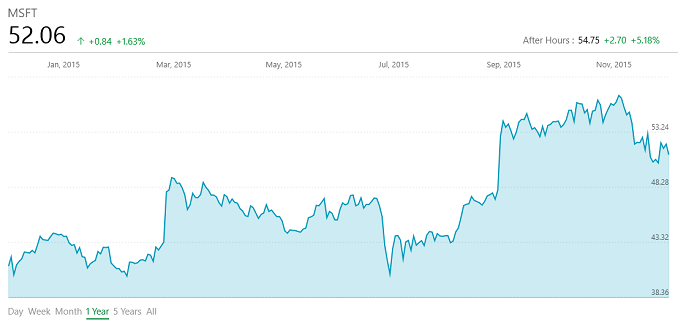
Today Microsoft released their earnings for quarter two of fiscal year 2016, which ended on December 31. Despite solid growth in their cloud platforms, the PC slowdown and world currencies have impacted Microsoft’s numbers. Revenue for the quarter was $23.8 billion, down from $26.5 billion a year ago. Gross margin was 58.5%, down from 61.7% a year ago, and net income was down 14.7% to $4.998 billion. Basic earnings per share was $0.63, down from $0.71 at the same time last year.
A big chunk of the difference this year has to do with currency rates, and Microsoft has released Non-GAAP measures as well to exclude these factors, along with restructuring charges. $1.2 billion of revenue was affected by currency rates. On a Non-GAAP basis, revenue was down only 2% to $25.693 billion, with gross margin of 61.6%. Non-GAAP operating income was up 3% to $7.9 billion, net income was up 8% to $6.3 billion, and earnings per share were up 11% to $0.78.
Microsoft’s largest segment is the More Personal Computing group, which includes Windows, Surface, Xbox, Search, and Phone. Revenue for this group was down 5% to $12.66 billion, however operating income was up 35% to $2.04 billion. Operating expenses were down 14%, in part due to the change in phone strategy that was announced in July of last year, so clearly the phone business was a major burden on the company. Windows OEM Pro revenue declined 6% for the quarter compared to Q2 2015, and non-Pro declined 3%, which is actually fairly strong considering the decline in PC sales. Microsoft attributes this to higher premium and mid-range devices, which means that they are having to give away discount or free versions of Windows 10 on fewer devices. Once again the major cuts to Lumia have driven device revenue down 22% (CC) and this was mostly driven by phone revenue which was down 49% (CC). Lumia sales were 4.5 million for the quarter. Surface, on the other hand, has grown 29% (CC) thanks in no small part to the launch of the Surface Pro 4 and Surface Book. Gaming revenue was up 9% (CC) but Microsoft no longer breaks out Xbox sales numbers. They did state that Xbox Live now has 48 million monthly active users, which is a 30% gain year-over-year. Game revenue was up 57% (CC) with the launch of Halo 5, as well as Minecraft. Xbox hardware revenue was down due to lower Xbox 360 console sales. The final part of More Personal Computing is search, and search revenue grew 21% (CC) year-over-year, with gains in both search volume, and higher revenue per search. Productivity and Business Processes, which is the financial group responsible for Office, Office 365, and Dynamics CRM had revenues of $6.69 billion for the quarter, down 2% compared to the same point last year. Operating income was down 8% year-over-year to $3.31 billion. Office commercial and cloud services revenue was up 5% (CC), with big gains in Office 365 commercial, which had its revenue grow 70% (CC) since last year. Standalone Office commercial products revenue fell 8% (CC). Office 365 commercial seats grew 59%. On the consumer side of Office, Office consumer revenue fell 8% (CC) which Microsoft states outperformed the PC market. Office 365 consumer continues to do well though, and Microsoft now has 20.6 million users of Office 365 consumer. A stat in their notes, although not directly relevant to their earnings, is that Outlook has been installed on over 30 million active iOS and Android devices. Finally, the Intelligent Cloud segment, which includes Server, Azure, and Enterprise services, continued outperforming the rest of the company, with revenue up 5% (11% CC) to $6.34 billion, although operating income was down 1% to $2.58 billion. Server products and cloud services revenue grew 10% (CC), but Azure revenue grew 140% (CC). Azure compute usage is up almost 100% year-over-year, and Azure SQL database usage has increased more than 500% since Q2 2015. The move to the cloud was slow to get started, but certainly appears to be ramping up. Enterprise Services revenue was up 16% (CC) for the quarter.
Overall, the quarter was pretty steady for the Redmond company. The decline in the PC market has certainly hit them, like it has hit most PC companies, but despite this Windows revenue outperformed the drop in PC sales. Microsoft’s phone strategy took a big shift last July, with the layoff of most of the remaining Nokia people, and that continues to affect their results, with a decline in revenue, but also a decline in expenses. The cloud side has been growing at a very sold rate though. It is a long way from overtaking the PC side of Microsoft, but the diversification is helping them weather rough days in the PC space. The free upgrade to Windows 10 will continue for the rest of this fiscal year, and we’ll have to watch and see if that continues to make an impact on revenues or not. Source: Microsoft Investor Relations | |||||||||||||||||||||||||||||||||||||||||||||||||||||||||||||||||||||||||||||||||||||||||||||||||||||||||||||||||||||||
| 8:00p | Apple Recalls "Duckhead" Power Adapters for Select Mac Laptops and iPads
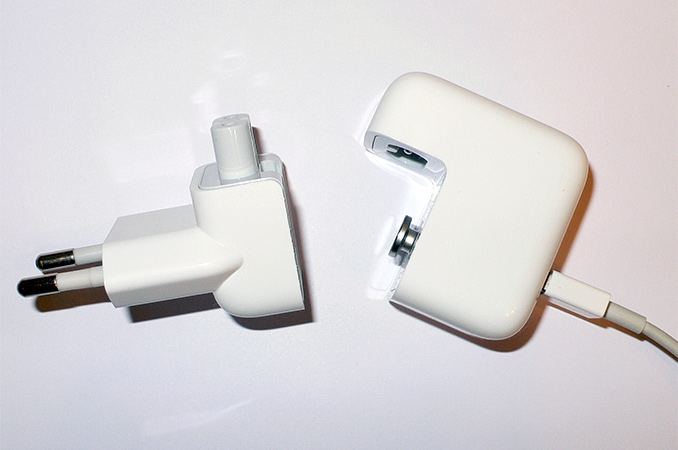
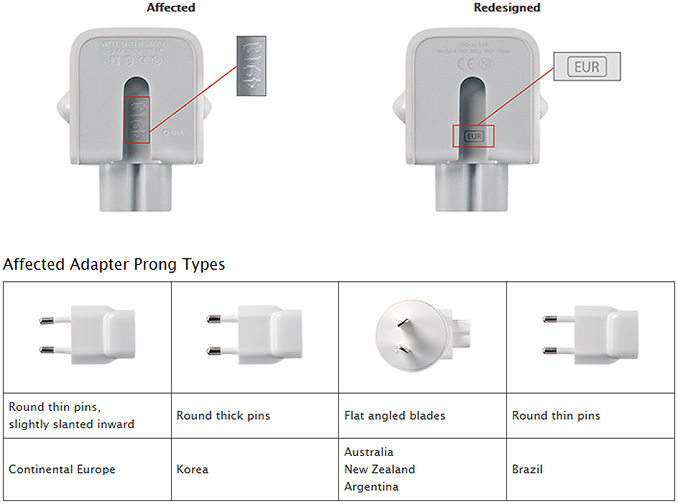
Apple has announced today that they are recalling AC wall plug adapters for its MacBook laptops and iPads in select countries. The issue stems from a design flaw that, if broken, causes the AC plug to pose a risk of electrical shock if touched. The adapters were shipped outside the U.S. from 2003 to 2015 and their total number should be rather huge. Nonetheless, the number of failures known to Apple is limited to 12 cases. Apple has found that its AC wall plug adapters (AKA "duckheads") designed for use in Continental Europe, Australia, New Zealand, Korea, Argentina and Brazil may malfunction and create a risk of electrical shock if touched. These wall plug adapters were bundled from 2003 to 2015 with Mac PCs as well as iPads. In addition, they were also included in the Apple World Travel Adapter Kit. The company will voluntarily exchange affected wall plug adapters with a new, redesigned model, free of charge. The affected wall plug adapters have four or five characters or no characters on the inside slot where it attaches to an Apple power adapter. The new wall plug adapters feature a 3-letter regional code in the slot (EUR, KOR, AUS, ARG or BRA). To exchange your device, you should visit a special page at Apple’s web-site.
The Verge reports that Apple is aware of 12 incidents that have occurred around broken adapters in the past 12 years. Details of the incidents are unknown; their exact circumstances are unclear too. From 2003 to 2015, Apple shipped over 120 million Macs and over 230 million iPad. The exact number of devices sold in Europe, Australia, New Zealand, Korea, Argentina and Brazil is uncertain, but it is likely that many tens of millions of AC plug adapters are potentially dangerous. On the other hand, 12 incidents that occurred over 12 years is a miniscule number. Moreover, the vast majority of laptops, smartphones, tablets, phones and players that are more than five years old are no longer in use. Nonetheless, the recall will cost Apple millions of U.S. dollars. Meanwhile the AC wall plug adapters for the U.S., the U.K., Canada, China, Hong Kong and not part of the recall, which likely indicates that they aren't affected by the underlying issue. Finally, it should be noted that Apple's AC wall plug adapters are made by contract manufacturers, such as Volex. The same producers make similar devices to other suppliers of consumer electronics. | |||||||||||||||||||||||||||||||||||||||||||||||||||||||||||||||||||||||||||||||||||||||||||||||||||||||||||||||||||||||

| << Previous Day |
2016/01/28 [Calendar] |
Next Day >> |