[Most Recent Entries] [Calendar View]
Friday, February 12th, 2016
| Time | Event |
| 8:00a | Examining Soft Machines' Architecture: An Element of VISC to Improving IPC Last week, Soft Machines announced that their 'VISC' architecture was available for licensing, following the announcement of the original concepts over a year ago. The concepts behind their VISC architecture, which splits the workload of a single linear thread across multiple cores in an effort to improve IPC, are intriguing and exciting. But as with any new fundamental change in computer processing, it will be subject to a large barrage of questions. We were invited to a presentation and call with the President and Chief Technical Officer Mohammed Abdallah and the VP Marketing and Business Mark Casey, and I put a number of questions on the lips of analysts to them. |
| 8:30a | HP’s New Laptops to Feature AMD FreeSync Technology
AMD has announced that the new versions HP’s Envy 15z laptops - powered by the company’s latest-generation A-series APUs - will feature the FreeSync variable refresh rate technology. In addition, all of HP’s consumer notebooks powered by AMD’s latest APUs will also get FreeSync tech in the second half of the year. At present, only Lenovo’s IdeaPad Y700 laptop based on AMD’s Carrizo APU and Radeon R9 M380 graphics processor supports the FreeSync technology for notebooks. In the coming months, HP plans to release a new version of its Envy 15z laptop featuring AMD’s Carrizo APUs and the FreeSync technology. The current-gen HP Envy 15z notebooks are powered by AMD’s A10-8700P APU with the Radeon R6 graphics or AMD FX-8800P APU with the Radeon R7 graphics. The systems feature 15.6-inch displays with 1366x768 or 1920x1080 resolution and have a premium metallic finish to stay true to their Voodoo DNA. On a brief aside, neither AMD nor HP mention whether the upcoming Envy 15z support dual-channel memory sub-system. At present, many Carrizo-based laptops use single-channel memory sub-systems, which negatively affects their performance, especially in graphics-intensive applications. Currently available HP Envy 15z can be equipped with either 6 GB (two DIMMs) or 8 GB (one DIMM) of DDR3L memory, so it is unclear whether they can support dual-channel mode or not.
What is, perhaps, more important, is that all HP laptops for consumers based on AMD’s 6th generation Carrizo APUs to be released in the second half of this year will also come with displays supporting the FreeSync technology. HP is one of AMD’s biggest customers and if it plans to enable FreeSync on a family of notebooks, this may be considered as a success for AMD. AMD’s FreeSync technology is built on top of the panel self-refresh (PSR) feature of the eDP standard, which is used to cut-down power consumption of laptops when high refresh rates are not required. FreeSync is, of course, designed for a completely different purpose – to synchronize framerate with the display’s refresh rate, which requires additional software tweaking as well as special panels that support relatively high refresh rates. Lenovo’s Y700 laptop supports refresh rates between 40 and 60 Hz, which is a pretty narrow range: it not only limits benefits of FreeSync, but also does not support AMD’s low framerate compensation technology (LFC). It is hard to find laptop panels with a wide range of supported refresh rates, so, it will be interesting to see what kind of panels will PC makers plan to use for their AMD APU-based notebooks with FreeSync. To enable AMD FreeSync on a PC, a graphics processor with the GCN 1.1 architecture is required. However, since FreeSync is primarily pitched towards gaming, some of the laptops featuring FreeSync will come equipped with an AMD APU as well as with an up-to-date mobile AMD Radeon 300-series discrete GPU (e.g., Bonaire, Tonga, Hawaii, etc.) to enable better performance in games. And for that reason, given AMD’s positions in the market of laptops, I expect AMD and its partners to address mainstream multimedia/gaming enthusiasts with their FreeSync-enabled notebooks. |
| 10:00a | Micron 3D NAND Status Update
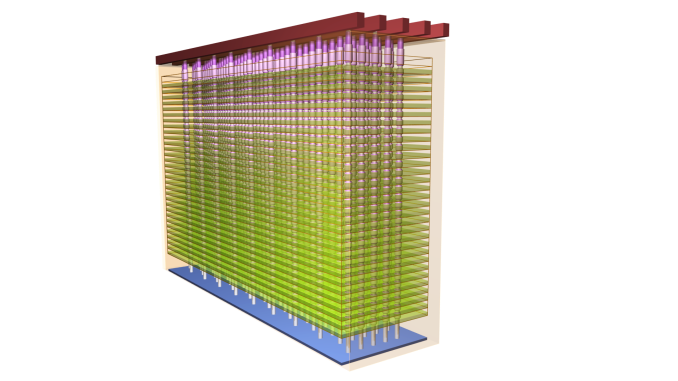
After samples of their upcoming 3D NAND were sighted in the wild at CES, Micron has taken the time to provide some details about the flash memory and their plans for it. A lot of this is a recap of information we've previously covered, but we've got some new details and a better idea of the roadmap for the future. The entire flash memory industry has shifted focus to the devlopment of 3D NAND flash memory as the replacement for planar NAND flash memory. Samsung took an aggressive approach and has enjoyed some great success with their V-NAND branded 3D NAND, but it hasn't been an entirely trouble-free transition. Micron has been more conservative both in technology and timing, but they plan on having a strong competitor on the market later this year. Micron's first generation 3D NAND takes the form of a 256Gb MLC die and a 384Gb TLC die (compare with their 128Gb 16nm MLC and TLC). At a high level, the die will be partitioned into four separate planes, compared to two planes for most competing NAND. A 480GB drive using the four-plane 256Gb dies will have access to approximately the same amount of parallelism as a 480GB drive using two-plane 128Gb dies, so this capacity jump won't bring the performance drops that have tarnished some NAND process shrinks. The key development that allows Micron to produce a four-plane die without inflating die size and cost relative to the two-plane competition is that they've layered much of the required additional circuitry under the 3D flash array, instead of sitting alongside. Micron says that their "CMOS Under the Array" design puts more than 75% of the logic (things like address decoding and page buffers) under the flash memory. It doesn't make the additional segmentation of the four-plane design entirely free, but it allows it to be a very cost effective performance optimization. This is still planar CMOS logic, not any kind of 3D or stacked logic; it's just got some metal interconnect layers and the flash array piled on top. On a smaller scale, the 3D NAND will have a page size of 16kB and erase block sizes of 16MB for the MLC and 24MB for the TLC. Because CPUs and filesystems are still mostly dealing with 4kB chunks, Micron has included a partial page read capability that allows for a 4kB read to be done a bit faster and with about half the power of a full 16kB page read. This helps offset some of the penalty the larger page size can have on random 4kB read performance. The large erase block sizes won't have much of a direct impact on performance and are a necessary efficiency measure: erasing requires charge pumps to produce higher voltages than reads or writes use, and it's a slower and more power-hungry operation. If you're going to fire up that extra circuitry and block access to the entire plane for 1ms or more, you might as well erase a usefully large amount of flash. For the architecture of the individual memory cells, we have nothing new to report. Intel and Micron are alone in their decision to stick with floating-gate flash technology instead of transitioning to charge-trap flash. We've previously explained how the technologies differ and what kinds of advantages the manufacturers want to reap from the change. The cost is that the design process involves different tradeoffs that are not as thoroughly explored and understood as the dynamics of floating-gate flash, and for now Micron is sticking with what they know. Micron's 3D NAND might not have the best write endurance, but they're expecting to have an advantage in data retention time for healthy flash. They aren't providing exact numbers, but they're estimating that drives relying on simpler BCH ECC can get effective program-erase cycle lifetimes in the thousands and drives with LDPC will have effective cycle counts of tens of thousands. Once the process has matured it should exceed their 20nm planar NAND's write endurance. The first 3D NAND Micron has ready for the market will produced to the endurance standards for client drives, with enterprise-grade 3D NAND following later. The MLC is currently a few weeks ahead of the TLC in the qualification process, but given the state of the client SSD market the TLC will be the more popular product. Overall their 3D NAND will comprise a majority of their flash output on a per-GB basis by the second half of 2016. Micron is sampling drives with 3D NAND to partners this month and is planning for general availability in June. Other drive vendors using Micron's NAND will be on similar release schedules. Looking further to the future, Micron gave a presentation last week at the IEEE International Solid-State Circuits Conference entitled "A 768Gb 3b/cell 3D-Floating-Gate NAND Flash Memory". This was more about bragging about their R&D in an academic context than announcing any concrete future product plans, but it does represent the most likely successor to their first-generation 3D NAND. The chip in question provides a whopping 768Gb (96GB) capacity when operated as TLC, and 512Gb (64GB) as MLC. The die size is about the same as their 32-layer 384Gb TLC, the areal bit density is almost doubled, and most of the other details are the same—implying that the layer count has probably increased, though Micron isn't saying how many layers it uses. If Micron has plans to switch to charge-trap flash they're keeping it under wraps for now, and any such transition isn't imminent. |
| 6:15p | StarTech Unveils Dual-Display Thunderbolt 2 Docking Station with 12 Ports
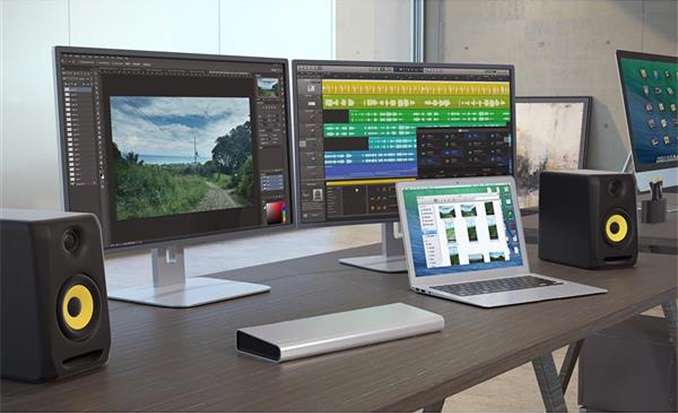
Modern laptops are getting thinner with every generation and it becomes increasingly harder for PC makers to integrate multiple ports into them. Nonetheless, end-users still need to connect their external monitors, external storage, various peripherals, LAN, audio equipment and so on to their notebooks. Fortunately, there is the Thunderbolt technology that has plenty of bandwidth and which can be used to connect many devices to a PC at the same time. However, good docking stations with multiple ports are hard to find. StarTech this week introduced its new docking station for notebooks equipped with Thunderbolt 2 ports, which can hook up to 12 different devices, including displays, storage, audio and LAN, to a single TB2 connector. The device costs $347.99, which is not really affordable, but it offers a comprehensive set of ports that is not available on other docks (at least, according to ThunderboltTechnology.net web-site) and which significantly expands capabilities of any TB2-equipped laptop.
The StarTech Thunderbolt 2 Dual-Monitor Docking Station for Laptops (TB2DOCK4K2DP) is based on the Intel DSL5520 (Falcon Ridge) quad-channel Thunderbolt 2 controller that can transfer data at 20 Gbps while simultaneously driving a single 4K (3840x2160) monitor or two QHD (2560x1440) monitors. The docking station can connect to two displays with up to 3840x2160 and 3440x1440 resolutions using DisplayPort and Thunderbolt connectors (ot just two DisplayPorts), essentially adding dual-monitor capability to any PC with a TB2 connector.
The Thunderbolt 2 Dual-Monitor Docking Station features two Thunderbolt 2 ports, two DisplayPort outputs, four USB 3.0 type-A ports (including one Fast-Charge port) driven by the Fresco Logic FL1100EX controller, one eSATA connector featuring the the ASMedia ASM1061 controller, one Gigabit LAN port enabled by the Intel WGI210AT chip, two 3.5 mm mini-jacks (TI PCM2912A) as well as one SPDIF optical Toslink audio output (CMedia CM6500). From the architectural standpoint, the StarTech Thunderbolt 2 docking station is a huge PCI Express-based expansion module with hot-plug capability. One USB 3.0 port can be used for charging smartphones or other devices compatible with the USB Battery Charging 1.2 specification (delivery of up to 7.5W of power) even when the dock itself is not connected to a PC. Since the vast majority of Thunderbolt 2-enabled systems are Apple MacBook laptops, the docking station unsurprisingly comes in aluminum casin to match design of Apple's notebooks. The first MacBook with Thunderbolt 2 was unveiled in late 2013 and by now tens of millions of laptops featuring the interface have been shipped. The existing MacBook user base is also likely why StarTech is releasing a TB2 dock now, even after the recent release of Thunderbolt 3 technology (which offers higher bandwidth and compatibility with USB 3.1). A TB3 dock would be incompatible with the sizable existing base of TB2 users due to the port change (and no adapters are currently available) and meanwhile the number of TB3 systems in the field is still low as adoption of the TB3 by laptop vendors and users is only beginnng.
The 12-port Thunderbolt 2 docking station is available from StarTech today for $347.99. According to StarTech's press release, the device will also be available from CDW, Amazon.com, Newegg.com, PC Connection, and Insight and will be distributed internationally by Ingram Micro, SYNNEX, Tech Data, D&H and ASI. The package includes the device itself, one copper Thunderbolt cable, one 72W power adapter, four power cords as well as a manual. |
| 8:40p | Apple Offering Replacement USB Type-C Cables For 2015 MacBook Owners
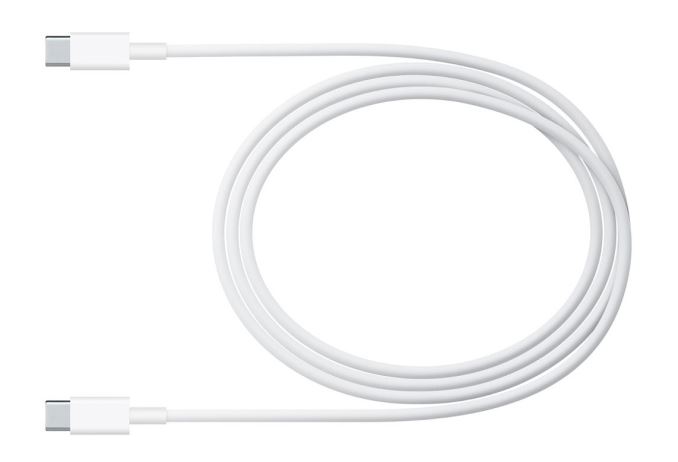
After last month’s “duckhead” power adapter recall, Apple has started another charger-related replacement program. Beginning today, Apple will be replacing early runs of their USB Type-C charging cable for the 2015 MacBook, covering both the included cable and any additional purchased cables. In the advisory for the program, Apple notes that cables made through June of 2015 could potentially fail, rendering the cable unable to charge the MacBook or only capable of charging it intermittently. The failed cables aren’t being cited as a safety issue – and hence there’s no recall – but rather Apple appears to be replacing them due to their unreliability.
The replacement program itself is being handled based on the serial number of the MacBook, as Apple did not issue serial numbers for USB cables at that time. In fact the means of telling apart an earlier, potentially faulty cable from a newer cable is the presence of a serial number, as newer cables have a serial number stamped on. According to Apple’s advisory, new cables will be going out by the end of this month. Finally, hearing that Apple is experiencing an issue with their USB Type-C charging cable is somewhat surprising news. The cable itself is only a USB Type-C 2.0 cable rated to carry additional power – the MacBook charges at 29W – so it’s not a complex cable. The fact that the replacement program isn’t a safety recall makes me suspect that the issue isn’t in the wiring itself (as this is typically a safety hazard), but rather it’s an issue with the controller within the cable that identifies its capabilities to USB hosts and devices via the CC sense pins. Though this is just an assumption on my part. |





| << Previous Day |
2016/02/12 [Calendar] |
Next Day >> |