[Most Recent Entries] [Calendar View]
Tuesday, February 16th, 2016
| Time | Event | ||||||||||||||||||||||||||||||||||||||||||||||||||||||||||||||||||||||||||||||||||
| 7:30a | MWC 2016: LG to Unveil the Stylus 2
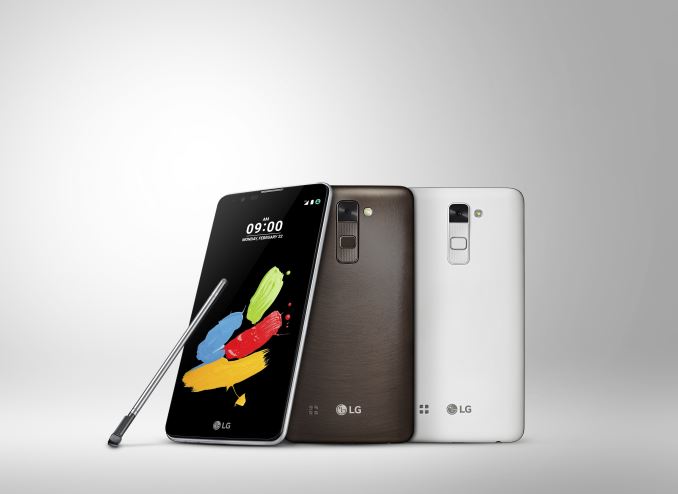
It is that time of year when the worlds of the smartphone and IoT ecosystems descend into Barcelona for Mobile World Congress. We’re still a few days out (the show starts on Monday with press events happening during the weekend) but first out of the gate with some pre-show releases is LG, announcing the unveiling of a larger mid-range smartphone with a stylus. The LG Stylus 2 is the generation up from the G4 Stylus, with LG’s aim to take what it learns on its flagships and integrate the stylus functionality for a different user experience. As with the G4 and the G3 versions, this unit is designed to cater for a larger global market than some of the high end units, with features that look similar to other $180-$250 models - but with a stylus and in the LG design.
As the user of a 5.5-inch 720p device using a MediaTek 1.0 GHz quad core SoC, and writing a review on it, I won’t lie and say it does everything great – there are obvious instances where a faster response rate or better camera would help, but it is nice for the price and the low SoC/screen makes for a longer battery life. It is interesting to see if using a stylus changes that with the need for more fast response events. One of the features LG is implementing with this model is a notification system that will pop up if the stylus is not back in its bay while the phone is in motion.
Compared to the G4 Stylus, the new version is lighter, but has less memory in the 16GB G4 version. The press release does not confirm the SoC in play, though if the G4 is anything to go by then we are probably looking at a quad-core A53 design from Qualcomm, probably the Snapdragon 410 similar to the G4. The phone offers a single SIM slot but with space for a microSD card up to 128GB, a 3000 mAh battery, and is available in three colors: ‘Titan’, White and Brown. LG states that there may be regional differences in the specifications, most likely due to modem and pricing arrangements – one of the G4 Stylus variants had a 4xA7 MediaTek SoC for example. As a result, pricing has not been announced but I suspect we will see more at LG’s press conference at MWC. | ||||||||||||||||||||||||||||||||||||||||||||||||||||||||||||||||||||||||||||||||||
| 8:00a | StarTech Standalone Hard Drive Eraser And USB 3.0 Dock Capsule Review When StarTech.com first offered up their USB 3.0 Standalone Eraser Dock for review, it took me a little while to really figure what it was for. The name is long and a bit confusing, but that's because this device fulfills two mostly separate roles. In one mode, it's a normal USB to SATA drive dock that allows for easy access to bare 2.5" or 3.5" drives. The rest of the time, it's a specialized standalone gadget for securely erasing and overwriting drives. | ||||||||||||||||||||||||||||||||||||||||||||||||||||||||||||||||||||||||||||||||||
| 8:15a | MWC 2016: LG to Launch new ‘X Series’ Mid-Range Smartphones, each with a Singular Premium Feature
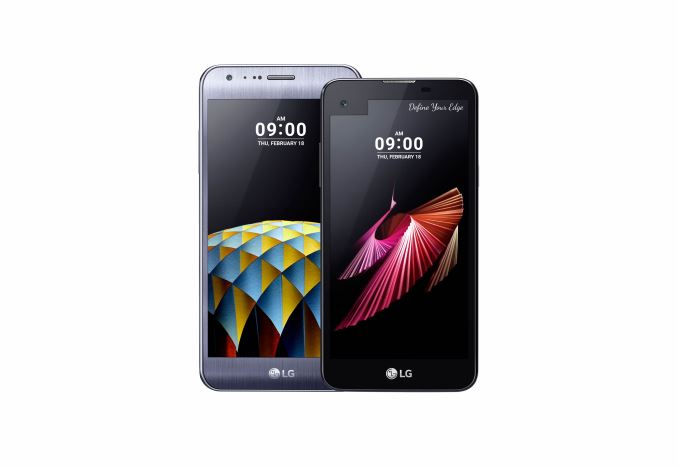
No sooner had I finished writing the news on the LG Stylus 2 announcement had another email landed in my inbox. On the back of the mid-range model with a stylus, LG is to launch a whole new series of smartphones called the ‘X’ series. These are essentially mid-range devices, but with one premium component more akin to a high-end device. In this instance, LG is initially going to offer an ‘X cam’ and ‘X screen’, each with obvious high-end upgrades.
The X cam (there’s no capital C in the name) will be using dual cameras on the rear to allow for better depth-of-field effects, color accuracy and image quality. That being said, the second dual camera is only a 5MP implementation and I imagine we will find our more at the LG press conference at Mobile World Congress next week. Unfortunately LG doesn't seem to want to share a photograph of the rear to show the camera as of yet. The front of the X cam will also feature ‘3D Bending Glass’, providing a curved finish on the front and designed to sit more comfortably in the hand. The X cam fits into the mid-range specifications in the other areas – a 5.2-inch 1080p screen, an octa-core 1.14 GHz SoC (presumably dual quad ARM Cortex A53s), a 2520 mAh battery and a 16GB/2GB storage plus memory combination.
The X screen brings a feature from LG’s high end V10 model down to the mid-range: instead of dual cameras this time we get dual screens. The main screen is a 4.93-inch 720x1280 screen, which is fairly common in smartphones of this segment, but this is enhanced through a 1.76-inch 520x80 secondary screen above it and off to the right. This screen is always-on, and runs almost separately to the main phone software allowing users to check status and adjust calls without disrupting the software on the main screen. The rest of the specifications run similar to the X cam, except the 1.2 GHz quad core SoC which looks similar to the Snapdragon 410 in the Stylus 2. Again, similar to the Stylus 2, specifications may be adjusted depending on region, although Asia, Europe and Latin America will be the first markets. One thing to note is that both units do not advertise microSD slots as of yet, which may or may not just be a PR oversight which we are trying to confirm. We will most likely hear more information, pricing and release dates during LG’s press conference at Mobile World Congress next week. The concept of a mid-range product with a single high-end component is actually rather intriguing, and opens up the possibility of a high-end SoC in a device, or 128 GB of storage in a mid-range, or 5000 mAh as that key component. | ||||||||||||||||||||||||||||||||||||||||||||||||||||||||||||||||||||||||||||||||||
| 8:30a | 16:10 Lives On: EIZO Releases 24-inch ColorEdge CG2420 and CS2420 Professional Monitors
For anyone that loves a 16:10 screen, with resolutions such as 1920x1200 or 2560x1600, there have been relatively slim pickings in the monitor world recently. Any high end or high refresh rate monitor is likely to be of the 16:9 variety (1920x1080, 2560x1440 or 3840x2160) or a 21:9 unit through the ultra-wide 2560x1080 or 3440x1440 monitors. One of the reasons as to why companies who make high end monitors do not produce many 16:10 units was given to me by ASUS: there are simply not enough companies producing the panels. It seems that EIZO has managed to find a couple though, with their new ColorEdge displays.
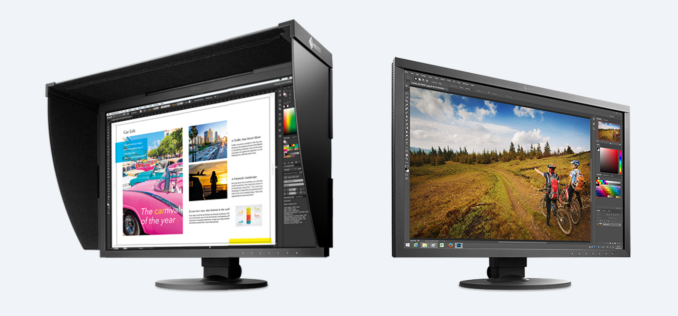
So admittedly these are not particularly consumer style monitors, and EIZO states that they are aimed at the creative industries rather than high refresh rate gaming. The cabinet designs come with a slimmer bezel that EIZO’s previous versions, and come with carrying handles for easier mobility across a working environment. The CG2420 is the higher specification of the two, with a built in self-calibration sensor to maintain color accuracy over time, a higher contrast ratio at 1500:1 and a shading hood as standard.
Both units are 1920x1200 wide-gamut 10-bit IPS non-glare displays but use 16-bit look up tables to do so, and offer DisplayPort, HDMI and DVI digital inputs. The wide gamut aspect means that these panels have 99% AdobeRGB coverage, with the CG2420 panel also covering 98 of the DCI-P3 color space. Unfortunately no Rec. 2020 coverage is specified at this time, as the focus seems to be for DCI-P3. Both monitors also come with EIZO’s custom ColorNavigator 6 software for calibration and a quoted time of 3-minutes for color stabilization from power-on.
Now, of course there will be users wondering why anyone wants a few extra pixels at the bottom, and why it matters. Typical 16:10 enthusiasts are coders and writers that love them for the extra vertical space, ensuring more content is on the screen at the same time. For media processing and consumption, the user can see the full 1920x1080 video on a 1920x1200 screen and still has space for functional buttons on editing or playback, rather than obscuring part of the video or making the content shrink/expand. As much as 16:10 monitors are rare, laptops even more so, which makes me wonder if I can’t go back to my Dell M4400, except that the battery now lasts 2 hours and it weighs 4kg+. Fingers crossed for a 16:10 laptop sometime soon. EIZO states that these monitors will be shipping from February, although intended markets and pricing are not yet confirmed. Both the CG2420 and CS2420 are backed by a five-year or 30,000 hour (3.4 year) on-time warranty for use and a 10,000 hour warranty on brightness and color. | ||||||||||||||||||||||||||||||||||||||||||||||||||||||||||||||||||||||||||||||||||
| 9:00a | Vulkan 1.0 Specification Released: Drivers & Games Inbound
Back in August of 2014, Khronos announced the Next Generation OpenGL Initiative. The industry consortium, responsible for overseeing a number of major cross-platform GPU standards such as OpenGL and OpenCL, was embarking upon a development project to create a true, next-generation successor to OpenGL and OpenGL ES. What would eventually become to be known as Vulkan, Khronos’s new graphics API would be an open, multi-platform low-level API to rival DirectX 12 and Metal. Now 18 months after the initiative began, today Khronos is announcing that the Vulkan 1.0 specification has been released, and that the consortium and its members intend to hit the ground running. Along with the release of the specification itself, today will also mark the launch of document, drivers, SDKs, conformance tests, and even beta software support. Khronos has never had a hard API launch before – previous procedures were to release the specification and then let members trickle in with drivers and applications – so this marks a major occasion not just for graphics APIs, but for Khronos as an organization going forward.
Vulkan 1.0 – Mantle, We Hardly Knew YeWe’ll start things off with the Vulkan API itself. Since Khronos’s last major press update almost a year ago in March of 2015, not a great deal has changed on the technical side from a high level. After being gifted Mantle 1.0 from AMD – an action that significantly sped up the development process and bypassed the need to figure out some fundamental questions about how the API should be designed – the consortium went about adapting Mantle to serve as a wider, more generic API suitable for hardware from multiple vendors across multiple OSes. The end result is that Vulkan has its roots firmly in Mantle, through Khronos has worked to make it very clear that multiple vendors are responsible for contributing IP that ultimately went into Vulkan. And while the specific low-level details of the API are beyond the scope of this article, I do know that the shader resource binding system is significantly different from Mantle, and that’s not the only system that was updated or overhauled during Vulkan’s development.
As for the API itself, Khronos’s goals are unchanged. Vulkan will be the low-level, low overhead successor to OpenGL, as low-level APIs have become increasingly important over the past few years. By implementing such a model, Vulkan gains abilities that OpenGL never could, not the least of which is the ability for multiple threads/cores to dispatch graphics work, a scenario that maps far better to modern multi-core CPUs. This also gives Khronos’s now flagship graphics API the chance to promote compute to a first class citizen within the graphics API, introducing support for separated graphics and compute queues (think: async shading). And though we’re still some time off from widescale adoption, Khronos will also be setting up Vulkan as their preferred API for virtual reality, as the lower overhead from the API (and lack of mandatory state validation and error handling) will cut down on API latency as compared to OpenGL.
Overall, Vulkan has also given Khronos the chance to start anew and to throw out 25 years of OpenGL history, something that some sections of the development community have been clamoring for since the middle of the last decade. Platforms & Feature SetsMeanwhile, as Vulkan is not the only low-level API on the block – and indeed is likely to be the last major low-level API to be introduced – Khronos will not just be fulfilling their mission in releasing Khronos as an open, multi-platform API, but they will be leveraging that in order to try to drive the adoption of the API. While OpenGL ES has been a modern success story on the mobile, mainline OpenGL has floundered on the desktop for a number of years now, and along with making a clean break from OpenGL on the API side, Vulkan gives Khronos a chance to make a clean break from OpenGL’s reputation on the desktop and general developer malaise towards it. Which is not to say that Vulkan is guaranteed to be any more successful than OpenGL has been, but certainly the new API and this new era of hard launching an API give Khronos and Vulkan the best chance they could realistically have.
From a technical perspective Khronos designed Vulkan to work on most hardware and operating systems that supported recent releases of OpenGL and OpenGL ES, and by and large they will hit that goal. Linux will of course get support for the API, as will Windows. In fact as Vulkan is not tied to the Windows driver model (WDDM) like DirectX 12 is, one of Vulkan’s differentiators will be that it will also be supported on Windows 8, Windows 7, and though no specific GPU vendors have been named, even the now obsolete (but still very much used in closed systems) Windows XP. Supporting a wider range of Windows version certainly gives Vulkan a leg-up in this respect, though DirectX’s overall momentum and the free upgrades being offered for Windows 10 should not be overlooked. Meanwhile on the mobile side, Google has previously committed towards integrating Vulkan support into Android, where it will be a first-class API. Android will not just support Vulkan for rendering, but the Android platform test itself will include tests for Vulkan. At this point in time Google has not commented on when they will actually integrate Vulkan, and the next version of Android (presumably Android N) is a likely bet, though it’s not outside the realm of possibility that it could be sooner to take advantage of next-generation SoCs that are due to launch.
Unfortunately the one notable holdout here – and the reason not all current OpenGL platforms will support Vulkan – is Apple. While Apple’s specific internal plans are not public, Khronos confirmed that after initially being involved with the Vulkan working group, Apple stepped aside and is no longer participating. In the last year Apple has doubled-down on their own low-level API, Metal, even extending it to the desktop. Meanwhile Apple never did update iOS to OpenGL ES 3.1, so all signs point to them being entirely insular here for both OS X and iOS. Unfortunately this means that there will not be a modern, low-level API that can cross iOS-Android or Windows-OS X, and the overall API ecosystem will be more Balkanized than in past years, something that most developers will likely rely on middleware to resolve. Though despite all of this, Khronos was quick to note that while Apple pulled out of participating in the Vulkan working group, they are still a member of the Khronos consortium overall. Moving on, let’s talk about feature sets. When we were briefed on Vulkan last year, Khronos announced that Vulkan would offer feature sets as a means of allowing a single API to accommodate the differences in features available on desktop and mobile GPUs. Historically OpenGL didn’t have a true concept of feature sets (rather it was individual capability bits), but they have been in use on DirectX for some time now.
For Vulkan, Khronos opted to give platform holders the right of first refusal on defining feature sets; Khronos would only define feature sets if the platform holder passed on it. Now that Vulkan is launching, we have updated information on which platforms will be defining their own feature sets, and what Khronos will be doing for the rest.
Google has confirmed that they will be handling their own feature set definitions. Meanwhile, as expected, Microsoft has declined and deferred to Khronos. Finally, the Linux development community has similarly opted to put Khronos in charge of feature sets, requesting that Linux’s feature sets are made identical to Windows’ feature sets. Khronos for their part has not yet defined the feature sets, so these are still to be determined. Now that Vulkan is shipping Khronos will be holding a developer feedback period to get input on what developers would like to see for feature sets, and to figure out what’s actually going to be viable within the consortium. The current idea being floated, though by no means guaranteed, would be to have a desktop feature set that closely mirrored OpenGL 4.5, and a separate mobile feature set that closely mirrored OpenGL ES 3.2. This would ensure that while developers are making the jump from OpenGL to Vulkan, they don’t also have to accommodate a significant shift in feature capabilities as well. Drivers & SoftwareKeeping with their goals for a hard launch for Vulkan, Khronos’s members will be hitting the ground running on the driver front. The all-important Vulkan conformance test is already complete, and 30 drivers have passed testing. In turn, some of those drivers will be getting released today for developers and end-users to experiment with right away.
At this point Khronos has confirmed that Android drivers from NVIDIA and Qualcomm have passed conformance testing, as have Linux drivers from Imagination, Intel, and NVIDIA. Finally, on the Windows side, so far only NVIDIA has passed conformance testing. ARM for their part has a Linux driver under review, and while we asked AMD about a Windows driver for today’s launch, they weren’t able to get back to us by press time. However in a separate pre-written press release that will be going out at the same time as this article, they say that “With this transition to public availability of the Vulkan 1.0 API specifications, AMD will be releasing a beta version of our Vulkan™ API-enabled Radeon™ Software driver,” so if not today then I’d expect to see one soon. On the hardware side of matters, there’s still some ambiguity in the mobile space about what specific GPUs will support Vulkan, in part due to the fact that it’s Google defining the feature sets. Imagination, Qualcomm, ARM, and NVIDIA have all publicly committed to supporting Vulkan, so the question is how they will handle older architectures. Qualcomm is just launching their new Adreno 5xx series, whereas ARM Mali “Midgard” and Imagination PowerVR “Rogue” continue to be each respective firm’s leading GPU architecture. Finally NVIDIA for their part has already confirmed that Kepler and newer will get Vulkan support. For NVIDIA that will extend to the desktop as well. So although Fermi is still slated to get DirectX 12 support (and this is something we’re looking into separately), only GPUs starting with Kepler will get Vulkan. AMD for their part has been advertising Vulkan support for their entire range of Graphics Core Next for some time, and at this point that would encompass all of their non-legacy GPUs. Finally for Intel, Valve has previously developed a Vulkan driver for Haswell, but it’s still not yet confirmed whether Haswell and Broadwell (Gen 8 and Gen 8.5) will get official Vulkan support.
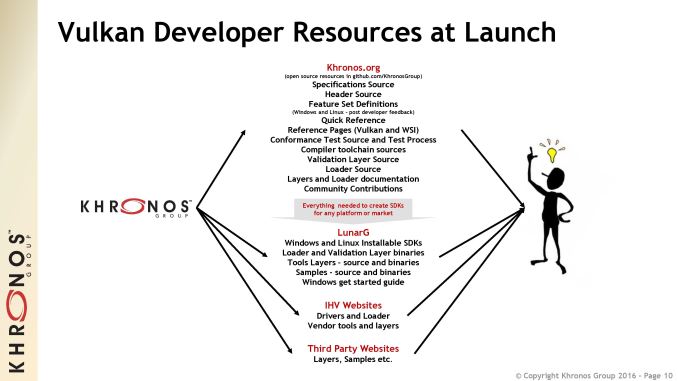
Also being released today alongside Vulkan drivers will be Vulkan software as well. Croteam has previously announced that they have been developing a Vulkan rendering path for their puzzle-em-up game The Talos Principle, and Khronos tells us that a version of the game with beta Vulkan support will be released today, giving everyone something to test Vulkan against. Croteam does note however that the Vulkan rendering path should be considered a proof of concept demonstration to showcase that Vulkan words, and indeed The Talos Principle is not a game known for pushing a lot of draw calls or using rendering techniques that would greatly benefit from Vulkan’s most potent abilities. Meanwhile though we haven’t heard of confirmed release dates, there have been several Vulkan demos showcased over the last year from hardware and benchmark developers alike, including Intel, Valve, Basemark, and Kishonti. So The Talos Principle may not be the only Vulkan software release today. Developers – SDKs and Documentation Available NowFinally, on the development side of matters, today’s hard launch will also include tools for developers to begin writing games against the final specification. Khronos for their part has a slew of resources, including documentation, references, and the source code for their validation and loader tools for debugging.
Meanwhile LunarG, the Valve-backed software group tasked with developing a Vulkan SDK, will be releasing their SDK for Windows and Linux. The LunarG SDK will include a complete set of tools for Vulkan development, including the necessary validation layer, debugging tools, and trace and replay tools.
At the same time however Khronos has also been trying to make it clear to the press and developers alike that while Vulkan is the next generation successor to OpenGL, OpenGL itself isn’t going anywhere. Like DirectX 12, Vulkan’s transition to a low-level API will unquestionably make it harder to use, and Khronos expects that it will primarily be used by guru-level programmers. For other programmers who don’t need the abilities of Vulkan or lack the expertise to comfortably program against it, OpenGL will not be going anywhere and is still a supported multi-platform graphics API. Ultimately I think middleware is going to solve much of the developer accessibility problem – as has been the plan with DirectX since the beginning – and Khronos tells us that at this point developer feedback and involvement on Vulkan has been better than expected. It is certainly a very optimistic message going into what is the group’s first hard launch, and with GDC 2015 taking place next month, it will be interesting to see what attendance is like at the planned developer events.
Gallery: Vulkan 1.0 Specificaiton Released
      | ||||||||||||||||||||||||||||||||||||||||||||||||||||||||||||||||||||||||||||||||||
| 1:00p | Price Check: Intel’s Unlocked Skylake Processors for Desktops Are Getting More Affordable
Due to unprecedented demand, Intel’s latest Skylake processors with unlocked multiplier were significantly overpriced late last year. However, it would seem that more units are coming into retail as the popular Core i7-6700K and Core i5-6600K CPUs are becoming more readily available from multiple stores. As a result, actual retail prices of the chips have dropped in the U.S. retail in the recent weeks. Nonetheless, the most powerful Skylake-S is still listed above its suggested retail price. Supply of Skylake-S Seems To Getting BetterIntel’s top-of-the-range processor for mainstream enthusiasts (before they make the step up to HEDT platforms), the Core i7-6700K (four cores with Hyper-Threading, 4.0 GHz/4.20 GHz, 8 MB cache, Intel HD Graphics 530 core, unlocked multiplier), has an MSRP of $350 according to Intel’s ARK. About six weeks ago, this processor in the US cost more than $420 at some stores, and was frequently in and out of stock of the biggest retailers.
However, this seems to be changing. Amazon currently (2/14) lists the Core i7-6700K for $365 but the chip is not in stock. According to CamelCamelCamel, a price-tracker that monitors Amazon and its partners, the Core i7-6700K was available from Amazon for $365 earlier this week, marking a significant shift in price. PriceZombie, which monitors Newegg, reports that the CPU is in stock and can be purchased for $412. According to NowInStock, the Core i7-6700K is available from multiple retailers but its price remains rather high (e.g., $395 – $412).
The Intel Core i5-6600K (four cores, 3.50 GHz/3.90 GHz, 6 MB cache, Intel HD Graphics 530, unlocked multiplier) is another chip in high demand by enthusiasts. The official price of the boxed version of the CPU is $243, but it was up to $290 in December. At present, both Amazon (CamelCamelCamel) and Newegg (PriceZombie) sell the part for $249 (2/14). Moreover, the Core i5-6600K CPU is readily available from a number of major retailers in the U.S., according to NowInStock.
As it appears, the availability of Intel’s Skylake-S microprocessors has improved since December and it is possible to get all the latest chips from Intel. The Core i7-6700K remains overpriced, it is still more expensive than the Core i7-5820K high-end desktop processor (six cores with Hyper-Threading, 3.30GHz/3.60 GHz, 15 MB cache, unlocked multiplier), which can be purchased for $379 – $385 in the U.S. Since the difference between the i7-6700K and the i7-5820K is now miniscule, for many people it makes no sense to invest in a HEDT platform, which involves purchase of an expensive Intel X99 motherboard and at least four memory modules.
Intel Boosts Shipments of 14nm ChipsAccording to Intel, starting from November, half of its client chips were made using 14 nm fabrication technology, which was a big breakthrough since the latest manufacturing process was a tough nut to crack for the chip giant. Intel had to delay mass production of its 14 nm CPUs from late 2013 to the second half of 2014 due to defect densities. The ramp up of mass production may mean that the defect densities are getting lower. “As of November, 14nm products made up more than 50% of the client computing volume,” said Brian Krzanich, chief executive of Intel, during the Q4 2015 Earnings Conference Call with investors and financial analysts.
Starting from the third quarter of fiscal 2015, Intel has been using its Fab 24 manufacturing facility in Leixlip, Ireland, to produce its chips using 14 nm fabrication process. Earlier Intel produced its chips using this technology only in its D1D, D1C and D1X fabs in Hillsboro, Oregon. As Intel ramps up production at Fab 24, shipments of its latest microprocessors are growing. The chip giant does not readily disclose what exactly it produces and where, so it is impossible to say for sure that supply of higher-end Skylake-S models is gradually improving because of the Fab 24 ramp, although given what we do know it seems more than likely. Nonetheless, it is evident that supply of Intel’s unlocked processors has gotten better, just like the share of Broadwell and Skylake CPUs has gotten higher in Intel’s shipments. At present Intel offers various 14 nm chips, including processors for desktops and laptops featuring Broadwell and Skylake micro-architectures, SoCs for tablets and notebooks based on Skylake and Airmont micro-architectures and so on. The company also plans to start shipments of its new Xeon processors featuring Broadwell-EP cores (as well as new Broadwell-E HEDT offerings) in the first half of the year. Intel: Demand for Core i7 Sets RecordsIt is interesting to note that demand for higher-end Core i7 and unlocked processors set a record in fiscal year 2015, according to Intel. Strong demand for CPUs for gamers and overclockers partly explains deficit of Intel’s unlocked Skylake-S chips late last year. “For the year, high-end Core i7 microprocessors and our K SKUs for gaming, both set all-time volume records, leading to our rich product mix,” Mr. Krzanich told investors and analysts. If demand for high-end SKUs is so high, it is not surprising that Intel is allegedly trying to limit overclocking to its Core i7 Extreme (HEDT) as well as Core i7/i5-K product lineups. There is simply no need for the company to enable overclocking for lower-end models if users are eager to buy higher-end parts. Unfortunately, it is also evident that demand for the high-end Core i7-6700K is still high enough to drive the price up at the retailer. Relevant ReadingSkylake-K Review: Core i7-6700K and Core i5-6600K - CPU Review | ||||||||||||||||||||||||||||||||||||||||||||||||||||||||||||||||||||||||||||||||||









| << Previous Day |
2016/02/16 [Calendar] |
Next Day >> |