[Most Recent Entries] [Calendar View]
Thursday, February 18th, 2016
| Time | Event | ||||||||||||||||||||||||||||||||||||||||||||||||||||||||
| 7:30a | SanDisk Ultra +Cloud 64GB + 64GB Flash Drive Review USB flash drives (UFDs) are a dime a dozen in the current market. In order to stand out in the crowd, manufacturers have adopted a two-pronged approach. While one category is devoted to drives that provide maximum possible capacity in a minimal footprint, the other category aims at delivering the maximum possible performance at a reasonable cost. Usually, UFDs are worth a capsule review, since there is really not much to talk about other than performance / endurance and price. However, SanDisk has opted to go with a third strategy for one of their UFD product lines - bundling a 3-year cloud storage subscription along with a commodity USB 3.0 flash drive. Priced at $30, SanDisk's Ultra +Cloud 64GB (local) + 64GB (cloud) seems like a no-brainer purchase. This review will analyze various aspects of the cloud storage component and also go into the performance of the flash drive itself. | ||||||||||||||||||||||||||||||||||||||||||||||||||||||||
| 8:00a | Seagate Begins to Ship 2.5-Inch, 7mm Thick 2 TB Mobile Hard Drives with SMR
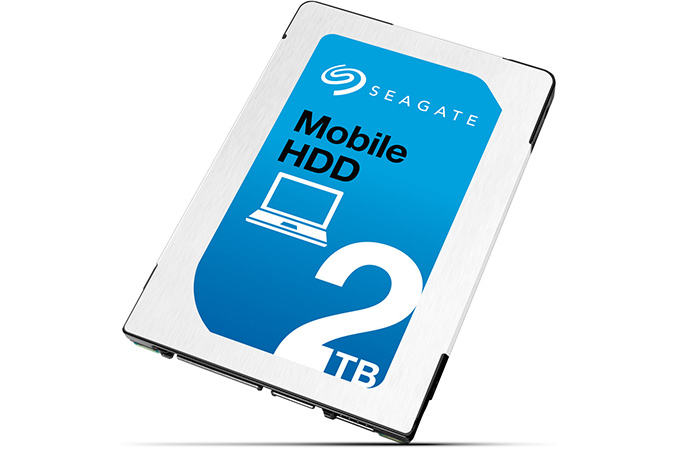
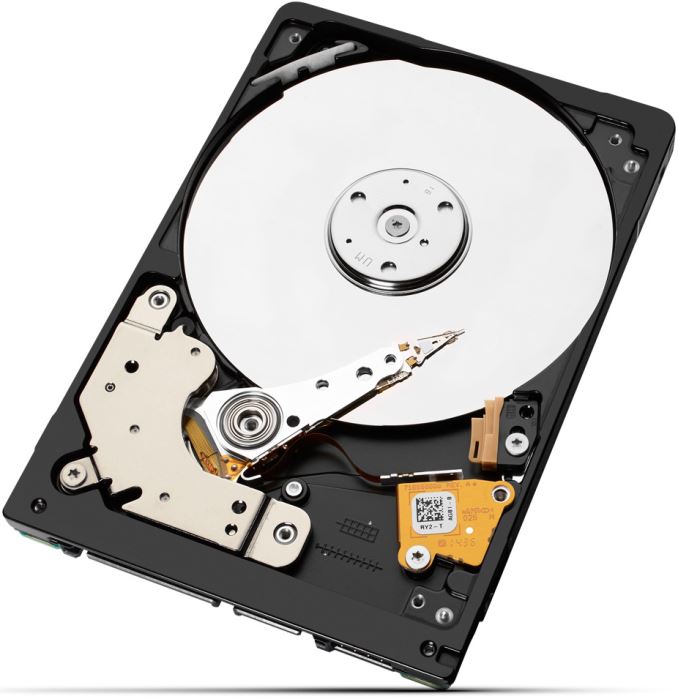
Seagate has started to ship its highest-capacity hard drives for notebooks. The new HDDs use shingled magnetic recording (SMR) technology with very high areal density as well as slimmed-down mechanics. The new Seagate Mobile HDD 2 TB is the first hard drive to market in a 2.5-inch/7 mm form-factor with such extreme capacity. The hard drive is based on two 1 TB SMR platters running at 5400 RPM and features 128 MB of cache as well as SATA interface. The maximum sustainable transfer rate of the HDD is 100 MB/s, which is considerably lower than that of mainstream mobile hard drives (145 – 169 MB/s for Seagate’s own laptop HDDs). Seagate declares 13 ms average seek time for the hard drives. The new HDD weighs 3.17 oz (or 90 grams) and is aimed primarily at mobile computers or bulk cold storage, where you can arguably fit eight drives into a single 5.25-inch bay. Supermicro has an 88-bay 4U rack unit where each drive is hotswappable, though that fits a large PC in the rear; if hot-swappable isn't required, we could be looking at nearly 200+ per storage 4U rack with appropriate backplanes. Three sets of drives will be on offer, in 1TB and 2TB models:
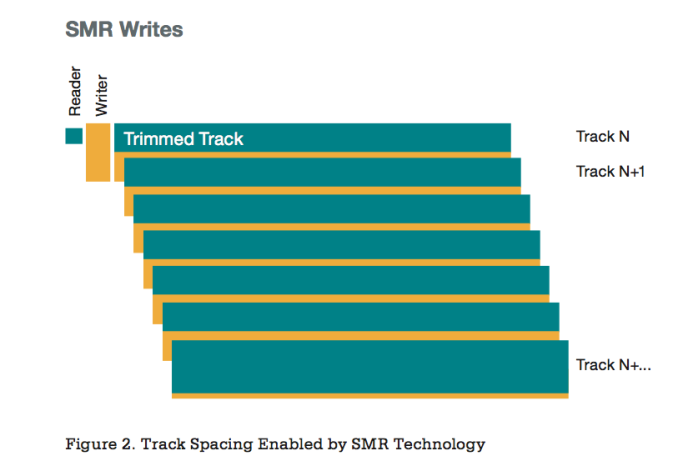
The SMR technology enables areal densities higher than 1 Tbit per square inch, but at the cost of performance. HDDs featuring shingled recording write new magnetic tracks that overlap part of the previously written tracks, which may slowdown writing since the architecture requires HDDs to rewrite adjacent tracks after any writing operation. In order to “hide” such peculiarities of SMR, Seagate has developed special firmware that ensures optimal writing performance. Part of the reason why Seagate installs a massive 128 MB cache on a 2 TB HDD is because the firmware needs it to store data from tracks that have to be overwritten. Alternatively, it is required to alter operating systems and software, which is not economically feasible.
Usage of SMR technology is justified in environments that are used to archive cold data that is not updated frequently because write performance of such HDDs may be rather slow. Client PCs both read and record data and it remains to be seen whether performance offered by SMR-based client HDDs will be sufficient for the end-user. The Seagate Mobile HDD 2 TB is around 60% slower than the Seagate Laptop HDD 2 TB based on maximum sustainable transfer rate. Seagate did not disclose whether SMR platters used inside the Mobile HDD 2 TB are made in-house, or by Showa Denko K.K. (SDK), the world’s largest independent producer of hard drive platters. In addition to SMR technology, Seagate used its new mechanics, including new head, preamp, channel and other mechanisms for the Mobile HDD 2 TB HDD. Slimmed down mechanical components allowed Seagate to integrate two platters into a 7 mm hard drive. Seagate did not reveal any information concerning pricing of its new HDDs. While the product is unique because of its form-factor and capacity, its performance is lower compared to other HDDs. It will be very interesting to see how Seagate prices its new HDD, given its pros and cons. Related ReadingSeagate to Ship 5TB HDD in 2014 using SMR - Brief SMR Overview | ||||||||||||||||||||||||||||||||||||||||||||||||||||||||
| 10:00a | AMD and the Associated Press Team Up for Experimental 360° Video & VR News Channel
This week AMD and Associated Press have announced a new collaborative project designed to fuel virtual reality journalism. Under the agreement, AP has created a special channel with 360° video and VR content, whereas AMD will provide the news agency appropriate hardware and software tools to create the content. The partnership could bring virtual reality closer to the masses. The Associated Press news agency was established in 1846 by five newspapers from New York in a bid to share their costs of news coverage of the Mexican-American war. While AP is primarily known for its standards of accuracy, neutrality, and integrity, the organization was an early adopter of multiple emerging technologies to distribute news content. In 1899, the AP used radio to transmit the results of the America’s Cup yacht race; in 1935 the AP established the WirePhoto network, which transmitted news photographs over telephone lines; in the late 1980s, the AP helped to refine Kodak’s first digital cameras and began their usage; in 2006 the organization was among the first major news-outlets to join YouTube. Today, AP believes that 360° video and VR technologies could be the next big thing in journalism.
This week AP opened up its new 360° Videos and Virtual Reality channel to demonstrate what is possible to do using new technologies that essentially put viewers in the middle of the action, allowing them to experience an event from inside despite of physical barriers. By producing 360° and VR content, AP journalists will learn how to better use the new technologies and whether it makes sense to use them at all. At present, the web site only contains 360° 2D videos and images that can be viewed using a compatible browser, a smartphone, or a VR headset with the help of the Ryot app (for Android or iOS). Eventually, AP’s 360° Videos and Virtual Reality channel will get 3D VR content developed and post-processed using AMD’s LiquidVR software development environment as well as Radeon or FirePro graphics cards. The channel itself is highly experimental, hence, content will be available across multiple platforms ranging from the Samsung Gear VR to the Oculus Rift and the HTC Vive. Right now, AP does not set any technical standards for its 360° videos and VR channel; there are no minimum requirements for resolution, level of details and so on. Many pieces of content will be available on all major platforms, but some will be limited to fully-fledged VR headsets (e.g., the Oculus Rift and the HTC Vive). For AMD, AP’s 360° Videos and Virtual Reality channel is a way to promote its LiquidVR software as well as GCN GPUs. In addition, AMD will learn through real-world field testing how good its technologies are for VR content creation. If the channel becomes popular among early adopters of virtual reality headsets or among those, who will watch 360° videos using their mobile devices, AMD’s Radeon brand will gain some additional recognition. 360° video and VR technologies for news reporting and documentaries could useful on some occasions. For example, when you need to show excitement of the crowd at a major sport, political or product launch event. However, in many cases typical photos will just do their job for the vast majority of people. Moreover, if we are talking about VR for the masses, we need to keep in mind motion sickness sometimes caused by contemporary VR headsets, which is something that will limit adoption of the technology in general. Finally, in their announcement the AP notes that their editors will have complete control over the editorial content presented via the new virtual reality channel, which means that we could see very creative way of using 360° video and VR technologies for journalism. Medium is a major thing in story telling. The VR360 channel from AP might just show whether virtual reality is the medium for next-generation journalism or not. | ||||||||||||||||||||||||||||||||||||||||||||||||||||||||
| 11:59a | GIGABYTE Unveils New 990FX and 970-Gaming Motherboards for AMD FX
In the past week, GIGABYTE has introduced two new high-end motherboards for AMD FX microprocessors. The new platforms belong to GIGABYTE’s premium Gaming G1 product lineup and include the latest storage/IO technologies like USB 3.1 and M.2, but also upgraded components and advanced overclocking capabilities. Despite formal positioning, the new mainboards are pretty affordable. AMD introduced the 32nm AMD FX processors, code-named Vishera and based on the Piledriver microarchitecture, back in late 2012. In 2013, the company released its FX 9000-series CPUs with increased clock-rates and TDP of up to 220 W designed for overclockers. To support the launch of ultra-high-end processors from AMD, makers of motherboards released their new platforms featuring enthusiast-class feature-set as well as robust voltage regulating modules (VRMs). Since then, AMD’s AM3+ platform has been ticking along while AMD has focused on the APU market. Because AMD’s current-gen chipsets for the FX processors were developed in 2009 – 2011, they do not natively support some of the latest standards such as PCIe 3.0, but aim to feature USB 3.1 and M.2 via PCIe lane based controllers. As a result, it can be a minefield when choosing motherboards for AMD FX processors that have up-to-date functionality. Even though there are new processors incoming from AMD over the next year, the company is not giving up its current FX platform just now and a number of its motherboard partners are releasing new models with current-generation features.
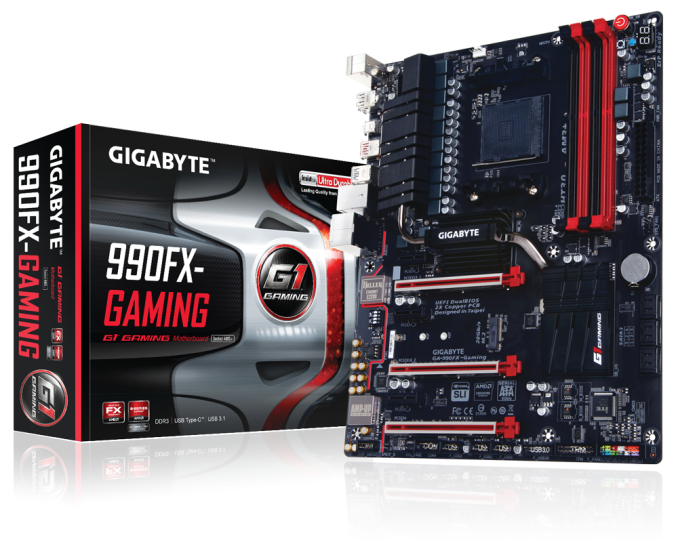
GIGABYTE decided to release not one, but two premium mainboards for AMD’s AM3+ processors: the GA-990FX-Gaming and the GA-970-Gaming based on the AMD 990FX+SB950 and the AMD 970+SB950 chipsets respectively. The GIGABYTE GA-990FX-Gaming will be the company’s flagship AM3+ product that will support all AMD FX CPUs (including the FX-9590 and the FX-9370 with 220W TDP) thanks to 10-phase VRM featuring solid-state chokes and 10K capacitors. The GIGABYTE GA-970-Gaming is designed for more mainstream CPUs up to 125W. Its five-phase power delivery will not support AMD FX-9000 chips, but will satisfy demands of all the rest AM3+ and AM3 processors, including the FX, the Phenom II, the Athlon II and the Sempron 100-series chips. Both motherboards are equipped with four memory slots and support up to 32 GB of DDR3-2133 memory.
The 990FX-Gaming features two PCIe 2.0 x16 slots and supports 2-way AMD CrossFireX as well as NVIDIA SLI multi-GPU technologies. The motherboard also has one PCIe 2.0 x16 slot running in x4 mode for an additional PCIe devices as well as three PCIe x1 slots. The 970-Gaming has one PCIe 2.0 x16 slot for PCIe adapters as well as two PCIe x1 slots and two PCI slots for add-in cards. In addition, the motherboard is equipped with one PCIe 2.0 x16 slot running in x4 mode and sharing bandwidth with the M.2 connector. If both slots are populated, they will run in PCIe 2.0 x2 mode.
Each motherboard features one M.2 slot (2242/2260/2280 form-factors are supported) operating in PCIe 2.0 x2 (the GA-970-Gaming) or PCIe 2.0 x4 modes (the GA-990FX-Gaming), providing 10 Gb/s or 20 Gb/s of bandwidth to PCIe M.2 SSDs. The motherboards fully support NVMe protocol and are compatible with both AHCI as well as NVMe SSDs. Just like other contemporary mainboards, the GA-990FX-Gaming and the GA-970-Gaming come with six SATA 6 Gbps ports for HDDs and SSDs (RAID 0, RAID 1, RAID 5, RAID 10, and JBOD are fully supported).
The mainboards are also equipped with the ASMedia ASM1142 controller that enables one USB 3.1 type-C and one USB 3.1 type-A connectors on the rear panel as well as the VIA VL805 chip that brings support for four USB 3.0 ports. AMD’s SB950 I/O controller supports up to 14 USB 2.0 ports, so, in addition to six high-speed USB implementations, there will be a plenty of ports to connect a mouse, a keyboard and other devices. Two of the ports even feature improved power circuitry to give cleaner power delivery to audio DACs if needed. In addition, the motherboards feature Rivet Networks' Killer E2201 gigabit LAN controller that can prioritize gaming traffic over other traffic in certain cases due to proprietary software. Finally, GIGABYTE installed its AMP-UP advanced audio sub-system with EM shielding and PCB separation of analog/digital signal on its new mainboards for AMD processors. The AMP-UP is based on the Realtek ALC 1150 codec as well as a TI Burr Brown NE5532 operational amplifier.
Generally speaking, the GA-990FX-Gaming and the GA-970-Gaming motherboards from GIGABYTE attempt to bring the feature-set of AMD’s FX platforms as close to that of Intel’s Skylake platforms as it can be. Due to lack of PCI Express 3.0 support and limitations of AMD’s chipsets, it is impossible to offer M.2 slots with 32 Gb/s bandwidth (required for high-end SSDs), Thunderbolt 3 and some other technologies. Nonetheless, it makes a great sense for both GIGABYTE and AMD to roll-out motherboards with up-to-date functionality now. AMD’s FX-8000 chips with four Piledriver modules have appropriate performance for their price point, but they can be competitive with feature unlocked multipliers, thus enabling easy overclocking. The AMD FX CPUs can offer rather decent levels of performance when they run at high clock-rates as well. GIGABYTE’s GA-970-Gaming is now available from Newegg for $99.99, whereas the GA-990FX-Gaming can be purchased for $139.99. Related ReadingAMD FX-8320E Review | ||||||||||||||||||||||||||||||||||||||||||||||||||||||||




| << Previous Day |
2016/02/18 [Calendar] |
Next Day >> |