[Most Recent Entries] [Calendar View]
Monday, February 29th, 2016
- Dr Ian Cutress, Host, Senior Editor (@IanCutress)
- Andrei Frumuşanu, Mobile Editor (@andreif7)
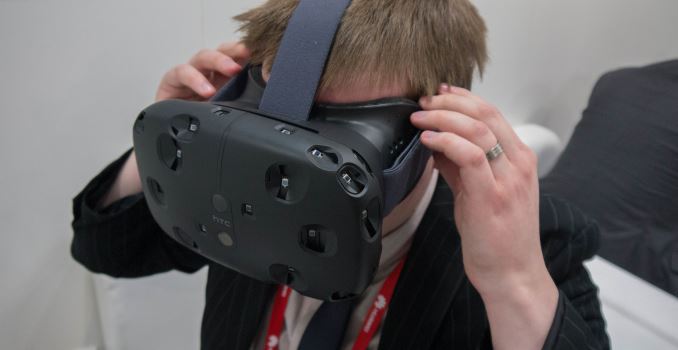
- HTC Vive head mounted display (HMD)
- Two Base Stations (for location)
- One pair of controllers
- A Link Box
- Vive Ear buds
- 10am ET
- 7am PT
- 3pm GMT (UK)
- 4pm CET
| Time | Event | ||||||||||||||||||||
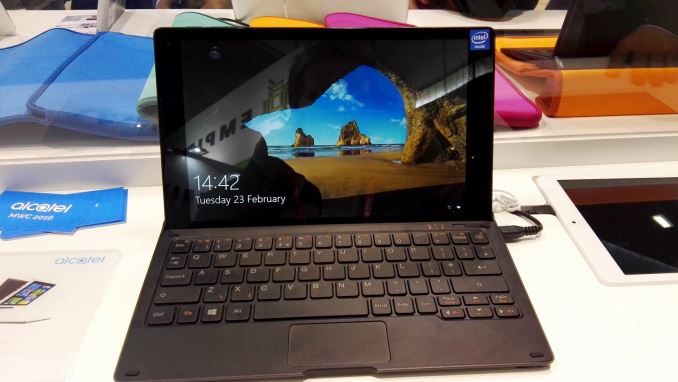
| 5:44a | MWC 2016: Hands On with Alcatel’s Plus 10, A Win10 2-in-1
Ever since OLPC tried to bring cheaper portable laptops around the world, there has been a steady stream of low level devices with one primary goal – get users online at a low price point. So while Mobile World Congress has been talking a lot about super high end devices and smartphones, alongside Alcatel’s launch of the Idol 4 and Idol 4S they are also launching the Plus 10, a new Windows 10 2-in-1 tablet.
The tablet houses the hardware – within the 10.1-inch IPS panel running at a 1280x800 resolution there is an Intel Atom x5-Z8350 SoC (quad core 14nm Cherry Trail, 1.92 GHz) with integrated HD 400 Graphics (12 EUs, 500 MHz), 2GB of DRAM, 32GB of internal storage which can be expanded via a 64GB microSD card, and a 5830 mAh battery. The tablet has some minor IO: USB, micro-USB and micro-HDMI, but the keyboard gets a full-sized USB Type-A and a couple of other ports. The keyboard also adds another 2590 mAh battery, but the whole unit is Cat 4 LTE capable, supporting up to 150 Mbps, and the keyboard can act as a mobile hotspot for up to 15 users.
We were able to get some hands on time with the device, and despite the fact that none of the keyboards seemed to work when installed, it came across as an easy to use tablet. Obviously touch on Windows isn’t the best experience without dedicated software, but the screen seemed bright enough when head-on and if the keyboard worked it could make an easy working experience. Because the device is a 2-in-1, the tablet and keyboard detach – the tablet can face either direction, making it easy for the keyboard to face away and act as a stand.
Another issue was when closing the tablet into the keyboard – because of the rigid lip on the keyboard end where the two connected, there wasn’t a good connection. Andrei pointed out that one magnet was weak (perhaps it was a demo model) but it went beyond that, it was clear that the two parts didn’t even line up, and I doubt they would stay together when being carried like a 2-in-1 is normally carried.
One thing worth noting in our examination is the use of 32-bit Windows 10. This might go some way of explaining the 2GB DRAM installed (most likely single channel as well), but might have repercussions for software compatibility and performance. The Wi-Fi module wasn’t listed in the official press release, but we found it listed in the system manager as the Realtek RTL8723BS, which is an 802.11n part which is limited to single stream 1T1R 2.4 GHz operation, making it a very cheap option to use.
We were told that the device will retail for around 259-269 Euros, which makes it a sizable and interesting upgrade from something like the HP Stream 11 series of clamshell devices, albeit with a few obvious flaws (at least on these units). I have a feeling these might end up in an educational context as one of the primary markets, alongside sales to end-users. | ||||||||||||||||||||
| 7:00a | The AnandTech Podcast, Episode 36: Mobile World Congress 2016, Snapdragon 820 and Exynos 8890
AnandTech Podcast #36: The annual smartphone extravaganza known as Mobile World Congress has come and gone. We clocked up 45.4km on foot during the week, averaging around five hours sleep and one meal a day to be able to see everyone of interest. Because so many interesting things were presented, from LG, Samsung, Huawei, Xiaomi and others, just before we left Barcelona Andrei and I put together a podcast of details, experience and analysis of the new devices. There are plenty of talking points with each of them, from a modular design to heatpipes to new silicon microarchitectures, and we recorded our initial impressions in a podcast.
The AnandTech Podcast - Episode 36
| ||||||||||||||||||||
| 8:00a | The Huawei Honor 5X Review: Mid-Range Meets Maturity Late last year Huawei introduced the Honor 5X, a phone branded and sold under their Honor sub brand for their home Chinese market. A few months later, the company announced that it would be the first Honor branded smartphone to launch in the United States, and we were first given access to the phone during Honor's launch event in Las Vegas. With the Honor 5X the company is hoping to bring a great smartphone experience with capable specifications to a relatively low $199 price point, delivering a phone at the tail-end of the mid-range category that should be able to punch above its weight. | ||||||||||||||||||||
| 9:00a | HTC Vive Preorder Available In An Hour: Now with Tilt Brush, Regional Pricing
A quick news post for anyone following the HTC Vive announcements: as we reported back at MWC, the official pricing and timing for pre-orders was announced. For your $799 on February 29th at 10am EST, you get the following:
As part of the package, two titles were also announced as being bundled: Job Simulator (the demo of which I still remember vividly as trying managed to microwave steak and wine) and Fantastic Contraption. As of yesterday, HTC announced that Google’s Tilt Brush will also be a part of the pre-order bundle for a limited time. Tilt Brush is the VR equivalent of MS Paint, that initial drawing platform allowing users to create, but this time in a full 3D environment. The pre-order time is set to go green in about an hour: The listed $799 price last week was the US pricing, without tax. HTC has announced regional pricing as well:
Credit card purchases will use a hold on the funds, whereas Paypal transactions will be processed immediately. Shipping beings April 5th, indicating that pre-orders will be first come, first serve, limited to one per customer. The link to preorder will be www.htcvive.com – we have not heard if there is limited preorder units, or if it will be ‘as we build them, they will be shipped’. | ||||||||||||||||||||
| 11:59a | FreeSync-over-HDMI: Samsung Launches 1800R Curved FHD Monitors in the CF591 and CF390
One of the big things to come out of Computex last year was our exclusive preview of a new project by AMD: being able to bring variable refresh rate technology through HDMI rather than via the more traditional method, DisplayPort. At the time, the demo seemed limited to a single monitor using a custom protocol between the standard GPU and a Realtek TCON with custom firmware to enable it. HDMI by default does not support the commands for a variable refresh rate, but the custom protocol additions made it possible with AMD wanting to move the standard in order to do so. At the time we were told that AMD wasn’t looking to produce the monitors needed to drive it, but wanted to open the standard up so any monitor manufacturer. In December, AMD announced that several manufacturers had stepped up to the plate, including Samsung, LG and Acer, with Samsung seeming to commit to more retail models than the others. Today’s announcement is a culmination of that effort.
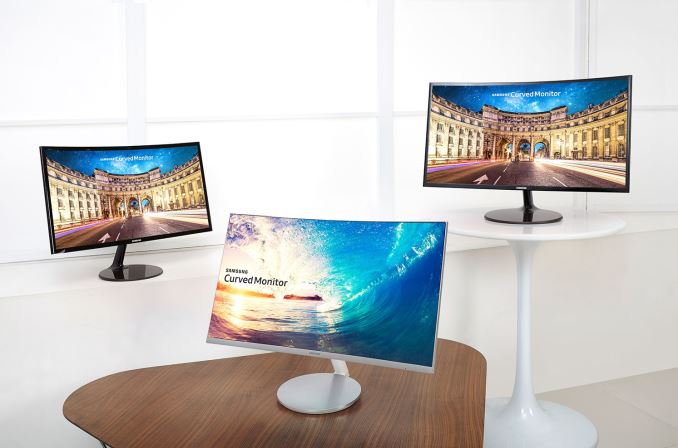
The CF390 (23.5-inch and 27-inch) and CF591 (27-inch only) are two panels that differ primarily in screen size and IO capabilities, but offer a couple of distinct features: FreeSync-over-HDMI support and an 1800R curve. This means that the circle that defines the curvature of the panel has a radius of 1800 mm (70.866 inches), which is much tighter than other panels on the market (2700R or 3000R typical). These panels are a mix of high quality and FHD resolution, promoting a 3000:1 contrast ratio and 119% sRGB coverage on the CF591 models.
The monitors will also come with specific gaming modes, which adjusts picture conditions depending on the light/dark areas of content as well as attempting to minimize stuttering and tearing. This is alongside Samsung’s Eye Saver Mode, which reduces blue color intensity, and various flicker-free functionality. The VA panels use a circular stand, they support 16.7 million colors (8-bit per channel), and have a rated brightness of 250 nits. The CF591 27-inch model is available in silver and white, whereas the CF390 models are black/glossy only. The CF591 also has DisplayPort, two HDMI 1.4 ports, D-Sub and audio in, whereas the CF390 models are solely D-Sub and HDMI. No word if either monitor has additional USB functionality. These new monitors will be available in the US, Europe and Asia in March, with other regions coming in April. They require an AMD variable refresh rate capable graphics card to enable the mode. Currently Samsung has the refresh rate listed as '60 Hz', not stating the Freesync minimum or maximum refresh rates supported. We're looking into this, as well as intended MSRPs and will update if we get additional information. As an interesting talking point, while the technical demo about FreeSync-over-HDMI was a poignant part of our Computex coverage, it needed that impetus from the panel manufacturers. When it works, it clearly is a value-add to certain models, without requiring DisplayPort or additional hardware as is the case of G-Sync. Ultimately the variable refresh rate technology market felt (subjectively) limited by the DisplayPort limitation, mainly because so many panels were already HDMI and HDMI has essentially become the in-home standard (whether that’s 1.4 or 2.0). Now that FreeSync has been ported over, assuming it all works out of the box and can be easily ported depending on controller firmware or the panel, it has the potential to become one of the dominant variable refresh rate implementations; especially if prices can reach parity with non variable refresh rate displays, meaning the only link in the chain is the GPU supporting the standard. With these curved panels, clearly they’re not casual purchases for sure, but it shows the technology moving in this direction. We expect to see more panels released this year with FreeSync-over-HDMI, and it will be interesting to see what markets the monitors will be focusing on. Source: Samsung (via The Tech Report) Related Reading New HP Laptops to Feature AMD FreeSync |







| << Previous Day |
2016/02/29 [Calendar] |
Next Day >> |