[Most Recent Entries] [Calendar View]
Wednesday, March 9th, 2016
| Time | Event | |||||||||||||||||||||||||||||||||
| 6:00a | Seagate Announces PCIe x16 SSD Capable Of 10GB/s
At the Open Compute Project Summit this week in San Jose, Seagate will show off a pair of upcoming enterprise NVMe SSDs with impressive throughput specifications. The drives will have PCIe x16 and x8 interfaces and provide maximum throughput of 10GB/s and 6.7GB/s respectively. Seagate has provided few details so far, but it's safe to say those numbers are peak sequential read speeds. The big question is what controllers are used in these drives. Most NVMe SSD controllers support at most 4 PCIe lanes, with the notable exceptions being PMC-Sierra's 8-lane controllers. Seagate does have an internal development team with SandForce, but it's highly unlikely they've been able to develop such a large controller so soon. And these new Seagate SSDs are probably not based on unannounced third-party controllers. This means the 16-lane SSD from Seagate is almost certainly a multi-controller solution with an on-board PCIe switch, which is now common for top of the line enterprise PCIe SSDs. A 10GB/s read speed suggests that the 16-lane drive is most likely based on four of Seagate's Nytro XM1440 M.2 SSDs, which advertise 2.5GB/s read speed for capacities of at least 800GB and use a Marvell controller. Seagate's blog shows CAD renderings that seem consistent with a layout of four Nytro XM1440 M.2 drives on one card, but the requisite PCIe switch chip isn't shown.
Seagate claims that the 10GB/s speed of the 16-lane drive is 4GB/s faster than any competing drive. If Seagate's new drive is a single-controller solution then that's a fair comparison and an impressive accomplishment, but there are already multi-drive products on the market offering RAID0 speeds well in excess of 6GB/s. HP's Z Turbo Drive Quad Pro is a PCIe x16 card that provides connectivity and cooling for up to four M.2 PCIe SSDs. When ordered as part of a workstation it can be configured with four Samsung SM951 SSDs to provide an advertised 9GB/s sequential read speed, though when sold separately it only comes populated with two M.2 SSDs. Meanwhile the 8-lane drive is probably not based on two 4-lane controllers, despite it being the most obvious solution. Most products based on a single controller from Intel, Samsung, Marvell or Phison with a PCIe 3.0 x4 link advertise maximum read speeds of 2.2–2.8GB/s, so providing 6.7GB/s from just two controllers would require 20% higher performance than any PCIe 3.0 x4 NVMe controller has attained. Instead, the PCIe x8 SSD Seagate is announcing is probably another four Marvell controller design that is limited in sequential speeds by the overhead of the drive's PCIe switch and the upstream PCIe link. The 1M IOPS claimed for the 8-lane drive is slightly higher than four times the rating for a single XM1440, but some capacities of the 2.5" XF1440 offer enough IOPS. The thermal constraints of the M.2 form factor compared to 2.5" drives and add-in cards with large heatsinks account for the discrepancy in IOPS rating. According to Seagate the 8-lane drive will offer some cost and power savings over the 16-lane drive, and it's not hard to imagine that it could also allow servers to a larger total capacity for the same number of PCIe lanes.
Seagate's blog shows a rendering of the 8-lane card with the same heatsink layout as their Nytro XP series flash accelerator cards that use a RAID of SandForce SATA controllers to provide up to 4GB/s sequential read speeds. There's a good chance this is just a placeholder illustration, as Seagate says the 8-lane drive is still being finalized. Both drives are intended for the Open Compute Project (OCP) hardware ecosystem founded by Facebook and now also supported by a variety of major companies in cloud computing, telecom, networking, and finance. The Open Compute Project focuses on datacenter hardware and infrastructure, with members contributing specifications and designs that are more detailed than industry standards like the ATX form factor. Seagate says their new drives will comply with OCP specifications, but the specific standards haven't been identified. Potentially relevant standards include a specification for thermal monitoring of PCIe add-in cards and a specification for M.2 SSDs that sets standards for things like minimum performance, the conditions under which thermal throttling is permitted, maximum power consumption and mandatory eDrive encryption support. Based on the assumption that both drives are rougly equivalent to four Nytro XM1440 drives plus a PCIe switch chip, peak power consumption will probably be at least 29W for the 8-lane drive and could be nearly 40W for the 16-lane drive. Seagate describes the PCIe x16 drive as production-ready but the 8-lane drive is still being finalized. Samples of each have been made available to Seagate's customers and the full product launch is planned for summer of 2016. Capacities have not been announced but are likely to start at 3.2TB or 3.84TB for the highest-performing models. | |||||||||||||||||||||||||||||||||
| 9:00a | An AnandTech Round Table with ASUS: 10 Years of the Republic of Gamers Earlier this year before CES 2016, we approached ASUS with an idea: as the Republic of Gamers brand is now in its 10th year of operation, we wanted to get together and discuss the feeling and utility of ROG a decade on, record it, have a question and answer session from our readers, and publish the video. The Republic of Gamers brand from ASUS has been difficult to ignore, both from an engineering perspective when it comes to motherboards and graphics cards, but also the origin story, integration with users, and the expansion out to many different product lines. I felt it was important to hear from the source, and see what makes the mind tick of some of the integral cogs behind the ROG experience. For long time AnandTech readers, you will know that very few people in this industry stay in one position – in recent times, Dustin has moved to Corsair, Vivek now works with Razer, and Anand works at Apple. I started as Senior Motherboard Editor back in 2011, when my predecessor Rajinder Gill took a position within ASUS’ technical team. His predecessor, Gary Key, is also with ASUS and currently sits as Director of Marketing for ASUS USA.
At the time when Gary, Raja and Kris Boughton (another former motherboard editor for AnandTech) were probing the original models, Vivian was one of their direct ASUS contacts, ensuring that direct line of communication and filling them in on the details. Then when Gary joined ASUS, Raja had Gary as his main contact, and so on, meaning that for this discussion we have the ASUS-AnandTech contact line right from the initial ROG launch. Between the AnandTech motherboard reviewing staff, we have covered the Republic of Gamers brand from its inception, with both Gary and Raja now involved in various levels with members of the team that designs, develops, tests and pushes the ROG ecosystem, then managing the perception of it as part of the ASUS brand within North America. If we look back at AnandTech’s content history, the deep dives from both Gary and Raja into those products are still insights into motherboard design and complexity. They are certainly worth a read several years on, along with Kris Boughton’s reviews, who worked alongside Gary in 07/08. For those interested, here’s every ROG motherboard we’ve ever tested: 07-2007: ASUS ROG at Computex – Gary Key You may remember we interviewed Dr Albert Chang, Senior Division Director of ASUS Motherboard Business Unit Research and Development back in 2014 about the general path for motherboard design, and how the ROG team is designed to be that skunkworks element of engineering. Raja assists ROG’s internal impromptu extreme overclocking events with top overclockers as well as community management, so we picked his brains on how design ideas from the forums and events assist product design. As a result of the ASUS ROG push, we end up meeting with ASUS frequently at events (much like other companies), but a round table was a great chance to get a decade of AnandTech Senior Motherboard Editors in front of the camera with Vivien Lien, the CMO of ASUS USA who was part of the team that supplied the first set of ROG motherboards we tested to AnandTech. We also posted an open Q&A pipeline, inviting questions from readers. I took the best part of a dozen of those questions for the round table. Audio only download: MP3 Timestamps MM:SS00:06 – Intro | |||||||||||||||||||||||||||||||||
| 8:15p | OWC Introduces SSD Upgrade for MacBook Pro and MacBook Air PCIe SSDs
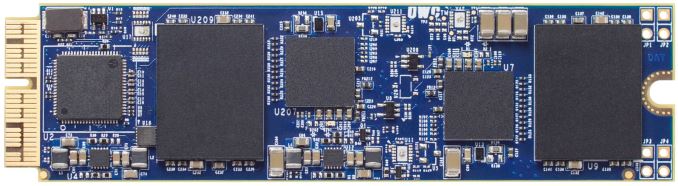
Apple's Retina MacBook Pro and all but the earliest MacBook Air models have relied solely on SSDs for internal storage, as Apple slimmed down the designs to the point that even a 1.8" hard drive was too bulky. Rather than adopt the mSATA or later M.2 form factor, Apple's SSDs have used custom form factors and pinouts. This has contributed to keeping the market for third-party upgrades very small. Only a few companies have produced SSDs in Apple-specific form factors, most notably Other World Computing (OWC) and Transcend. Transcend has generally used Silicon Motion controllers while OWC has used SandForce controllers, but until now their offerings have been limited to SATA-based SSDs. Apple migrated their notebook SSDs to PCIe-based interfaces in 2013 and has been using drives supplied by Toshiba, SanDisk, and Samsung. OWC has finally devised a compatible replacement and released it as part of their Aura SSD product line. Like the Apple originals, the OWC Aura PCIe SSD uses the AHCI protocol; Apple so far only supports and uses NVMe on the Retina MacBook that doesn't have a removable SSD. The requirement to use AHCI instead of NVMe limited OWC's choices for SSD controller. While Apple is a big enough customer to convince Samsung to make the SM951 in a custom form factor, OWC is not. Marvell has shipped several AHCI-compatible PCIe SSD controllers, but their typical business model is to sell just the controller and leave it up to the customer to write their own firmware or license from a third party, either of which is a substantial up-front expense. In order to keep costs under control, OWC has opted to not use a native PCIe SSD controller. Instead, the PCIe Aura SSD uses a Marvell 9230 SATA RAID controller and a pair of Silicon Motion SM2256 SATA SSD controllers. The Marvell 9230 has a PCIe 2.0 x2 host interface, so the PCIe Aura SSD has the potential to outperform SATA SSDs but won't be able to approach the peak transfer rates of the recent Samsung SM951-based Apple originals. The Silicon Motion SM2256 controllers mean the PCIe Aura SSD is almost certainly using TLC flash, which is less expensive but also performs worse and draws more power than MLC flash. The PCIe Aura SSD's RAID design unfortunately does not support passing through TRIM commands nor retrieving SMART information from the individual SSD controllers.
Based on OWC's measurements of the first PCIe SSDs Apple used back in 2013, the Aura SSD's peak performance is slightly better than the slowest 128GB SanDisk/Marvell drive, but without TRIM the Aura's write performance advantage could easily disappear over time. That leaves the PCIe Aura SSD with capacity as its only strong selling point. The MacBook Air can be configured with up to 512GB of storage from Apple, but the Aura SSD can provide up to 960GB. Many Apple customers are put off by the steep price of build-to-order SSD upgrades: $200 to upgrade from 128GB to 256GB, another $300 to move up to 512GB, and another $500 to move up to 1TB for the MacBook Pro. At $347.99 for 480GB and $597.99 for 960GB, OWC's Aura manages to be both much cheaper than Apple's SSD upgrades and much more expensive than single-controller drives with a standard form factor. The Aura SSD is sold either as a bare drive or an upgrade kit that includes the necessary screwdrivers to install the SSD and a USB 3.0 enclosure to facilitate data migration. The drive is expected to start shipping in late March. | |||||||||||||||||||||||||||||||||







| << Previous Day |
2016/03/09 [Calendar] |
Next Day >> |