[Most Recent Entries] [Calendar View]
Friday, May 13th, 2016
| Time | Event | ||||||||||||||||||||||||||||||||||
| 3:30p | Philips Begins to Sell 43” 4K IPS BDM4350UC Display for $799
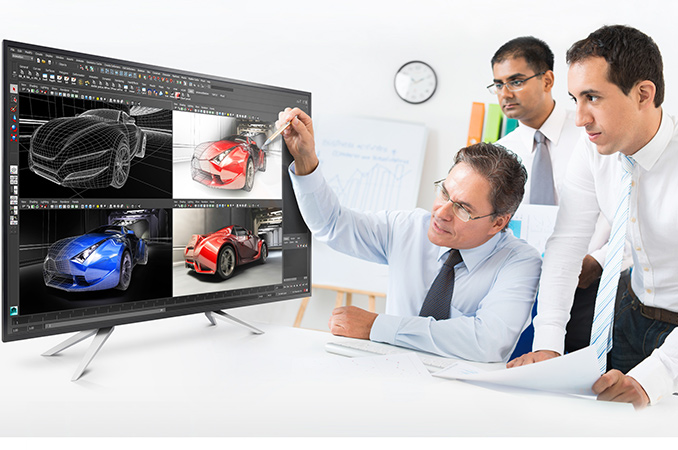
For many workloads that require a lot of on-screen space, big displays are hugely beneficial — the bigger the better. TPV Technology, the company that produces monitors under Philips brand, recently decided to go very big and introduced a new 43" display with a 3840 x 2160 resolution. While the monitor is intended mostly for prosumer workloads, its price is not too high. Extremely large displays are generally overkill for everyday workloads, but there are industries where the workloads require more on-screen space than a single monitor can provide. For example, many engineers and financial brokers use multi-display setups to maximize their productivity and view far more info than they could on a single display. While it is impractical to substitute four, six or eight displays in control rooms or in traders’ offices with fewer physical screens, engineers and designers could use one big monitor instead of two smaller ones. Philips is targeting this group of users with its Brilliance UltraClear 43” display, which is more like a television than a monitor.
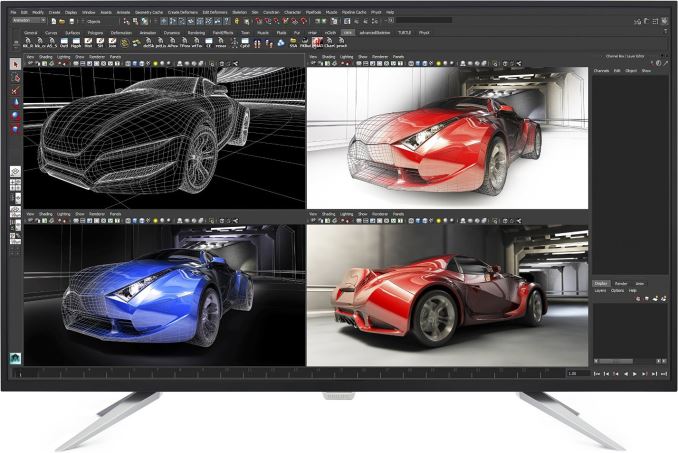
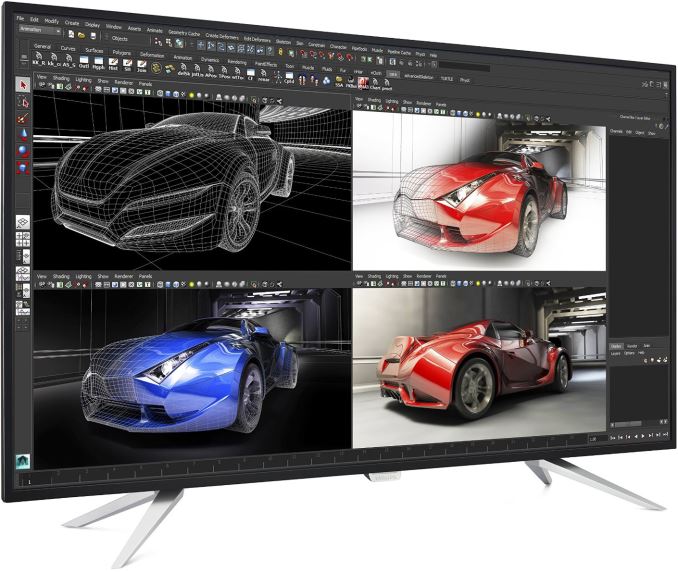
The Philips UltraClear 43” (BDM4350UC) display uses an IPS panel with a 3840 × 2160 resolution and W-LED backlighting. It has a 300 nit brightness, a 1200:1 contrast ratio, and a 60 Hz refresh rate. According to Philips, the brightness uniformity is 96~105%, which is quite good for a display of this size. Philips also includes a uniformity feature called Smart Uniformity to correct inconsistencies in the backlighting, but it's not clear how well it works in the real world or what limitations it imposes on the display modes that can be used.
The UltraClear 43” comes with two HDMI 2.0 ports with MHL support, two DisplayPort 1.2 ports, and a D-Sub connector. The monitor can be connected to up to four video sources and display images from them in picture-by-picture mode. The display is also equipped with a quad-port USB 3.0 hub as well as two 7W speakers. Just like TVs, the Philips UltraClear 43” comes with a stand that does not allow adjustment of tilt or height, which is a drawback. Fortunately, the monitor has a VESA mount, so, it should be possible to get an appropriate arm or aftermarket stand that does support this, although it will need to be able to support the display's mass and size.
It remains to be seen whether there's a sizable market for the UltraClear 43”, but for tasks like editing spreadsheets and CAD work it could be quite useful. Right now the Philips UltraClear 43” is available on Amazon for $799.99. | ||||||||||||||||||||||||||||||||||
| 6:00p | QNAP Expands Thunderbolt NAS / DAS Lineup with TVS-x82T Series
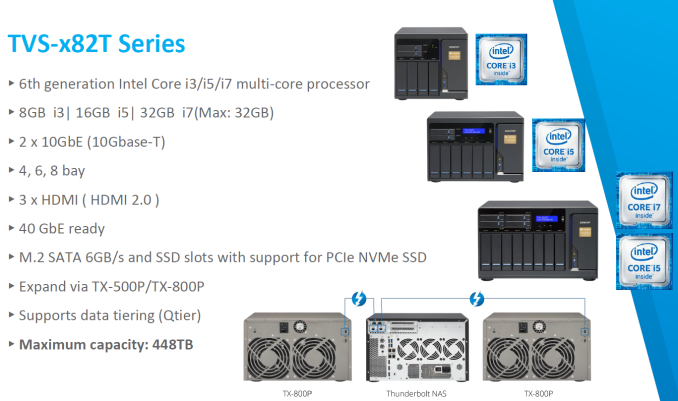
QNAP recently held a product launch event in San Jose. The main announcement was the follow-up to their TVS-871T released late last year. The first generation Thunderbolt NAS came with eight 3.5" drive slots, 16GB of RAM, two Thunderbolt 2 ports and two 10GBASE-T ports. Despite being priced at $2800 (Haswell Core i5 configuration) and $3200 (Haswell Core i7 configuration), QNAP noted that it was popular enough to expand the lineup with more models. The popularity stems from the fact that creative professionals dealing with multimedia content often deal with Thunderbolt DAS units for fast access to data. However, those DAS units are typically not amenable to shared workflows. This is where a NAS / DAS combination like the TVS-871T has been able to make an impact. Thunderbolt networking support means that multiple PCs can access the NAS / DAS at high speed, while the network links can be used by other non-performance sensitive clients to access the data. The new TVS-x82T series comes in three different varieties, the TVS-682T, TVS-882T and TVS-1282T. They have 4, 6 and 8 3.5" drive bays respectively. The 4- and 6-bay units have two additional 2.5" drive slots, while the 8-bay unit has four additional 2.5" drive slots. The 6- and 8-bay units have LCD screens in the front panel. As the slide below shows, the models come with three HDMI ports (2x HDMI 1.4 + 1x HDMI 2.0), and have two M.2 SSD slots on the motherboard. The TVS-1282T also has a spare PCIe 3.0 x8 slot that can be used to add a 10 GbE / 40 GbE card or NVMe SSD or a USB 3.1 Gen 2 card or even a discrete GPU (that can be used as a passthrough device for a VM running on the TVS-1282T).
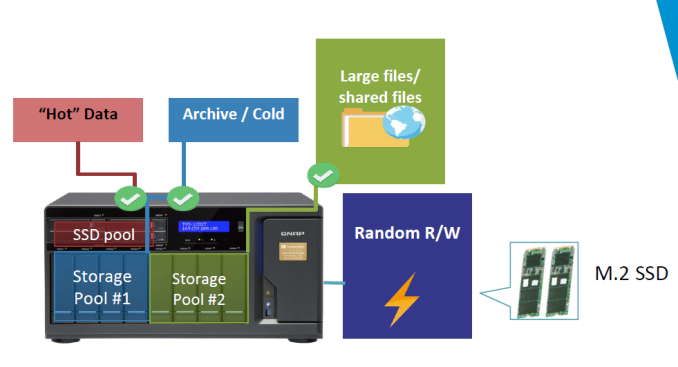
QNAP was also heavily promoting their Qtier automatic data tiering technology which helps in improving performance while also enabling archive functionality within the same NAS by using another storage pool. Thunderbolt expansion units (5-bay and 8-bay) are also available.
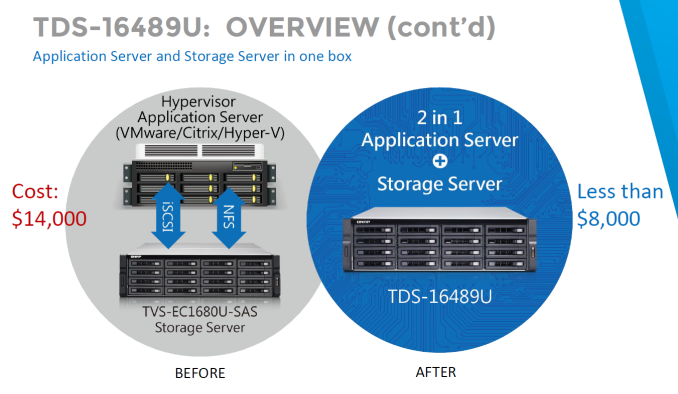
More information on the TVS-x82T models can be found on QNAP's product page here. It is interesting to note that the Thunderbolt ports are v2 and enabled by an add-on card. One of our chief complaints is the usage of Thunderbolt 2 instead of Thunderbolt 3 (which can also act as a USB 3.1 Gen 2 host / client as needed). QNAP mentioned that Thunderbolt 3 add-on cards are definitely in the pipeline, but, most current Thunderbolt users are in the Apple ecosystem. Thunderbolt 2 is the best technology currently available in those setups, and QNAP is pitching the TVS-x82T to that market currently. QNAP also had live demonstrations of the TDS-16489U (for hyperconvergence with a 2P Xeon platform that enables the application server and storage server to be one unit) and the ES1640dc dual-controller ZFS NAS.
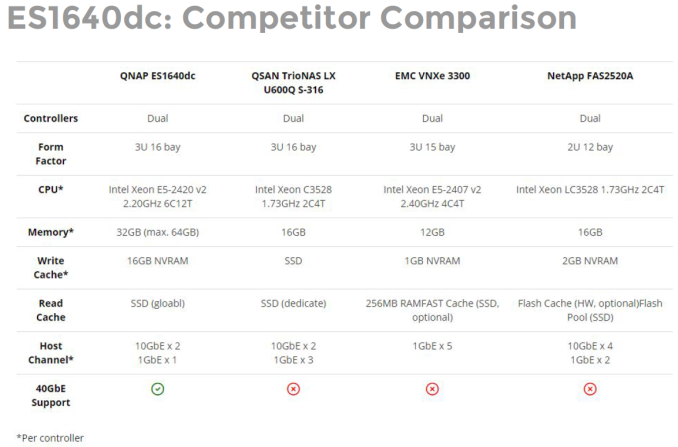
We have already looked at both these products in detail as part of our 2016 CES coverage. The new information presented at the San Jose event included availability details (mid-June for all products) and pricing for the enterprise NAS units (starting at $7700 for the TDS-16489U and $9700 for the ES1640dc). One of the striking slides that we saw as part of the ES1640dc presentation was the competitor landscape / target market for the unit.
It is great to see QNAP move up to the next level and compete with the big guys such as QSAN, EMC and NetApp in the enterprise space. As the above slide shows, the hardware configuration is very good compared to the competition and I am pretty sure the pricing is more than competitive. However, in the enterprise space, the main challenge is support requirements. Enterprise customers require service contracts that keep any hardware-related downtime to the absolute possible minimum, and the software needs to be stable and production-ready. Quality Assurance steps also need to be more stringent compared to the typical requirements in the SMB market that QNAP has been serving so far. I will be closely tracking how QNAP's aspirations in the enterprise space pan out in the long run.
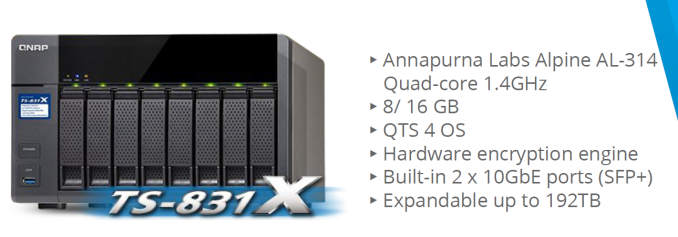
In other news, QNAP also launched the TS-831X, an ARM-based NAS with the Annapurna Labs AL314 SoC. It comes with dual 10G SFP+ ports. If that sounds familiar, the configuration is similar to the Synology DS2015xs that we reviewed last year. While the DS2015xs uses the 1.7 GHz AL-514, the TS-831X uses the 1.4 GHz AL-314 SoC. Both of them use a quad-core Cortex-A15 as the host CPU. QNAP's MSRP for the TS-831X will be $799, a lot lower than the current street price of $1400 for the Synology DS2015xs. | ||||||||||||||||||||||||||||||||||


| << Previous Day |
2016/05/13 [Calendar] |
Next Day >> |