[Most Recent Entries] [Calendar View]
Wednesday, May 25th, 2016
- HMD will become the world’s only licensee for all types of Nokia-branded mobile phones and tablets till 2016. Under the terms of the 2013 deal between Nokia and Microsoft, the former could develop Nokia-branded tablets and return to the market of smartphones in 2016. The rights for Nokia-branded tablets, feature phones and smartphones now belong to HMD.
- Nokia Technologies will take a seat on the five-seat board of directors of HMD. It will set compulsory brand requirements and performance-related provisions for all Nokia-branded products. Besides, it will also have certain controls over quality, design and features of the devices.
- HMD gets brands, cellular standard essential patent licenses in return for royalty payments to Nokia Technologies.
- HMD will invest $500 million over the next three years to support the global marketing of Nokia devices. The company hopes to get the money from its investors and profits from the acquired feature phone business (which means that the unit, which produces $30 - $60 handsets is still profitable).
- HMD and Nokia will have access to Foxconn's device manufacturing, supply chain and engineering capabilities as well as proprietary mobile technologies and components developed by the company.
- HMD will have full operational control of sales, marketing and distribution of Nokia-branded mobile phones and tablets (formally, the assets will belong to Foxconn).
- Foxconn will be exclusive manufacturer of the Nokia-branded devices.
| Time | Event | |||||||||||||||||||||||||||||||||||||||||||||||||||||||||||||||||||||||||||||||||||||||||||||||||||
| 8:00a | Toshiba Revamps OCZ Brand
Over the past few months, Toshiba has started fully assimilating & integrating OCZ, the SSD business they acquired from bankruptcy in 2014. Rather than just absorb OCZ's SSD-related assets like the Indilinx SSD controllers, Toshiba kept the business relatively intact as the independently operated subsidiary OCZ Storage Solutions. The existing product lines were updated to use Toshiba NAND and OCZ drives accounted for the bulk of Toshiba's retail and consumer SSD presence. Last year, the OCZ Trion 100 marked a shift in strategy as a Toshiba-developed drive bore OCZ branding for the first time. OCZ has continued developing their own products as well, but now the two development roadmaps are being combined, some projects have been repurposed as Toshiba products instead of OCZ products, and work is underway to reduce the overlap between the product lines. Organizationally, OCZ is being absorbed into Toshiba America Electronic Components Inc. (TAEC), though the brand and the products they develop will still be international. Later this year, TAEC will be consolidating several Silicon Valley offices onto a single campus in San Jose and their former OCZ employees will no longer work at a separate location. The public facing OCZ name will function as a consumer-only brand which now features just three products. The Trion, Vector and RevoDrive families are all that's left and the names have been shortened to just two letters, giving a lineup of TR150, VT180 and RD400. The former two are just rebadges of existing products while the RD400 is the successor and replacement for the RevoDrive 350. Older products that are still supported but not for sale are retaining their original naming. The Toshiba brand may still be applied to some consumer SSDs particularly in markets where the OCZ brand is less well-established, so the distinction between brands won't be as clear as it is for Micron and Crucial. Where the two brands do coexist in the consumer market, expect to see OCZ used as the more enthusiast-oriented brand.
In addition to renaming the SSDs, several of OCZ's other trademarks are being replaced with more mainstream and mundane names. The OCZ SSD Guru software is now the OCZ SSD Utility and the ShieldPlus Warranty is now the Advanced Warranty Program, but both are functionally equivalent. It does appear that going forward the Advanced Warranty will be offered in fewer countries (or else OCZ drives will be sold in fewer countries), but no existing warranties are being dropped. The new OCZ web site lists fewer supported legacy products than were listed at the time of the Toshiba acquisition as still eligible for the full original warranty term. OCZ has assured me that drives like the original Vector that are still within their original warranty period are still supported, so it appears that Toshiba is just trying to avoid mentioning on their site the pre-acquisition OCZ drives that used a competitor's NAND. The future of OCZ's enterprise products is less certain. Intrepid, Saber and Z-Drive products are still supported but are no longer for sale. It's likely that Toshiba hasn't entirely decided what to do with those product lines but if they reappear in some form they will be under the Toshiba brand with different names. Likewise, any OCZ enterprise SSD projects that haven't made it to market yet are now Toshiba enterprise SSD development projects. This area in particular might be more likely to see cancellations due to overlap between OCZ and Toshiba efforts, but we are unlikely to get much information about such inner workings from Toshiba. | |||||||||||||||||||||||||||||||||||||||||||||||||||||||||||||||||||||||||||||||||||||||||||||||||||
| 8:02a | The Toshiba OCZ RD400 (256GB, 512GB, 1TB) M.2 PCIe SSD Review Having recently assimilated OCZ and turned it into an enthusiast-oriented consumer brand, Toshiba has released their first M.2 PCIe SSD into the consumer market. Initially previewed by OCZ as the RevoDrive 400 and now simply the OCZ RD400, it is a high-end PCIe 3 NVMe SSD based on last year's OEM-only Toshiba XG3. | |||||||||||||||||||||||||||||||||||||||||||||||||||||||||||||||||||||||||||||||||||||||||||||||||||
| 8:30a | Nokia Is Set to Return to Smartphones and Tablets: What to Expect?
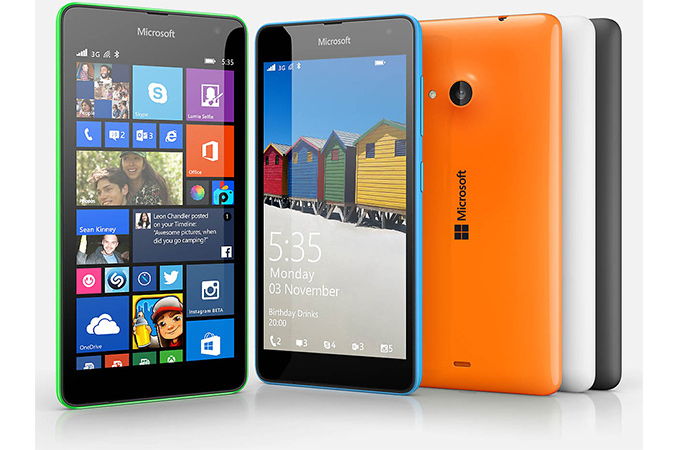
For several months now, the management of Nokia has been talking about the possible return of the brand to the smartphone market, but emphasized multiple times that the corporation itself is no longer interested in producing, or selling handsets itself. On Wednesday, the future of Nokia in the world or smartphones and tablets became more or less clear: Nokia-branded Google Android-based devices are set to return in the coming quarters. However, the upcoming products will not be developed by Nokia itself, but by a brand new company called HMD Global. Let’s try to analyze what just happened and what to expect from the “new” Nokia devices. Microsoft Departs with Feature Phone Assets for $350 MillionA little more than two years ago, Microsoft acquired Nokia’s devices and services business unit in a bid to become a sizeable supplier of smartphones and ensure that its (forthcoming) Windows 10 Mobile would be available on a top-to-bottom family of devices. Since then, the company has changed its corporate strategy, ceased to use the Nokia brand for new products, stopped development of new mainstream devices and announced plans to shrink its family of smartphones. This month the company signed an agreement to sell off its feature phone business to FIH Mobile, a subsidiary of Hon Hai/Foxconn Technology Group (we will call the company “Foxconn” onwards in this column just to make it short and simple). Separately, HMD Global, a private venture, got an exclusive global license to create Nokia-branded mobile phones and tablets for the next ten years. Microsoft will get $350 million in cash from the two companies as a result of the deal. The transactions will enable Foxconn and HMD to build and sell feature phones, smartphones, and tablets under the Nokia brand. Under the terms of the deal, Foxconn gets a manufacturing facility in Hanoi, Vietnam, which is used to manufacture Nokia-branded feature phones, but the future of the factory is unknown. Foxconn will also get customer contracts, critical supply agreements, sales and distribution assets which used to belong to Microsoft (and Nokia before that). HMD will get brands, intellectual property, and software which were previously sold to Microsoft. Moreover, after the deal is closed in the second half of 2016, about 4,500 employees will transfer to, or have the opportunity to join, Foxconn or HMD Global.
While the feature phone business does not seem to be very important for anyone right now, the acquisition of Nokia's facilities and contracts is a big deal for Foxconn. For many years, Foxconn has been trying to reduce its reliance on Apple as the primary source of its revenue. The recent acquisition of Sharp and the new deal with HMD and Nokia could help the company to improve its revenue and profitability. Microsoft will continue to develop Windows 10 Mobile and support Lumia devices, as well as Windows-based smartphones from other vendors, including Acer, Alcatel, HP, Trinity and VAIO. However the acquisition of Microsoft’s feature phones division demonstrates that the software giant has no plans to address the market of low-cost handsets with entry-level smartphones in the future. Just like Microsoft announced in 2014, the company will not pursue smartphone market share, but will focus on profitability and development of halo devices. Microsoft will likely apply its Surface tablet and Surface Book hybrid PC strategy to smartphones: it will produce flagship smartphones and rely on its partners to follow with more affordable models. The Union of ThreeFIH Mobile, HMD Global and Nokia Technologies on Wednesday (5/18) signed several agreements, which will enable the companies to jointly develop, manufacture and distribute Nokia-branded smartphones and tablets. What is interesting to note is that the agreements are negotiated in such a way that the three companies can only bring products to market if they work closely together. Take a look: In accordance with the current agreements, HMD will handle development of mobile phones and tablets running Google’s Android operating system under the control of Nokia. At present, the extent of collaboration between the two companies is not completely clear, however, it is evident that Nokia will have control over many aspects of the upcoming products. The latter part is important because Nokia knows how to build devices and which features to add. Moreover, Nokia will naturally keep its cellular standard essential patents, which is important as the world is gearing up for 5G networks. Thus, Nokia retains control over devices, gets royalty payments, but never takes any tangible risks. Foxconn will be the exclusive producer of Nokia-branded smartphones and tablets. Moreover, HMD and Nokia will use its engineering resources to develop the aforementioned devices. While this may seem a tad strange, but nowadays contract manufacturers handle a substantial amount of engineering work for their clients. As a result, Nokia and HMD will not have to R&D manufacturing basics like designs of antennas, but will be able to focus on something that matters for the next generation of phones and tablets. What Is HMD Global?Speaking of HMD Global: one of the questions curious readers might have asked us is what is HMD Global? From what we have researched, this is now a private company which has just spent tens of millions of dollars buying feature phones brands and IP from Microsoft and planning to invest another $500 million in Nokia devices over the next three years. HMD Global is based in Helsinki, Finland, not far away from Nokia, which is based in Espoo. The CEO of HMD is Arto Nummela, a veteran from Nokia, who worked there for 20 years from 1994 to 2014 and oversaw development of smartphones, product roadmaps, and strategic decisions. The president of HMD is Florian Seiche, another industry veteran, who used to work at Orange, HTC and Nokia, where he oversaw their businesses in EMEA. Right now, both executives of HMD Global work at Microsoft in the feature phone division. It is important that both share the same “old Nokia” culture, they know requirements of end-users and carriers and they know how to manufacture handsets. However, there is another name which cannot be ignored. The domain name hmdglobal.com was registered on April 11, 2016, by Jean-Francois Baril. Mr. Baril is a former senior vice president and chief procurement officer of Nokia, who worked at the company from 1999 to 2012. An interesting thing from his biography is that prior to Nokia he worked as sourcing director at Compaq under the direct leadership of Tim Cook. With this background in his arsenal, Mr. Baril can definitely attract investors to his projects. According to Reuters, HMD Global is owned by Smart Connect LP, a private equity fund run by Jean-Francois Baril. In addition to Smart Connect LP, the former Nokia exec also manages Ginko Ventures and Connecting Partners SA as well as sits on the board of Vertu. “We are impressed by the experience and expertise of the HMD management team and are committed to supporting them with our manufacturing, technology, and supply chain capabilities, to capture market opportunities together in the future,” said Vincent Tong, chairman of FIH Mobile. Feature Phones to Open Doors to Nokia’s SmartphonesSome of Microsoft’s feature phone assets, including production facilities and supply agreements, are not likely to be a sizeable asset for Foxconn, which is the world’s largest contract maker of electronics and has its own fabs and supply contracts. The working fab in Vietnam will not hurt, though. However, assets like sales and distribution networks are hard to overestimate. These assets are something that Foxconn currently does not have and they will be instrumental in bringing Nokia devices back to the market, particularly in Asia, Africa and Europe, where the brand is still strong. Remember, Nokia’s sales organization once made the company the world’s largest supplier of mobile phones and they used to be relatively successful until Nokia’s market share collapsed as a result of the company’s decision to solely adopt Microsoft’s Windows Phone operating system.
Since feature phones are hardly popular in North America and Western Europe, appropriate sales and distribution networks in these regions might have been trimmed by Microsoft (and the software company is keeping its smartphone sales/distribution assets). It is unknown whether current sales assets there are good enough at all. In the worst-case scenario, Foxconn and/or HMD will probably need to build new teams and/or relationships in several countries, which means, to start from square one in certain areas. In any case, the vast majority of Nokia-branded products that HMD/Foxconn will offer in the second half of 2016 will be inexpensive feature phones. Therefore, for a while, the sales and distribution assets of Foxconn will naturally keep selling feature phones to their customers, who are primarily network carriers and distributors in developing countries. While Microsoft sells tens of millions of feature phones and seems to do so profitably (at least, based on this HMD press release), industry analysts from companies like Gartner and IDC predict that such devices will be rare several years from now, even in emerging markets, as smartphones come down in cost. Still, because current users of Nokia feature phones are loyal to the brand (no one, except Nokia, addressed them properly back in the days, which is why the trademark still has a strong presence in many developing countries), HMD and Foxconn will be able to capitalize on that and offer them compelling smartphones, which should be inexpensive and easy to use, in the coming years. Therefore, the "new Nokia" will have to keep selling feature phones for a while and then introduce very affordable smartphone models. Nonetheless, inexpensive smartphones for the emerging world will definitely not be the only focus of the “new Nokia”. What to Expect?While there are no doubts that it is possible to hire engineers and develop feature-rich and relatively competitive smartphones based on reference designs from companies like Qualcomm, this is not what Nokia is known for. Right now, neither of the companies will reveal any details about their future plans, but there are certain things we do know already. Besides, we can make some educated guesses.
For more than a year, the management of Nokia has been talking about its interest in returning to the smartphone market with a manufacturing partner, which would license its brand and technologies. It is hard to imagine that the company was publicly discussing its return in 2016 (after the non-compete agreement with Microsoft expired) without any ongoing R&D activities. While we do not know what Nokia has been developing internally, the important thing is to consider that projects may be in the advanced stages of completion (simply because of the timing). In fact, back in 2014 the company even released its Z Launcher user interface for Android (which was later used on its tablet that is made by Foxconn). While it is plausible to think that Nokia already has something up its sleeve, it remains to be seen whether HMD/Foxconn can bring that to market by the end of the year. The CEO of HMD implied that the company would act quickly, but naturally did not elaborate. “We will be completely focused on creating a unified range of Nokia-branded mobile phones and tablets, which we know will resonate with consumers,” said Arto Nummela. “We will work with world class manufacturing and distribution providers to move quickly and deliver what customers want.” The new range of Nokia mobile phones and tablets will be based exclusively on Google Android operating system, which is not surprising. It is logical to expect Nokia to introduce its own implementation of Android as well as exclusive programs. However, from a hardware standpoint, the first wave of Nokia-branded devices will likely use platforms developed by third parties. Some of Nokia's traditional IP remains at Microsoft: the PureView camera technology (a massive sensor with an image co-processor and a set of sophisticated algorithms that “know” how to process oversampled images), ClearBlack display technology (a set of special filters on the display that can enhance blacks) and some other important assets. Which is why HMD and Foxconn (and, perhaps, Nokia?) will have to develop new technologies for high-quality imaging and displays because both features are crucial for modern handsets, especially in a competitive mid-range market. We do not expect HMD and Foxconn to introduce custom SoCs for Nokia devices anytime soon both due to technological and financial reasons. Even though Foxconn has been adding semiconductor design capabilities into its war chest for some time now, it is unlikely that the company can produce anything comparable to Mediatek's low-cost SoCs, and as a result the software will play a critical role for the new Nokia smartphones and tablets. A good news is that Nokia plans to control certain aspects of design, performance and feature-set of the devices, which could mean exclusive technologies and capabilities. Moreover, the real fruits from Nokia’s participation in the project should emerge with the roll-out of 5G networks in 2020 – 2022. Nokia is a big contributor to the standard and it could help its partners to capitalize on it.
When the Nokia N1 tablet was launched, user reviews noticed a good build quality, performance and fine design. What they also noticed was the lack of killer features, which would have set the N1 apart from other Android-based tablets at the time. One might argue that the N1 was supposed to be inexpensive and was designed exclusively for the Chinese market, but it is important to note that the device lacked Nokia’s touch. With smartphones, Nokia used to have features like PureView, but going forward it will have to invent something else. While people are familiar with the Nokia brand, if smartphones carrying the label do not offer any breakthrough features, it will be a matter of time before HMD/Foxconn will have to engage in a price war against other smartphone vendors in a bid to gain market share. There are many technologies that HMD, Foxconn and Nokia could bring to future smartphones and tablets carrying the brand, at the end of the day Nokia has historically been a very innovative company. However, the real big questions are which market segments they plan to address and how much money they can invest. Part of the reasons why the Nokia brand has become so popular was the company’s very broad product family, which consisted of several lineups of devices targeting different types of customers (young/active, business, fashion, luxury, etc.). A similar approach may not make a lot of sense today, but they could smartly mix utility features like waterproof cases with high-performance SoCs and stylish design. While many expect the “new Nokia” to create a strong rival for Apple’s iPhone and Samsung’s Galaxy S (which they are likely to do as far as technology is concerned), this is hardly their primary concern. The companies will need to offer a lineup of compelling products to compete against suppliers like HTC, Huawei, Xiaomi and to appeal to those who currently use feature phones in what Mediatek call the 'Super-Mid' range. It would be interesting to see Nokia’s QWERTY, sliders and fashion phones in the future, although chances that this will happen are thin as this is currently a niche market. Closing ThoughtsAfter Nokia’s (and then Microsoft’s) failed attempt to popularize Microsoft’s Windows Phone, the decision to use Google’s Android for Nokia-branded devices looks positive for many loyal customers of the company (especially those, who are currently on Android), but restricts an element of differentiation. While the adoption of Android was an inevitable decision, from many points of view it is still a way for ex-Nokia executives to reinvigorate the brand and product line. The obvious challenge is that there are far too many vendors shipping proper Android-based smartphones today. Even though Nokia still has a great brand recognition, HMD/Foxconn will have a relatively short amount of time to prove that the “new Nokia” is relevant for today’s market. Moreover, it will not be easy to sell Nokia-branded devices at a hefty premium, as it used to be a decade ago.
Making predictions regarding product lineup and business performance of the “new Nokia” is relatively rough at the moment because there are far too many variables. All we do know for sure is that Nokia has been extensively working on tweaking Google’s Android for years (first for its X-series smartphones and then for the N1 tablet), whereas Foxconn is a top performer in volume production as well as sourcing of components and materials. Besides, Nokia could give HMD and Foxconn a lot if insights regarding the forthcoming 5G. Wrapping things up, it is most likely a good thing to see that the Nokia brand is back and that there are companies who are willing to create another supplier of volume and high-quality smartphones. However, it remains to be seen how good those products will actually be. We expect to certainly see some noise by Mobile World Congress in Q1 2017 | |||||||||||||||||||||||||||||||||||||||||||||||||||||||||||||||||||||||||||||||||||||||||||||||||||
| 12:01p | Market Trends Q1 2016: Shipments of SSDs Up 32.7% Year-over-Year
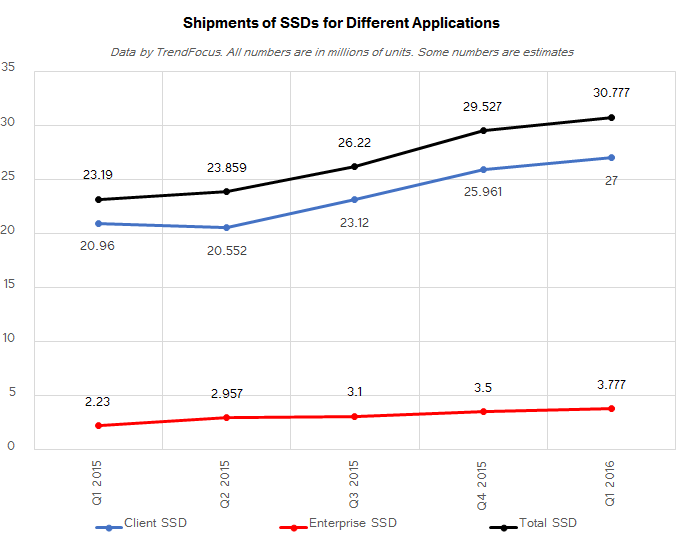
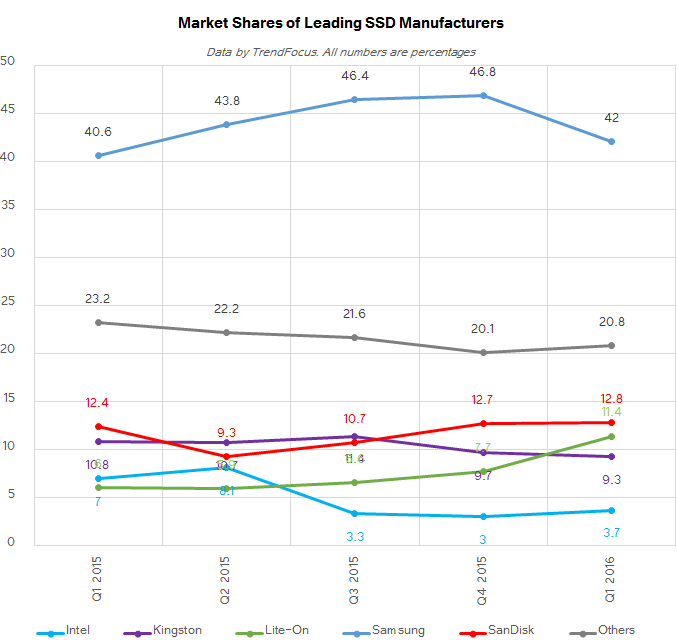
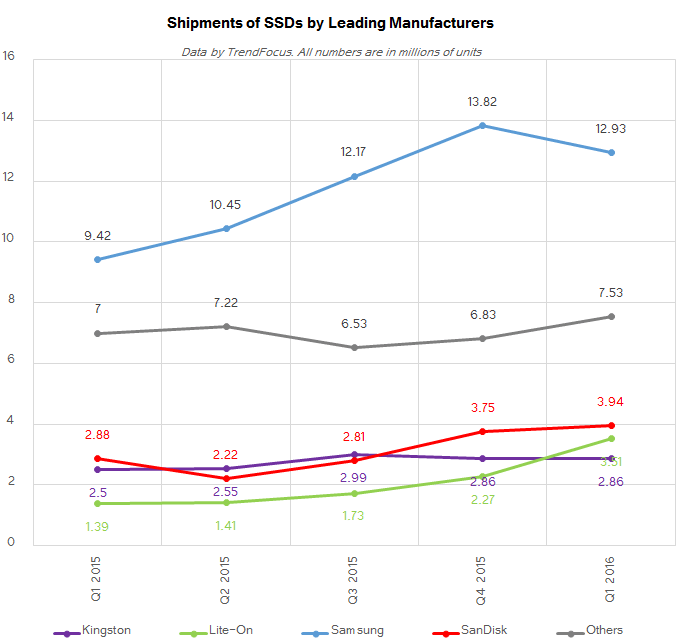
Shipments of SSDs in the first quarter of 2016 were up 32.7% compared to the same period a year ago, according to findings of TrendFocus*, a storage market tracking company. Sales of all types of SSDs, including those for client and server systems, were up sequentially and year-over-year, which indicates that NAND-based storage devices are taking share away from traditional hard drives. 30.777 Million SSDs Shipped in Q1 2016The industry sold a total of 30.777 million SSDs in Q1 2016, up 32% from 23.190 million in the same period of 2015, according to data by TrendFocus. By contrast, shipments of PCs dropped to 60.6-64.8 million units (according to Gartner and IDC), or by around 10% year-over-year (YoY); whereas shipments of HDDs collapsed by 20% YoY, based on data from hard drive manufacturers. The growth of SSDs has been consistent despite slowing sales of PCs and HDDs for several quarters now, therefore, a minor sequential increase (~4%) of their shipments in Q1 2016 was not surprising.
Of nearly 31 million SSDs sold in the first quarter, approximately 27 million drives were designed for client PCs, whereas about ~4 million were aimed at servers. In the PC space, sales of SSDs grew about 29% over the first quarter of last year, but in the enterprise space shipments of SSDs skyrocketed by 69% compared to the same period in 2015.
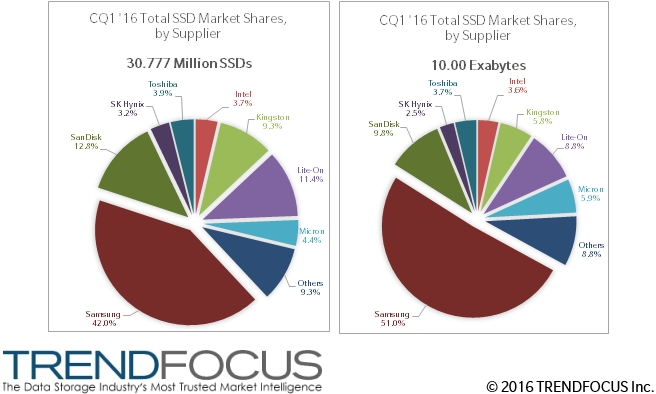
TrendFocus estimates that the total capacity of SSDs shipped in Q1 2016 was around 10 Exabytes, up from 5.65 EB in Q1 2015, an increase of nearly 77%. The average capacity of one SSD also grew from approximately 245 GB in the first quarter last year to roughly 325 GB in the first quarter of this year (or by 33%). Due to speedy development of solid-state drives, there are multiple trends, which help to speed up adoption of NAND flash storage across the whole spectrum of the market. Rapid per-GB price declines thanks to TLC NAND help to reduce prices of entry-level SSDs. As a result, 120 GB solid-state drives now cost only around $40 in retail, which is why many PC makers use them instead of HDDs. In addition, major performance improvements thanks to NVMe and new controllers are driving adoption of SSDs by high-end client computers. Samsung Remains No. 1 SSD Maker
Samsung is the world’s largest maker of NAND flash and is also the largest manufacturer of SSDs. The company has been controlling over 40% of the market for a while now and its unit shipments increased from 9.42 million in Q1 2015 to 12.93 million in Q1 2016. Samsung supplies SSDs to such large PC makers as Apple, HP and Lenovo, therefore, its success is well expected. The second largest supplier of SSDs in Q1 2016 was SanDisk, which shipped 3.94 million drives and controlled 12.8% of the market. It is noteworthy that while SanDisk and Toshiba operate the world’s largest NAND flash manufacturing complex, the latter is not a major maker of SSDs. In Q1 the company only sold 1.2 million of SSDs, whereas its market share was 3.9%. The world’s third largest supplier of SSDs in the first quarter of 2016 was Lite-On, which sells drives under Plextor and Lite-On brands. The company not only increased shipments of its SSDs from 1.39 million units in Q1 2015 to 3.51 million units in Q1 2016, or by 152% year-over-year, but also gained a significant amount of market share. In the first quarter Lite-On controlled 11.4% of the global SSD shipments. Kingston, which is the world’s No. 1 independent supplier of DRAM modules, is also a significant maker of SSDs. The last 12 months were not exactly good for Kingston in comparison to others. Unit sales of Kingston’s SSDs only increased by around 14% year over year, but its market share dropped from 10.8% in Q1 2015 to 9.3% in Q1 2016.
It is noteworthy that shipments and market shares of Intel, Micron and HGST dropped year-over-year. The reasons for that are unclear, but it is possible that the three companies focused on high-capacity enterprise-class SSDs, which is why their unit sales declined. Shipments of PCIe and SAS Enterprise SSDs Are Growing, But Unit Numbers Are Not HighWhen it comes to data-centers, multiple companies are replacing their 10K/15K HDD-based mission critical deployments with SSDs at a very rapid pace. Since one high-end enterprise SSD offers higher IOPS and throughput than multiple hard drives, volume shipments of PCIe and SAS solid-state drives are not high. In the first quarter only around 164 thousand of PCIe enterprise SSDs were shipped, whereas sales of SAS-based SSDs grew to 590 thousand units. By contrast, the industry sold 2.95 million SSDs with a SATA interface.
TrendForce believes that Samsung, Intel and HGST control the lion’s share of enterprise SSDs (approximately 80%). HGST is also a leading supplier of enterprise-class HDDs, which is why the transition from HDDs to SSDs by various owners of data-centers does not hurt the company, but rather allows it to capitalize on its SAS expertise. The Future Looks Bright for SSDsIf sales of PCs drop in Q2 2016, shipments of SSDs and HDDs will decline as well. Earlier this year Western Digital already predicted a slight decrease of the HDD TAM (total available market) in the second quarter, which is a bad news for storage market in general. On the other hand, shipments of PCs usually increase in the second half of the year, which means that not only HDDs 'should' rebound, but SSDs will have good chances to set a new record in terms of unit shipments (we say should, as various reports have mixed predictions). There are several positive trends for the solid-state storage in general. Firstly, NAND flash is getting cheaper to manufacture and companies like Intel and Micron are about to ramp up production of their 3D NAND. More affordable memory helps to build cheaper SSDs. Secondly, the share of mobile PCs that can only house SSDs is increasing as computers are getting thinner and lighter. Thirdly, Seagate no longer wants to aggressively participate in the market of affordable notebook storage. All-in-all, the future looks good SSDs, but the question is whether all market participants are ready to take advantage of the current situation. *Please note that some of the numbers mentioned in this news story were not directly revealed by TrendFocus as a part of the company’s press release on the matter, which is why we fetched them from previous announcements, or estimated based on previously released numbers by the company. If you need precise numbers for business decisions, you should acquire the full report from TrendFocus. | |||||||||||||||||||||||||||||||||||||||||||||||||||||||||||||||||||||||||||||||||||||||||||||||||||
| 2:00p | The Corsair Lapdog Review: Gaming with a Mouse and Keyboard in the Living Room Corsair clearly wants a piece of the living room gaming market, as their upcoming Bulldog barebones is a system designed with that specific purpose in mind. To that end, Corsair’s engineers designed the Lapdog, a “gaming control center” that seeks to make the use of a keyboard and mouse on a couch convenient and to keep everything tidy enough for use inside a modern living room. We are having a thorough look at Corsair's new product, paired with the K70 Mechanical Keyboard in this review. | |||||||||||||||||||||||||||||||||||||||||||||||||||||||||||||||||||||||||||||||||||||||||||||||||||
| 2:50p | Samsung Expands 750 EVO SSD Lineup with 500 GB Model, Changes Positioning
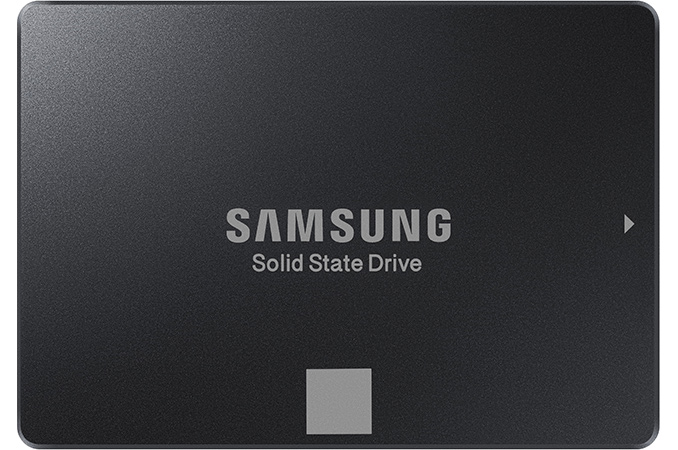
When Samsung released its 750 EVO lineup of SSDs based on planar TLC NAND flash memory earlier this year, it seemed like a big surprise, as the company was first to ramp up production of 3D NAND memory and to use it for SSDs. Apparently, Samsung not only decided to expand the lineup with a 500 GB model, but also to make such drives available worldwide and even change their positioning. Earlier this year Samsung introduced its 750 EVO drives with 120 GB (MZ-750120BW) and 250 GB (MZ-750250BW) capacities, which are based on simplified version of the company’s MGX controller with only two cores and TLC NAND chips produced using 16 nm fabrication process. The drives are equipped with 256 MB of DRAM cache, AES-256 encryption, and support various performance improving technologies typically found in TLC-based SSDs, such as pseudo-SLC cache and so on. Samsung’s 750 EVO 500 GB drive (MZ-750500BW) is based on the company’s 16 nm TLC NAND and offers similar levels of performance as already released SSDs — up to 540 MB/s sequential read and up to 520 MB/s sequential write speed. Besides, the higher-capacity version is rated for 100 TB total bytes written (TBW) endurance.
Initially, Samsung positioned its 750 EVO SSDs as inexpensive solutions primarily designed for system builders in select markets, but with the addition of a 500 GB model into the family, the company also changes positioning of the lineup. Starting from early June, the 750 EVO family of SSDs will be offered in 50 countries, including the U.S., Europe, China, Korea, and other regions. Moreover, the drives will be marketed not only to system builders, but also to end-users. The 750 EVO SSDs are positioned just below the V-NAND-based 850 EVO and replace the discontinued 840 EVO, which faced writing performance degradation scandal and caused some troubles for Samsung. Despite formal positioning, performance levels of the 750 EVO are very similar to those offered by the 850 EVO drives. However, endurance of the planar TLC-based drives is unsurprisingly somewhat lower compared to the 850 EVO (which uses 3D V-NAND). Besides, the more advanced drives also come with a five-year warranty. The 750 EVO 500 GB’s MSRP is $149.99 and the drive is covered with a three-year warranty (or 100 TB TBW). By contrast, the 120 GB version costs $54.98, whereas the 250 GB model is priced at $83.99 at Amazon. | |||||||||||||||||||||||||||||||||||||||||||||||||||||||||||||||||||||||||||||||||||||||||||||||||||
| 4:45p | Microsoft Streamlines Its Smartphone Business Again, Lays Off 1850 People
Microsoft on Wednesday announced another reorganization of its smartphone business with plans to streamline operations and eliminate redundant personnel. The company will lay off 1850 of its employees in Finland and other countries and will take a $950 million charge. The actions seem to be in line with Microsoft’s plans to focus on development of flagship smartphones and leave the market of mass handsets. When Microsoft closed its acquisition of Nokia in late April, 2014, it received approximately 25,000 new employees from around the world, who were involved into development, production, sales, and distribution of smartphones and feature phones. Shortly after, in July, 2014, Microsoft laid off 12,500 former Nokia staff as a part of its major reorganization, when it let go 18,000 Microsoft employees in total. The first wave of dismissals eradicated numerous positions at Nokia and shut down the division, which developed software for feature phones, leading to eventual elimination of Asha devices from Microsoft’s lineup. A year after the company announced the first phase of streamlining, the software giant revealed further plans for phone business restructuring. In July, 2015, Microsoft decided take an impairment charge of approximately $7.6 billion related to assets associated with the acquisition of the Nokia Devices and Services business, and take a restructuring charge of approximately $750 million to $850 million. As part of its second phase of optimizations, the company laid off another 7,800 former Nokia employees globally. Besides, Microsoft announced their intentions to focus on flagship smartphones and generally to phase out inexpensive handsets going forward. Today’s announcement further eliminates 1350 jobs in Finland as well as 500 additional jobs globally. The actions are to be fully completed by July, 2017, and will cost Microsoft approximately $200 million related to severance payments. Microsoft further noted that sales teams based in Espoo, Finland, will not be affected by the layoffs.
As a result of its optimizations of the handset business, by mid-2017 Microsoft will have eliminated approximately 21,650 former Nokia employees out of the iniitlal ~25,000 who joined Microsoft in 2014. Moreover, as 4,500 former Nokia staff are set to join FIH Mobile or HMD Global in the coming months, it means that by mid-2017 the absolute majority of the former Nokia employees will be gone from Microsoft. Microsoft did not reveal any new plans concerning its smartphones going forward, but repeated what it said in 2015: the company will concentrate on flagship models and will support its traditional hardware partners with development of their smartphones featuring Windows 10 Mobile. The software giant sees security, manageability and Continuum feature as its key strengths on the smartphone market going forward, which essentially indicates that the company sees enterprises as the main customers for its handsets. Microsoft did not mention its PureView camera and other consumer focused assets it got from Nokia as its unique advantages to address consumers, which may indicate that the company no longer considers consumers as its main customers in the smartphone world.
“We are focusing our phone efforts where we have differentiation — with enterprises that value security, manageability and our Continuum capability, and consumers who value the same,” said Satya Nadella, chief executive officer of Microsoft. “We will continue to innovate across devices and on our cloud services across all mobile platforms.” What the head of Microsoft did mention is that the company will continue to offer cloud-based services to all mobile platforms. Again, this is not something new as it emphasizes Satya Nadella’s cloud approach to mobile and his reluctance to fight against Apple, Google and Samsung in the world of mobile platforms and mobile hardware. | |||||||||||||||||||||||||||||||||||||||||||||||||||||||||||||||||||||||||||||||||||||||||||||||||||







| << Previous Day |
2016/05/25 [Calendar] |
Next Day >> |