[Most Recent Entries] [Calendar View]
Friday, May 27th, 2016
- ROG Maximus VIII Formula
- Maximus VIII Hero
- ROG Maximus VIII Extreme/Assembly
- ROG Maximus VIII Hero Alpha
- Maximus VIII Impact
- Maximus VIII Extreme
- Maximus VIII Ranger
- Maximus VIII Gene
| Time | Event | |||||||||||||||||||||||||||||||||||||
| 7:30a | Corsair's Bulldog PC Barebone for the Living Room is now Available: $299/$399
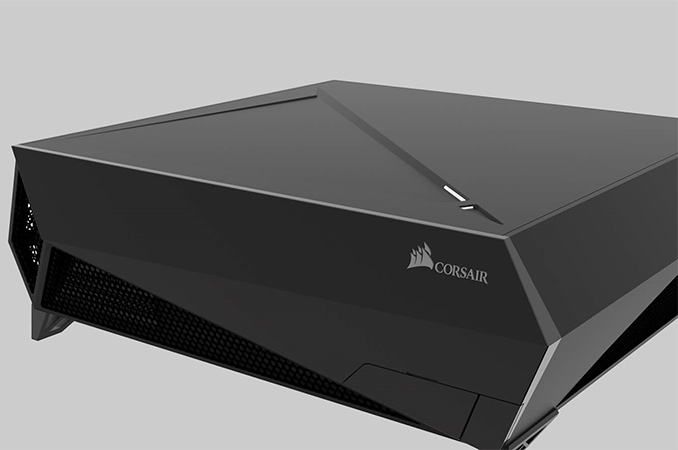
Many PC and chassis makers these days are trying to address console gamers with computers that are as small as game consoles and fit into the living room design-wise, but which are considerably more powerful and can run games at ultra-high resolutions. When Corsair announced its plans to enter this market with its Bulldog concept a year ago, it was not exactly a big surprise: a company with expertise in cooling and PC chassis is arguably the best possible candidate to offer such kind of products. Even though some chassis designs seem to churn out over weeks, Corsair has taken over a year and a half to bring the final product to the market. This week, Corsair finally started to sell the Bulldog chassis and barebones in North America and Australia. Corsair equips its Bulldog case with its H5 SF low-profile liquid cooler, which was specifically designed for mini-ITX systems and which performance is sufficient for all mainstream CPUs from Intel and AMD, its SF600 SFX PSU as well as two fans. The Bulldog case can house a mini-ITX motherboard, a full-height graphics card (which is not longer than 300 mm and is not thicker than 90 mm), a 3.5” HDD, up to three 2.5” storage devices, multiple fans as well as an SFX power supply. The price of the Bulldog chassis (CS-9000003-NA) is $299, just like Corsair promised a year ago.
The internal architecture of the Corsair Bulldog allows installing modern high-performance graphics cards, such as NVIDIA’s reference GeForce GTX 1080 with blowers. However, due to thermal constraints, Corsair recommends using its own H55 liquid cooling system with the HG10 bracket to cool-down GPUs, or install the AMD Radeon R9 Fury X or graphics cards with pre-equipped hybrid cooling. Corsair also offers the Bulldog DIY PC barebone with pre-installed GIGABYTE GA-Z170N-WIFI motherboard. The GA-Z170N-WIFI supports all modern Intel Skylake-S processors in LGA1151 packaging (as well as, we assume, the next Intel generation of Kaby Lake processors), up to 32 GB of DDR4 memory, an M.2 slot for high-performance SSDs, a PCIe x16 slot for graphics cards, two Gigabit Ethernet ports, 2T2R 802.11ac Wi-Fi, integrated multi-channel audio, USB 3.0 (with Type-A and Type-C connectors) ports and so on. The Bulldog barebone kit (CS-9000001-NA) is priced at $399, in line with Corsair’s original promises. In addition, select PC makers and system integrators will offer pre-configured systems featuring Corsair’s Bulldog chassis, which will cost according to their specifications.
From an aesthetics point of view, Corsair has altered the design of its Bulldog compared to the prototype. Among some other things, it eliminated red inlays to make it look less aggressive in order to blend in with home theater surroundings. The chassis has retained its futuristic look as well as the ventilation capabilities, but now it matches various players and other equipment in terms of color scheme.
Even though Corsair’s Bulldog has hit the market somewhat later than expected, it still looks very promising thanks to the emergence of new 14nm and 16nm video cards this quarter that can better handle games in 4K resolution than previous-gen graphics adapters. (Edit from Ian: I should also add a nod to Dustin Sklavos, former AnandTech editor for cases and cooling, who is the Corsair Product Manager for Bulldog and had a big hand in its design and development.) | |||||||||||||||||||||||||||||||||||||
| 9:00a | Zotac and EVGA Reveal Custom GeForce GTX 1080 Designs
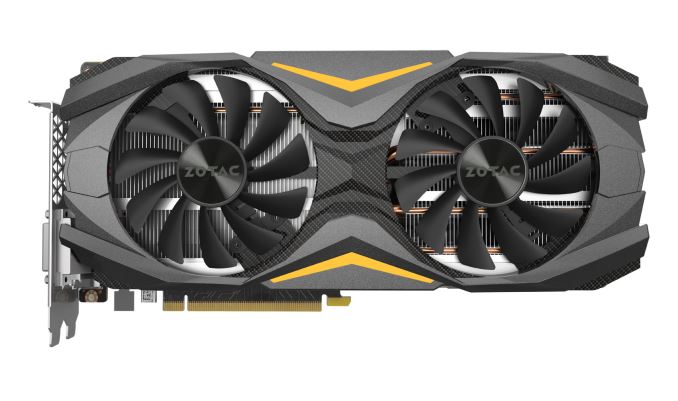
A few weeks back we saw the announcement of NVIDIA’s GeForce GTX 1080. NVIDIA put the founders cards on sale first, with third-party cards set to be released later. As we approach the sale date of the 1080 we can now lift the covers on the solutions other vendors will be releasing. Today features cards from both Zotac and EVGA. Zotac will be releasing two custom version of the GeForce GTX 1080, the GeForce GTX 1080 Amp Edition and Amp Extreme. Both cards will receive their own revision of their Icestorm cooler. The key differences between the two for the cooler is that the the AMP Edition (pictured above) sports five heatpipes and two 100mm fans, while the AMP Extreme will have six heatpipes, three 90mm fans, and those fans will have a new design aimed at reducing the dead spot in the middle of the fan. Zotac claims that on the latter this will increase airflow and reduce noise.
Speaking of noise, both cards will have a 0 dB fan idle mode that they call Freeze, which stops the fan under low load situations. Each of these cards will be wearing what Zotac calls “Carbon Exoarmor”. Featuring a full backplate, a metal fan shroud, and what appears to be carbon fiber highlights. To aid with fitting these cards in with any build these cards will feature Zotac’s all new Spectra lighting system. Meaning that these cards will have RGB LED’s on both the front and back of the card, and will be fully adjustable from the redesigned FireStorm App. Pricing and availability for these cards is not yet known. EVGA’s entry into the ring is the EVGA GeForce GTX 1080 SC Gaming ACX 3.0. What this will mean is a card that carries the third iteration of their ACX 3.0 Cooler Featuring a 0 dB fan idle mode, RGB lighting, and a load of heatsink changes. EVGA is specific on two features of this cooler including their Straight Heat Pipe 3.0 technology which they say increase heat pipe and copper contact to increase cooling. They also note a cooling plate, a.k.a. heat spreader, that sits between the PCB and the heatsink to cool memory and MOSFETs.
Worth noting for these numbers is increased base and boost clocks to the tune of about 6%. A moderate but practical difference. Aside from that we are looking at the standard memory and memory speeds. EVGA will also be releasing Precision X 6.0 to Coincide with the upcoming release. The EVGA GeForce GTX 1080 SC Gaming ACX 3.0 card will release in early June for $649.99. As the incoming hardware approaches we can look forward to learning more of what the market will bring us. Today saw the announcement of cards from Zotac and EVGA, though I’m sure we’re bound to see many more releases as summer comes upon us. Be sure to keep an eye out here in the coming weeks as review samples start to trickle in. | |||||||||||||||||||||||||||||||||||||
| 10:30a | FSP Announces Twins: 500W and 700W ATX PSU with Redundancy Capability
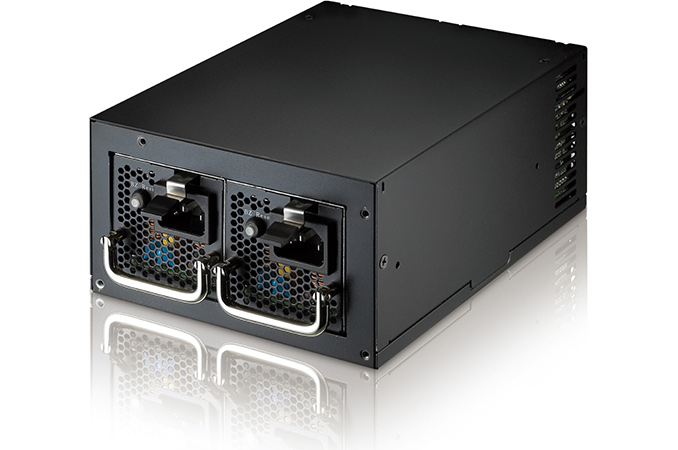
FSP this week announced its new series of redundant PSUs called the 'Twins'. The new power supplies are compatible with standard ATX and PS2 tower chassis, but provide redundancy capabilities and can thus enable building non-stop servers using 'relatively affordable' components. The manufacturer positions the FSP Twins PSUs for home and SMB mail, web and intranet servers when building in a standard ATX or PS2 tower chassis. Like other redundant power supply units, the FSP Twins houses two hot-swappable PSUs and if one fails, another immediately kicks in, ensuring that the system never stops due to power supply failure. Both PSUs can be replaced without shutting down the machine, similar to typical datacenter-class mission critical servers. The PSU modules are proprietary, and each has its own 40-mm high-pressure server-grade fan, implying they have the potential to be pretty noisy. The FSP Twins series come with special firmware and sensors that monitor over-current, short-circuit, over-voltage, or fan failure, and the special LED indicators can alarm users of any problems. Initially, FSP will offer two Twins models with 500W and 700W PSUs. The Twins will have EPS12V power connectors (one 24-pin and two 4+4-pin connectors) and will thus be able to handle dual-socket (or even multi-socket) motherboards up to the power capacity. The 500W version will feature two PCIe 6+2-pin power connectors, six SATA power connectors, two Molex plugs, one connector for floppy drives and one 8-pin USB connector to interface with monitoring software. FSP notes that all cables supplied with the Twins are flat in a bid to enable easier cable management in space-constrained chassis. The specifications of the 700W unit have not been announced as of yet.
The FSP’s Twins series is not the first attempt to wed ATX/EPS12V PSU form-factor with redundancy. However, some of the predecessors of Twins did not have enough wattage for modern servers, poor serviceability, or became EOL quite quickly for replacement components. Moreover, keep in mind that an ATX chassis is not particularly designed for a server, despite the homebrew market, which is why the market for such PSUs is relatively small. The FSP Twins 500W will cost $399, which comes across as a reasonable price for a redundant PSU module that is essentially two 500W units. The price of a 700W version is being determined, as is the individual units themselves. Both will come with a five-year limited warranty later this year. FSP will demonstrate its Twins series at the Computex Taipei 2016 trade show next week. | |||||||||||||||||||||||||||||||||||||
| 2:00p | Corsair Launches Dominator Platinum Memory Modules for ASUS ROG Systems
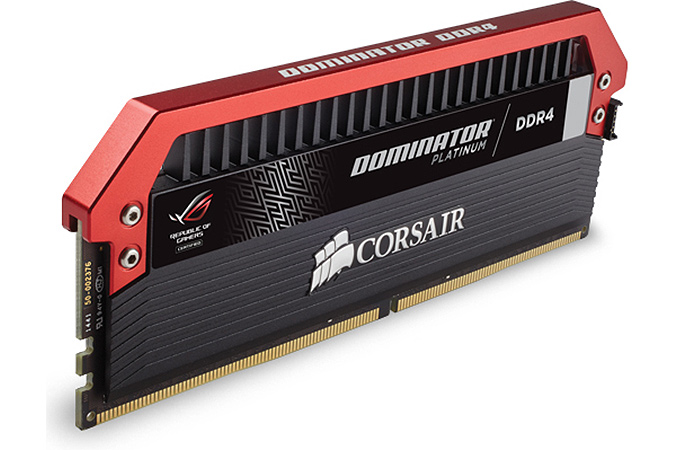
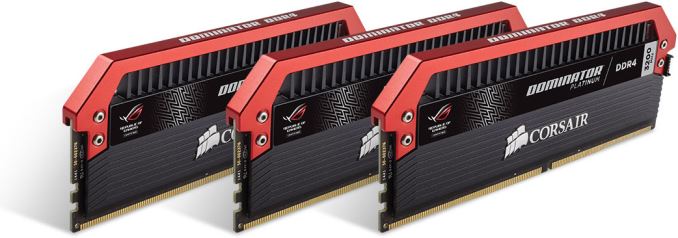
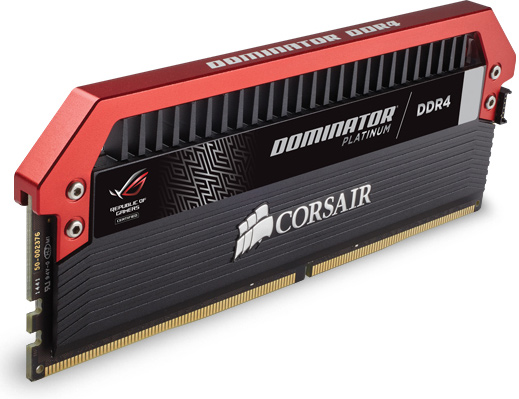
Corsair has introduced its new custom-built kit of Dominator Platinum memory modules, which are specifically designed for ASUS ROG motherboards. The new DDR4 modules contain an exclusive SPD profile, which is only available on select ASUS ROG platforms featuring Intel’s Z170 PCH (platform controller hub). The Corsair Dominator Platinum ROG Edition kit (CMD16GX4M4B3200C16-ROG) consists of four 4 GB DDR4 memory modules rated to run at 3200 Mbps data-rate with CL16 18-18-36 timings at 1.35 Volts. The modules are primarily designed for Intel’s Skylake-S processors when used in Intel’s Z170-based motherboards that support XMP 2.0 technology (to automatically set their frequencies and latencies when they are installed into appropriate PCs and the BIOS option is selected). However, when the Dominator Platinum ROG Edition kit is installed into one of ASUS ROG motherboards featuring the Z170 chipset, it allows setting 3333 Mbps data-rate and CL16 timings.
The Dominator Platinum ROG Edition modules are based on binned DRAM chips as well as Corsair’s proprietary 10-layer PCB with internal cooling planes as well as external thermal pads. For improved cooling and visual aesthetics, the modules come with aluminum heat-spreaders and customizable LED lighting. The memory sticks also feature famous Republic of Gamers red and black brushed aluminium finish, to compliment the current-generation ASUS ROG line of motherboards. As for the price, the Corsair Dominator Platinum ROG Edition kit represents a premium, much like other DDR4-3200+ kits. The set of four ROG-branded modules costs $224.99 excluding taxes in the U.S., which is considerably higher than the price of any other 16 GB DDR4-3333 kit. The Dominator Platinum ROG Edition kit is also more expensive than Corsair’s own Dominator Platinum 16 GB DDR4-3200 CL15 (4 x 4 GB kit), which is priced at $189.99. Possibly, an exclusive SPD setting, custom-painted heatsinks as well as elite Republic of Gamers brand add a tangible amount of money to the price tag, but is aimed squarely at users with specific ROG motherboards.
The list of compatible motherboards looks as follows: | |||||||||||||||||||||||||||||||||||||




| << Previous Day |
2016/05/27 [Calendar] |
Next Day >> |