[Most Recent Entries] [Calendar View]
Monday, June 13th, 2016
- VM cache allocation (the ability for a supported hypervisor to mark a VM as high priority or partition cache as needed for QoS),
- New memory bandwidth monitoring tools,
- New frequency/power management tools to reduce frequency adjustment latency (see slide 29),
- Transactional extension support (TSX, was a feature in Haswell but disabled due to a fundamental hardware bug),
- A new non-deterministic random bit generator instruction for seed generation,
- Haswell to Broadwell generational improvements (decreased divider latency, 40% faster vector floating point multiplier, hardware assist for vector gather, cryptography focused instructions),
- AVX Turbo modes affect single cores rather than the whole processor,
- Entry/Exit latency for virtualization environments reduced to ~400 cycles from ~500 cycles.
| Time | Event | |||||||||||||||||||||||||||||||||||||||||||||||||||||||||||||||||||||||||||||||||||||||||||||||||||||||||||||||||||||||||||||||||||||||||||||||||||||||||||||||||||||||||||||||||||||||||||||||||||||||||||||||||||||||||
| 8:30a | Intel Launches 4S and 8S Broadwell-EX Xeons: E7-4800 v4 and E7-8800 v4 Families, up to 384 Threads
The super-high-end of Intel’s Xeon CPU range, based on servers with as many cores and as much memory as you can throw at them, represent a good part of Intel’s business with the potential to offer large margins: some customers want the most, the best, the powerful, and are willing to pay for it. For a number of generations, this has come via the Intel E7 line, consisting of two families of products designed for quad-socket servers (the E7-4000 v4) and eight socket servers (the E7-8000 v4). The new element to this launch is the use of ‘v4’, meaning that following the launch of Broadwell-EP for 1S/2S systems a couple of months ago and Broadwell-E (high-end desktop, HEDT) two weeks go, Intel has now filled out the v4 product line as we would typically expect. The new Xeons will be under the Broadwell-EX nomenclature (following Haswell-EX, Ivy Bridge-EX and so on), and using the Brickland platform aimed at mission critical environments. Intel currently runs several processor lines in the Xeon/enterprise space, from E3-1200 v5 processors using consumer level performance in a Xeon package, the recently released E3-1500 v5 processors with embedded DRAM to help accelerate visual/video workflow, all the way up to the large EX core platforms.
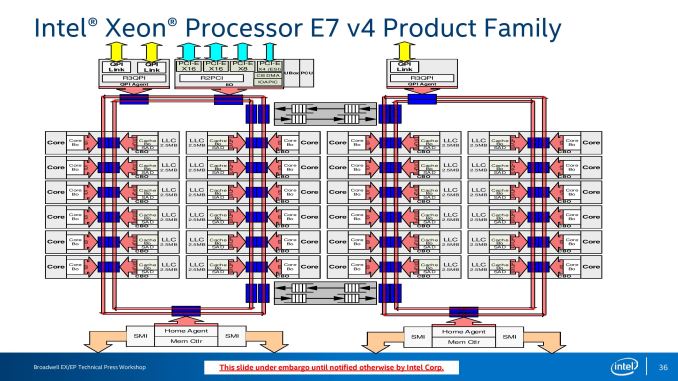
As referred to in Johan’s very detailed review of the dual socket E5-2600 v4 platform, Broadwell Xeon processor dies come in three die sizes: a low core count (LCC) featuring ten physical cores at 246.24 mm2 for ~3.2 billion transistors, a medium core count (MCC) with fifteen physical cores at 306.18 mm2 for ~4.7 billion transistors, and high core count (HCC) with 24 physical cores at 456.12mm2 for ~7.2 transistors. The MCC and HCC arrangements use dual memory controllers to address four memory channels whereas the LCC die uses a single memory controller which results in a slight performance hit compared to the other two. Most of the new E7 v4 processors however will be using the HCC die.
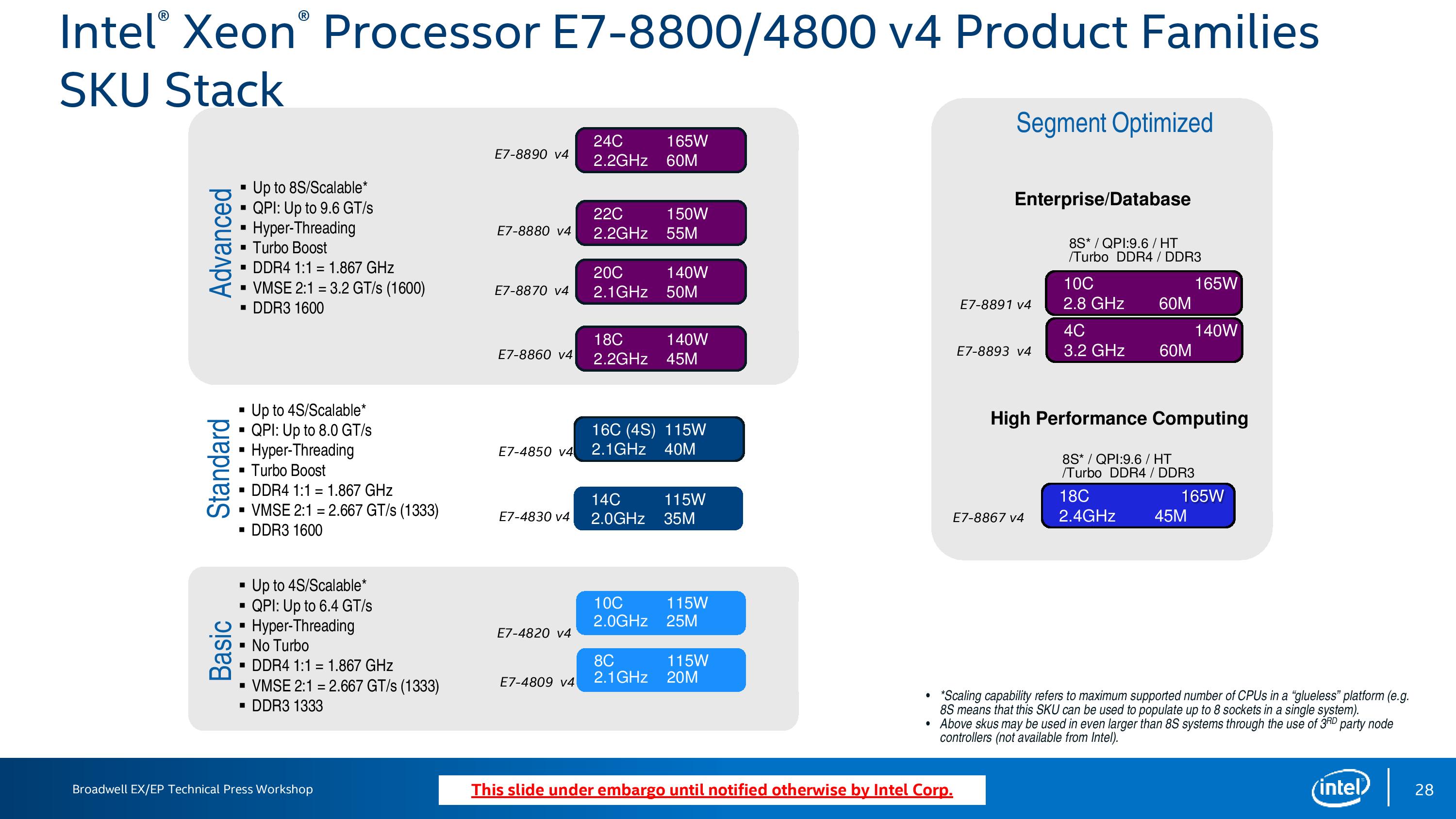
Intel has formally announced eleven processors between the 4S and 8S families, varying in core count, frequency, power consumption and L3 cache. The design of the HCC core is such that a processor can have certain cores fused off but the rest of the die can have access to the L3 cache, providing some SKUs with more ‘total cache per core’, such as the E7-8893 v4 which will be a four-core design but with 60 MB of L3 cache between them. These are classified by Intel as 'segment optimized', where applications require faster cache rather than more cores. This is arguably a stone-throw away from an eDRAM SKU with 64MB of eDRAM, but in this case Intel is still going with a large (and faster than eDRAM) L3 cache.
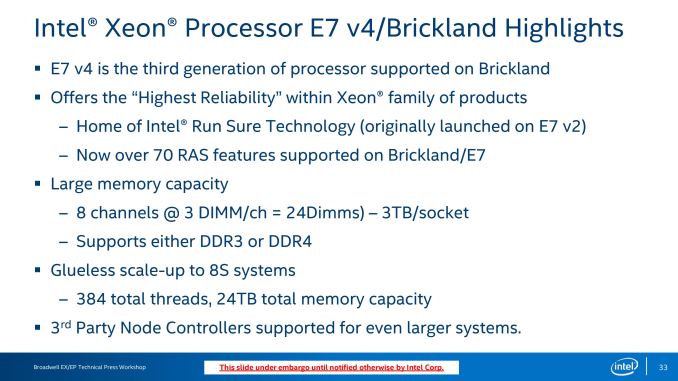
The flagship model is the E7-8890 v4, a 165W processor supporting the full 24 cores in the HCC die with hyperthreading, offering 48 threads per CPU. At a base frequency of 2.2 GHz, this processor can be used in an eight-socket glueless configuration (an 8S implementation means 192 cores/384 threads) or up to 128 sockets using third party controllers. In the eight socket configuration, a system can support up to 24TB of DDR4 LRDIMMs (three modules per channel, 12 modules per socket, 256GB per module). All the CPUs listed will support DDR4 and DDR3 with the dual controller configuration.
The E7-4800 v4 line by comparison will use a reduced QPI speed (6.4 or 8.0 gigatransfers per second compared to 9.6 gigatransfers per second on the E7-8800 v4) as well as some of the family having no Turbo frequencies. These non-turbo processors will run at their given frequency no matter the loading. The new E7 v4 carries over all of the new features that Johan covered in our E5 v4 review, including:
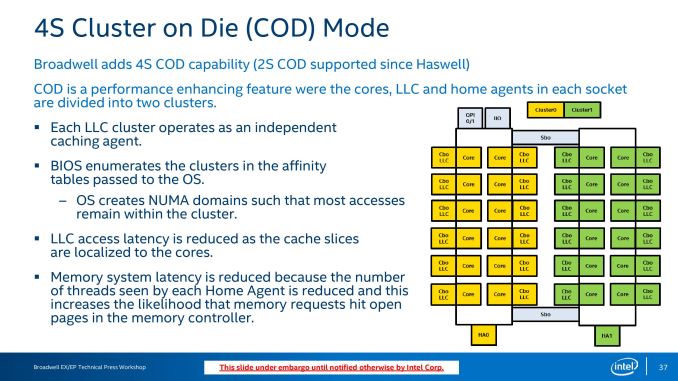
There are a couple of features for the HCC based processors that may be more relevant for the 4S systems, such as an upgraded version of Cluster on Die. Due to the configuration of the die and the dual ring design, if a core needs data in an L3 cache on the other side of the die, the latency would be higher than if it was closer to the die. To alleviate this, Haswell E5/E7 Xeons separated each die into two clusters such that each part would be seen by the BIOS as a non-unified memory domain. This allows the home agent/system agent to manage the likelihood that memory requests are aimed at data closer to the core that needs it. In Broadwell, this feature is now brought up from dual-processor systems to four-processor systems, and should reduce last level cache latency and performance for larger systems.
The new E7 v4 processors use the same socket as the previous generation, the E7 v3 processors. With a BIOS update, the new processors are a drop in with the older platform. The usual Intel partners (Supermicro, HP Enterprise, Dell, Cray) are expected to offer systems based on the new processors. We expect the new processors to cost in line with the previous generation with a typical generational increase. I believe Johan is currently in the process of testing a few parts, and I’m looking forward to the review. | |||||||||||||||||||||||||||||||||||||||||||||||||||||||||||||||||||||||||||||||||||||||||||||||||||||||||||||||||||||||||||||||||||||||||||||||||||||||||||||||||||||||||||||||||||||||||||||||||||||||||||||||||||||||||
| 9:00a | Razer Exhibits OSVR HDK2 VR Headset, And $5 Million Developer Fund At E3 2016
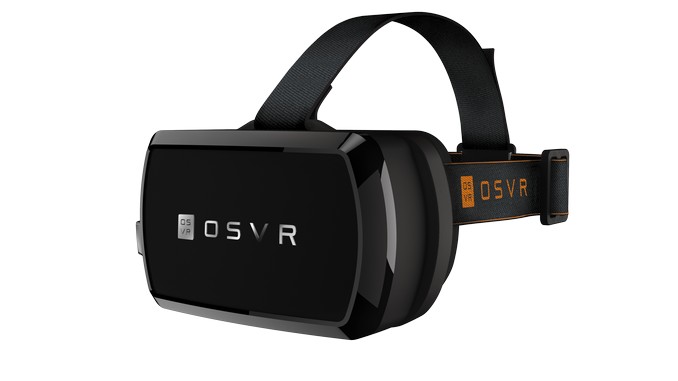
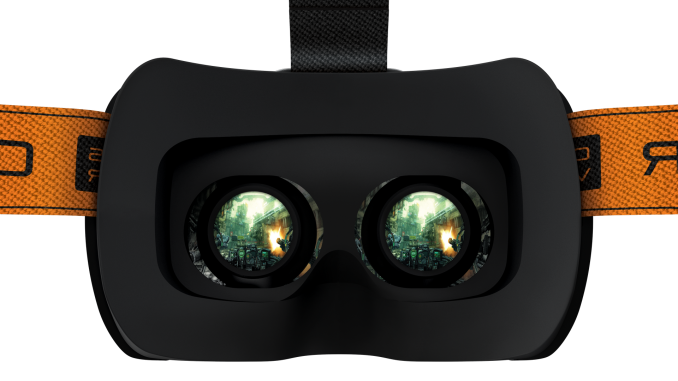
The Open Source Virtual Reality (OSVR) headsets have been progressing in the new field of VR for some time, releasing and demoing several versions of their Hacker Development Kit (HDK) for a while now, and we even saw some demos back at CES 2015. They have been iterating the design a few times, with the current version being HDK 1.4. Today OSVR is announcing the updated HDK 2. The big improvement to HDK 2 compared to HDK 1.4 is the new display panel. HDK 2 now features the same 2160x1200 resolution OLED display as the Oculus rift, and with the same 90 Hz refresh rate. Resolution is still a big issue with VR kits, and the previous version was just a 1920x1080 display, so this is a nice step up in pixels per inch. VR is still going to need higher resolution, but at the moment the HDK 2 does meet the benchmark laid down by the other players in this space.
In order to help reduce the screen-door effect, the HDK 2 also has what they are labelling IQE, or Image Quality Enhancer, which, according to the OSVR spokesman, is an optical coating to help with this pronounced issue with VR glasses. Likely this means that it is attempting to blur the pixels, in order to have them blend in with the other pixels. The displays do need to improve to remove this completely, and it doesn’t help that the OLED panels are actually pentile. I’d need to test this kit in person to get a good feeling for how well they have done with the coating, but there are of course downsides to blurring the image, even if it does help with one of the biggest issues with VR. The HDK 2 comes with a 100 Hz IR camera for positional tracking, and the headset features individual eye focusing with the dual-lens system. Adjustments can be made from +4.5 to -2 per eye, which should allow it to work with the majority of users. The headset itself has a removable face mask, with bamboo charcoal microfiber foam. Unlike the Rift, there is no audio integrated with the headset. OSVR has an open framework (as suggested by its name) so it will be able to work with a variety of controllers, and as more control mechanisms become available, it should be able to support them. The HDK system supports several content technologies, including SteamVR, and they plan to announce more content soon. On that note, OSVR is also announcing a $5 million developer fund. Their goal is to ensure unrestricted access of VR content on all hardware. If you are a VR content developer, you can apply to this fund. If approved by the fund, and OSVR support is added to the content, Razer, or other future contributors, will purchase game codes in bulk to help compensate developers for their integration time, and the fund will also assist with marketing and promotional support. The HDK 2 will be available for purchase at the beginning of July, and here OSVR is trying to win over some support by undercutting the competition. The HDK 2 will retail for just $399, compared to $599 for the Oculus Rift and $799 for the HTC Vive. In addition, the HDK 1.4 will remain on sale for $299.
I think OSVR has a long road ahead of them, since they are up against some well-backed competition, but it’s great to see the VR space already showing competition. Strong players should spur innovation in the field and lead to better products for all. Source: Razer | |||||||||||||||||||||||||||||||||||||||||||||||||||||||||||||||||||||||||||||||||||||||||||||||||||||||||||||||||||||||||||||||||||||||||||||||||||||||||||||||||||||||||||||||||||||||||||||||||||||||||||||||||||||||||
| 12:30p | Microsoft Announces Xbox One S Console: A Slimmer Design
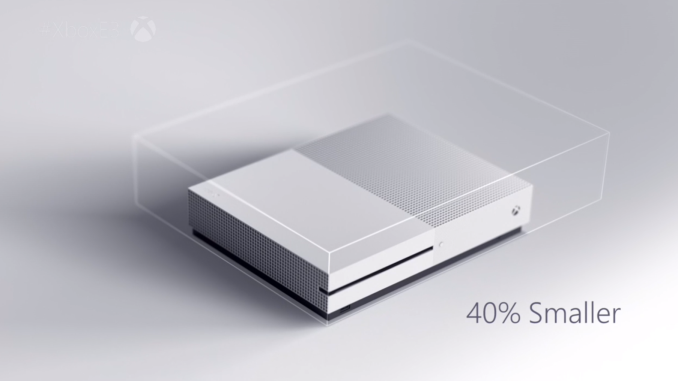
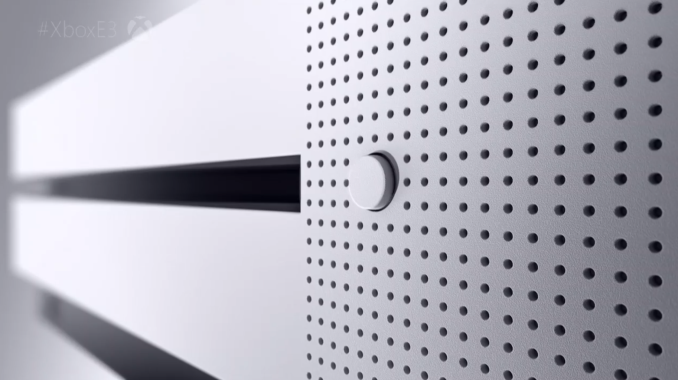
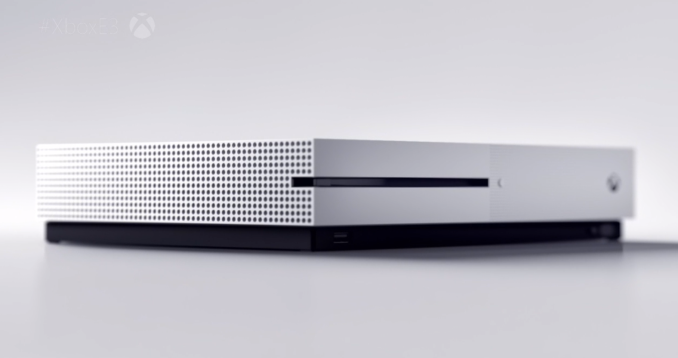
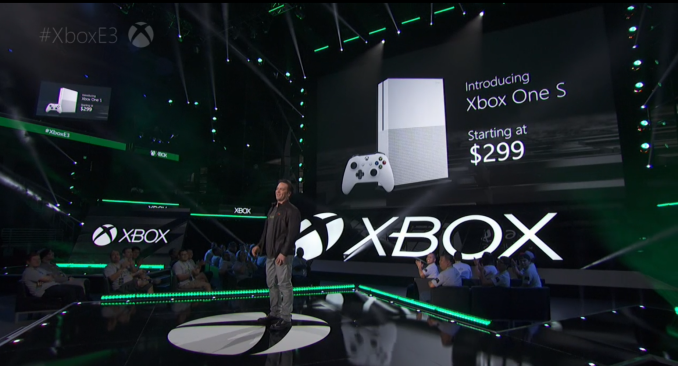
Today at the annual Electronic Entertainment Expo (E3), Microsoft has lifted the lid on their new Xbox One console design. The Xbox One is part of the eighth generation of consoles, and was originally released in November 2013. The new Xbox One S is assumed to have similar hardware inside, however the design is taking up 40% less volume. Typically when a device changes in volume this much, as with previous generations that have launched slimmer designs, inside there will be a processor on a smaller process node and optimized for power for the same performance. This allows a smaller more efficient design, and in this case Microsoft has integrated the power supply into the console, negating the need for a large power brick.
Other highlights for the launch include HDR and 4K output support, although it is unspecified if this is through HDMI 2.0 or DisplayPort. The main thing here is for streaming video from services such as Netflix, Amazon and Hulu rather than running games at 4K. Theoretically it also means that the video outputs can offer enough bandwidth for some of the virtual reality headsets on the market/coming to market. The new Xbox One S will support HDR as well, suggesting that it must also support HDMI 2.0a or DisplayPort 1.4. HDMI 2.0a is more likely, as DisplayPort which isn't part of the original Xbox design and would suggest that the SoC has been adjusted to support it. Though for consistency we would assume that the core GPU architecture is the same, and is more likely to be HDMI 2.0a. As mentioned by nathanddrews in the comments, HDMI 2.0a can't support 10-bit 4:4:4 chroma like DisplayPort 1.4, which is what we would expect on a PC-like interface, but it it does do 10-bit in 4:2:0 chroma, which is what we would expect for games and film.
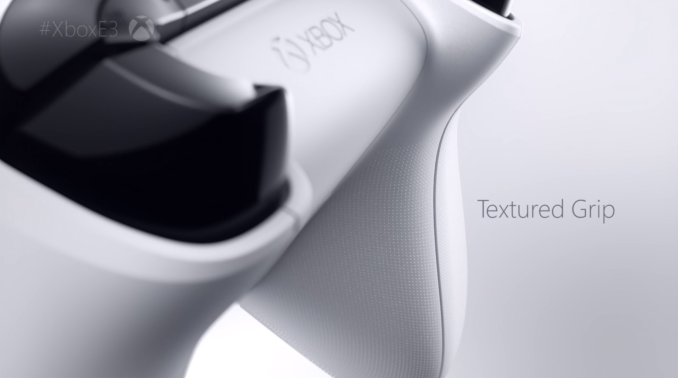
The controller for the Xbox One is also new, featuring a redesigned textured grip on the rear and what looks like at an attempt to improve the ergonomics. The Xbox One Elite Controller was released a while back at $150, but the new controller is designed to mimic the one originally released with the Xbox One. The new controller will be available for worldwide purchase for $60, and now supports Bluetooth for connection to PCs so that USB dongles are not needed. The controllers should still use WiFi to Xbox One as standard, as these controllers need to work with the original Xbox One consoles.
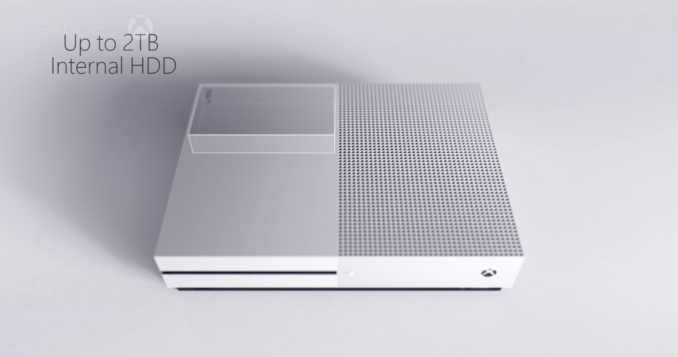
The Xbox One S can support up to 2 TB of a hard disk drive, suggesting that in the console space having more capacity (for games as well as downloaded shows) is more important than solid state storage. There will be 500GB and 1TB editions as the main set, with 2TB being a special launch edition.
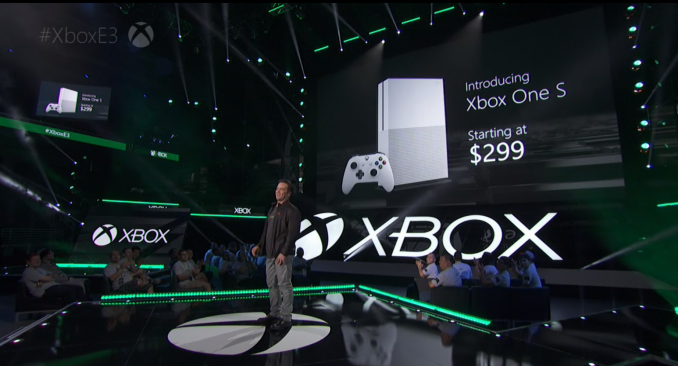
At $299, the One S comes in at the same price as the original Xbox One 500GB console with a one-game bundle when we compare prices on Amazon. In fact, checking the press release shows that $299 is the 500GB edition of the One S, a 1TB model at $349, and the 2TB Special Edition will be available in certain markets at $399 starting from early August. Additionally, the official Xbox One Vertical Stand will be on sale for $20.
When it was first launched, the expected lifetime of a the console generation was around five to seven years, which means that we currently sit in the middle of that timeframe, and if a manufacturer was going to offer an updated model, this would be it. Updating a console design mid-generation is nothing new, we’ve seen it as far back as the original Playstation, however this generation has an additional issue: with everyone talking about VR, no-one is confident that the current generation of consoles is up to the task. So it will be interesting to see how the new Xbox One S will play in this space, now that the video output is up to the task. Gallery: Xbox One S
      Source: Microsoft at E3
| |||||||||||||||||||||||||||||||||||||||||||||||||||||||||||||||||||||||||||||||||||||||||||||||||||||||||||||||||||||||||||||||||||||||||||||||||||||||||||||||||||||||||||||||||||||||||||||||||||||||||||||||||||||||||
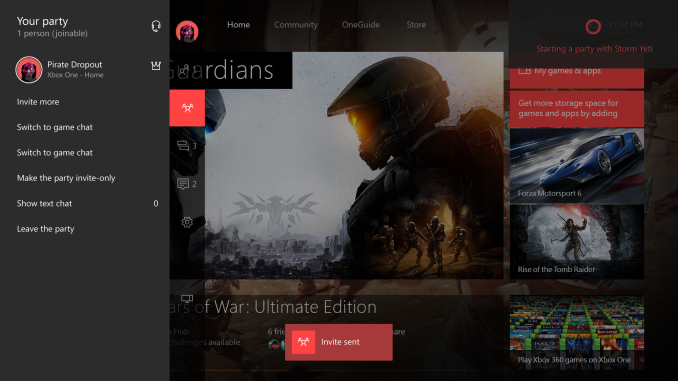
| 1:30p | Cortana Coming to Xbox Live
A short word coming out of E3: despite rolling out a couple of days ago, Microsoft has formally announced Cortana, the Windows-based speech recognition helper (similar to Siri and Google Now) is coming to Xbox Live and the Xbox console platform. This announcement has been suspected for a while as Microsoft integrates more of its technologies together, trying to craft a consistent user experience across as many potential devices as possible. Aside from 'Xbox On', all commands can be processed via Kinect or a headset. According to XboxOneUK via Xbox One Preview Program’s Facebook Page, the following commands are supported:
Initially, Cortana will be available for Xbox Live Preview Members, before being launched in supported markets to all users. Initially Cortana will come to Preview users in the US, UK, France, Italy, Germany and Span first. No specific timeframe has been announced as of yet to roll out to all users. Source: Microsoft E3 and XboxOneUK | |||||||||||||||||||||||||||||||||||||||||||||||||||||||||||||||||||||||||||||||||||||||||||||||||||||||||||||||||||||||||||||||||||||||||||||||||||||||||||||||||||||||||||||||||||||||||||||||||||||||||||||||||||||||||
| 2:02p | Microsoft Teases Project Scorpio for 2017: 8 cores, 6 TeraFLOPs, Backwards Compatible with Xbox. Zen or Jaguar?!
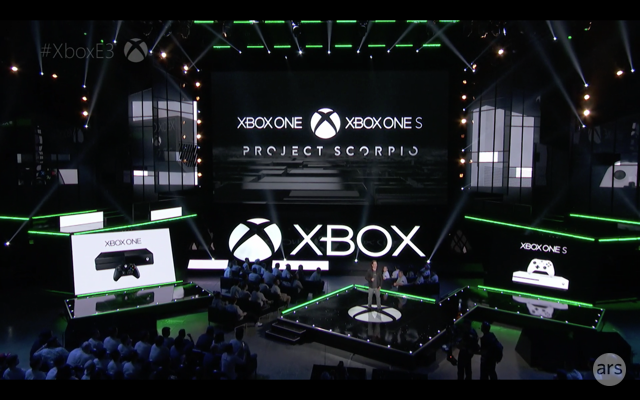
This news piece contains speculation, and suggests silicon implementation based on released products and roadmaps.The only elements confirmed for Project Scorpio are the eight cores, >6 TFLOPs, 320 GB/s, and it is coming in 2017. If anyone wants to officially correct any speculation, please get in touch. Here’s an announcement at E3 for you. Microsoft just announced Project Scorpio, an internal project to develop the next generation Xbox set to be released in 2017. Project Scorpio is to be backwards compatible with Xbox One, and seems to be directly in line to compete with whatever Sony are supposedly releasing in the near future. But here’s some specifications for you that has my mind in a twist.
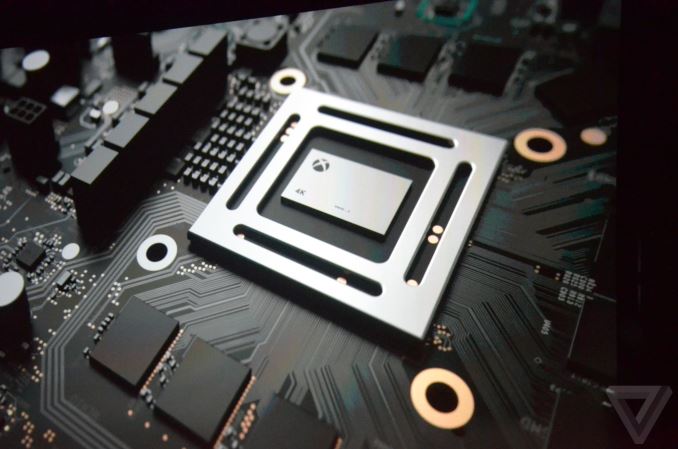
In the presentation, Microsoft states that the Project Scorpio SoC will have eight cores, up to 320 GB/s of memory bandwidth, and over 6 TeraFLOPs of power. To put this into context, this is more processing power than the recently announced AMD RX 480 GPU using a GCN 4 based architecture, set to be launched later this month. Microsoft specifically announced that Project Scorpio is to be launched next year, which puts a few things together worth mentioning. By this time next year, we expect AMD’s Zen microarchitecture to be in full swing, and AMD has already showcased a silicon sample of an 8-core Zen processor. However, the current Xbox line relies on AMD’s ‘cat’ core architecture, which according to current AMD roadmaps doesn’t seem to feature anywhere for 2017. Without a direct confirmation, it’s hard to tell if Project Scorpio is the same Jaguar cores as the Xbox One, or the newer Zen microarchitecture. I would assume we won’t find out until later next year.
On the GPU side, the current Xbox One uses a 16 CU implementation in the SoC, with two disabled giving 14 CUs. We already know that AMD’s RX 480, running at 5 TFLOPs and built on Global Foundries 14nm FinFET process, runs in at 36 CUs. So Project Scorpio will have easily have more CUs than Xbox One, and judging by the shots in the video, the die size is relatively small. The Xbox One was built on TSMC’s 28nm HP process. At this point it’s still not confirmed if this is an AMD win, however judging by the comments towards backwards compatibility and SoC integration (where CPU and GPU are on the same silicon (or package)), all fingers would point in that direction.
The memory bandwidth of Project Scorpio, 320 GB/s, is also relatively interesting given the current rates of the RX 480 topping out at 256 GB/s. The 320 GB/s number seems round enough to be a GPU only figure, but given previous embedded memory designs is likely to include some form of embedded memory. How much is impossible to say at this point. AMD has stated that the RX 480 is a VR Gaming capable card, so given what we've said about the Xbox One S tackling VR, it's clear that Project Scorpio is right on the money. AMD's business plan as of late is to expand its custom SoC business, and thus sticking Zen and a GCN 4 based architecture on a combined package or die for Microsoft makes a lot of sense. At the RX 480 announcement, it was stated that AMD wants to power the first 100 million VR users, and this would help towards that goal. It's worth noting that this news piece contains a decent amount of speculation based on knowledge of the market, and the only elements confirmed for Project Scorpio are the eight cores, >6 TFLOPs, 320 GB/s, and it is coming in 2017. If anyone wants to officially correct any speculation, please get in touch. Sources: Ars Technica (Carousel Image), Verge Live Blog (Video Screen Capture) | |||||||||||||||||||||||||||||||||||||||||||||||||||||||||||||||||||||||||||||||||||||||||||||||||||||||||||||||||||||||||||||||||||||||||||||||||||||||||||||||||||||||||||||||||||||||||||||||||||||||||||||||||||||||||
| 3:30p | AMD Teases Future Radeon RX 470 & Radeon RX 460 Cards
With the annual Electronic Entertainment Expo once again upon us, this week has been a flood of gaming hardware and software news. On the PC front, AMD is once again sponsoring PC Gamer’s PC Gaming Show, and while the company isn’t making quite as large of a presence this year – having just announced a bunch of tech at Computex – AMD is still attending E3 to tease a bit of hardware. Announced in a press release that’s going out at the same time as the PC Gaming Show starts, AMD is very briefly teasing the next two Polaris-based Radeon cards: the Radeon RX 470 and the Radeon RX 460. | |||||||||||||||||||||||||||||||||||||||||||||||||||||||||||||||||||||||||||||||||||||||||||||||||||||||||||||||||||||||||||||||||||||||||||||||||||||||||||||||||||||||||||||||||||||||||||||||||||||||||||||||||||||||||
| 4:05p | Huawei Announces The Honor 5A
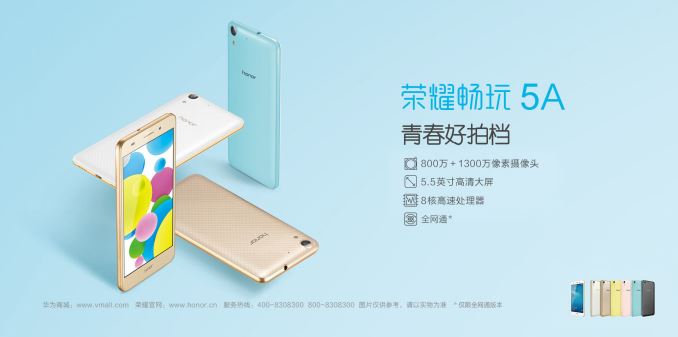
Today Huawei announced a new member to the Honor 5 series, the Honor 5A, which brings a number of upgrades to the Honor 4A it replaces. The 5A comes with either a Qualcomm Snapdragon 617 SoC, which includes a 64-bit octa-core CPU based on ARM’s Cortex-A53 cores and Adreno 405 GPU built on the 28nm LP node, for the model specific to China Netcom, or a HiSilicon Kirin 620 SoC, which also includes an A53-based octa-core CPU and ARM’s Mali-450MP4 GPU built on a 28nm process. All versions include 2GB of LPDDR3 RAM, just like the Honor 4A and 5X, and 16GB of internal storage that’s expandable with a microSD card.
Screen size increases from 5-inches on the Honor 4A to 5.5-inches for the 5A, but the resolution for the IPS LCD panel remains at 720p, giving the 5A a pixel density of 267ppi. The upgraded hardware in the 5A is actually very similar now to the previously announced Honor 5X that we looked at previously this year. One important distinction between the two is display resolution: The Honor 5X’s 5.5-inch display has a higher 1080p resolution.
Both the front and rear cameras also receive significant upgrades. The rear camera increases from 8MP on the 4A to 13MP. It’s not clear if the Honor 5A is using the same 13MP Sony IMX214 Exmor RS sensor that the Honor 5X uses, however. Sitting atop the rear camera is a 5-element, 28mm wide-angle lens array with an f/2.0 aperture. The front camera sees a sizeable increase in resolution too, jumping to 8MP from the 4A’s rather low 2MP. Because the Honor series targets cost-sensitive consumers, some features need to be sacrificed. The Honor 5A does not include a fingerprint sensor or NFC support, for instance. It also does not support 802.11ac Wi-Fi. Overall the Honor 5A is a significant upgrade over the 4A, with specs that rival the Honor 5X. Moving to an octa-core CPU with a max frequency of either 1.5GHz or 1.2GHz should yield a small uptick in performance over the 4A’s quad-core Snapdragon 210 SoC, and the significantly larger 3100mAh battery should noticeably extend battery life beyond what the 4A’s 2200mAh battery provides. Whether the larger display is an improvement is a matter of personal taste, but the regression in pixel density is unfortunate.
The Honor 5A is available in six colors, including white, black, blue, pink, yellow, and gold. It will be available for purchase in China this summer for a price of ¥ 699 (USD $106). Gallery: Honor 5A
      | |||||||||||||||||||||||||||||||||||||||||||||||||||||||||||||||||||||||||||||||||||||||||||||||||||||||||||||||||||||||||||||||||||||||||||||||||||||||||||||||||||||||||||||||||||||||||||||||||||||||||||||||||||||||||
| 8:55p | Apple Announces iOS 10: Continued Refinement
As we get to iOS 10, there are a number of new features that Apple has added to iOS. While not a total redesign on the order of iOS 7, iOS 10 now has a number of design refreshes to keep pushing forward in terms of functionality and usability of Apple’s mobile devices, which are increasingly the core of Apple’s revenue base.
To start, the lock screen, notification system, and 3D Touch on apps have been redesigned. With the lock screen, a number of people complained that TouchID was too fast on the iPhone 6s, which made the lock screen only visible for maybe a few hundred milliseconds before it was flashed off to something else. With iOS 10, the lock screen is automatically shown when motion sensors detect that you’ve raised the phone, similar to the Apple Watch.
Notifications are also noticeably changed to be more actionable. On the lock screen, they no longer darken the background and it’s possible to view videos, photos, and do things like reply to messages and keep a conversation going within the notification rather than entering another application, which avoids costly context switches from a UI perspective. These notifications can be accessed using 3D Touch although it wasn’t really made clear at the keynote how things would work for iOS devices without 3D Touch.
While initial launch of the iPhone 6s didn’t really integrate a huge amount of functionality into 3D Touch when using the gesture on app launch, with iOS 10 the same gesture now integrates widget-like functionality that allows you to quickly peek into apps to see relevant information about them without actually launching the app.
In addition to these redesigns, the keyboard has received new functionality to allow for bilingual and contextual predictions using neural networks to better predict what you want to say, but apparently all of this is done of the device so it’s fairly likely that the models won’t be as robust as the ones that Google will build. However, Apple emphasizes that this improves privacy.
The other changes here include Siri, Apple Maps, Home, and Messages, which now have third party app integration. Additionally, Apple Maps has the ability to see traffic, dynamic zoom, live traffic, and destination prediction. The Home app allows for easy control of all HomeKit enabled smart home devices, and Messages has a whole host of new features regarding emoji suggestions, effects, third party stickers and apps, deep linking, handwriting, and “invisible ink” for messages that have to be swiped to be revealed. For the most part these features are nothing life-changing, but should be good for quality of life improvements for those on the platform already. Apple Pay is also now enabled on the web to enable fast payment with iOS devices. Overall, iOS 10 is a decent step up, but for the most part like the smartphone market itself it appears to be a mostly incremental release. Outside of design changes and improving 3D Touch usability, most of the changes are to add extensibility and enable third party apps to integrate into the OS better than before. The other changes here would be what I would call app-level changes, things like the addition of voicemail transcription, redesigned news, music, and maps apps. It’s not likely that users will find any particular reason to switch that they didn’t have before, but iOS continues to gain refinement and stays current with iOS 10. iOS 10 will be available for public beta this summer, with release in the fall. According to Apple it will support all iPhones as old as the iPhone 5, the iPad 4/Mini 2 and later, and the iPod Touch 6G.
| |||||||||||||||||||||||||||||||||||||||||||||||||||||||||||||||||||||||||||||||||||||||||||||||||||||||||||||||||||||||||||||||||||||||||||||||||||||||||||||||||||||||||||||||||||||||||||||||||||||||||||||||||||||||||
| 9:00p | Apple Announces WatchOS 3
While Apple Watch and watchOS 1 was a solid first step towards seriously addressing the smartwatch market, it was obvious to me that it was still in need of development. Apple had come far, but still had far to go. With watchOS 3, we’re finally starting to see the refinements needed to make watchOS truly mass market, with focuses on responsiveness and adds a fair number of new features to help make the overall user experience more compelling.
At an OS level, the rather painful loading screens seen in previous iterations of watchOS are now dead, which is a fairly massive improvement. I’m not sure what architectural changes happened here yet, but it’s likely that offloading more compute onto the watch and periodic refresh of app data on the watch, along with more advanced multitasking is a fairly critical part of making all of this happen. It’s likely that this will have a power impact, but given the user experience improvements I think this is likely to be an acceptable trade-off.
Other than this architectural change, there have been a number of changes to the UI. Rather than overloading Glances with both a control center and various other glances, it looks like the two have been separated to better mesh with how iOS works. Rather than placing contacts on the side button, it looks like a Dock for apps launches instead. Other UI changes include a simple swipe to change the watchface on the fly and improved notification handling to make interactions like replying to a message from the watch faster than before.
On the feature side, apps like Activity now feature a multiplayer component by allowing you to share your activity data with friends and family. Activity also supports wheelchair mode to allow for more widespread usability, and has a whole host of new algorithms designed to properly track activity for those that are wheelchair-bound. There’s also a Breathe app, which is supposed to make it easier for people to do deep breathing/meditative breathing, along with Home for remote control of smart home devices. There’s also support for in-app Apple Pay, Mac unlock with Watch proximity, and SOS mode to automatically call emergency services with a long hold of the side button. There’s also improved workouts, with the ability to set no time limit for a workout and automatic workout pausing based upon motion detection.
Overall, watchOS 3 is starting to feel like it’s approaching what I really want from a smartwatch in terms of functionality and polish, and I think with Apple Watch 2 or 3 and maybe watchOS 4 or 5 we’ll finally see a smartwatch that I can whole-heartedly recommend for the first time, although it’s definitely possible that a company other than Apple may pull this off first. WatchOS 3 will be available in beta this summer, and will release to all Apple Watches this fall. | |||||||||||||||||||||||||||||||||||||||||||||||||||||||||||||||||||||||||||||||||||||||||||||||||||||||||||||||||||||||||||||||||||||||||||||||||||||||||||||||||||||||||||||||||||||||||||||||||||||||||||||||||||||||||









| << Previous Day |
2016/06/13 [Calendar] |
Next Day >> |