[Most Recent Entries] [Calendar View]
Tuesday, June 28th, 2016
| Time | Event | ||||||||||||||||||||||||||||||||||
| 6:00p | Turtle Beach Demos HyperSound Glass: Transparent Speakers Made of Glass
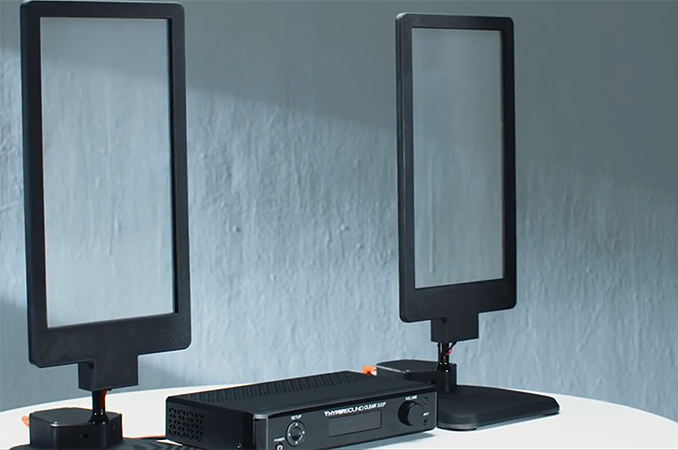
Turtle Beach has announced that it had built its first transparent directional speakers featuring its HyperSound technology. The company demonstrated an early prototype of the speaker set publicly at the E3 trade show, but does not reveal when it expects the new tech to be commercialized. Turtle Beach’s HyperSound Glass is comprised of multiple layers of thin transparent films, which can generate a narrow beam of ultrasound (high frequency sound) that delivers audio to a targeted listener (by the time it reaches the targeted spot, ultrasound becomes normal sound) and does not disturb others. Since the speakers produce ultrasound, the audio is inaudible in a very short distance from the speakers and is also claimed to be imperceptible in locations outside of the targeted area. To generate that beam, Turtle Beach uses the HyperSound software technology, which the company already commercializes, but not with glass. According to Turtle Beach, the sound generated by its films maintains clarity over longer distances than traditional loudspeakers (which may well be correct given the size of the “driver”), but the company does not reveal technical specifications of its devices, such as frequency response or wattage. As pointed out above, the HyperSound tech is not something completely new. At present, Turtle Beach offers its HyperSound Clear 500P speaker system for those with hearing problems and their families. The HyperSound Clear 500P do not feature transparent speakers, but can beam loud audio to a specific spot, whereas those around will hear normal volume audio. The product does not use glass/films, but a special metallic grill to produce ultrasound. Turtle Beach claims that the HyperSound Glass could be integrated into various monitors, desktop speakers, and automotive dashboard glass to deliver sounds to specific listeners. Turtle Beach does not plan to build products based on the HyperSound technology exclusively itself, but can license it to others. The HyperSound Glass technology is still work in progress and we have no idea when this tech could be commercialized. Nonetheless, since Turtle Beach showed off prototypes at E3, it is highly likely that the technology is nearly ready. | ||||||||||||||||||||||||||||||||||
| 9:00p | Western Digital Rolls Out 256 GB SanDisk microSDXC Memory Cards
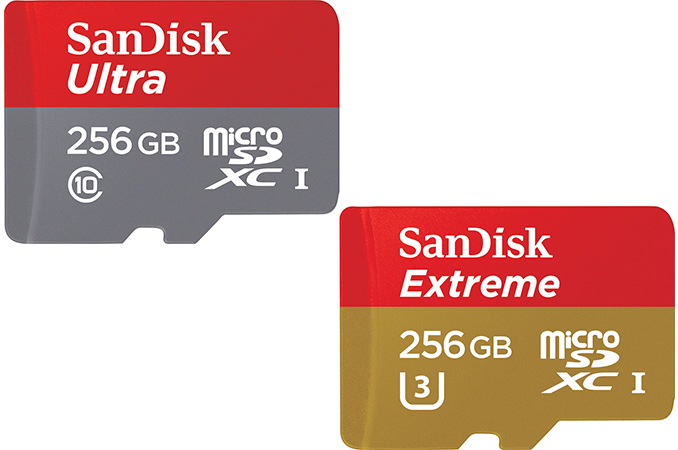
Coinciding with the Mobile World Congress at Shanghai, SanDisk owner Western Digital is introducing two new microSD memory cards that can store up to 256 GB of data. The new SanDisk-branded cards are designed for smartphones, tablets and content-capture devices. The capacities are akin to those of mainstream SSDs, albeit at a higher price. The new 256 GB memory cards from Western Digital are the SanDisk Extreme microSDXC as well as the SanDisk Ultra microSDXC Premium Edition. Both cards use the UHS-I interface which supports transfer rates of up to 104 MB/s. Compatibility with existing microSDXC and microSDHC devices is retained, but, obviously at lower speeds. The SanDisk Extreme microSDXC supports read/write speeds of up to 100/90 MB/s, while the SanDisk Ultra microSDXC Premium Edition is slightly slower and features transfer speeds up to 95 MB/s. The Extreme card also has higher minimum sequential write speed - 30 MB/s vs. 10 MB/s, which is important for recording high-bitrate 4K videos.
Like other high-end Secure Digital cards, the new 256 GB microSDXC products from Western Digital are waterproof, temperature-proof, shock proof, and X-ray proof, which is useful for those who travel a lot and/or have to use memory cards in harsh conditions. Western Digital’s SanDisk 256 GB microSDXC cards will not be alone on the market and will compete against Samsung’s EVO Plus 256 GB microSDXC card introduced in May. The latter also features a UHS-I interface and transfer speeds up to 95 MB/s. To build such card, Samsung had to use its 3D V-NAND memory. Meanwhile, SanDisk has not yet disclosed what type of NAND flash it uses to build its high-capacity memory cards. The 256GB SanDisk Ultra microSDXC UHS-I Premium Edition card will be available worldwide in August 2016 for $149.99. The faster 256GB SanDisk Extreme microSDXC UHS-I card will be available in Q4 2016 for $199.99. | ||||||||||||||||||||||||||||||||||


| << Previous Day |
2016/06/28 [Calendar] |
Next Day >> |