[Most Recent Entries] [Calendar View]
Wednesday, June 29th, 2016
| Time | Event | ||||||||||||||||||||||||||||||||||||||||||||||||||||||||||||||||||||||||||||||
| 9:00a | The AMD Radeon RX 480 Preview: Polaris Makes Its Mainstream Mark Back in December of last year, AMD’s Radeon Technologies Group began slowly trickling out the plans for what would be their first GPU architecture built for the now-modern FinFET processes: Polaris. As part of a broader change in how GPU architectures have been handled – more information is now released ahead of launch – AMD laid out what they wanted to do with Polaris. Aim for the mainstream, radically improve power efficiency, lay the groundwork for HDR displays, and, of course, improve performance. Now six months later we are seeing AMD’s plans come to fruition, as the Polaris GPUs are in full production, and the first retail products are launching today. Kicking off the Polaris generation in the desktop market will be AMD’s Radeon RX 480, which is aiming for the mainstream market. We’ve already seen the card, the price, and AMD’s marketing spiel back at Computex 2016, so now it’s time to take a look at the final, retail hardware. | ||||||||||||||||||||||||||||||||||||||||||||||||||||||||||||||||||||||||||||||
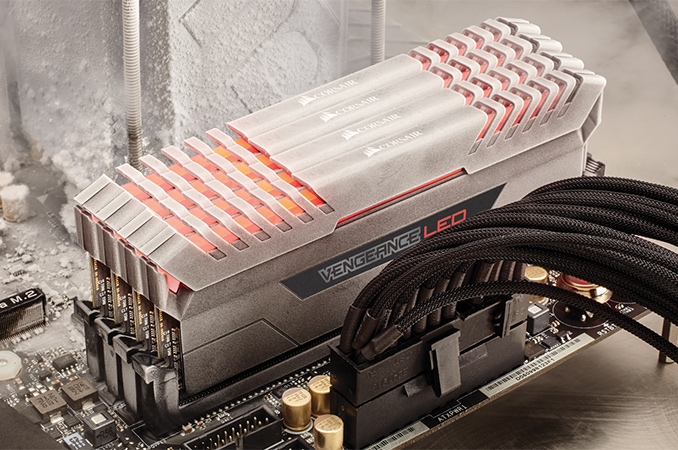
| 12:00p | Corsair Unveils Vengeance LED Modules: DDR4 Gets Lighting, 4333 MT/s Data-Rate
Corsair has introduced its Vengeance LED family of memory modules designed for enthusiasts of high-performance PCs and modders. The fresh range of Corsair’s memory combines new design featuring LED lighting with high capacities as well as increased data-rates. Initially, the Vengeance LED DDR4 DIMMs will be available with data-rates up to 3466 MT/s, but in the near future the company promises to add DRAM sticks with speeds up to 4333 MT/s. Each Corsair Vengeance LED unbuffered memory module is based on a custom 10-layer PCB as well as pre-binned DRAM chips that can run at data-rates well beyond 2133 MT/s and 2400 MT/s officially supported by today’s CPUs. The modules are equipped with aluminum heat spreaders featuring red or white lighting to complement design of modern motherboards, graphics cards, cases and PSUs. All new Vengeance LED DIMMs are optimized for Intel’s X99 and 100-series platforms and come with XMP 2.0 profiles to make it easier for end-users to run them at their data-rates with the right timings and voltage.
Initially available Corsair Vengeance LED memory modules come in 8 GB and 16 GB capacities (which means that they are likely based on the latest 8 Gb DDR4 ICs) and are shipped in dual-channel and quad-channel kits. The modules are rated to run at 2666 MT/s, 3000 MT/s, 3200 MT/s, 3400 MT/s as well as 3466 MT/s data-rates with CL15 17-17-35, CL16 18-18-35 or CL16 18-18-36 latencies. Depending on exact speed bins, the modules feature 1.2V or 1.35V power supply.
Eventually, Corsair plans to introduce Vengeance LED modules capable or running at higher data-rates, including 3800 MT/s, 4000 MT/s as well as 4333 MT/s. Right now, the world’s highest-performing memory modules have 4 GB capacity and can run at 4266 MT/s. Therefore, with the introduction of DDR4-4333 DIMMs, Corsair would formally offer the world’s fastest memory sticks. | ||||||||||||||||||||||||||||||||||||||||||||||||||||||||||||||||||||||||||||||
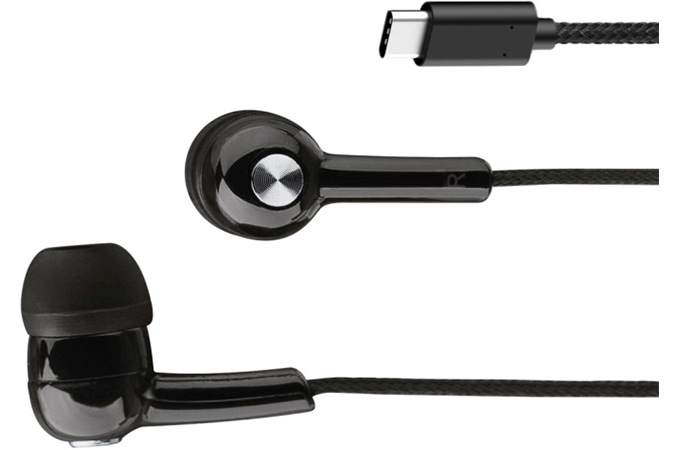
| 1:40p | Conexant Reveals CX20888: A New Chip for USB-C Headsets with Advanced Functionality
Conexant on Wednesday introduced its third CODEC for upcoming digital headsets using a USB Type-C interface. The new CX20888 chip is specifically tailored for headsets and supports a variety of advanced features, such as a headphone amplifier, active noise cancellation, sampling rates up to 96 kHz and so on. The company unveiled the product at the Mobile World Congress Shanghai in a bid to attract the attention of Chinese makers of consumer electronics. The Conexant CX20888 is built around an ARM Cortex-M0 controller core (clocked at 50 MHz) and is equipped with two 32-bit Conexant DSPs (both clocked at 100 MHz) with floating point assist—bringing the total compute power of the DSPs to 400 MIPS—as well as 504 KB of SRAM that's shared between the M0 core and the DSPs. The CODEC also incorporates a variety of interfaces for peripherals, including two I2C master (or master + slave) interfaces, one I2S interface, one SPI, two multi-rate timers, a self wake-up timer, four monitor ADCs (to enable volume control, temperature sensor and battery monitor), two stereo PDM digital microphone interfaces, S/PDIF input and up to 28 GPIO pins.
Conexant utilizes the processing capabilities, as well as rich I/O features of the CX20888, to enable such functionality as low-latency active noise cancellation (eliminating up to 30 dB of external sound with a range of up to 3.8 kHz), acoustic echo canceling, equalization, microphone automatic gain control, volume control and others. The chip also supports a wake-on-voice trigger, which is important for enablement of services like Cortana that can listen to what is happening in its surroundings while the OS is in sleep mode. To enable high-quality audio output, the CX20888 contains one 24-bit stereo ADC (97 dB dynamic range) and one 24-bit stereo DAC (104 dB dynamic range), supporting sampling rates between 8 kHz and 96 kHz. In addition, the chip incorporates a class-H headphone amplifier as well as programmable microphone preamplifiers with dedicated bias to prevent crosstalk. Because power circuitry is important for audio devices, the CX20888 has an integrated DC-DC converter with power switches and dynamic voltage scaling to ensure quality of output while keeping power consumption under control.
Like other USB-C Digital Audio solutions announced so far, the CX20888 supports USB 2.0 bandwidth, which should be plenty for audio and smart functionality. It also auto switches between CTIA and OMTP headsets if used inside a docking station. Conexant tells us that the CX20888 is the industry’s only single-chip solution with such feature-set, which is suitable for digital USB-C headsets. The company naturally does not reveal the exact price of its solution, but claims that the chip reduces BOM costs of headsets because of its high level of integration. As for form factor, the CX20888 comes in 5×5×0.5 mm 81-pin BGA package and is small enough for a variety of designs.
Intel made a number of proposals for its part in the USB-C Digital Audio specification earlier this year and Conexant expects billions of people to adopt headsets and smartphones with a USB-C interface in the coming years (to support the transition of audio devices to USB-C, Conexant introduced two appropriate codecs earlier this year). The new interface is projected to improve the quality of headsets and expand their functionality by adding features, such as temperature sensors or noise cancellation technologies, but these depend entirely on decisions of actual hardware makers and not the standard itself. On paper USB-C Digital Audio enables a lot, but we will have to wait and see how it takes shape. | ||||||||||||||||||||||||||||||||||||||||||||||||||||||||||||||||||||||||||||||




| << Previous Day |
2016/06/29 [Calendar] |
Next Day >> |