[Most Recent Entries] [Calendar View]
Wednesday, July 6th, 2016
| Time | Event | |||||||||||||||||||||||||||||
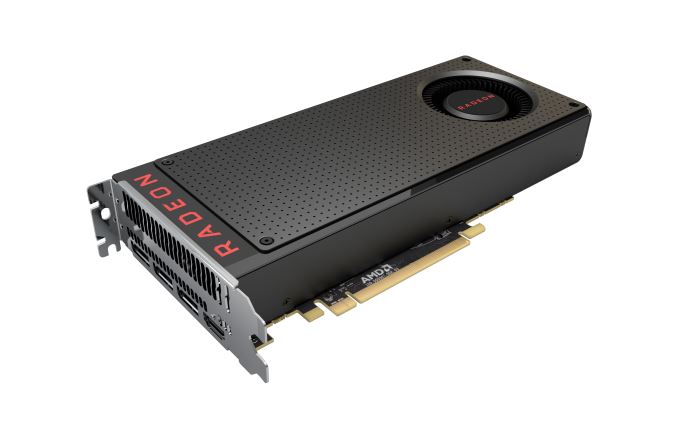
| 12:45a | AMD's Tuesday Radeon RX 480 Status Update: New Driver By Late Thursday
Following up on this weekend's statement from AMD about a potential power issue with the reference Radeon RX 480, AMD has just sent over their previously promised update on their progress dealing with the issue. In short, they are nearly finished preparing their updated driver, 16.7.1, which will be posted "within the next 48 hours" (which at this point is late Thursday). The new driver will offer two solutions to the power problem. The default solution: shift some of the power load off of the PCIe Graphics (PEG) slot connector, presumably in order to bring power consumption within PCIe spec. Note that AMD doesn't say anything about reducing the total power consumption, and given option #2, it's reasonable to assume that this involves holding the power requirements as-is and shifting the load to the external 6-pin power connector. Based on earlier data this would potentially put the 6-in connector further over spec, but the vast majority of PSUs are very tolerant of this going out of spec. The optional solution: a toggle that reduces the total power consumption of the card, presumably ensuring both the PEG slot and 6-pin power connector stay below their respective limits. Since the RX 480 is already throttling at times due to power limits, this would further hurt performance, but it's also the most standards-compliant solution (and aptly named "compatibility" mode). AMD notes that this option will have "minimal performance impact", and while we'll have to see the results in the benchmarks, it's worth noting that power consumption is cubic - that is, roughly to the 3rd power of frequency - so a small reduction in frequency can significantly reduce power consumption, as we've seen in the case of the Radeon R9 Nano. Along with this, AMD is also touting some slight performance optimizations in this driver that they hope will offset any performance loss (though I'd note that these optimizations would have come anyhow). We'll have more on this when AMD ships their driver. In the meantime AMD's full statement is as follows:
| |||||||||||||||||||||||||||||
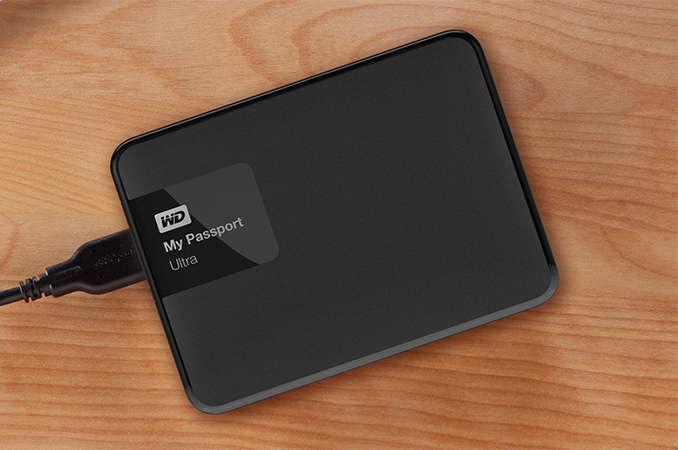
| 11:15a | Western Digital Expands My Passport External USB 3.0 Drives To 4 TB
Western Digital last week introduced several new members to its My Passport family of external hard drives. The new portable external HDDs can store up to 4 TB of data, an improvement over previous-gen portable storage solutions from the company. The new drives are based on the WD’s new 2.5”/13.5 mm HDD platform which uses high-capacity platters. Like the other Western Digital’s My Passport HDDs, the new models feature a USB 3.0 interface and come with automatic WD Backup software. The drives also have hardware AES-256 encryption. As for visual aesthetics, the design of the new 4 TB My Passport drives remained the same as that of the latest generation.
While the update looks fairly regular, it is important what is inside these new 4 TB drives. Western Digital traditionally does not disclose a lot of technical specifications of its external HDDs, such as spindle speeds or cache sizes. However, what the company did confirm is that the new My Passport 4 TB HDDs are based on 2.5”/13.5 mm hard drives featuring four 1 TB platters. We believe these should be based on either PMR or SMR technology. 2.5” SMR platters of such capacities are not something brand new in general because Seagate has been using them for several months but it would be noteworthy if Western Digital has started to use them for commercial products. Besides, the company has a platform that can house four of such platters, thus enabling 4 TB 2.5”/13.5 mm HDDs.
Western Digital stresses that it has not announced any internal 4 TB 2.5”/13.5 mm hard drives for consumer or other devices, which is perhaps not surprising given that mainstream notebooks use 7 mm and 9.5 mm drives. Nonetheless, formally Western Digital has the highest-capacity commercial 2.5”/13.5 mm HDD on the planet. Last year Seagate released its Samsung Spinpoint M10P HDD 4 TB HDD in 2.5"/15 mm form-factor, which has been exclusively used inside the Samsung M3 and P3 portable external hard drives.
Western Digital’s new My Passport Ultra 4 TB external HDD is already available from the company’s online store and from select retailers and distributors for $159.99. Next quarter the company plans to start selling its more expensive My Passport Ultra Metal and My Passport for Mac external HDDs with 4 TB capacity. | |||||||||||||||||||||||||||||
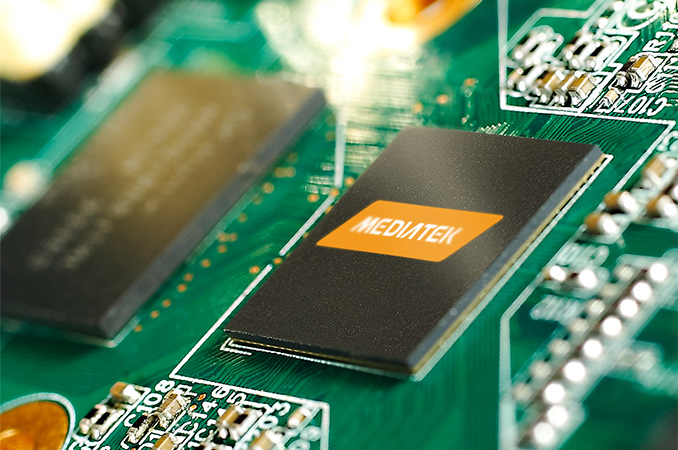
| 12:30p | MediaTek Introduces Helio X20-Based Board for a Broad Range of Applications
MediaTek will be introducing a special development board based on its Helio X20 SoC that is compatible with Linaro’s 96Boards specification and is aimed at developers, who are working on various low-power applications running Android. MediaTek uses development boards like this to help address new IoT markets in addition to smartphones and tablets.
The Helio X20 Development Board is listed as suitable to initiate design for consumer applications such as virtual reality headsets, advanced driver assisted systems (ADAS), mobile point-of-sale, smart signage, vending machines and other similar verticals. The platform from MediaTek is compatible with Linaro’s 69Boards hardware specification for consumer electronics devices, hence, it comes equipped with basic input/output capabilities, such Wi-Fi + Bluetooth, USB 2.0/3.0 (with OTG), microSDHC socket for memory cards (or embedded NAND flash storage), display output(s), 40-pin and 60-pin low-profile headers for hardware makers and so on. As for dimensions, we are talking about a low-profile “credit card” form-factor: 85 x 54 x 12 mm.
Right now, despite being made on a 20nm planar process node, MediaTek’s Helio X20 (two ARM Cortex-A72 cores, eight Cortex-A53 cores, ARM Mali-T880 MP4 graphics, dual-channel LPDDR3 memory controller, etc.) is one of the most powerful 64-bit mobile SoCs. Its heterogeneous multi-core architecture allows developers to delegate background/simple tasks to low-power A53 cores, while using high-performance A72 cores for workloads that require more general-purpose horsepower. Such design could be useful for a variety of consumer applications and for now, the Helio X20 Development Board will be the most powerful 96Boards-compatible platform when it comes to compute performance. The default board will come with 2GB of dual channel LPDDR3 at 933 MHz, and 8GB of eMMC 5.1 storage. Furthermore, advanced features of the Helio X20, such as imaging capabilities (32 MP camera support, 3D depth hardware engine), world-mode LTE modem, and hardware-accelerated 4K video playback with 10-bit color depth, should enable developers to create a wide variety of consumer applications using the tiny board.
“The Helio X20 Development Board will enhance the range of 96Boards development platforms, enabling commercial and hobbyist developers working on the next generation of products and software,” said David Rusling, chief technology officer of Linaro. The MediaTek Helio X20 Development Board is compatible with Google Android and will be available from ArcherMind Technology in China to begin. Pricing will scale depending on interest. | |||||||||||||||||||||||||||||
| 2:00p | The Evolution of HDDs in the Near Future: Speaking with Seagate CTO, Mark Re In the recent months, Seagate has made several significant announcements regarding the future of HDD technology and unveiled a number of important products. In particular, late last year the company has said that hard disk drives would continue to evolve in the following 20 years, implying that Seagate is exploring multiple technologies to improve capacities and performance of HDDs. Additionally, Seagate introduced the first shingled magnetic recording (SMR) based consumer drives for mobile PCs, which marks a significant milestone in the development of the technology. We spoke with Mark Re, Chief Technology Officer of Seagate, to discuss Seagate's plans to announce HDDs featuring other important technologies. Rather than a question/answer discussion, what follows is a culmination and expansion of topics discussed. | |||||||||||||||||||||||||||||


_thumb.jpg)


| << Previous Day |
2016/07/06 [Calendar] |
Next Day >> |