[Most Recent Entries] [Calendar View]
Thursday, July 14th, 2016
| Time | Event |
| 7:30a | Seagate to Lay Off Over 8,000 to Lower Costs
It is not a secret that total available market of hard drives significantly shrank in the recent years due to the slowing sales of PCs and popularization of SSDs for most low-end capacity devices. In a bid to stay profitable, leading hard drive makers attempt to lower their costs by optimizing product roadmaps, reducing production capacities and reducing overhead. In the recent weeks. Seagate has announced plans to cut its headcount by over 8,000 people within the next 12 months. Seagate announced its first restructuring plan in late June, under which it plans to lay off 1,600 people worldwide, or about 3% of the company’s workforce. The decision will affect all geographies and organizations equally for the most part, Seagate indicated. The company said that the implementation of this plan would cause pretax charges of $62 million (recorded in the fiscal fourth quarter of 2016), but will help the company to save approximately $100 million on an annual run rate basis in the fiscal year 2017. The second restructuring plan announced this week seems to be considerably more drastic than the first one. Seagate intends to reduce its workforce in Americas, Asia and EMEA by approximately 6,500 people, or 14% of its global headcount by the end of its fiscal year 2017. As a result, Seagate will lay off about 8,100 of its employees within the next 12 months in total. The move will cost the company $164 million, but is expected to significantly lower the manufacturer’s expenditures going forward. While the measures to cut down the headcount seem rather significant, it looks like Seagate has not revealed all of its restructuring initiatives just yet. During its latest conference call in April, Seagate announced plans to reduce its manufacturing capacities from around 55 million to 60 million drives per quarter to approximately 35 million to 40 million drives per quarter. The decline in personnel it seems is only a part of the plan to cut down expenses and manufacturing capacities. So far the company did not elaborate on its intentions regarding the reduction of manufacturing capacities, but this will likely happen in the coming weeks as Seagate decides to proceed with the plan. At present, it is unknown whether the move might trigger additional overhead optimizations, but this is a possibility. In the Q4 of its fiscal 2016 (which is calendar Q2 2016) Seagate sold approximately 37 million HDDs, down from around 45.2 million in the same period a year ago, and earned about $2.65 billion in revenue, the company said in its statement. Seagate’s gross margin during the quarter was 25%, but the hard drive maker expects its margins to increase to 27-32% by late December thanks to its lower costs and increased sales of enterprise-class HDDs. Given the current sales of hard drives, Seagate might indeed need to reduce its production capacities since the company could produce significantly more drives that it could sell. |
| 9:00a | AMD Carrizo Part 2: A Generational Deep Dive into the Athlon X4 845 at $70 Prior to the announcement for AMD's 7th Generation of APUs, Bristol Ridge, the latest micro-architecture from AMD based on the x86 instruction set was given the codename Excavator, using the fourth generation of AMD's Bulldozer design, called Carrizo cores. Carrizo and Excavator were primarily aimed at laptops and is an important part of the efficiency goals AMD has set itself. We tested some 15W laptops earlier in the year, but when AMD announced a 65W part was coming to desktop, we actively sourced a part to compare generational performance improvements on the dekstop side in a like-for-like setting. This is that review, and we're testing the Athlon X4 845 and its microarchitectural counterparts through the years: the Athlon X4 860K with Kaveri cores and the Steamroller µArch, the Athlon X4 760K with Richland cores and an improved Piledriver µArch, and the Athlon X4 750K with Trinity cores using the original Piledriver µArch. |
| 11:00a | Razer Announces Mechanical Switch Keyboard For The Apple iPad Pro
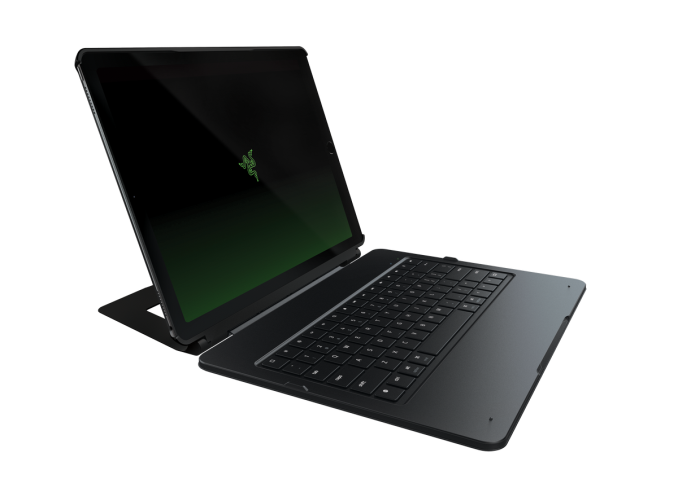
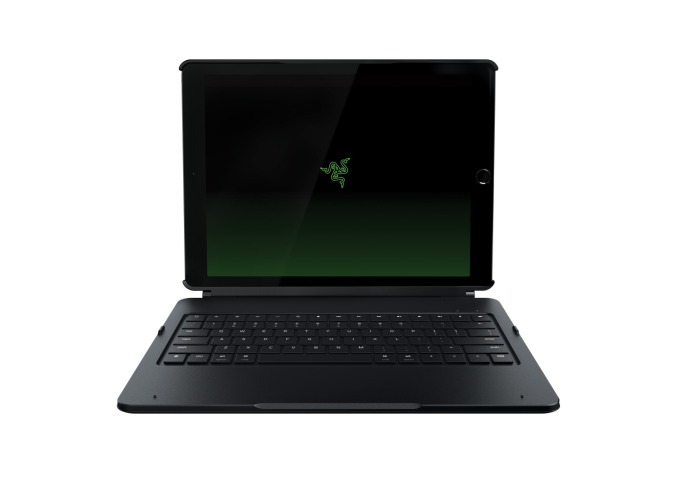
When Apple announced the iPad Pro, they also announced a new accessory which was meant to be paired with the large form factor tablet in the Smart Keyboard. To quote Josh on his review of the tablet though, “this feels like one of the clunkier aspects of the iPad Pro” which has opened the doors to other manufacturers to step in and try to build a different solution. Although not the first on the scene with a keyboard for the iPad Pro, Razer has leveraged their experience in peripherals with the launch of the Razer Mechanical Keyboard Case for the Apple iPad Pro. The name kind of gives away the news here, but Razer has incorporated mechanical switches in their take on the iPad case. They have done that by creating their own keyboard switch production line, and for this product they are also announcing the Razer Ultra-Low-Profile Mechanical Switch which allows them to pack a true mechanical switch into a thin form factor like a tablet case. The keys themselves retain 70 grams of force for actuation, although with a much shorter throw than their desktop keyboard range of course. We’ll have to wait for a hands-on to see how well they succeeded here, so stay tuned.
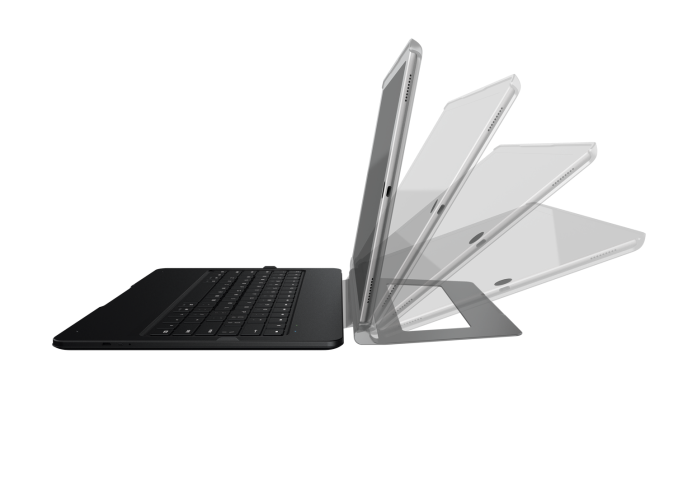
In addition, the keyboard case features a metal kickstand, which folds out behind. This would replace the folding one-position version that comes with the Apple accessory. With the hinged kickstand, the Razer case offers much more adjustability for positioning the tablet for typing.
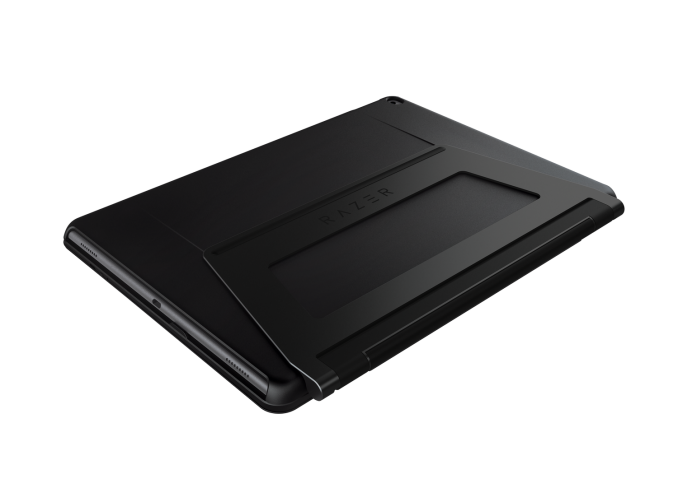
For protecting the iPad itself, the keyboard comes with a detachable polycarbonate case which can be put over the back of the iPad if needed.
This accessory is for the larger iPad Pro, and not the 9.7” model, at least for now. I’ve asked Razer for some more information on thickness, weight, and overall dimensions, and will update this when they get back to me. The keyboard also features backlighting, and the keyboard has its own battery to power this, as well as the keyboard itself. It connects over Bluetooth, and offers 10 hours of charge with the backlighting at maximum brightness, or a rated 600 hours of charge with no backlighting. It’s a bit odd that they chose Bluetooth for this, rather than use the Smart Connector. It will certainly allow it to be used with more devices, but the downside is that it will require its own battery and charging to function, as well as suffer from interference if it’s in an area with a lot of 2.4 GHz spectrum being used. The Razer Mechanical Switch Keyboard is available immediately for U.S. $169.99 / EU €189.99. Source: Razer |
| 1:00p | Futuremark Releases 3DMark Time Spy DirectX 12 Benchmark
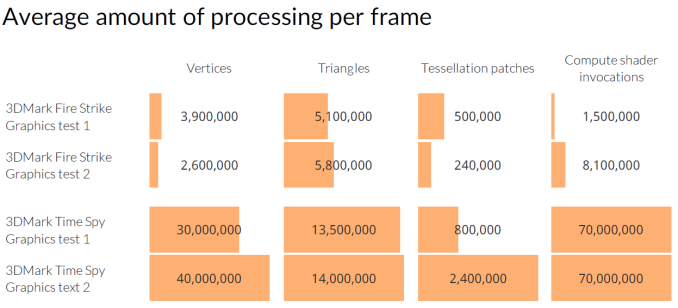
Today Futuremark is pulling the covers off of their new Time Spy benchmark, which is being released today for all Windows editions of 3DMark. A showcase of sorts of the last decade or so of 3DMark benchmarks, Time Spy is a modern DirectX 12 benchmark implementing a number of the API's important features. All of this comes together in a demanding test for those who think their GPU hasn’t earned its keep yet. DirectX 12 support for game engines has been coming along for a few months now. To join in the fray Futuremark has written the Time Spy benchmark on top of a pure DirectX 12 engine. This brings features such as asynchronous compute, explicit multi-adapter, and of course multi-threading/multi-core work submission improvements. All of this comes together into what I think is not only visually interesting, but also borrows a large number of gaming assets from benchmarks of 3DMarks past.
For those who haven’t been following the 3DMark franchise for more than a decade, there are portions of the prior benchmarks showcased as shrunken museum exhibits. These exhibits come to life as the titular Time Spy wanders the hall, giving a throwback to past demos. I must admit a bit of fun was had watching to see what I recognized. I personally couldn’t spot anything older than 3DMark 2005, but I would be interested in hearing about anything I missed. Unlike many of the benchmarks exhibited in this museum, the entirety of this benchmark takes place in the same environment. Fortunately, the large variety of eye candy present gives a varied backdrop for the tests presented. To add story in, we see a crystalline ivy entangled with the entire museum. In parts of the exhibit there are deceased in orange hazmat suits demonstrating signs of a previous struggle. Meanwhile, the Time Spy examines the museum with a handheld time portal. Through said portal she can view a bright and clean museum, and view bustling air traffic outside. I’ll not spoil the entire brief story here, but the benchmark makes good work of providing both eye candy for the newcomers and tributes for the enthusiasts that will spend ample time watching the events unroll. From a technical perspective, this benchmark is, as you might imagine, designed to be the successor to Fire Strike. The system requirements are higher than ever, and while Fire Strike Ultra could run at 4K, 1440p is enough to bring even the latest cards to their knees with Time Spy.
Under the hood, the engine only makes use of FL 11_0 features, which means it can run on video cards as far back as GeForce GTX 680 and Radeon HD 7970. At the same time it doesn't use any of the features from the newer feature levels, so while it ensures a consistent test between all cards, it doesn't push the very newest graphics features such as conservative rasterization. That said, Futuremark has definitely set out to make full use of FL 11_0. Futuremark has published an excellent technical guide for the benchmark, which should go live at the same time as this article, so I won't recap it verbatim. But in brief, everything from asynchronous compute to resource heaps get used. In the case of async compute, Futuremark is using it to overlap rendering passes, though they do note that "the asynchronous compute workload per frame varies between 10-20%." On the work submission front, they're making full use of multi-threaded command queue submission, noting that every logical core in a system is used to submit work.
Meanwhile on the multi-GPU front, Time Spy is also mGPU capable. Futuremark is essentially meeting the GPUs half-way here, using DX12 explicit multi-adapter's linked-node mode. Linked-node mode is designed for matching GPUs - so there isn't any Ashes-style wacky heterogeneous configurations supported here - trading off some of the fine-grained power of explicit multi-adapter for the simplicity of matching GPUs and useful features that can only be done with matching GPUs such as cross-node resource sharing. For their mGPU implementation Futuremark is using otherwise common AFR, which for a non-interactive demo should offer the best performance.
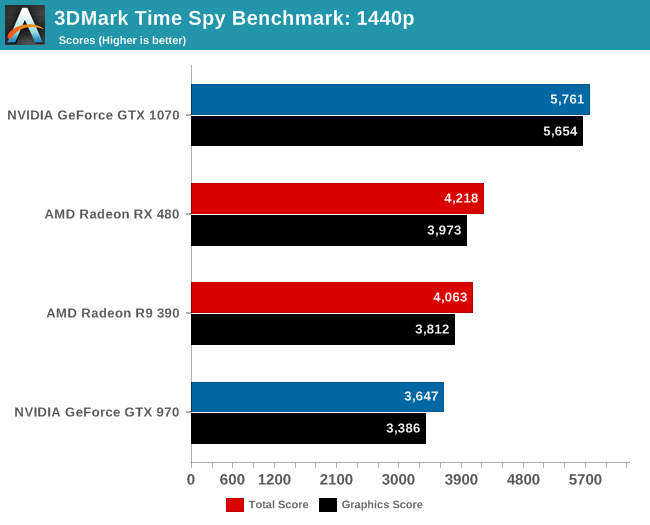
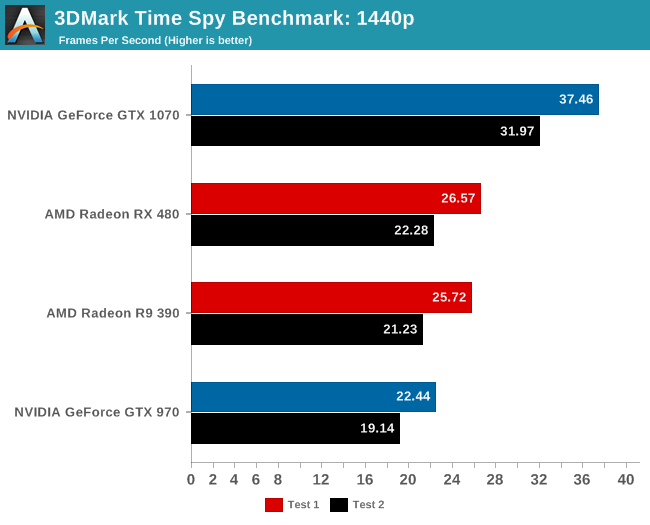
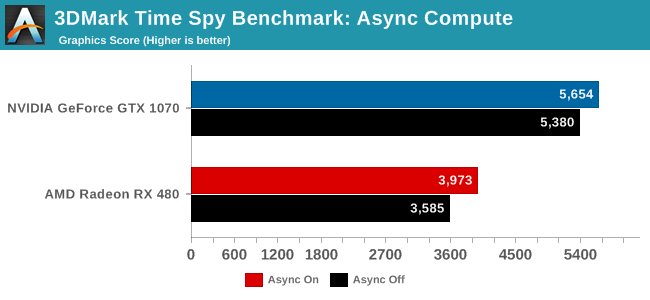
To take a quick look at the benchmark, we ran the full test on a small number of cards on the default 1440p setting. In our previous testing AMD’s RX 480 and R9 390 traded blows with each other and NVIDIA’s GTX 970. Here though, the RX 480 pulls a small lead over the R9 390 while they both leave a slightly larger gap ahead of the GTX 970. Only to then see the GeForce GTX 1070 appropriately zip past the lot of them. The graphics tests scale similarly to the overall score in this case, and if these tests were a real game anything less than the GTX 1070 would provide a poor gameplay experience with framerates under 30 fps. While we didn’t get any 4K numbers off our test bench, I ran a GTX 1080 in my personal rig (i7-2600k @4.2GHz) and saw 4K scores that were about half of my 1440p scores. While this is a synthetic test, the graphical demands this benchmark can place on a system will provide a plenty hefty workload for any seeking it out. Meanwhile, for the Advanced and Professional versions of the benchmark there's an interesting ability to run it with async compute disabled. Since this is one of the only pieces of software out right now that can use async on Pascal GPUs, I went ahead and quickly ran the graphics test on the GTX 1070 and RX 480. It's not an apples-to-apples comparison in that they have much different performance levels, but for now it's the best look we can take at async on Pascal.
Both cards pick up 300-400 points in score. On a relative basis this is a 10.8% gain for the RX 480, and a 5.4% gain for the GTX 1070. Though whenever working with async, I should note that the primary performance benefit as implemented in Time Spy is via concurrency, so everything here is dependent on a game having additional work to submit and a GPU having execution bubbles to fill. The new Time Spy test will be coming today to Windows users of 3DMark. This walk down memory lane not only puts demands on the latest gaming hardware but also provides another showcase of the benefits DX12 can bring to our games. To anyone who’s found FireStrike too easy of a benchmark, keep an eye out for Time Spy in the near future. |



| << Previous Day |
2016/07/14 [Calendar] |
Next Day >> |