[Most Recent Entries] [Calendar View]
Tuesday, July 26th, 2016
| Time | Event | ||||||||||||||||||||||||||||||||||||||||||||||||||||||||||||||||||||||||||||||||||||||||||||||||||||
| 8:00a | Seagate Expands Nytro Enterprise SSD Family with 2TB M.2 XM1440
As Flash Memory Summit 2016 approaches, many major players in the SSD market are starting to announce new products. A year after introducing the Nytro XM1440 enterprise M.2 PCIe SSD, Seagate is expanding the lineup with a 2TB option. The XM1440 M.2 and XF1440 2.5" U.2 SSDs are based on the combination of Marvell's 88SS1093 PCIe 3.0 NVMe controller and Micron MLC NAND. The products are a result of a collaboration between Micron and Seagate, and are sold by Micron as the 7100 series. The 2.5" version has had a 2TB-class capacity option from the start, but the new XM1440 2TB is the first of its kind. The higher drive capacity is achieved through denser NAND packaging rather than from switching to higher-capacity 3D NAND dies. The XM1440 and XF1440 are available in either a capacity-optimized configuration intended for read-intensive workloads and rated for 0.3 drive writes per day, or in an endurance-optimized configuration for mixed workloads and rated for 3 drive writes per day. The latter sacrifices some usable capacity for increased overprovisioning and higher random write speeds, but otherwise they are the same drive. The 2TB XM1440 M.2 will unsurprisingly be one of the capacity-optimized variants, with similar specifications to the 1920GB XF1440 2.5" U.2 SSD.
Seagate is also introducing a PCIe add-in card counterpart to the XM1440 and XF1440 as the Nytro XP7102. Based on the same controller and NAND, the XP7102's model number appears to mark it as the entry-level option in a new XP7000 generation to replace the XP6000 series products that were multi-controller solutions with an on-board RAID controller. The Nytro XP7102 targets only the endurance-optimized mixed workload segment with 800GB and 1600GB as the only two capacity options, and has similar specifications to its XF1440 equivalents.
The 2TB XM1440 M.2 will be available in November 2016 and the Nytro XP7102 PCIe add-in card is already available. | ||||||||||||||||||||||||||||||||||||||||||||||||||||||||||||||||||||||||||||||||||||||||||||||||||||
| 8:30a | AMD Announces Radeon Pro WX Series: WX 4100, WX 5100, & WX 7100 Bring Polaris to Pros
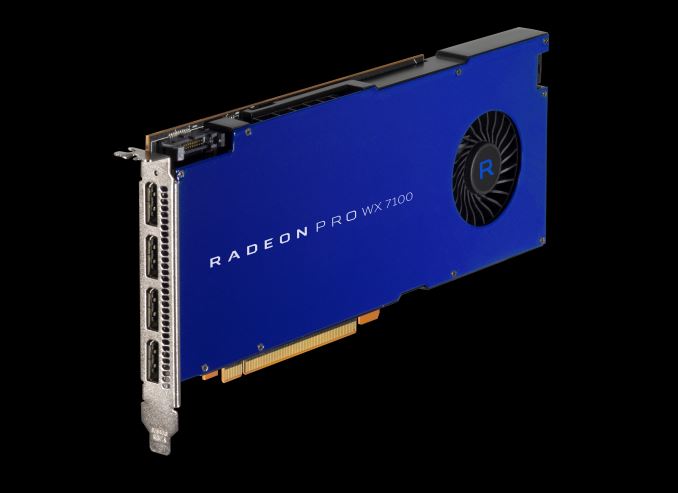
It’s been a while since we’ve last seen a new workstation graphics card from AMD. With their Fiji GPU not being a good fit for the market, the company hasn’t had a significant update of the lineup since 2014, when Tonga was introduced into the mix. However as part of their SIGGRAPH 2016 professional graphics event, AMD is giving their professional card lineup a proper update and then some. Announced Monday night, the company is introducing 3 new cards under their new Radeon Pro WX family, the WX 7100, WX 5100, and WX 4100. Powered by the AMD’s new Polaris family of GPUs, AMD is looking to bring the architecture’s power efficiency and display controller improvements to their workstation users. As this is based on the Polaris 10 and Polaris 11 GPUs, like their consumer desktop counterparts, AMD is targeting the bread-and-butter workstation market with their latest wares, in this case meaning the sub-$1000 market.
Branding aside (more on that later today), the Radeon Pro WX series is essentially a continuation of AMD’s existing FirePro W series lineup and the traditional workstation market it targets. To that end the new Radeon Pro WX cards are retaining the FirePro W series numbering system, indicating which card/tier they are a replacement of. At the top of the new Radeon Pro WX stack is the WX 7100. The successor to the Tonga based W7100, this is based on AMD’s leading Polaris 10 GPU. Relative to its predecessor then, it should offer a decent performance boost, combining a slightly larger number of SPs with higher clockspeeds. AMD has disclosed that the card will ship with 2048 SPs (32 CUs), which somewhat surprisingly is fewer than a fully enabled Polaris 10 GPU. Meanwhile specific clockspeeds have not been revealed, but given AMD’s 5 TFLOPs minimum, this puts the boost clock at no lower than 1.2GHz.
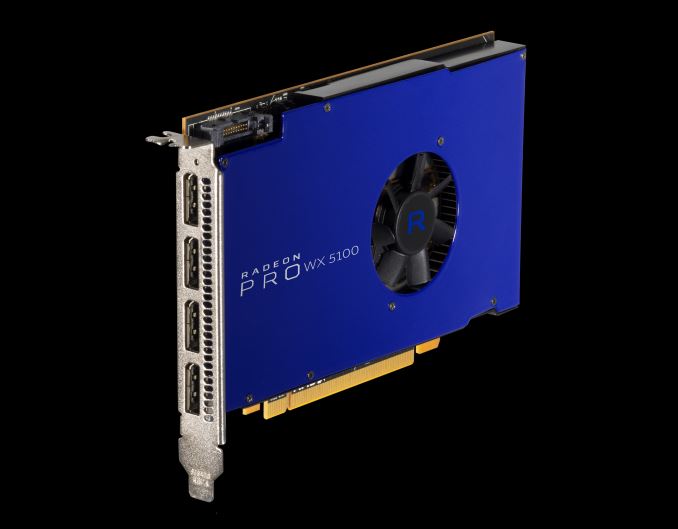
On the memory side the card will be shipping with 8GB of GDDR5 attached to a 256-bit bus. Clockspeeds have not been disclosed, but the consumer counterpart to this card, Radeon RX 480, used 8Gbps chips, so I’d expect at least 7 for the workstation card. I am a bit surprised that AMD opted to go with just 8GB of memory here – Polaris 10 should be able to support 16GB – but given the price goal and the target market, it makes sense. On the TDP front I’m still waiting for AMD to post the full specifications of the card. But it’s a very safe bet it’s a 150W card given the GPU configuration and the fact that its predecessor hit the same power target. Speaking of which, like W7100 before it, this is a single slot, full profile card. AMD has once again given the card 4 DisplayPort outputs, this time capable of the newest DisplayPort 1.4 standard. WX 5100The second of the new WX trio is the WX 5100. Also based on the Polaris 10 GPU, this card opts for a lower balance of price, performance, and power consumption. This replaces the Bonaire based W5100, and comes with 1792 SPs (28 CUs) enabled, and a clockspeed that will be at least 1.2GHz. Compared to its predecessor it should be massively faster as AMD has more than doubled the number of SPs, not to mention the clockspeed boost.
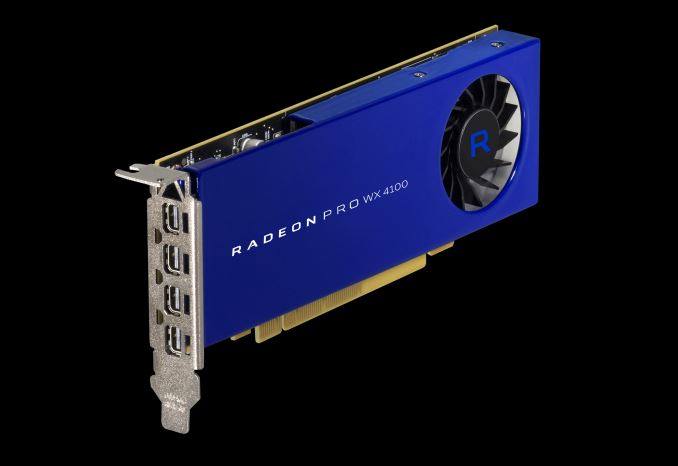
Attached to the GPU will be 8GB of GDDR5 memory over a 256-bit bus. Like the RX 7100 AMD has not disclosed memory frequencies here, though I’m going to be surprised if it’s as high as its bigger sibling since it needs to be a cheaper and lower power card. On that note TDPs are not available either; W5100 was a 75W card, but given the use of a mostly enabled Polaris 10, I’m not sure that’ll be the case here. RX 5100 is essentially a second-tier to 7100, which is something that did not exist in the previous FirePro generation. In terms of build we’re looking at a card that takes a cue from its predecessor, utilizing a single wide, full profile, but overall relatively short card design. AMD is aiming for continuity with the previous generation in their card designs, so WX 5100 should be a drop-in replacement in that respect. WX 4100Last but not least we have the WX 4100. This replaces the W4300 as the low performance member of the workstation card family. As you might expect from such a description, this is based on AMD’s forthcoming Polaris 11 GPU, which so far we haven’t seen yet, but we’re told is aggressively power optimized. In terms of underlying hardware we’re looking at a fully enabled Polaris 11 GPU, with 1024 SPs (16 CUs), clocked at no less than 975MHz boost. Relative to its predecessor it should deliver a good performance boost, with 33% more SPs and a modest clockspeed bump.
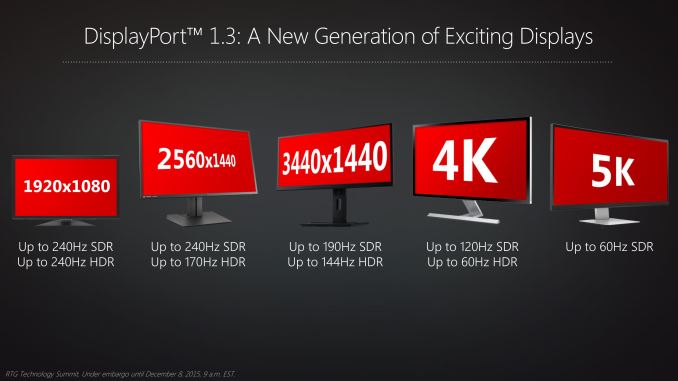
With regards to memory, we’re looking at 4GB of GDDR5 attached via a 128-bit bus. Memory clockspeeds have not been disclosed. For that matter neither has TDP, but given that this is a Polaris 11 card meant to replace the W4300, it’s a very safe bet that this is a sub-75W card. For design we’re looking at the only low profile member of the new WX family. The card utilizes a single wide cooler design and is outfit with mini-DisplayPorts in order to get 4 of them on a single low profile card. Polaris Architecture & Card AvailabilityWhile the immediate performance and power efficiency gains afforded by AMD’s Polaris architecture are going to be the biggest piece of news here, Polaris brings other new functionality to the table as well. For the professional graphics market and FirePro/Radeon Pro users, these should be some very welcome changes. When it comes to the display controller, Polaris represents a big step up from AMD’s prior generation architectures. DisplayPort 1.4 is now supported, which means that these cards can be used to drive 5K monitors via a single port, allowing up to 4 of such monitors to be driven per card. Meanwhile this also brings full and formal support for HDR and its many requirements (e.g. HDR metadata), which should be a boon for media users, especially now that HDR monitors are hitting the market. And though it’s not directly exposed on the new WX cards since all of them use DisplayPort, HDMI 2.0b is also supported, which again for media users should be useful for when they need to work specifically with HDMI displays/TVs via an adapter.
Along those lines, Polaris also introduces AMD’s new video encode and decode block. This marks the first time that HEVC decode and encode have been available on a FirePro workstation card, This once again is another media-centric feature in the pro graphics workspace, as it allows for much better (and faster) support for HEVC content, including of course HDR content. Finally, getting back to AMD’s Radeon Pro reformation, among the other changes AMD has announced is that they have significantly extended the warranty period for these new Radeon Pro WX cards. Whereas the older FirePro cards had a 3 year warranty, these new cards come with a 10 year warranty. Looking at the fine print in AMD’s announcement, this is compared of a 3 year warranty plus a 7 year extended warranty. I suspect this means that support after 3 years is more limited (e.g. possibly only hardware support and critical security fixes), but we’ll see what AMD has to say. But to put this in perspective, if you went back 10 years from now, this would mean AMD would still be supporting their ancient DX9-era R500-based FireGL 7300.Raja Koduri quipped that he’s never heard of anyone using a workstation card for 10 years, and I don’t doubt he’s right. Wrapping things up, the new Radeon Pro WX series cards will be released in Q4 of this year. AMD has not announced pricing at this time beyond the fact that the entire lineup will be under $1000. Pricing will be released closer to launch, though as AMD themselves have noted, most of their sales are via preconfigured OEM workstations, so the bulk of their customers will never buy a card directly to begin with. In any case, AMD’s regular OEM partners such as HP have already announced their support, so we should be seeing WX-equipped workstations show up in Q4 as well. | ||||||||||||||||||||||||||||||||||||||||||||||||||||||||||||||||||||||||||||||||||||||||||||||||||||
| 10:30a | MSI Shows New Radeon RX 480 Gaming Cards, with an 8-pin
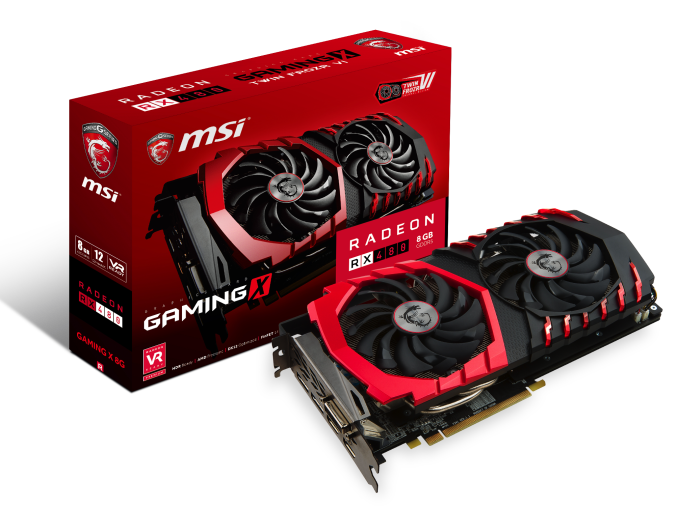
Today MSI is announcing the latest entry in the Gaming X GPU line with the Radeon RX 480 Gaming X 8G/4G cards as well as non-X variants. The main difference between the non-X and X cards is in the core and memory frequencies, with the X card having the higher performance. In return, there will be a small price difference between the two variants.
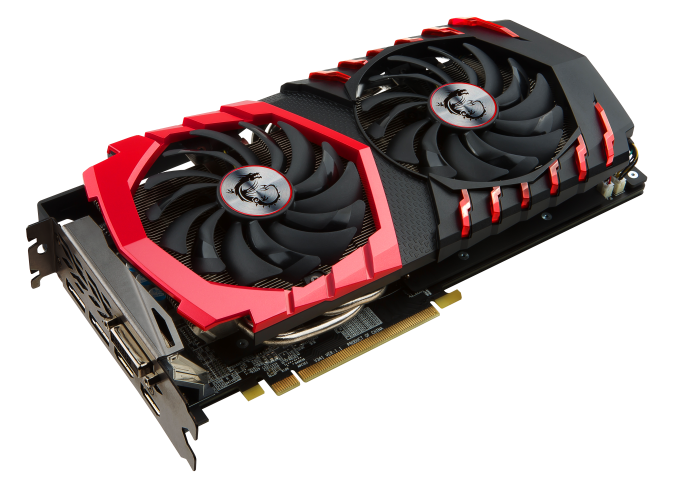
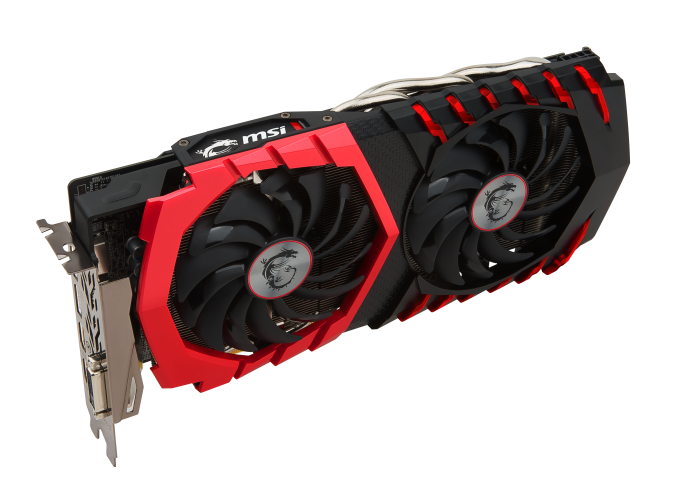
Starting with appearance, all four models shown today feature an angular, aggressive, red and black design for the cooler, which glows through the red highlights. On the side of the card is an MSI logo lit by customizable RGB lighting which is adjusted through the MSI Gaming software bundled with the card. Around back there is a full cover back plate on the Gaming X cards, and moving back around to the cooler we have two large fans over a full-length cooler and PCB. Running through the heatsink are three heat pipes at 8mm thick each. These heat pipes are squared off at the bottom and mated to a nickel-plated copper baseplate, aiming to increase contact with the GPU core and hence increase heat transfer. This cooler is toned down from that used on the highest end cards, but should still make for a very capable cooling solution.
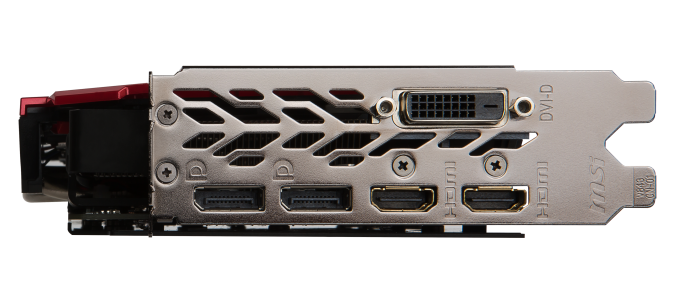
Moving from form over to function, MSI’s RX 480 Gaming X cards are built from what MSI calls “Military Class 4” components, which is marketing speak for their choosing quality components to assemble this card. For power, the cards have a single 8-pin connector, and for the output we have two HDMI, two DisplayPort, and one DVI-D connection. This appears to be a very popular arrangement this generation, allowing one HDMI port for a monitor and another for a VR headset. MSI also use their TORX Fan 2.0 design which they say will generate 22% more air pressure, and like other Gaming and Gaming X cards the fans will shut off at temperatures below 60C. If true these fans coupled with the Twin Frozr VI heatsink could do an admirable job of quietly handling any heat an RX 480 can muster. For performance numbers on the Gaming X, we have a moderate clock speed gain over the reference card in OC mode, while the memory is bumped up to 8.1 Gbps in OC mode.
With no word on pricing, both 8GB and 4GB versions of the MSI Radeon RX 480 Gaming X are expected to be in stores worldwide around the middle of August 2016.
| ||||||||||||||||||||||||||||||||||||||||||||||||||||||||||||||||||||||||||||||||||||||||||||||||||||
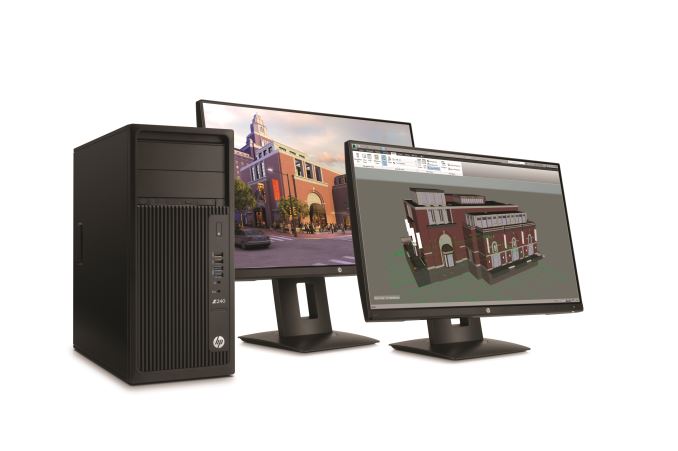
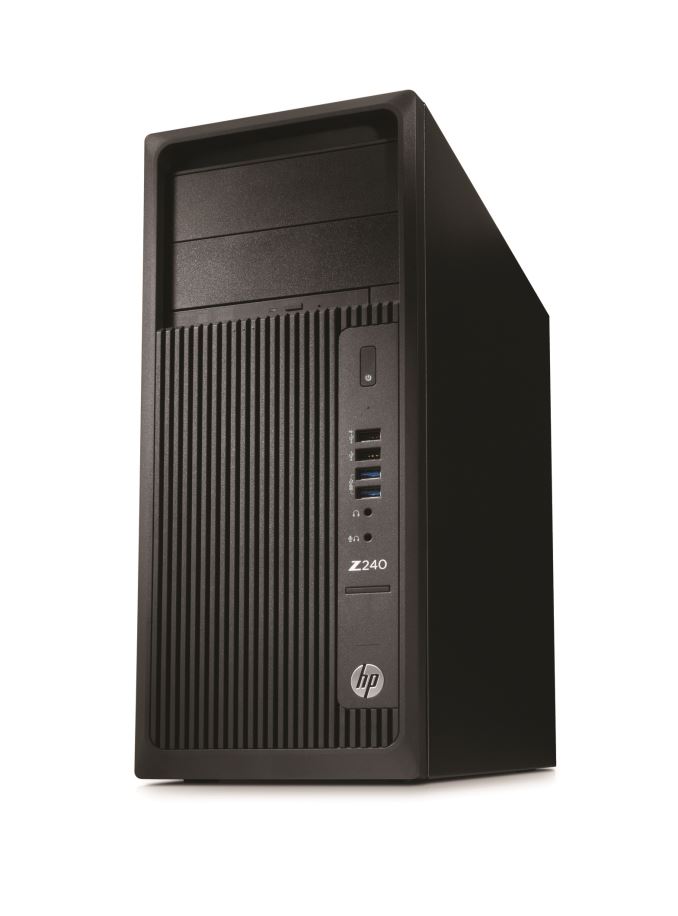
| 1:00p | HP Updates The Z240 Workstation With The Core i7-6700K
HP has an interesting announcement today - they are refreshing their existing Z240 workstation, which is targeted towards small and medium-sized businesses, with a non-Xeon Core i7 based processor. It was already available with Skylake based Xeon CPUs, up to the Intel Xeon E3-1280 v5. That’s a 3.7-4.0 GHz Xeon, with 4 cores, 8 MB of cache, with an 80-Watt Thermal Design Power (TDP). That’s certainly an excellent choice for a lot of workloads that workstations are tasked with, and with support for ECC memory, reliability under load is also a key factor. But HP has been talking to their customers and found that many of them have been choosing to forgo the error checking capabilities of ECC and have been building or buying equivalent gaming-focused machines in order to get more performance for the money. Specifically, they have been building desktops with the Core i7-6700K, which is an unlocked 4.0-4.2 GHz quad-core design, with a 91-Watt TDP, and in pure frequency can offer up to 13% more performance than the fastest Skylake Xeon. So armed with this data, HP has refreshed the Z240 line today, with the usual Skylake Xeons in tow but also an option for the Core i7-6700K. This desktop sized workstation supports up to 64 GB of DDR4-2133, with ECC available on the Xeon processors only. It’s a pretty interesting move, but can make a lot of sense if most customers would probably rather purchase a workstation from a company like HP so that they get the testing and support offerings found with workstation class machines. If some of them had to resort to building their own in order to get the best CPU performance, HP has made a wise decision to offer this. Despite the higher TDP, HP has created fan profiles which they say will allow full turbo performance with no thermal throttling, while at the same time not exceeding their acoustic threshold which I was told was a mere 31 dB. Although they have offered closed loop liquid cooling on their workstations in the past, the Z240 achieves this thermal performance with more traditional air cooling. (Edit from Ian: It has not been stated if HP will implement a variation of MultiCore Turbo/Acceleration at this time, but given the limited BIOS options of the major OEMs in recent decades, this has probably been overlooked. Frankly, I would be surprised if the BIOS engineers had even heard of mainstream motherboard manufacturers implementing the feature, though I will happily be proved wrong.) The Z240 is currently offered with a wide range of professional graphics, if required, including the NVIDIA NVS 310, 315, and 510, and Quadro up to the M4000. With yesterday’s announcement of the Pascal Quadro, and today's announcement of the new Radeon Pro WX, they are likely to offer these soon. If a user requires AMD professional graphics, HP will offer the FirePro W2100, W5100, W4300, and the W7100 with 8 GB of memory.
A simple device refresh mid-cycle is far from unexpected, but it is pretty interesting that by talking to their customers HP has found that many of them would prefer higher single threaded performance with a Core i7-6700K, rather than the Xeon ecosystem with a focus on stability and ECC. It will be interesting to see if Intel reacts to this, since the Xeon is a nice high margin product. As a small comparison, the highest clocked Xeon E3 v5 is the E3-1280 v5 at 3.7-4.0 GHz, and has a recommended customer price of $612 on Intel Ark. The one underneath is the E3-1275 v5 at 3.6-4.0 GHz, but is a more palatable $350. This latter part compares in price to the Core i7-6700K, which is at $350 list price also, however the i7-6700K has the margin on frequency at 4.0-4.2 GHz. Comparing the two Xeons to the Core i7, HP can offer a bit more performance with the trade-off of no ECC support, and in the case of the peak Xeon, save some money as well. For those that need the top raw CPU performance available especially for single-threaded workloads, short of overclocking, this is the way to go. Source: HP | ||||||||||||||||||||||||||||||||||||||||||||||||||||||||||||||||||||||||||||||||||||||||||||||||||||
| 10:15p | Apple Announces Q3 FY 2016 Results: App Store Up, Hardware Down
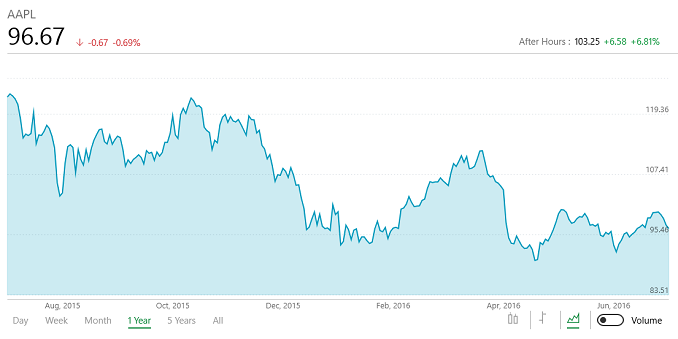
Today Apple announced their third quarter results for their fiscal year 2016. Much like last quarter, Apple has struggled to maintain the sales pace of the iPhone 6s, compared to the iPhone 6. For the quarter, Apple had revenues of $42.358 billion, which is down 11% from a year ago. Gross margin was $16.106 billion, down from $19.681 billion in Q3 2015, and percentage wise it is 38.0%. Operating income was $10.1 billion, down from $14.1 billion last year, and net income was down almost $3 billion to $7.8 billion. Diluted earnings per share were $1.42, down from $1.85 a year ago. Despite the lower quarter, Apple did beat expectations which has helped their share price in after-hours trading.
Apple announced a dividend of $0.57 per share payable on August 11th to shareholders of record as of August 8th. They also returned over $13 billion during Q3 through share buy-backs and dividends, and they have completed almost $177 billion of their $250 billion capital return program. iPhone sales are far and away the largest part of the company, and this quarter Apple sold 40.4 million handsets. That is down from the 51.2 million last quarter, and 47.5 million in Q3 2015, meaning iPhone sales were down 15% year-over-year. This resulted in revenue of $24 billion, down 23% from a year ago. It’s certainly a noticeable drop, and it shows just how successful the iPhone 6 was when it launched. Moving on, iPad sales continued their slow and steady decline. Sales of the tablet were just a hair under ten million for the quarter, which is a drop of 9% year-over-year. Revenue was $4.9 billion, which is up 7%. A year ago, the average selling price of the iPad was $415, but this quarter, average selling price for the iPad rose $85 to $490. Declining sales of the iPad Mini, as well as new sales of the higher priced iPad Pro are certainly the case, but Apple doesn’t break out the numbers for individual models to know just how much each was a factor. The Mac didn’t fare very well either, with unit sales of 4.25 million, which is down 11% year-over-year. This resulted in revenue of $5.24 billion, down 13%. With basically no Mac refreshes in a long time, they are no longer outperforming the PC market as a whole, which was the case for the last while. Apple’s “Other Products” includes Apple TV, Apple Watch, Beats, iPods, and accessories, and while none of this is broken down by sub-category, the Other Products as a whole also fell 16% in revenue compared to Q3 2015, with revenues for this quarter of $2.22 billion.
The one segment in which Apple had strong growth was their Services segment. Services grew by 19% compared to Q3 2015, with revenue of $5.976 billion, which is up almost a billion or 19% year-over-year. Q2 2016 revenue was pretty much the same at $5.991 billion, meaning services have once again outpaced both Mac and iPad sales, and now represent the second largest segment at Apple.
Overall, it’s the second consecutive quarter of revenue loss, and last quarter was the first time that happened since Q1 2003, so Apple is in somewhat unfamiliar territory. Their guidance for next quarter is $45.5 to $47.5 billion, and margins between 37.5% and 38%. That guidance is also for a loss of revenue, since Q4 2015 had the company coming in at $51.5 billion, and 39.9% margins. It will be interesting to see if hardware refreshes in the fall can stop the drop in sales. Source: Apple Investor Relations | ||||||||||||||||||||||||||||||||||||||||||||||||||||||||||||||||||||||||||||||||||||||||||||||||||||





| << Previous Day |
2016/07/26 [Calendar] |
Next Day >> |